This guide explains how solar panels on east and west facing roofs perform in the UK and similar northern European latitudes, when an east-west system beats a single south face, and how the generation pattern changes through the day and the year. If you have a roof with its ridge running north to south, east west solar panels are often the only option, and the numbers below show they are a better one than the usual “15 to 20% less” headline suggests.
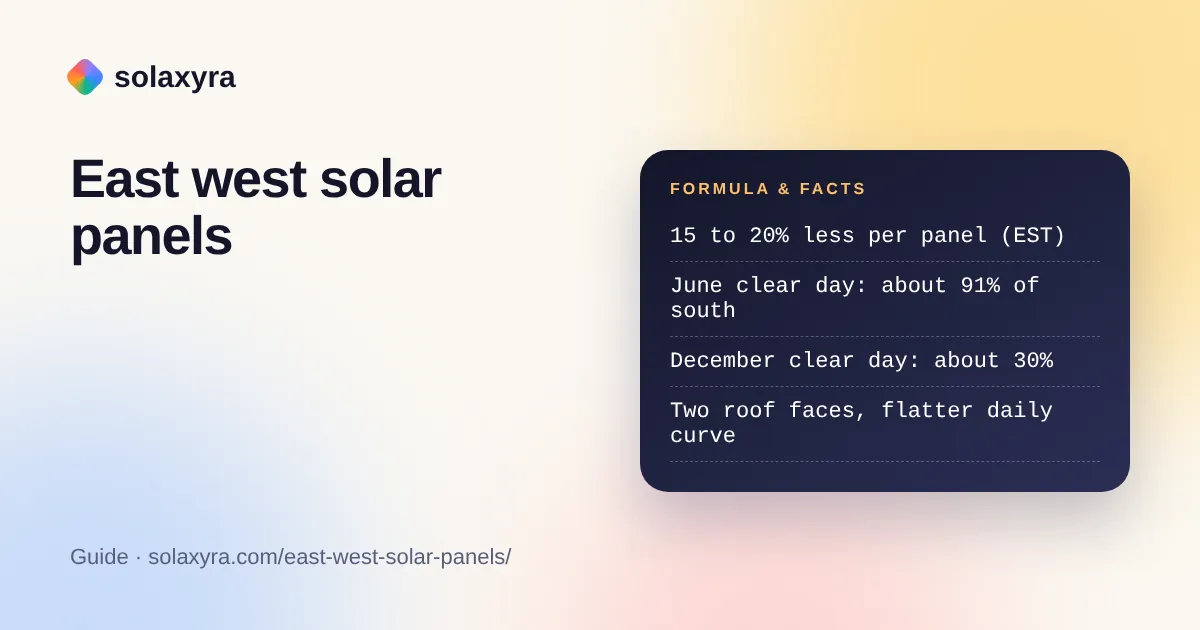
Quick answer: East west solar panels produce around 15 to 20% less per panel than south facing ones in the UK, according to the Energy Saving Trust. Using both roof faces can fit twice the panels, spreads generation into the morning and evening and lowers the midday peak. The shortfall is largest in winter and small in midsummer.
How much less do east or west facing solar panels produce?
The Energy Saving Trust says a system facing east or west tends to get around 15 to 20% less energy than one facing directly south, and it does not recommend north facing roofs. So each kWp on an east or west roof produces roughly 80 to 85% of what the same kWp would produce facing south at the same site.
East and west perform almost identically over a year in the UK, because the sun’s path is close to symmetrical about solar noon. Small differences come from local weather, such as morning mist or afternoon cloud, and from shading on one side, so check each face for trees, chimneys and neighbouring buildings. To get a percentage for your exact compass bearing and tilt, use the solar panel direction and tilt calculator.
Why is the east-west shortfall mostly a winter problem?
In midsummer the sun rises in the north-east and sets in the north-west, so east and west faces catch plenty of direct light; in midwinter the sun stays low in the south and barely reaches them. We modelled clear-sky direct sunlight at latitude 51.5° N (London) on panels tilted at 35°, comparing a south array with an array split equally between east and west:
| Clear day | East-west direct sunlight as share of south (whole day) | East-west peak as share of south peak |
|---|---|---|
| 21 June | about 91% | about 73% |
| 20 March | about 59% | about 52% |
| 21 December | about 30% | about 28% |
Method: sun position from latitude, date and hour; air mass from the Kasten and Young formula and direct beam strength from the empirical air mass relationship described in the air mass (solar energy) reference; then the angle between the sun and each panel. This is direct light only on cloudless days, so it exaggerates the gap.
In real UK weather much of the light is diffuse, arriving from the whole sky, and diffuse light reaches east, west and south faces far more evenly. That is why the measured yearly gap for east west solar panels, 15 to 20%, is much smaller than the winter model figure. Since most yearly output comes in the brighter months, when the gap is small, the annual penalty stays modest.
When in the day do east west solar panels generate?
East-west arrays move a modest share of generation out of the middle of the day: in our June model, 30% of direct sunlight arrives before 10:00 solar time and 30% after 14:00, against 25% and 26% for a south array. The east face peaks in the morning, the west face in the afternoon, and together they give a flatter, wider curve.
| Clear day, 35° tilt | Before 10:00 solar time | 10:00 to 14:00 | After 14:00 |
|---|---|---|---|
| June, south | 25% | 49% | 26% |
| June, east-west | 30% | 40% | 30% |
| March, south | 22% | 56% | 23% |
| March, east-west | 25% | 49% | 26% |
| December, south | 12% | 75% | 13% |
| December, east-west | 16% | 67% | 17% |
Solar time is set by the sun, not the clock: in the UK solar noon is close to 12:00 GMT, which is about 13:00 during British Summer Time, a little later in the west of the country. Shares are of each array’s own daily total, so they show shape, not amount.
Is an east-west split better than one south face?
It can produce more in total, because east west solar panels use two roof faces instead of one; per kWp they produce less, but you can usually fit more kWp. The comparison depends on how much roof each option gives you.
Example: assume a south facing system at your site would produce 1,000 kWh per kWp a year (example value, change to yours). East west solar panels at 15 to 20% less give 800 to 850 kWh per kWp.
| Example roof option | System size | Yearly output (example yield) |
|---|---|---|
| South face only | 4 kWp | about 4,000 kWh |
| One east or west face only | 4 kWp | about 3,200 to 3,400 kWh |
| Both east and west faces | 8 kWp | about 6,400 to 6,800 kWh |
The bigger system costs more, so judge it on cost per kWh, not just total kWh. As a cost benchmark, the Energy Saving Trust gives about £7,600 for a typical 4.5 kWp system. A national reference point for yield is the measured UK average load factor of 8.3% in the DESNZ Feed-in Tariff load factor analysis, about 727 kWh per kWp a year (0.083 × 8,760) across all the orientations in the data set.
Do east-west panels help you use more of your own solar power?
Usually a little: east west solar panels start generating earlier and stop later, which overlaps better with breakfast and early evening use, so more of the output replaces grid electricity at the full unit rate instead of being exported. Every kWh you use yourself is worth the 26.32p October 2026 cap rate, while exported units earn far less, around 12p under the Smart Export Guarantee according to the Energy Saving Trust.
The effect should not be overstated. Our model shows the shift is a few percentage points of the day’s output, and the big evening peak after sunset is still uncovered. A battery shifts far more energy than orientation does. The solar self-consumption calculator shows how your daytime use and any battery change the share you keep.
How should an east-west system be wired and sized?
With east west solar panels, each roof face should feed its own inverter input (MPPT tracker), its own inverter, or panel-level electronics such as microinverters or optimisers, because the two faces receive different light at the same moment. Panels wired in one series string share the same current, so mixing faces in one string drags the stronger face down to the weaker one.
- Confirm the inverter has two MPPT inputs, or plan for microinverters or optimisers.
- Keep each string on a single roof face, with the same panel model, tilt and direction.
- Check string voltage limits for the coldest expected temperatures on each input; the solar string size calculator shows the limits an installer works to.
- Size the inverter for the combined peak, which is lower than for the same kWp facing south, then test ratios with the solar inverter size calculator.
- Have the design and installation done by an MCS certified installer. All electrical work must meet BS 7671, and the roof structure should be checked for the extra load of covering two faces.
Does tilt matter more on an east-west roof?
Yes: on east or west faces a lower tilt loses less, because a flatter panel faces more of the sky and less of one side. At very low tilts east west solar panels behave almost like a flat panel, which is why low east-west racking is an option on flat roofs.
On a flat roof, pairs of low panels leaning back to back need less space between rows than south-facing rows, which avoid shading each other only with wide gaps, so more capacity fits on the same area. Ballasted racking adds weight and must resist wind uplift, so a structural engineer should confirm the roof can take it before installation. On steep pitched roofs facing east or west, the penalty in winter grows because the panel faces away from the low southern sun.
You rarely get to choose the pitch of an existing roof, but it is worth checking both the tilt and the bearing before relying on the headline 15 to 20%. The solar panel angle calculator shows the best fixed tilt for your latitude. For a deeper look at low racking, see our guide to solar panels on a flat roof.
Frequently Asked Questions
Is east or west better for solar panels in the UK?
Over a year they produce almost the same, because the sun’s path is close to symmetrical about solar noon. West can suit households that use more electricity in the late afternoon and early evening; east suits morning use. Local shading and weather patterns usually matter more.
How much less do east west solar panels produce than south?
The Energy Saving Trust says a system facing east or west tends to get around 15 to 20% less energy than one facing directly south. The gap is small in midsummer and much larger in winter, when the low sun stays in the southern sky.
Are east-west solar panels worth it?
Often, yes. Each panel produces less than it would facing south, but using both roof faces can roughly double the number of panels, spreading generation across the day. Judge the quote on cost per kWh generated and on how much you will use yourself.
Do east-west panels need a special inverter?
They need an inverter with a separate input (MPPT tracker) for each roof face, or panel-level electronics such as microinverters or optimisers. Putting both faces on one string loses output because the faces receive different light at the same time.
Should I put solar panels on a north-facing roof as well?
The Energy Saving Trust does not recommend north facing roofs. Use east, west and south faces first; north facing panels at a steep pitch receive little direct sunlight, especially in winter, so each one produces much less.
Checked October 2026 by the Solaxyra Editorial Team. Sources: Energy Saving Trust: solar panels, DESNZ: Feed-in Tariff load factor analysis 2024/25, Wikipedia: air mass (solar energy), Wikipedia: diffuse sky radiation, Ofgem: energy price cap October to December 2026.