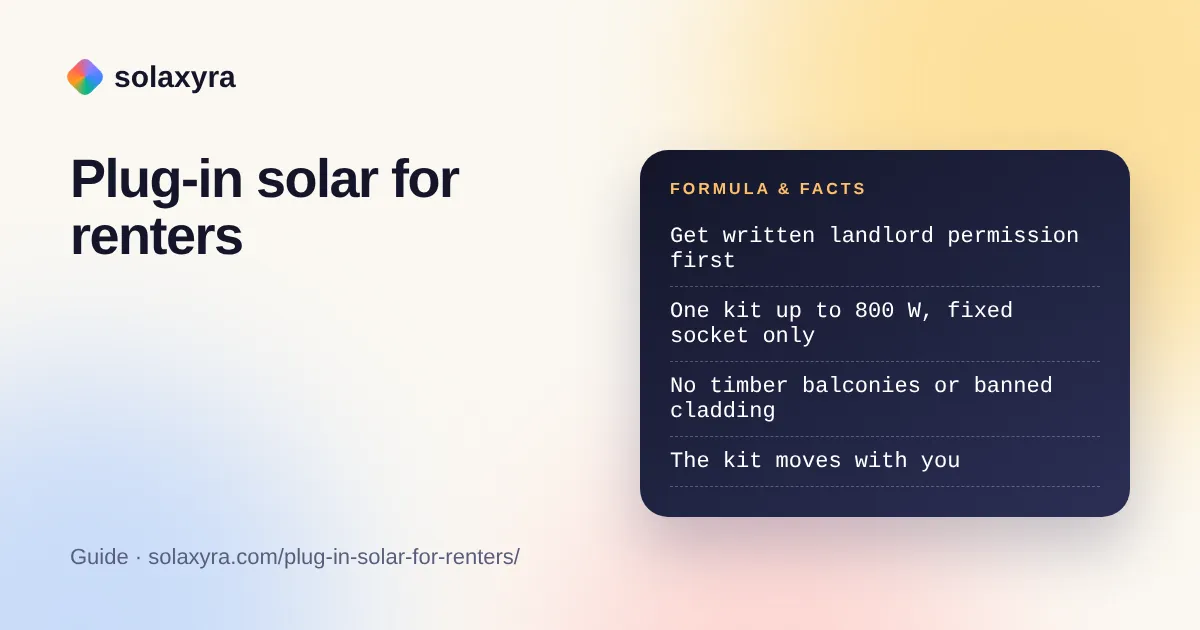
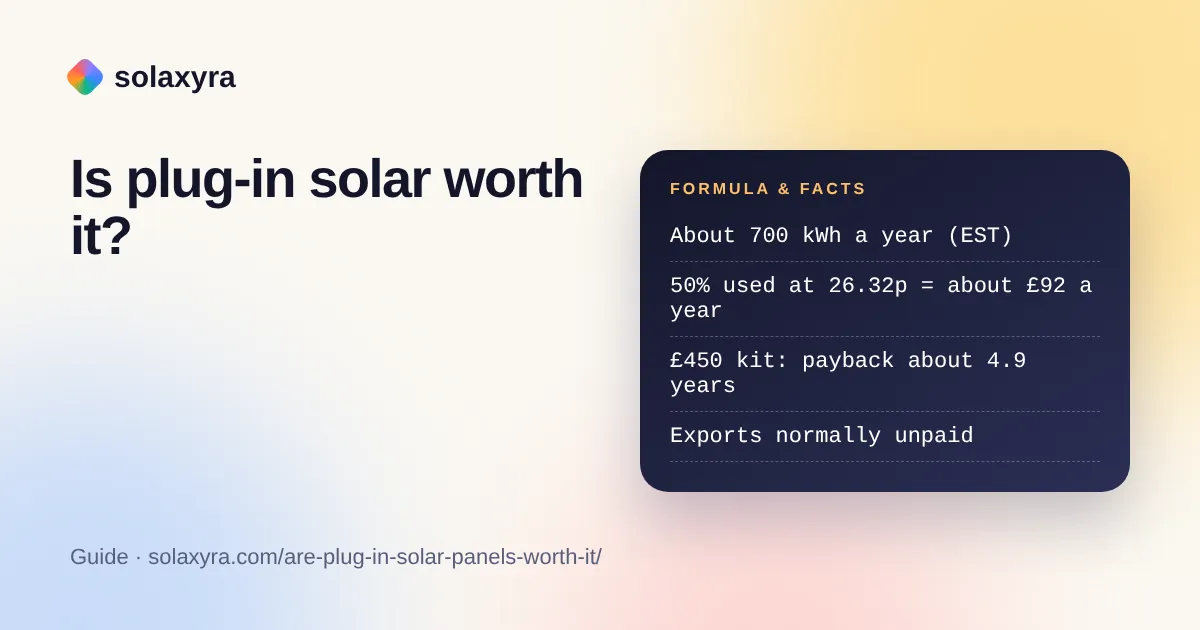
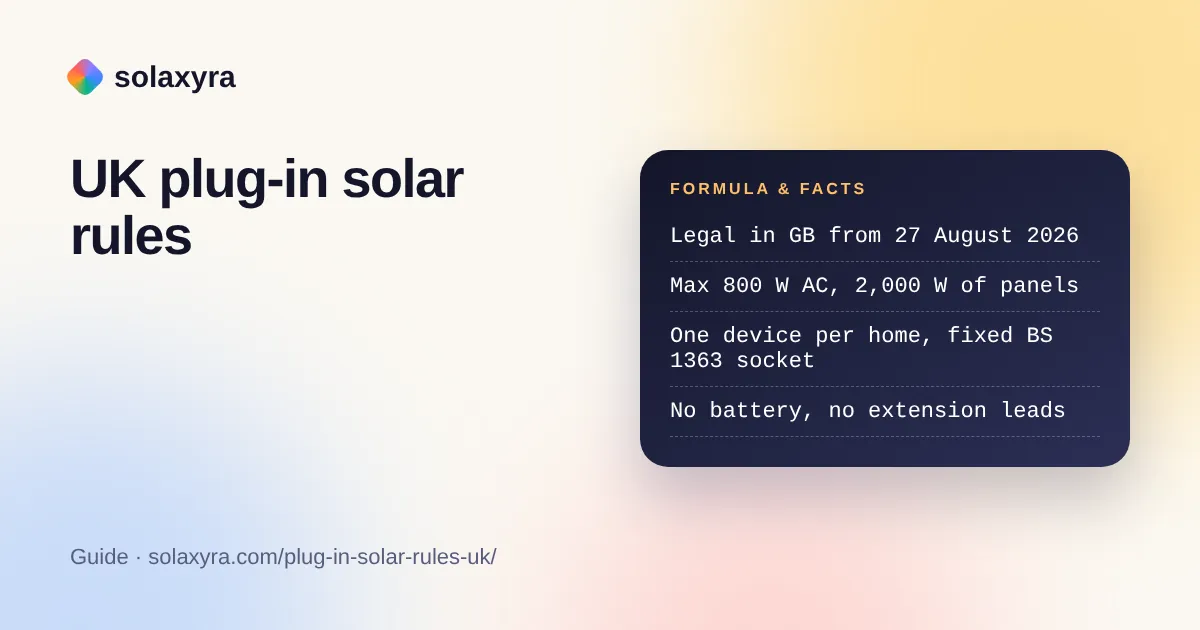
Category: Guides

  • Smart Export Guarantee Explained: How SEG Pays for Your Solar Exports

    Smart Export Guarantee Explained: How SEG Pays for Your Solar Exports

    This guide explains how the Smart Export Guarantee pays households in Great Britain for electricity they send to the grid from solar panels and other small generators, who must offer it, what it pays in practice and how to choose and apply for a tariff. With the smart export guarantee explained using Ofgem’s own figures, you can judge how much export income is realistic and whether using your solar at home is worth more.

    Quick answer: With the Smart Export Guarantee explained simply, larger electricity suppliers in Great Britain must pay you for low-carbon electricity you export, such as surplus solar. Each supplier sets its own rate, which must stay above zero, and pays per kWh your export meter records. Ofgem’s latest annual report shows an average rate of 10.8p per kWh.
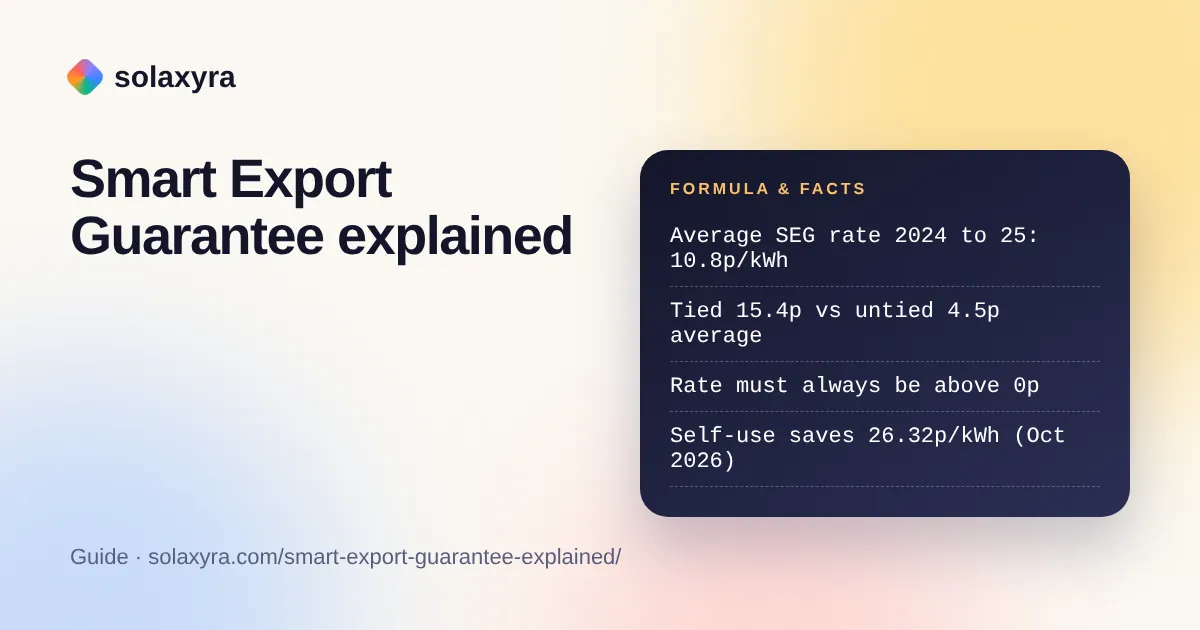
    Smart export guarantee explained with Ofgem average export rates and the value of using solar at home

    What is the Smart Export Guarantee?

    The Smart Export Guarantee (SEG) is a government-backed scheme, running since 1 January 2020, that requires certain electricity suppliers to pay small-scale generators for low-carbon electricity they export to the grid. According to Ofgem’s SEG guidance, these suppliers are called SEG licensees, and they decide the rate, contract length and other terms themselves. Ofgem does not set the rate.

    The one fixed rule on price is that SEG tariff rates must always be above zero. That means a supplier can offer a low rate, but it cannot charge you for exporting or pay nothing at times of surplus. The scheme only covers installations located in Great Britain, so Northern Ireland is not included.

    SEG pays for exports only. Electricity you generate and use yourself earns nothing from SEG, but it saves you buying that unit from the grid, and as the table further down shows, that saving is usually worth more than the export payment.

    Who has to offer SEG, and who can get paid?

    Every electricity supplier with at least 150,000 domestic electricity customers must offer at least one SEG tariff, and smaller suppliers may choose to. Ofgem’s annual report for April 2024 to March 2025 lists 11 SEG licensees offering 50 tariffs between them.

    To be eligible, your installation must use one of these technologies and stay within the size limit:

    • solar photovoltaic (solar PV);
    • wind;
    • hydro;
    • anaerobic digestion;
    • micro combined heat and power (micro-CHP), up to 50 kW.

    All other technologies are eligible up to 5 MW, far above any home system. Solar, wind and micro-CHP installations up to 50 kW need a Microgeneration Certification Scheme (MCS) certificate or an equivalent, which is why a professionally installed rooftop system comes with MCS paperwork. Payments are calculated from export meter readings, so you also need a meter that records exports; in practice this is usually a smart meter, and the supplier will tell you what it accepts.

    Ofgem’s report shows that solar PV made up 99.98% of SEG installations at the end of the year, so for almost every household SEG is a solar question.

    How much does the Smart Export Guarantee pay?

    Ofgem’s Year 5 annual report puts the average SEG rate across all tariffs at 10.8p per kWh, but the range runs from 1p to 40p per kWh, and the type of tariff makes the biggest difference. The Ofgem SEG annual report for April 2024 to March 2025 gives these figures:

    • Total paid to generators: £56.97 million, up 86% on the year before.
    • Total exported: 443.1 GWh.
    • Installations registered at year end: 270,395.
    • Average tied tariff: 15.4p per kWh. Average untied tariff: 4.5p per kWh.
    • Highest untied rate: 12p per kWh. Lowest rate: 1p per kWh.

    A tied tariff is one you can only get if you also buy your electricity from the same supplier, or meet another condition such as owning certain equipment. An untied tariff is open to anyone, whoever supplies your import. The gap between the two averages is large, so the export rate is often a reason to choose an import supplier, and the import tariff that comes with it should be checked as carefully as the export rate.

    Our own arithmetic on Ofgem’s totals gives a rough picture of an average year: £56.97 million ÷ 443.1 GWh is about 12.9p paid per kWh exported, and dividing by the 270,395 installations gives roughly 1,640 kWh exported and £211 paid per installation. These are approximate, because installations joined at different times during the year, but they are a better guide than marketing claims. For your own system, the Smart Export Guarantee calculator works out yearly earnings from your exported kWh and the rate you are offered.

    Is it better to export solar power or use it at home?

    At current prices, using a unit of solar electricity at home is worth more than exporting it: each kWh you use saves 26.32p at the Ofgem price cap for October to December 2026, while the average SEG rate in Ofgem’s latest report was 10.8p. The table values 1,000 kWh of solar output three ways.

    Export rate (Ofgem Year 5 figures)1,000 kWh exported earns1,000 kWh used at home saves (26.32p)Extra value from using itStored in a battery at 90% then used
    1p (lowest rate)£10.00£263.20£253.20£236.88, £226.88 more than exporting
    4.5p (untied average)£45.00£263.20£218.20£236.88, £191.88 more than exporting
    10.8p (all tariffs average)£108.00£263.20£155.20£236.88, £128.88 more than exporting
    12p (highest untied)£120.00£263.20£143.20£236.88, £116.88 more than exporting
    15.4p (tied average)£154.00£263.20£109.20£236.88, £82.88 more than exporting

    The battery column assumes 90% round-trip efficiency as an example value; check the datasheet for any battery you are quoted. It shows the gross value of the stored energy only, not the cost of the battery itself. To compare that against the purchase price, use the home battery savings calculator, and to estimate how much of your generation you use directly, try the solar self-consumption calculator.

    Export still matters. Even a household that runs its washing machine and dishwasher in daylight will usually export some summer surplus, and an SEG tariff turns that into income rather than nothing.

    How is SEG different from the Feed-in Tariff?

    The Feed-in Tariff (FIT) paid for both electricity generated and electricity exported, at rates set through the scheme, whereas SEG pays for exports only at rates each supplier chooses. The FIT closed to new applicants from 1 April 2019, according to Ofgem, and generators accredited before then continue to receive support for 10 to 25 years depending on their installation.

    FeatureFeed-in Tariff (FIT)Smart Export Guarantee (SEG)
    Open to new installationsNo, closed from 1 April 2019Yes, since 1 January 2020
    Pays for generationYesNo
    Pays for exportYesYes
    Who sets the rateSet through the schemeEach SEG licensee
    Minimum rateScheme rateMust be above 0p per kWh
    Payment basisMeter readings, paid quarterlyExport meter readings

    If you already receive FIT payments, check carefully with your FIT licensee before changing anything about your export arrangement, because your FIT generation payments are valuable and long-running.

    How do you apply for a Smart Export Guarantee tariff?

    You apply directly to the SEG licensee whose tariff you choose, which does not have to be your current electricity supplier unless the tariff is tied. The usual order is:

    1. Make sure your installation is commissioned and you have the MCS certificate or equivalent.
    2. Check that you have a meter that records exports, usually a smart meter; ask your supplier if you are unsure.
    3. Compare tied and untied tariffs, looking at the export rate, contract length, how the rate can change and any conditions on your import tariff.
    4. Apply to the chosen licensee with your MCS certificate and meter details.
    5. Check your first statement to make sure exported kWh are being recorded and paid.
    6. Review the market every year or so, since rates and conditions change.

    For a new installation, your installer must also notify the local network operator. MCS guidance says smaller systems can be notified under G98 within 28 days of installation, while systems above 3.68 kW need a G99 application before installation. All fixed wiring must be done by a qualified electrician and meet BS 7671, the UK wiring regulations.

    Frequently Asked Questions

    Do all energy suppliers have to offer the Smart Export Guarantee?

    No. Suppliers with at least 150,000 domestic electricity customers must offer at least one SEG tariff, and smaller suppliers can choose to. In April 2024 to March 2025, Ofgem reports 11 SEG licensees offering 50 tariffs between them.

    Who sets the Smart Export Guarantee rate?

    Each SEG licensee sets its own rate, contract length and terms. Ofgem does not set rates. The only rule on price is that the rate must always be above zero, so you are never charged for exporting and never paid nothing.

    Do I need a smart meter for the Smart Export Guarantee?

    You need a meter that records how much electricity you export, because SEG payments are calculated from export meter readings. In practice this is usually a smart meter. Ask the licensee which meters it accepts before you apply.

    Can I get SEG from a different supplier to my electricity supplier?

    Yes, for untied tariffs, which are open to anyone. Tied tariffs require you to buy your electricity from the same supplier or meet another condition. Ofgem’s latest report shows tied tariffs averaged 15.4p per kWh and untied tariffs 4.5p.

    Is it worth exporting solar electricity under SEG?

    Export earns something for surplus you cannot use, but using solar at home is usually worth more. Each kWh used saves 26.32p at the October 2026 price cap, compared with an average SEG rate of 10.8p in Ofgem’s latest annual report.

    Does the Smart Export Guarantee apply in Northern Ireland?

    No. Ofgem’s SEG guidance states that installations must be located in Great Britain, which means England, Scotland and Wales. Households in Northern Ireland need to check what export arrangements their own supplier offers.

    Checked October 2026 by the Solaxyra Editorial Team. Sources: Ofgem: Smart Export Guarantee, Ofgem: SEG annual report, April 2024 to March 2025, Ofgem: Feed-in Tariffs, Ofgem: energy price cap October to December 2026, MCS: notifying DNOs.
  • kW vs kWh: What Is the Difference and Which Do You Pay For?

    kW vs kWh: What Is the Difference and Which Do You Pay For?

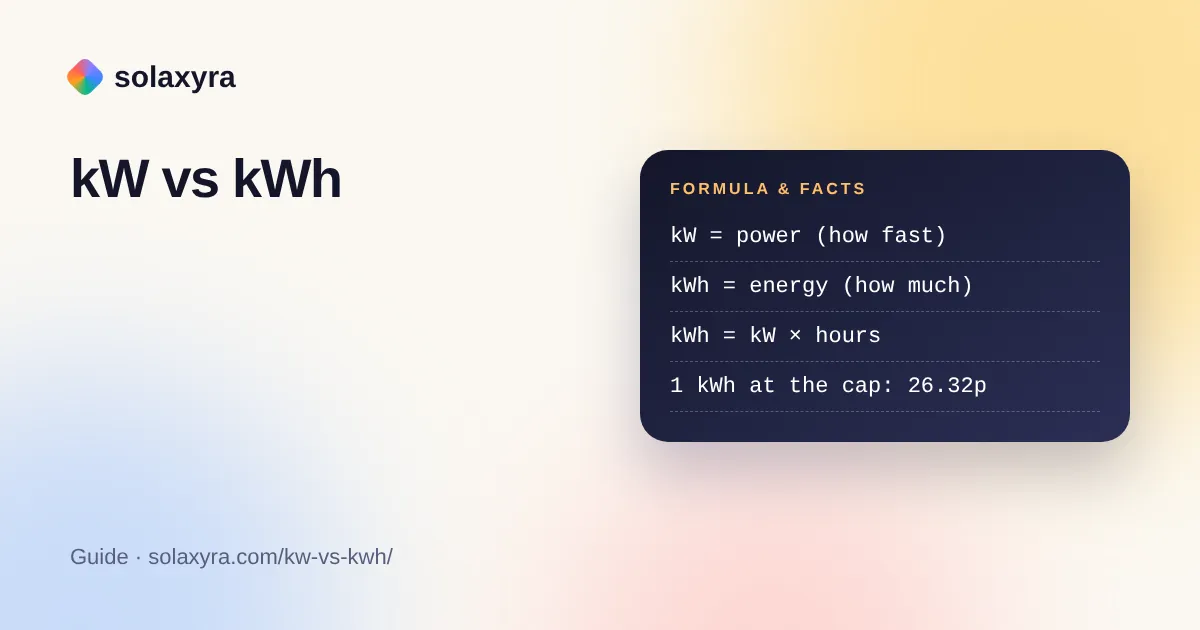
    This guide explains the difference between kilowatts and kilowatt-hours for UK households, so you can read an appliance label, a solar quote, a battery specification or your electricity bill and know exactly what each number means and what it costs. Getting kW vs kWh right is the first step in every energy calculation, and mixing them up is the most common reason home estimates go wrong.

    Quick answer: In kW vs kWh, a kilowatt (kW) measures power, the rate at which energy is used or produced at a moment. A kilowatt-hour (kWh) measures energy, the amount used over time. One kW for one hour is one kWh. UK bills charge per kWh, currently 26.32p on average under the October 2026 price cap.

    kW vs kWh diagram showing power versus energy and the formula kWh equals kW times hours

    What is the difference between kW and kWh?

    A kilowatt is a unit of power and a kilowatt-hour is a unit of energy: kW tells you how fast, kWh tells you how much. The kilowatt-hour is defined as the energy delivered by one kilowatt of power for one hour, which equals 3.6 megajoules. A watt is one joule per second, and a kilowatt is 1,000 watts.

    A road trip is a useful picture. Speed in miles per hour tells you how fast you are going at a given moment; the distance on the trip meter tells you how far you have gone. Power (kW) is like speed. Energy (kWh) is like distance. A car doing 60 mph for two hours covers 120 miles, and a 2 kW heater running for three hours uses 6 kWh.

    The link between the two is one simple formula:

    Energy (kWh) = power (kW) × time (hours)

    Turn it round to find average power: kW = kWh ÷ hours. If you know any two of the three, you can work out the third.

    Which one do you pay for on your electricity bill?

    You pay for kWh. Each kWh is one “unit” on a UK bill, and under the Ofgem price cap for October to December 2026 the average direct debit unit rate is 26.32p per kWh. On top of that comes a standing charge of 54.83p per day, which does not depend on how many kWh you use.

    So running something rated at 1 kW for one hour costs 26.32p at the average cap rate. Running something rated at 1 kW for ten minutes uses one sixth of a kWh and costs about 4.4p. Power on its own does not cost money; power multiplied by time does. To price any appliance at your own unit rate, use the electricity cost calculator.

    Ofgem’s typical domestic consumption value for electricity is 2,500 kWh a year. Spread over the 8,760 hours in a year, that is an average power of only about 0.29 kW, even though your kettle may draw ten times that for a few minutes. That gap between brief peaks and a low average is exactly why kW and kWh describe different things.

    How do you convert kW to kWh for an appliance?

    Multiply the appliance’s power in kW by the hours it runs; if the label shows watts, divide by 1,000 first. These steps work for any appliance with a rating plate:

    1. Find the power rating on the plate or in the manual, for example 2,000 W.
    2. Convert to kW by dividing by 1,000: 2,000 W = 2 kW.
    3. Estimate how many hours it runs, for example 4 hours a day.
    4. Multiply: 2 kW × 4 h = 8 kWh a day.
    5. Multiply by your unit rate to get cost: 8 × 26.32p = £2.11 a day.
    6. For appliances that cycle on and off, such as heaters with a thermostat or fridges, the real kWh will be lower than the rating suggests, so use a plug-in energy monitor or the manufacturer’s kWh figure where you can.

    The watts to kWh calculator does these steps for you, and the home energy consumption calculator adds up a whole list of appliances.

    What is rated in kW and what is rated in kWh?

    Anything that describes how much power a device can draw or deliver is in kW (or W); anything that describes an amount stored, used or generated over a period is in kWh. The table sorts common UK examples. The appliance wattages are example values, so check the labels on your own equipment; costs use the 26.32p cap rate.

    ItemNumber in kW (power)Number in kWh (energy)Example cost at 26.32p
    LED bulb, example 10 W for 5 hours0.01 kW0.05 kWh1.32p
    Kettle, example 3 kW for 3 minutes3 kW0.15 kWh3.95p
    Fan heater, example 2 kW for 4 hours2 kW8 kWh£2.11
    Home EV charger, example 7 kW for 4 hours7 kW28 kWh£7.37
    Plug-in solar kit, full output for 1 hourup to 0.8 kW (800 W)0.8 kWh generatedSaves up to 21p if all used at home
    Home batteryPower rating, how fast it charges or dischargesCapacity, how much it stores (typical 10 kWh)Depends on tariff
    Rooftop solar systemSize in kWp (peak power)Yearly generation in kWhDepends on use and export
    Your electricity billNot shown for most homesUnits used in kWhUnit rate per kWh plus standing charge

    The plug-in solar row uses the government’s limit: from 27 August 2026 plug-in kits in Great Britain produce up to 800 W. The kWh they actually generate depends on weather, season and orientation, which is why a kit’s 0.8 kW rating says nothing on its own about yearly savings.

    Why does kW vs kWh matter for solar panels and batteries?

    For solar panels, the kW (more precisely kWp, kilowatt peak) is the size of the system under standard test conditions, while the kWh is what it produces over a day or year; you need both to judge a quote. A 4 kWp system and a 4 kWh daily output are completely different statements, and the ratio between them, kWh per kWp, tells you how productive the site is. The kWh per kWp calculator works this out from your generation data.

    For batteries the two numbers describe different limits. The kWh is the tank size: how much energy it can store. The kW is the tap size: how fast it can deliver that energy. Example: a battery rated 5 kW and 10 kWh can run a 5 kW load for at most 2 hours (10 ÷ 5), or a 1 kW load for up to 10 hours, before losses. If your evening peak includes a 3 kW oven and a 3 kW kettle at once, a 5 kW battery cannot cover all of it, however many kWh it holds. The Energy Saving Trust gives 10 kWh as a typical home battery capacity.

    Heat pumps are rated by heat output in kW, but you pay for the electricity they use in kWh. A heat pump delivering 6 kW of heat with a COP of 3 draws about 2 kW of electricity, so in one hour it uses about 2 kWh, costing about 53p at the cap rate.

    What are the most common kW and kWh mistakes?

    The most common mistake is writing kW/h or “kWh per hour”; the correct unit of energy is kWh, and kW/h would mean a change in power over time, which is almost never what anyone intends. Other errors to watch for:

    • Comparing a battery’s kWh capacity with an appliance’s kW rating directly, without dividing to get hours.
    • Treating a solar system’s kWp as its daily output.
    • Reading half-hourly smart meter data as kW. Each half-hour reading is energy in kWh. To get the average power in that half hour, multiply by 2; for 15 minute data, multiply by 4.
    • Assuming the bill tracks kW. Domestic UK bills charge per kWh plus a daily standing charge.
    • Forgetting that watts and kilowatts differ by 1,000: a 1,500 W hair dryer is 1.5 kW, not 1,500 kW.

    How much power can a UK plug socket supply?

    A standard UK 13 A plug can supply about 3 kW: at 230 V, 230 × 13 = 2,990 W. That is why most kettles and portable heaters sold for UK sockets are rated at or below about 3 kW. Appliances that need more, such as electric showers, cookers and most home EV chargers, are wired on their own dedicated circuits. Any new circuit or change to fixed wiring must be installed by a qualified electrician and meet BS 7671, the UK wiring regulations.

    The kW figure matters for safety and circuit sizing; the kWh figure matters for cost. If you want to see what a rating means in amps for your circuit, the kW to amps calculator converts it at UK voltages.

    Frequently Asked Questions

    Is kWh the same as a unit of electricity?

    Yes. On a UK electricity bill one unit is one kilowatt-hour. If your bill shows 250 units for the month and your unit rate is 26.32p, the energy part of that bill is 250 × 26.32p, which is £65.80, before the daily standing charge.

    How many kWh does a 1 kW appliance use?

    A 1 kW appliance uses 1 kWh for every hour it runs at full power. Half an hour uses 0.5 kWh and ten hours uses 10 kWh. Appliances with thermostats switch on and off, so their real use is usually lower than the rating times the hours.

    Is kW/h the same as kWh?

    No. kWh means kilowatt multiplied by hours and is a unit of energy. kW/h would mean kilowatts per hour, a rate of change in power, which is almost never what is meant. Always write energy as kWh.

    Why does my battery have both a kW and a kWh rating?

    The kWh rating is how much energy the battery stores; the kW rating is how fast it can charge or discharge. Divide kWh by kW to find the minimum time it can run at full output, for example 10 kWh ÷ 5 kW = 2 hours.

    How do I turn smart meter half-hourly kWh into kW?

    Each half-hourly reading is the energy used in 30 minutes. Multiply it by 2 to get the average power in kW during that half hour. For example, 0.75 kWh in a half hour means an average of 1.5 kW.

    Checked October 2026 by the Solaxyra Editorial Team. Sources: Wikipedia: kilowatt-hour, Ofgem: energy price cap 1 October to 31 December 2026, GOV.UK: plug-in solar panels come to market, Energy Saving Trust: battery storage.

  • Home Battery Without Solar: Does It Pay in the UK?

    Home Battery Without Solar: Does It Pay in the UK?

    This guide explains how a home battery without solar panels saves money for UK households, what tariff it needs, what it costs, and how to check whether the numbers work for your own home before you ask for quotes. It is written for people who cannot fit panels, such as many flat owners, or who want to add storage first and solar later.

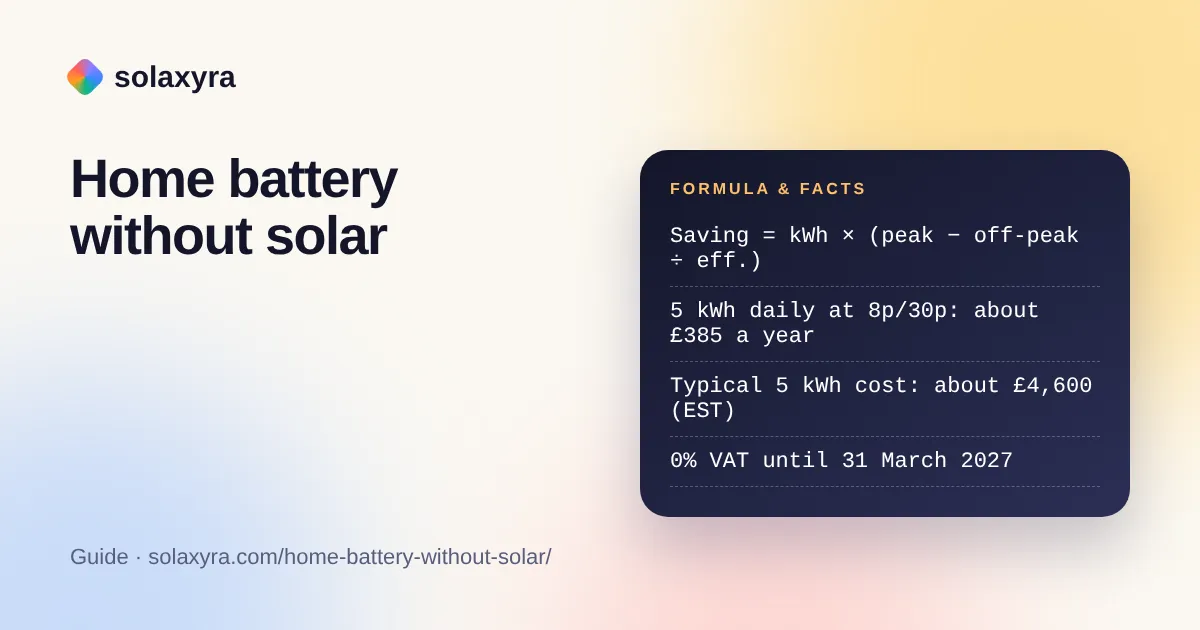
    Quick answer: A home battery without solar charges from the grid when electricity is cheap, usually overnight on a time of use tariff, and powers your home at peak times. After round-trip losses, a 5 kWh battery fully used every day saves roughly £300 to £400 a year at example rates, against a typical cost of about £4,600.

    Home battery without solar savings formula with example time of use rates and payback

    Can you have a home battery without solar panels?

    Yes. A battery does not care where its electricity comes from, and the Energy Saving Trust confirms you can have one without solar panels and pair it with a smart time of use tariff to buy electricity when it is cheap and avoid peak rates. This is called energy arbitrage: you fill up at the low price and use the stored energy when the price is high.

    A battery-only system is normally AC-coupled. It has its own inverter and connects to your home’s wiring near the consumer unit, so it can charge from the mains and supply your circuits without any panels. If you add solar later, an AC-coupled battery can usually store solar surplus too, though you should check this with your installer at the quote stage.

    How does a battery without solar save money?

    The saving per day equals the kWh you shift multiplied by the peak price, minus the cost of buying that energy at the off-peak price divided by the battery’s round-trip efficiency. In plain words, you pay a little more than one unit of cheap electricity for each unit you get back out, because some energy is lost in charging and discharging.

    Daily saving = shifted kWh × (peak price − off-peak price ÷ round-trip efficiency)

    The Energy Saving Trust notes that using stored energy is less efficient than using it directly, so you lose some energy along the way. We use 90% round-trip efficiency as an example value in this guide. Check the figure on the datasheet for the battery you are quoted and change it in the formula.

    Example: off-peak 8p per kWh and peak 30p per kWh (example rates, not quoted from any supplier), 90% efficiency. Each kWh you take out of the battery cost 8 ÷ 0.9 = 8.89p to put in, so it saves 30 − 8.89 = 21.11p. Shift 5 kWh a day and you save 105.56p a day, or about £385 a year.

    How much can a battery without solar save each year?

    At example rates, a 5 kWh battery used fully every day saves about £176 to £385 a year and a 10 kWh battery about £352 to £771, depending on the gap between your off-peak and peak prices. The table uses 90% round-trip efficiency and one full cycle a day. The 26.32p rows use the Ofgem price cap electricity rate for October to December 2026 as the price you avoid, which is a fair comparison if you are deciding between a default tariff and a time of use tariff plus battery.

    Example off-peak rateExample peak rate avoidedNet saving per kWh shifted5 kWh used daily, per year10 kWh used daily, per yearPayback on £4,600 (5 kWh)
    8p30p21.11p£385.28£770.5611.9 years
    8p26.32p (price cap)17.43p£318.12£636.2414.5 years
    12p30p16.67p£304.17£608.3315.1 years
    15p26.32p (price cap)9.65p£176.17£352.3526.1 years

    The Energy Saving Trust gives about £4,600 as a typical price for a 5 kWh system and a lifespan of about 10 to 12 years. Set those two figures side by side and the message is clear: the battery only pays for itself within its life if the price gap is wide and you really do use the stored energy every day. To pay back £4,600 in ten years, a 5 kWh battery needs a net saving of about 25p for every kWh it delivers, which at an 8p off-peak rate means avoiding a peak price of about 34p.

    To run the numbers with your own rates, battery size and price, use the home battery savings calculator.

    Will you actually use a full battery every day?

    Only if your peak-time use is at least as large as the battery, and many homes use less than people expect. Ofgem’s typical domestic consumption value for electricity is 2,500 kWh a year, about 6.8 kWh a day across all 24 hours. If only part of that falls in the peak window, a 10 kWh battery will rarely empty and the second half of it earns nothing.

    Example: a two-bedroom flat with no electric heating shifts about 3 kWh a day out of a 5 kWh battery. At the 8p and 30p example rates, the saving is 3 × 21.11p = 63.33p a day, about £231 a year, and the payback on £4,600 stretches to nearly 20 years, beyond the expected battery life.

    The picture changes for homes with a heat pump or an electric car, where evening demand is higher. The Energy Saving Trust notes that a battery saves more when it runs a heat pump than when it only stores surplus solar. To estimate how much electricity your appliances use in the evening, add them up in the energy consumption calculator, and use the watts to kWh converter for individual items.

    How do you check whether a battery without solar pays for your home?

    You can test the case with your own smart meter data before you ask for quotes. Work through these steps:

    1. Download your half-hourly usage from your supplier’s app or account, ideally covering winter and summer.
    2. Add up your average daily use in the peak window of the time of use tariff you are considering.
    3. Choose a battery whose usable capacity is close to that figure, not larger.
    4. Apply the formula above with the tariff’s off-peak and peak rates and the battery’s round-trip efficiency.
    5. Multiply by 365 and compare the yearly saving with the installed price and the warranty period.
    6. Remember to compare against what you would pay on your current tariff, because switching to a time of use tariff can change your costs even without a battery.

    Tariff rates change. A battery bought for a particular price gap can lose much of its saving if that gap narrows, so treat a payback period as an estimate, not a promise.

    What does a battery-only system cost, and is there VAT?

    The Energy Saving Trust says battery systems range from about £1,500 to £10,000, with a 5 kWh system around £4,600 and a typical home system around 10 kWh. On tax, HMRC VAT Notice 708/6 applies the zero rate from 1 February 2024 to 31 March 2027 to installed electrical storage batteries in homes, and it explicitly includes a standalone battery that stores electricity from the grid.

    • The zero rate applies only when the battery is supplied and installed, not to a battery bought on its own without installation.
    • After 31 March 2027 the guidance says installations revert to the reduced rate of 5%.
    • No solar panels are needed to qualify.

    Who can install it, and what approvals are needed?

    A home battery must be installed by a competent, qualified installer, and the electrical work must meet BS 7671, the UK wiring regulations; this is not a DIY job. The Energy Saving Trust recommends getting at least three quotes from MCS certified installers and says batteries are commonly placed in garages, on external walls or in utility rooms.

    Your network operator (DNO) must also be told. According to MCS guidance, for smaller systems the installer can submit a G98 notification within 28 days of installation, while systems above 3.68 kW need a G99 application to the DNO before installation. Your installer is responsible for the paperwork, but ask to see confirmation that it has been done.

    If you want the battery to keep lights on during a power cut, ask specifically for backup or emergency power capability. Not every battery-only system provides it, and those that do may only supply selected circuits.

    Frequently Asked Questions

    Can a home battery work without solar panels?

    Yes. A battery can charge from the mains when electricity is cheap, usually overnight on a time of use tariff, and supply your home at peak times. The Energy Saving Trust confirms batteries can be used without solar panels for exactly this purpose.

    Do I need a special tariff for a battery without solar?

    In practice, yes. Savings come from the gap between off-peak and peak prices, so you need a time of use or smart tariff with a cheap period. On a single flat rate tariff, a battery saves nothing and loses some energy in round-trip losses.

    How much does a battery without solar save per year?

    It depends on the price gap and how much you shift. At example rates of 8p off-peak and 30p peak with 90% efficiency, a 5 kWh battery used fully every day saves about £385 a year. Using only 3 kWh a day cuts that to about £231.

    Is there VAT on a standalone home battery?

    Not until 31 March 2027 if it is installed in your home. HMRC Notice 708/6 applies the zero rate to installed batteries, including standalone batteries storing grid electricity. After that date installations revert to the reduced rate of 5%.

    What size battery do I need without solar?

    Match the usable capacity to the electricity you use in the tariff’s peak window each day, not to your total daily use. A battery larger than your peak-time demand will not empty, and the extra capacity adds cost without adding savings.

    How long does a home battery last?

    The Energy Saving Trust says home batteries typically last about 10 to 12 years. Compare the payback period you calculate with that lifespan and with the warranty offered, and ask your installer what capacity the warranty guarantees after a set number of years.

    Checked October 2026 by the Solaxyra Editorial Team. Sources: Energy Saving Trust: solar panel battery storage, HMRC: VAT Notice 708/6, MCS: notifying DNOs, Ofgem: energy price cap October to December 2026.

  • Heat Pump vs Gas Boiler: Which Is Cheaper to Run in 2026?

    Heat Pump vs Gas Boiler: Which Is Cheaper to Run in 2026?

    This guide compares an air source heat pump with a gas boiler for homes in England, Scotland and Wales, using the Ofgem price cap from 1 October 2026 so you can see which is cheaper to run, what each costs to fit and which suits your house. The heat pump vs gas boiler question usually comes down to one number, the heat pump’s seasonal efficiency, and we show you how to work out the figure your home needs to reach.

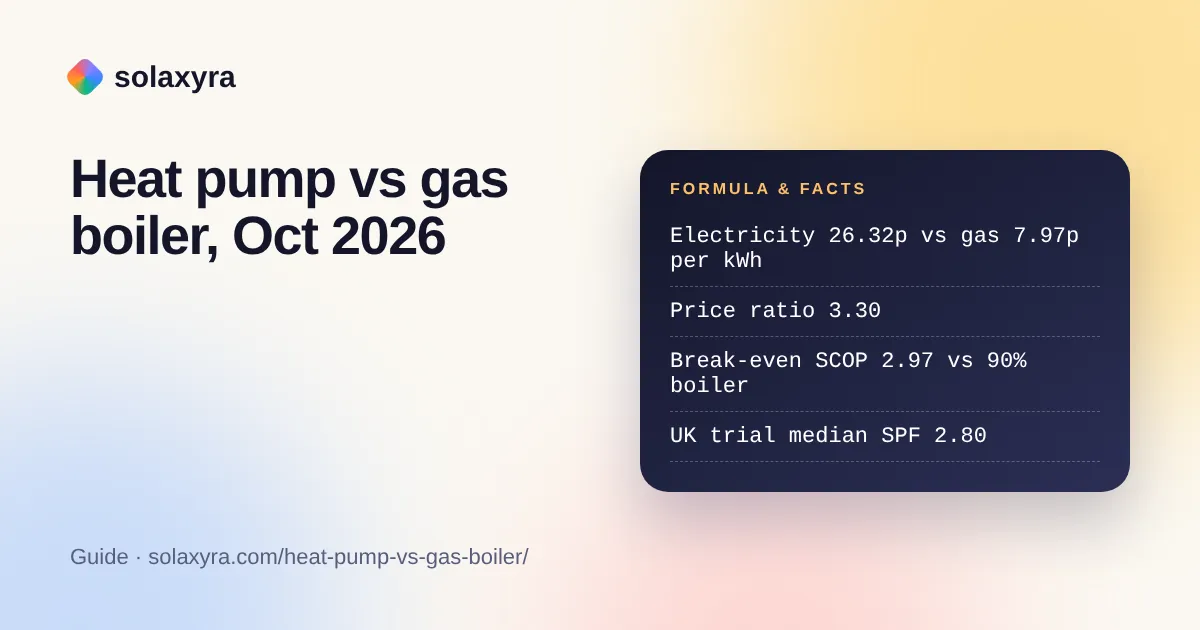
    Quick answer: In the heat pump vs gas boiler comparison, efficiency decides running costs. At the October 2026 price cap, electricity costs 3.3 times as much per kWh as gas, so a heat pump needs a seasonal efficiency of about 3.0 to match a 90% efficient boiler. Dropping the gas standing charge lowers that to about 2.6.

    Heat pump vs gas boiler running cost comparison and break-even SCOP at the October 2026 price cap

    How does a heat pump differ from a gas boiler?

    A gas boiler burns fuel and turns slightly less than 100% of the energy in the gas into heat, while a heat pump moves heat from the outside air into your home and typically delivers around three units of heat for every unit of electricity it uses. That ratio is called the coefficient of performance (COP) when measured at one moment, and the seasonal coefficient of performance (SCOP) or seasonal performance factor (SPF) when averaged over a year.

    Real homes matter more than brochure figures. In the Electrification of Heat demonstration project, funded by the Department for Energy Security and Net Zero, the Energy Systems Catapult reported a median SPF of 2.80 for air source heat pumps across the trial, and a median of 2.44 on the coldest days. A well designed system can do better; a poorly designed one can do worse.

    A boiler’s efficiency depends on its age and on how it is set up. A modern condensing boiler running at low return temperatures is more efficient than an older one running hot. In the tables below we use 90% as an example for a modern boiler and 85% and 80% for older or poorly set up ones. These are example values; change them to suit your boiler.

    Which is cheaper to run at October 2026 prices?

    At the current cap, a heat pump with a SCOP of 3.0 costs about £750 a year to supply 8,550 kWh of heat, against about £757 of gas for a 90% boiler, so the two are close and the gas standing charge decides it. The rates come from Ofgem’s October to December 2026 price cap: 26.32p per kWh for electricity and 7.97p per kWh for gas, with a gas standing charge of 29.68p a day, on direct debit as a Great Britain average.

    Example: a home whose gas use is Ofgem’s typical 9,500 kWh a year, all for heating and hot water, with a 90% boiler, needs about 8,550 kWh of useful heat. The table prices that same heat demand every way. The electricity standing charge is not included because you pay it either way.

    Heating option (example)Fuel bought per yearFuel cost at the capPlus gas standing chargeYearly total
    Gas boiler, 90% efficient9,500 kWh gas£757.15£108.33£865.48
    Gas boiler, 85% efficient10,059 kWh gas£801.69£108.33£910.02
    Gas boiler, 80% efficient10,688 kWh gas£851.79£108.33£960.13
    Heat pump, SCOP 2.44 (trial median, coldest days)3,504 kWh electricity£922.28£0 if gas is capped off£922.28
    Heat pump, SCOP 2.8 (trial median, whole year)3,054 kWh electricity£803.70£0 if gas is capped off£803.70
    Heat pump, SCOP 3.02,850 kWh electricity£750.12£0 if gas is capped off£750.12
    Heat pump, SCOP 3.52,443 kWh electricity£642.96£0 if gas is capped off£642.96
    Heat pump, SCOP 4.02,138 kWh electricity£562.59£0 if gas is capped off£562.59

    The SCOP 2.44 row is only a guide, because a whole year never runs at coldest day efficiency. It shows the worst case for a typical installation. If you keep a gas hob, you keep paying the gas standing charge, so add £108.33 back to each heat pump row before you compare. To run these numbers with your own heat demand, efficiency and tariff, use the heat pump and gas boiler running cost calculator.

    What SCOP does a heat pump need to beat a gas boiler?

    The break-even SCOP equals the electricity price divided by the gas price, multiplied by the boiler efficiency; at October 2026 cap rates that is 26.32 ÷ 7.97 × 0.90 = 2.97 for a 90% boiler. Any heat pump that averages above that figure over the year is cheaper per unit of heat.

    ScenarioPrice ratio (electricity ÷ gas)Break-even SCOP vs 90% boilerBreak-even SCOP vs 85% boiler
    October 2026 cap, no VAT on electricity3.302.972.81
    Same, gas standing charge removed (example 8,550 kWh heat)3.30about 2.60about 2.47
    Same unit rate with 5% VAT added back (27.64p)3.473.122.95

    The third row matters for planning. The government has removed VAT from household electricity only from 1 October 2026 to 31 March 2027, as Ofgem confirms. If it returns at 5%, the bar for a heat pump rises a little. Wholesale prices will also move, so treat the ratio as something to recheck each quarter rather than a fixed fact.

    The Energy Saving Trust notes that heat pumps can cost slightly more to run than new gas boilers on standard tariffs, and that heat pump or time of use tariffs can make them cheaper. A cheaper overnight rate effectively lowers the price ratio, which lowers the break-even SCOP. If you also have solar panels, the solar self-consumption calculator helps you estimate how much of the heat pump’s daytime use your own generation could cover.

    How do you work out the right comparison for your home?

    You can estimate your own break-even point in a few minutes from your annual gas statement. Follow these steps:

    1. Find your yearly gas use in kWh on your statement or online account.
    2. Take off an allowance for cooking if you have a gas hob. This is your judgement; for most homes heating and hot water are the bulk of gas use.
    3. Multiply the remaining figure by your boiler efficiency (for example 0.90) to get useful heat in kWh.
    4. Divide that heat by a realistic SCOP for a heat pump, such as the trial median 2.8 and a well designed 3.5, to get electricity in kWh.
    5. Price both at your own unit rates, then decide whether you will keep or cap off the gas supply and adjust for the gas standing charge.
    6. Ask an MCS certified installer for a heat loss survey; their design figures replace your estimate.

    A heat loss survey also tells you whether your radiators are big enough. Heat pumps run most efficiently at lower water temperatures, so some rooms may need larger radiators. That design work is part of what you pay an installer for and is the main reason two similar houses can end up with very different SCOPs.

    How much does each cost to install, and is there a grant?

    The Energy Saving Trust puts the typical cost of installing an air source heat pump at around £12,000, and the Boiler Upgrade Scheme takes £7,500 off that in England and Wales. On those figures alone, the example net cost would be about £4,500 before any radiator or cylinder work your survey identifies.

    • Air source heat pump: £7,500 grant.
    • Ground source heat pump, including water source: £7,500 grant.
    • Air-to-air heat pump: £2,500 grant.
    • Until March 2027, an extra £1,500 towards an air or ground source heat pump if the property uses oil or LPG and has no mains gas.
    • Hybrid systems that pair a gas boiler with a heat pump are not funded.

    To qualify you must own the property and be replacing fossil fuel heating such as gas, oil, LPG or electric. The installer must be MCS certified, and the installation must be finished within 120 days of the application. Most new builds and social housing are excluded. Our Boiler Upgrade Scheme guide covers the process in detail.

    We do not quote a typical gas boiler replacement price because we could not verify one from a primary source today. Get at least two written quotes, and compare the heat pump’s net cost against the boiler quote, not against zero, because a failing boiler has to be replaced with something.

    Is your home suitable for a heat pump?

    The Energy Saving Trust says air source heat pumps are suitable for most types of homes, and most installations count as permitted development, so planning permission is usually not needed, except in cases such as listed buildings and conservation areas. Suitability is mainly about heat loss, space and emitters:

    • Insulation and draughts: the lower your heat loss, the smaller and cheaper the heat pump and the easier it is to reach a good SCOP. The heat loss calculator gives a first estimate.
    • Outdoor space for the unit, with airflow around it.
    • Indoor space for a hot water cylinder if you currently have a combi boiler.
    • Radiators or underfloor heating that can deliver enough heat at lower flow temperatures.

    A gas boiler remains the simpler swap where none of this work is possible, for example in a flat with no outdoor space. If you stay with gas, lowering the flow temperature on a condensing boiler can improve its efficiency; see our guide to boiler flow temperature.

    Who must install and work on each system?

    Any work on a gas boiler or gas pipework must be done by a Gas Safe registered engineer; it is illegal and dangerous to do it yourself. For a heat pump funded by the Boiler Upgrade Scheme, the installer must be MCS certified. The electrical supply to a heat pump, including any new circuit or isolator, must be installed by a qualified electrician and meet BS 7671, the UK wiring regulations. Removing or capping a gas supply is also a job for a Gas Safe registered engineer and your gas network.

    Frequently Asked Questions

    Is a heat pump cheaper to run than a gas boiler?

    It can be, but at standard October 2026 cap rates it is close. A heat pump needs a seasonal efficiency of about 3.0 to match a 90% boiler on unit costs alone. Removing the gas standing charge or using a heat pump tariff makes it cheaper.

    What is a good SCOP for a heat pump in the UK?

    The DESNZ-funded Electrification of Heat trial found a median of 2.80 for air source heat pumps over the year, and 2.44 on the coldest days. A well designed system with low flow temperatures can achieve more, so ask your installer for a design SCOP.

    How much is the Boiler Upgrade Scheme grant?

    In England and Wales it is £7,500 for an air source or ground source heat pump and £2,500 for air-to-air. Until March 2027 off-gas homes using oil or LPG can get an extra £1,500. Hybrid systems are not funded.

    Do I need to replace my radiators for a heat pump?

    Not always. Heat pumps work best at lower water temperatures, so some rooms may need larger radiators to stay warm. An MCS certified installer should carry out a room by room heat loss survey and tell you exactly which radiators, if any, need changing.

    Will the end of the electricity VAT holiday change the comparison?

    Slightly. VAT is removed from household electricity from 1 October 2026 to 31 March 2027. Adding 5% back to the current unit rate raises the break-even SCOP against a 90% boiler from about 2.97 to about 3.12, if gas prices stay the same.

    Checked October 2026 by the Solaxyra Editorial Team. Sources: Ofgem: energy price cap 1 October to 31 December 2026, GOV.UK: Boiler Upgrade Scheme, what you can get, GOV.UK: Boiler Upgrade Scheme eligibility, Energy Saving Trust: air source heat pumps, Energy Systems Catapult: Electrification of Heat findings.

  • Energy Price Cap Explained: What It Limits and What You Will Pay

    Energy Price Cap Explained: What It Limits and What You Will Pay

    This guide explains how the Ofgem cap on household gas and electricity prices works for homes in England, Scotland and Wales, what it does and does not limit, and how to turn the current rates into a yearly bill for your own usage. With the energy price cap explained step by step, you can check whether your supplier is charging what the rules allow and judge whether a fixed deal is worth a look.

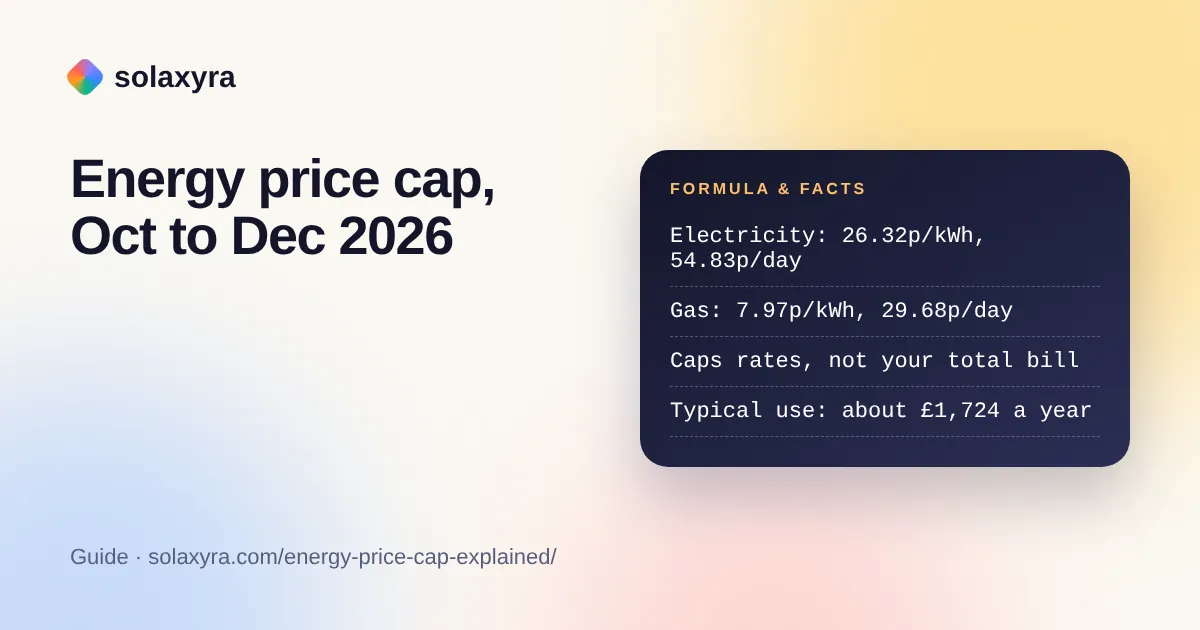
    Quick answer: The energy price cap is the maximum Ofgem allows suppliers to charge per kWh and per day on standard variable tariffs in England, Scotland and Wales. It changes every three months. From 1 October to 31 December 2026 the average direct debit cap is 26.32p per kWh for electricity and 7.97p per kWh for gas. Total bills are not capped.

    Energy price cap explained with October to December 2026 Ofgem unit rates and standing charges

    What does the energy price cap actually limit?

    The cap limits two numbers on your tariff, the unit rate (pence per kWh) and the standing charge (pence per day), and it does not limit the total you pay in a year. Ofgem states this plainly on its price cap explainer: the more energy you use, the higher your bill will be.

    This is the single most common misunderstanding. Headlines often quote a “typical bill” figure, and many people read it as a ceiling on what they can be charged. It is not. That figure is just the capped rates multiplied by an assumed level of use. A household that uses twice the typical amount of electricity will pay roughly twice the unit costs, all at capped rates and all perfectly legal.

    The standing charge is the fixed daily amount you pay to stay connected, whether you use any energy or not. It is capped too, but because it does not depend on use, it makes up a much larger share of the bill for low users than for high users. The table further down shows this in numbers.

    What are the price cap rates from 1 October to 31 December 2026?

    For a household paying by direct debit, the average capped rates in Great Britain are 26.32p per kWh and 54.83p per day for electricity, and 7.97p per kWh and 29.68p per day for gas. These come from Ofgem’s announcement of changes to the cap for October to December 2026, published on 26 August 2026.

    Fuel (direct debit, GB average)Unit rateStanding chargeVAT in the figure
    Electricity26.32p per kWh54.83p per dayNone (0% from 1 Oct 2026 to 31 Mar 2027)
    Gas7.97p per kWh29.68p per dayIncluded at 5%

    Ofgem says prices rise by 4% for a typical dual fuel direct debit household compared with the previous quarter, and links the rise to higher wholesale gas prices. The next announcement is due on 25 November 2026 and will cover 1 January to 31 March 2027.

    These are averages. Your own capped rates depend on your region, how you pay (direct debit, standard credit on receipt of a bill, or prepayment) and your meter type. Ofgem publishes the regional tables on its website, and your supplier must show your actual rates on your bill and in your account.

    Why is there no VAT on electricity this winter?

    The government has removed VAT from household electricity bills from 1 October 2026 to 31 March 2027, so the capped electricity rates for this period contain no VAT, while gas still carries the usual 5%. Ofgem confirms this in both its October announcement and its explainer page.

    This matters when you compare figures. If you see an older electricity rate quoted with VAT, it is not like for like. As a simple check of the arithmetic, adding 5% to 26.32p gives 27.64p, so a rate quoted around that level with VAT is broadly equivalent before tax. When the zero rate ends on 31 March 2027, expect rates to be quoted with VAT again unless the government says otherwise.

    Who is protected by the price cap and who is not?

    The cap protects households in England, Scotland and Wales who are on a standard variable tariff, which is the default tariff you are moved to when a fixed deal ends or if you never chose one. Prepayment customers on a default tariff are covered as well, at their own capped levels.

    The cap does not apply to:

    • fixed tariffs, where the price is agreed in your contract for a set term;
    • business energy contracts;
    • homes supplied through a heat network (communal or district heating);
    • Northern Ireland, which has a separate market and regulator and is not part of the Ofgem cap.

    If you are on a fixed deal, the cap still matters as a benchmark. A fixed rate above the current cap costs you more today, though it may protect you if the cap rises later. Nobody can promise which way the next quarter will go, so compare the fixed rates against the cap figures above rather than against a headline.

    How is the energy price cap calculated?

    Ofgem builds the cap from eight cost allowances that a supplier is expected to face, adds them together for each fuel, and turns the result into a unit rate and a standing charge. According to Ofgem, the building blocks are:

    1. Wholesale costs: buying the gas and electricity on the wholesale market, which is the largest and most volatile part.
    2. Network costs: building and running the pipes and wires that bring energy to homes.
    3. Policy costs: government schemes funded through bills, such as the Warm Home Discount.
    4. Operating costs: running a supplier, including billing and customer service.
    5. EBIT: an allowance for supplier earnings before interest and tax.
    6. Headroom: a small allowance for uncertainty.
    7. Levelisation: an adjustment so that standing charges are spread fairly across payment methods.
    8. VAT: currently 5% on gas and 0% on electricity until 31 March 2027.

    Because the cap is announced several weeks before each period starts and then holds for three months, it moves some time after wholesale markets do. That lag works both ways: rises reach bills later, and so do falls.

    What does the cap mean for a typical yearly bill?

    At the October to December 2026 rates, a home using Ofgem’s typical 2,500 kWh of electricity and 9,500 kWh of gas a year would pay about £1,724 if those rates applied for a full year. Ofgem revised its typical domestic consumption values from 1 July 2026, from 2,700 kWh to 2,500 kWh for electricity and from 11,500 kWh to 9,500 kWh for gas, so older articles using the previous values will show higher “typical” bills.

    The table below is our own arithmetic using the GB average direct debit rates. The low and high rows are examples only, not official categories; change them to the figures on your annual statement.

    Yearly useElectricity costOf which standing chargeGas costTotal per yearPer month
    Example low: 1,500 kWh electricity, 6,000 kWh gas£594.93£200.13 (34%)£586.53£1,181.46£98.46
    Ofgem typical: 2,500 kWh electricity, 9,500 kWh gas£858.13£200.13 (23%)£865.48£1,723.61£143.63
    Example high: 4,000 kWh electricity, 15,000 kWh gas£1,252.93£200.13 (16%)£1,303.83£2,556.76£213.06

    Two things stand out. First, the standing charges alone come to £308.46 a year for dual fuel (£200.13 electricity plus £108.33 gas) before you boil a kettle. Second, the standing charge is a third of a low user’s electricity bill but only a sixth of a high user’s, which is why small households often feel the cap is unfair. Our guide to how standing charges work goes into this in more depth.

    To price a single appliance at the capped rate, use the appliance electricity cost tool, or list everything in the house with the home energy consumption calculator to estimate your yearly kWh before you work out the bill.

    How do you check your own bill against the cap?

    You can check your bill in about ten minutes using your latest statement and the Ofgem regional table for your area. Work through these steps:

    1. Find your tariff name. If it says “standard variable”, “default” or similar, the cap applies; if it is a fixed deal, it does not.
    2. Note your unit rates and standing charges for each fuel from the bill or your online account.
    3. Look up the capped rates for your region and payment method on Ofgem’s website for the current period.
    4. Compare each figure. On a default tariff, your rate should not be higher than the cap for your region, payment method and meter.
    5. Find your annual kWh on your statement, multiply by the unit rate, then add 365 days of standing charge to get your own yearly estimate.
    6. If a rate looks too high, contact your supplier, quote the Ofgem figure for your region and ask for an explanation in writing.

    Example: a flat with a single rate meter on a default direct debit tariff uses 1,800 kWh of electricity a year and has no gas. At the GB average cap, that is 1,800 × 26.32p = £473.76 for units plus 365 × 54.83p = £200.13 for standing charge, about £673.89 a year or £56.16 a month. Your regional figure will differ slightly.

    Does the price cap apply to Economy 7 and smart tariffs?

    Default tariffs for multi-register meters such as Economy 7 are capped too, with their own day and night rates; Ofgem’s typical value for these meters was revised to 3,400 kWh from 1 July 2026. The cap only covers default tariffs, so a smart or time of use tariff you signed up to on a fixed contract is not capped; check your tariff terms to see which kind you have.

    If you have solar panels, a battery or an electric car, your import price still follows your tariff, so the cap only helps if you are on a default tariff. What you earn for exported electricity is a separate matter, paid under the Smart Export Guarantee, and the price cap does not set export rates. To see how running costs compare across heating options at capped rates, the heat pump versus gas running cost tool uses the same unit prices.

    Frequently Asked Questions

    Does the energy price cap limit my total bill?

    No. The cap limits the unit rate per kWh and the daily standing charge on default tariffs. Your total bill depends on how much energy you use, so a household using more than the typical amount will pay more than the headline typical bill figure.

    How often does the energy price cap change?

    Ofgem resets the cap every three months, for periods starting 1 January, 1 April, 1 July and 1 October. The next announcement is due on 25 November 2026 and will set the cap for 1 January to 31 March 2027.

    Does the price cap apply in Northern Ireland?

    No. The Ofgem price cap covers households in England, Scotland and Wales only. Northern Ireland has a separate energy market and its own regulator, so prices there are set and regulated in a different way.

    Am I covered by the cap if I am on a fixed tariff?

    No. A fixed tariff has prices agreed in your contract for a set term, so the cap does not apply. It is still useful as a benchmark: compare your fixed unit rates and standing charges with the current cap for your region.

    Why is my electricity rate different from 26.32p per kWh?

    26.32p is the Great Britain average for direct debit. Capped rates vary by region, payment method and meter type, so your own rate can be a little higher or lower and still be within the cap for your circumstances.

    Is VAT included in the price cap rates?

    For 1 October 2026 to 31 March 2027 the government has removed VAT from household electricity, so capped electricity rates contain no VAT. Gas rates still include VAT at 5%, as Ofgem confirms in its October 2026 announcement.

    Checked October 2026 by the Solaxyra Editorial Team. Sources: Ofgem: changes to the energy price cap, 1 October to 31 December 2026, Ofgem: energy price cap explained, Ofgem: summary of changes with revised typical consumption values.

  • Solar Panel Output in Winter: UK Data, Sun Angles and Tips

    Solar Panel Output in Winter: UK Data, Sun Angles and Tips

    This guide shows UK homeowners and plug-in solar users how much electricity solar panels really produce from October to February, why output falls, how it differs from Cornwall to Shetland, and what you can do about it. Instead of the rough percentages often quoted, it uses measured government data on solar panel output in winter UK installations achieve, plus sun-angle figures for each region worked out from standard solar geometry.

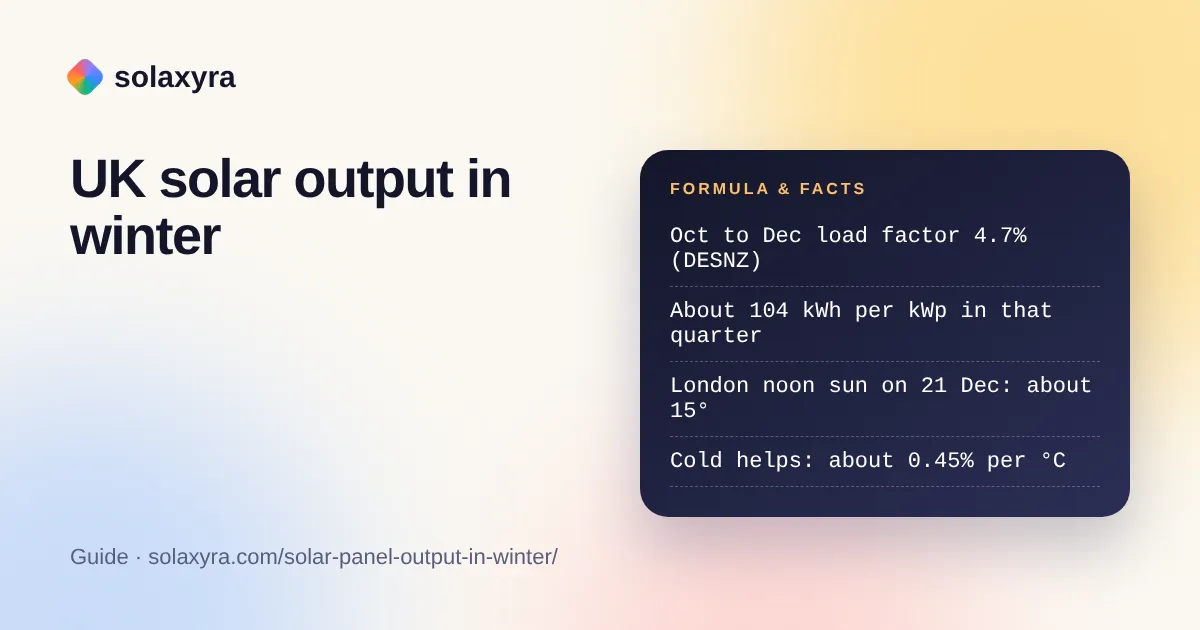
    Quick answer: Solar panel output in winter UK systems achieve is roughly a third of spring output. Government data from over 280,000 installations show a load factor of 4.7% from October to December 2024, against 13.6% from April to June. That equals about 104 kWh per kWp over the quarter, around 1.1 kWh per kWp a day.

    Solar panel output in winter UK: measured load factors, kWh per kWp and noon sun height by city

    How Much Do Solar Panels Produce in Winter in the UK?

    A UK solar system produces about 104 kWh for every kWp of panels between October and December, compared with about 297 kWh per kWp between April and June. Those figures come from the DESNZ Feed-in Tariff load factor analysis for 2024/25, which uses meter readings from 282,047 solar installations. A load factor is the energy a system actually produces divided by what it would produce running at full rated power all the time.

    To turn a load factor into kWh, multiply it by the hours in the period and the system size. The arithmetic is shown so you can check it:

    Period (DESNZ data)Load factorHours in periodkWh per kWp in periodkWh per kWp per day
    April to June 202413.6%2,184about 297about 3.3
    October to December 20244.7%2,208about 104about 1.1
    Whole year 2024/25 (median)9.2%8,760about 806about 2.2

    National generation tells the same story. DESNZ Energy Trends reports that UK solar generated 2.1 TWh from October to December 2025, out of a record 20.0 TWh for the whole of 2025, so the last quarter supplied only about 10.5% of the year’s solar power. The April to June 2025 quarter produced 8.4 TWh, four times as much.

    Keep in mind that the October to December figures include October, which is much brighter than December. December on its own, and January, are the weakest months, so a single dull week in midwinter can produce well under the quarterly average.

    Why Do Solar Panels Produce Less in Winter?

    Winter output falls mainly because the days are shorter and the sun is low, not because of the cold. On 21 December the sun in London rises only about 15° above the horizon at noon, compared with about 62° in June, and the day is roughly 7 hours 35 minutes long rather than 16 hours 25 minutes.

    A low sun hurts in three ways. Its light travels through more atmosphere before it reaches you, so less arrives. It strikes a typical roof at a glancing angle, so each square metre of panel intercepts less of it. And it casts long shadows, so trees, chimneys and neighbouring buildings that never matter in summer can shade panels for much of a winter day. Thick cloud, more common in winter, then reduces what is left to mostly diffuse light.

    Cold, on the other hand, helps. Solar cells become more efficient as they cool: according to published data on solar cell efficiency, each 1 °C rise in cell temperature cuts efficiency by about 0.45%, so the reverse also applies. Example: a panel with cells at 5 °C works about 9% more efficiently than at the 25 °C standard test temperature (20 °C times 0.45%). Our temperature loss calculator shows the effect for your panel’s own coefficient.

    How Does Winter Output Vary Across the UK?

    The further north you live, the lower the winter sun and the shorter the day: on 21 December the noon sun reaches about 16° above the horizon in Plymouth but only about 11° in Edinburgh and 6° in Lerwick. The table applies two standard equations, noon elevation equals 90° minus the difference between latitude and the sun’s declination (minus 23.44° at the December solstice), and the sunrise equation for day length.

    LocationLatitudeNoon sun height, 21 DecemberNoon sun height, 21 JuneDay length, 21 DecemberDay length, 21 June
    Plymouth50.4° N16.2°63.1°7 h 47 min16 h 13 min
    London51.5° N15.0°61.9°7 h 35 min16 h 25 min
    Birmingham52.5° N14.1°61.0°7 h 25 min16 h 35 min
    Manchester53.5° N13.1°60.0°7 h 13 min16 h 47 min
    Belfast54.6° N12.0°58.8°6 h 59 min17 h 1 min
    Edinburgh56.0° N10.6°57.5°6 h 41 min17 h 19 min
    Aberdeen57.2° N9.4°56.3°6 h 23 min17 h 37 min
    Lerwick60.2° N6.4°53.3°5 h 28 min18 h 32 min

    Day lengths are geometric, from the sun’s centre crossing the horizon; actual daylight is a few minutes longer because the atmosphere bends light. The pattern explains why northern systems show a bigger gap between summer and winter, even where yearly totals are similar: Scotland gains long summer days but loses more in midwinter. For a month-by-month estimate at your own location, the solar panel output calculator uses regional yield data.

    Does Panel Angle Matter More in Winter?

    Yes. In December a steep panel catches far more direct sunlight than a shallow one: at London’s 15° noon sun, a south-facing panel tilted at 60° or hung vertically intercepts about 97% of the direct beam, a 35° roof about 77%, and a flat panel only about 26%. In June the order reverses, and a vertical panel catches less than half.

    Panel tilt (facing south)Direct noon sunlight captured, 21 December, LondonDirect noon sunlight captured, 21 June, London
    0° (flat)26%88%
    15°50%97%
    30°71%100%
    35° (typical roof)77%99%
    45°87%96%
    60°97%85%
    90° (vertical railing or wall)97%47%

    The figures are the cosine of the angle between the sun’s rays and the panel’s face at solar noon. They cover direct light only; on overcast days diffuse light from the whole sky dominates and the advantage of a steep panel shrinks. Even so, it explains why vertical balcony kits lose less in winter than in summer. You cannot re-angle most roof systems, but if you are choosing a stand for a plug-in kit, the solar panel angle calculator gives the best fixed and seasonal tilts for your latitude.

    How Much Will a Typical System Make This Winter?

    Example: a 4 kWp south-facing roof system producing at the national October to December load factor of 4.7% would make about 415 kWh over the quarter, or about 4.5 kWh a day, compared with about 1,188 kWh (about 13 kWh a day) from April to June. That is the arithmetic of 4 kWp times 2,208 hours times 0.047.

    In winter, output is small compared with household demand, so most of it is likely to be used at home rather than exported. Valued at the Ofgem price cap rate of 26.32p per kWh for 1 October to 31 December 2026, the example’s 415 kWh is worth about £109 if all of it is used at home.

    Example: an 800 W plug-in kit at the same load factor would make about 83 kWh from October to December, under 1 kWh a day on average, worth about £22 at 26.32p. The national data come mainly from roof systems, so a well-angled kit could do a little better in winter and a shaded one worse. To model your own kit, use the plug-in solar calculator.

    How Can You Get More From Solar Panels in Winter?

    The biggest gains come from using power while the sun is up and removing winter-only shading; cleaning and battery choices matter less.

    • Run the dishwasher, washing machine and other timed loads in the middle of the day, when the low sun is highest.
    • Check for new shade from trees, scaffolding or neighbouring extensions; long winter shadows reach further than you expect.
    • Check your inverter app or generation meter weekly; a fault is easy to miss when output is low anyway.
    • If you have a battery, expect winter solar to fill only part of it; if your system and tariff allow, charging from the grid at an off-peak rate can cover the gap, and the battery size calculator helps you plan.
    • Do not oversize a system for winter alone; extra panels mostly add summer surplus.

    What Should You Do About Snow and Frost on Solar Panels?

    Leave it to melt or slide off on its own, because the lost output in midwinter is small and the risk of clearing it is not. Never climb onto a roof or lean a ladder against panels to clear snow. Working at height on icy roofs is dangerous, so if snow stays for long periods, ask your installer or a competent roofing professional, and use only cleaning methods your panel manufacturer approves. For ground-level or plug-in panels, a soft brush is usually enough, provided you can reach them safely.

    Frequently Asked Questions

    Do solar panels work in winter in the UK?

    Yes. They produce less because days are short and the sun is low, but they still generate. Government data from over 280,000 UK installations show a load factor of 4.7% from October to December 2024, about 104 kWh per kWp over the quarter.

    What percentage of solar output is produced in winter?

    Very little. In 2025, UK solar generated 2.1 TWh from October to December out of 20.0 TWh for the year, about 10.5%, according to DESNZ Energy Trends. December and January are the weakest months, so midwinter output alone is lower still.

    How many kWh does a 4 kWp solar system produce in December?

    At the national October to December load factor of 4.7%, a 4 kWp system averages about 4.5 kWh a day. December is below that quarterly average, so expect less on many days, with occasional bright, cold days producing more.

    Does cold weather reduce solar panel output?

    No. Cold improves efficiency: each 1 °C fall in cell temperature raises efficiency by about 0.45%. Winter output is lower because of short days, low sun and cloud, not the temperature itself.

    Should I clear snow off my solar panels?

    Not from a roof. Midwinter output is small anyway, and climbing on an icy roof is dangerous. If snow stays for a long time, ask your installer or a competent roofing professional, and follow the panel manufacturer’s cleaning advice.

    Do vertical panels work better in winter?

    For direct sunlight, yes. At London’s 15° midwinter noon sun, a vertical south-facing panel catches about 97% of the direct beam, while a 35° roof catches about 77%. In summer the vertical panel catches less than half, so it produces less over a year.

    Checked October 2026 by the Solaxyra Editorial Team. Sources: DESNZ Feed-in Tariff load factor analysis 2024/25, DESNZ Energy Trends March 2026, DESNZ Energy Trends September 2026, Solar zenith angle, Sunrise equation, Axial tilt, Solar cell efficiency, Ofgem price cap October to December 2026.

  • Balcony Solar Rules in Germany: Limits, Registration and Rights

    Balcony Solar Rules in Germany: Limits, Registration and Rights

    This guide sets out the balcony solar Germany rules that apply in 2026 for anyone fitting a Balkonkraftwerk (in law, a Steckersolargerät): the power limits, registration, plug and meter rules, and the rights of tenants and flat owners. It is written in English for residents of Germany, and for UK and Irish readers comparing the German model with the plug-in solar rules that started in Great Britain in August 2026.

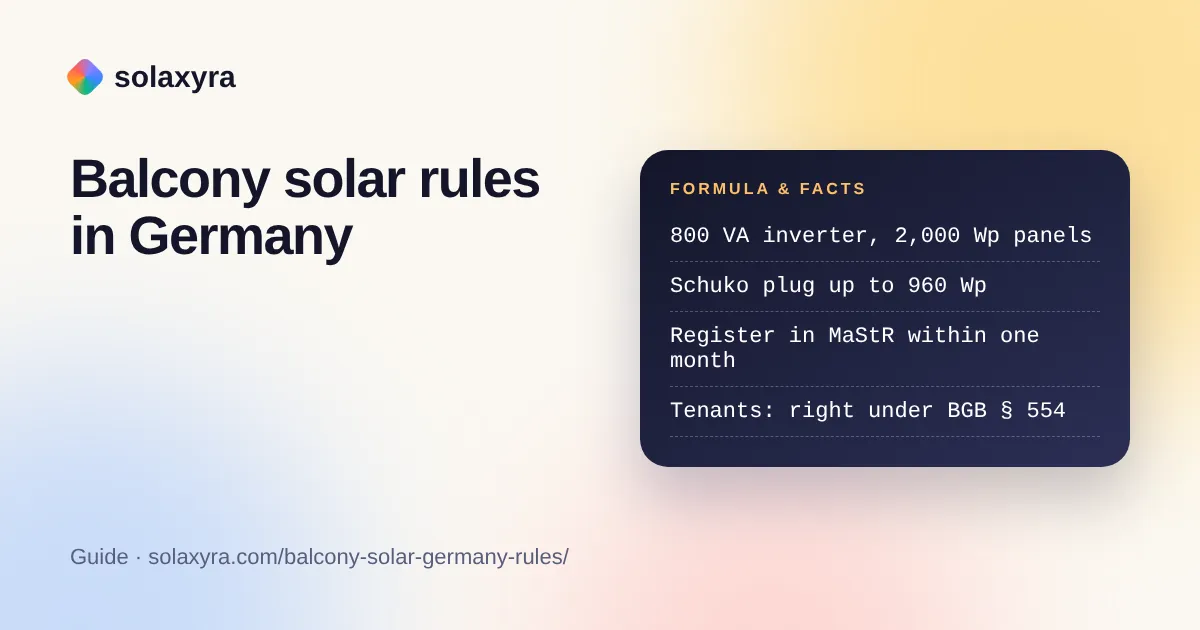
    Quick answer: Under the balcony solar Germany rules, a system may have up to 800 VA of inverter output and 2,000 Wp of panels per grid connection. Register it in the Marktstammdatenregister within one month; the grid operator is informed automatically. Kits up to 960 Wp may use a Schuko plug, and tenants have a legal right to request one.

    Balcony solar Germany rules: 800 VA limit, MaStR registration, Schuko plug up to 960 Wp

    What Are the Power Limits for Balcony Solar in Germany?

    A German balcony solar system may feed in no more than 800 VA through its inverter and carry no more than 2,000 W of panels, and both limits are totals for all plug-in devices behind the same grid connection point. The Bundesnetzagentur balcony solar page states the limits and dates the simplified rules from 16 May 2024, when the Solarpaket amendments to the Renewable Energy Sources Act (EEG) took effect.

    Because the limit is cumulative, two small kits on one flat count together. Two 400 VA inverters are fine; two 800 VA inverters behind one meter are not. A system above these limits is treated as a normal solar installation, with the full connection process that involves the grid operator and an installer.

    The 2,000 W panel allowance exists because panels rarely deliver their rated power on a vertical railing or in winter. Extra panel area keeps the inverter closer to its 800 VA output for more of the day. To see what a given panel size and mounting angle produce, the balcony solar calculator includes Germany as a country option.

    How Do You Register a Balkonkraftwerk?

    You register a balcony solar system in the Marktstammdatenregister (MaStR), the Bundesnetzagentur’s register of energy installations, within one month of putting it into operation. Since 2024 this single entry replaces a separate notice to the local grid operator, which receives the location and technical data automatically from the register.

    The register’s own help guide for balcony systems asks for only a few items about the device: the commissioning date, total module power, inverter power and your meter number, together with your location and a name for the unit. Registration is done online in two stages: create a user account, then register yourself as operator and add the system.

    1. Create a user account on the Marktstammdatenregister website and confirm your email address.
    2. Register yourself as the operator of the installation.
    3. Choose the balcony solar option and enter the commissioning date, module watts, inverter VA and meter number.
    4. Download and keep the registration confirmation.

    Which Plug and Socket Can You Use in Germany?

    Since the DIN VDE V 0126-95 product standard was published in December 2025, a balcony solar device with up to 960 Wp of panels may connect through a normal household Schuko socket, while a system with up to 2,000 Wp needs a special energy socket. That is the position set out by VDE FNN, the grid technology forum of the German electrical standards body.

    Panel power (Wp)Inverter outputConnection allowedWho connects it
    Up to 960 WpUp to 800 VAHousehold Schuko socket, with a device built to DIN VDE V 0126-95 (protected plug or internal disconnection)The user, following the manufacturer’s instructions
    961 to 2,000 WpUp to 800 VASpecial energy socket (often called a Wieland socket) or fixed connectionThe socket and circuit work is for a qualified electrician
    Above 2,000 Wp or above 800 VAAnyNot a balcony solar device; normal PV connection processInstaller and grid operator

    VDE FNN recommends the energy socket as the safe option whenever the conditions for a household socket cannot be met, and says an electrician should check that the existing circuit is adequately rated and protected. Never use a multi-way adaptor or join devices together to get round the limits, and do not alter sockets or wiring yourself.

    Do You Need a New Electricity Meter?

    Yes, a bidirectional meter is required, but you do not have to wait for it: the Bundesnetzagentur says an older meter that runs backwards may be tolerated temporarily until the replacement is made. Under § 10a EEG the meter operator must replace it without undue delay, and you do not need to ask separately because registration in the MaStR triggers the process.

    Electricity you feed into the grid is unpaid by default. The Bundesnetzagentur assigns balcony solar to free feed-in (unentgeltliche Abnahme), so the value of a system comes from the power you use at home while it generates. The self-consumption calculator shows how daytime habits change that share.

    Can Tenants and Flat Owners Install Balcony Solar in Germany?

    Yes, since October 2024 tenants and condominium owners have a legal claim to install a balcony solar device, because plug-in solar was added to the privileged structural changes in § 554 of the Civil Code (BGB) for tenants and § 20 of the Condominium Act (WEG) for owners. The Bundestag voted the change through on 4 July 2024.

    The claim is not unconditional. A landlord may refuse where the measure cannot reasonably be expected of them, and landlords and owners’ associations keep a say over how the system is installed, for example the position and fixing on the facade. Ask in writing, describe the device and its mounting, and keep the reply.

    How Do Germany’s Rules Compare With the UK?

    The two systems share the 800 W output cap and the 2,000 W panel allowance, but the UK adds stricter rules on devices per home, extension leads and mounting surfaces. The UK rules took effect on 27 August 2026 under SI 2026/848 and the government’s interim product specification, which names the German product standard DIN VDE V 0126-95 as its main technical reference.

    RuleGermanyGreat Britain
    In force since16 May 2024 (EEG Solarpaket limits)27 August 2026
    Inverter output800 VA800 VA
    Panel power2,000 Wp (960 Wp on a Schuko socket)2,000 W (professional assessment advised above 960 W)
    Number of devicesSeveral allowed if the totals stay within the limits per connection pointOne device per household
    PlugSchuko or special energy socketMoulded BS 1363 plug with a fuse of 5 A or less
    RegistrationMarktstammdatenregister within one monthOnline registration; householder notifies the network operator
    TenantsLegal claim under BGB § 554Landlord permission needed
    Feed-in paymentNone by default (free feed-in)Normally none (MCS needed for the Smart Export Guarantee)
    BatteryOutside the simple balcony rulesNot allowed with a plug-in device

    The UK government’s announcement noted that around half a million new devices were plugged in in Germany last year, and described the UK safety specification as more stringent than Germany’s. For the full British position, see our guide to the plug-in solar rules in the UK, and for output and payback figures with UK or German yields, use the plug-in solar calculator.

    What About Batteries?

    A balcony solar device with built-in battery storage falls outside the simple rules described here: DIN VDE V 0126-95 covers devices without storage, and the consumer advice centres (Verbraucherzentrale) say kits with integrated storage still need installation by a qualified electrician and notification to the grid operator. Treat any home battery as fixed electrical equipment and have it fitted and checked by a qualified electrician.

    Frequently Asked Questions

    Is 800 W the maximum for balcony solar in Germany?

    Yes. The inverter may feed in no more than 800 VA, and all plug-in devices behind one grid connection point count together. The panels may total up to 2,000 Wp, so a kit can produce close to 800 VA for more hours of the day.

    Do I have to tell the grid operator about my Balkonkraftwerk?

    Not separately. Since 2024 registering the system in the Marktstammdatenregister within one month of commissioning is enough, and the Bundesnetzagentur says the grid operator receives the location and technical data automatically.

    Can I plug a balcony solar system into a normal socket in Germany?

    Yes, for devices with up to 960 Wp of panels built to the DIN VDE V 0126-95 product standard from December 2025. Systems with up to 2,000 Wp need a special energy socket, and that socket and circuit work should be done by a qualified electrician.

    Can my landlord stop me installing balcony solar in Germany?

    Only in limited cases. Since October 2024 § 554 BGB gives tenants a claim to approval for plug-in solar, but a landlord may refuse where it cannot reasonably be expected of them and can set conditions on how the system is installed.

    Will an old electricity meter be a problem?

    No. The Bundesnetzagentur says an older meter that runs backwards may be tolerated temporarily. After you register, the meter operator must fit a bidirectional meter without undue delay, and you do not need to request it separately.

    Checked October 2026 by the Solaxyra Editorial Team. Sources: Bundesnetzagentur: Balkon-Solaranlagen, Marktstammdatenregister registration guide for balcony systems, VDE FNN: plug-in PV systems, VDE FNN: what is now possible, Deutscher Bundestag, 4 July 2024, Verbraucherzentrale: laws and standards for plug-in solar, GOV.UK plug-in solar announcement, DESNZ interim product specification.

  • Plug-In Solar for Renters: Permission, Rules and Moving

    Plug-In Solar for Renters: Permission, Rules and Moving

    This guide explains how tenants in England, Scotland and Wales can use plug-in solar legally: whose permission you need, where you can and cannot fit a kit, how to ask your landlord, and what happens when you move. Plug in solar for renters became a realistic option on 27 August 2026, when 800 W kits that plug into a normal socket became legal in Great Britain.

    Quick answer: Plug in solar for renters is allowed in Great Britain, but you must get permission from your landlord, freeholder or managing agent first. The kit must be up to 800 W, plug straight into a fixed socket, be registered and avoid banned spots such as timber balconies. You can take it with you when you move.

    Plug in solar for renters: landlord permission, allowed homes and moving out checklist

    Can Renters Use Plug-In Solar in the UK?

    Yes, renters in Great Britain can use one plug-in solar device of up to 800 W, provided they have permission from whoever is responsible for the building. In its July 2026 consultation response, the government said renters, leaseholders and residents in managed buildings should obtain any permissions that may be required before installing a device, and its interim product specification makes the user responsible for getting consent from the property owner, landlord, freeholder, managing agent or relevant authority.

    The same response recognised why the change matters to tenants: people in rented homes, flats and properties without suitable roof space usually cannot fit rooftop solar because they do not control the roof. It also recorded concerns from respondents that landlord opposition and uncertainty about insurance could hold renters back.

    Plug-in solar is not currently legal in Northern Ireland, so tenants there cannot use it yet.

    Do You Need Your Landlord’s Permission?

    Yes, you should get written permission before you buy, because the government guidance, the product specification and the Energy Saving Trust all say to get consent from whoever is responsible for the building. A kit fixed to a wall, railing, fence or flat roof is attached to property you do not own, and your tenancy agreement may also restrict alterations, so a written yes protects you if there is a dispute later or when your deposit is returned.

    Planning can also apply. The Energy Saving Trust checklist tells you to check the Planning Portal in England and Wales or ePlanning Scotland, and to ask the local authority if the building is listed or in a conservation area. Your landlord may already know the answer.

    How Do You Ask Your Landlord for Permission?

    A short written request that answers the landlord’s likely worries in advance gets the quickest yes. Include these points:

    1. The exact make and model, and confirmation that it is listed on the ENA type test register required for plug-in devices.
    2. Where it will go and how it is fixed, using the manufacturer’s frame. Mention that the rules require any fixing to be reversible and non-permanent, and that ropes, cable ties, tape and straps are not allowed as the only fixing.
    3. Which socket it will use: a fixed socket, with no extension lead or adaptor, on a circuit with RCD or RCBO protection.
    4. That you will register the device as required and that only one device will be used.
    5. Who pays for any electrical check and that you will remove the kit and make good any fixing holes when you leave.
    6. That you will tell your contents insurer, and ask the landlord to check whether the buildings insurer needs to know.

    Keep the reply with your tenancy papers. If the landlord refuses or attaches conditions, ask what would change their mind; a freestanding ground frame in a garden involves no fixings to the building at all.

    Which Rented Homes Suit Plug-In Solar?

    Houses with a garden or yard suit plug-in solar best, while some flats are ruled out by the mounting rules regardless of what the landlord says. The table summarises the main situations, based on the government product specification and Energy Saving Trust guidance.

    Rented homeUsually possible?What to check
    House with a garden or yardYes, with permissionA freestanding frame and a suitable socket; an outdoor socket must be fitted by a qualified electrician and be at least IP65
    Flat with a masonry or metal balconyPossiblyLandlord and freeholder consent, the building’s fire safety rules and a manufacturer mount suited to your railing
    Flat with a timber balconyNoThe specification bans installation on timber balconies
    Building with ACM, MCM, HPL or timber claddingNoThe specification bans installation on these cladding systems
    Building under external wall or building safety remediationNoExcluded by the specification until restrictions are lifted
    Shared house where another tenant already has a kitNoOnly one plug-in device is allowed per household
    Home with an old fuse board and no RCD or RCBOOnly after an electrical checkA registered electrician must check and, where needed, upgrade the installation to BS 7671; this needs the landlord’s agreement

    Fire safety in flats was raised by many consultation respondents, who said balconies and walls of multi-occupancy and high-rise buildings carry greater risk. Expect landlords and managing agents of blocks to be cautious, and do not install on a balcony without clear written consent from the building owner.

    What Electrical Rules Apply in a Rented Home?

    The kit must plug directly into a fixed BS 1363 socket on a circuit protected by an RCD or RCBO, and never into an extension lead or multi-way adaptor. The Energy Saving Trust adds that the socket should not also control lighting or a hardwired appliance such as a boiler or cooker.

    In a rented home the electrical installation belongs to the landlord, so any work on it, including a new outdoor socket or an upgrade from an old fuse board, needs their agreement and must be done by a registered electrician to BS 7671. Do not change sockets, fuses or wiring yourself. The specification also requires a label to be fixed at or near the consumer unit showing that a plug-in solar device is present, which helps anyone working on the electrics later.

    You cannot add a battery. The legal definition of a plug-in microgenerator excludes devices that store energy, and every kit must warn that it is not for use with a battery storage system. Portable power stations charged from their own panels are a separate product and are not connected to your home wiring.

    Is Plug-In Solar Worth It If You Might Move?

    Yes, often, because the kit moves with you: the Energy Saving Trust notes that plug-in panels are portable and can be taken when you move home. The money you save while you live in one place is a bonus on top of a kit you still own.

    The table shows savings over the time left in a tenancy, using the Energy Saving Trust estimate of about 700 kWh a year and the Ofgem price cap rate of 26.32p per kWh for 1 October to 31 December 2026. The share used at home is an example; change it to match your daytime habits.

    Share of output used at home (example)Yearly savingSaving over 1 yearSaving over 3 yearsSaving over 5 years
    40% (out during the day)£74£74£221£368
    50%£92£92£276£461
    60% (home most of the day)£111£111£332£553

    These figures assume the same rate each year; the cap changes every quarter, and the 26.32p rate excludes VAT only until 31 March 2027. Your output will also change at a new address with a different direction or more shade. To test a specific spot before you buy, use the plug-in solar calculator, and if your only space is a balcony the balcony solar output calculator compares railing and angled mounts.

    What Should Renters Do When They Move Out?

    Unplug the kit, remove it and its fixings, and tell the network operator it has been disconnected, since the rules require notification of both connection and disconnection.

    1. Switch off and unplug the device from the socket before dismantling the panels.
    2. Remove the mounting frame and make good any marks, as agreed in your permission letter.
    3. Update the plug-in solar registration to record the disconnection.
    4. Leave the consumer unit label in place only if the landlord asks; otherwise remove it so the next occupant is not misled.
    5. At your new home, get fresh permission, check the socket and circuit, and register the device at the new address.

    Frequently Asked Questions

    Can my landlord refuse plug-in solar?

    Yes. The government says renters should obtain any permissions that may be required before installing, and landlords, freeholders and managing agents can refuse or set conditions. A freestanding ground frame with no fixings, and an offer to pay for any electrical check, can make agreement easier.

    Can I use plug-in solar in a rented flat?

    Sometimes. You need consent from the landlord and often the freeholder or managing agent, and the kit must not go on a timber balcony, on ACM, MCM, HPL or timber cladding, or on a building under safety remediation. A masonry or metal balcony with a suitable mount may be possible.

    Can I take plug-in solar panels with me when I move?

    Yes. The Energy Saving Trust says plug-in panels are portable and can be taken when you move. Record the disconnection on the registration, remove all fixings, then get permission and register the device again at your new home before plugging it in.

    Who pays for electrical work needed for plug-in solar in a rented home?

    That is for you and your landlord to agree in writing. Any work such as a new outdoor socket or replacing an old fuse board must be done by a registered electrician to BS 7671, and the landlord must agree because the installation belongs to them.

    Can renters add a battery to plug-in solar?

    No. UK law defines a plug-in microgenerator as a device that does not store energy, and the government specification says it must not be connected to or used with a battery storage system. This applies to tenants and owners alike.

    Checked October 2026 by the Solaxyra Editorial Team. Sources: DESNZ plug-in solar government response, July 2026, DESNZ Plug-in Solar Device Interim Product Specification, SI 2026/848, Energy Saving Trust: plug-in solar panels, Energy Saving Trust: plug-in solar checklist, Ofgem price cap October to December 2026.

  • Are Plug-In Solar Panels Worth It? UK Savings and Payback

    Are Plug-In Solar Panels Worth It? UK Savings and Payback

    This guide shows UK households how to judge whether a plug-in solar kit pays for itself, using official output and price figures and a payback table you can read off for your own situation. If you are asking are plug in solar panels worth it, the honest answer depends on one number more than any other: how much of the electricity you use at the moment the panels produce it.

    Quick answer: Are plug in solar panels worth it? Often yes, if you use much of the power as it is generated. The Energy Saving Trust estimates about 700 kWh a year from a typical kit. At 26.32p per kWh, using half of that saves about £92 a year, so a £450 kit pays back in roughly five years.

    Are plug in solar panels worth it: UK payback by kit price and share of power used at home

    How Much Does a Plug-In Solar Kit Save a Year?

    A typical plug-in kit saves about £70 to £110 a year in the UK, depending mainly on whether someone is at home using power during daylight. The Energy Saving Trust puts typical output at around 700 kWh a year and estimates savings of £100 a year for a household at home all day and £70 for one out during the day, while the government announcement quotes savings of up to £110 a year.

    Those Energy Saving Trust figures were worked out at 24.7p per kWh. From 1 October to 31 December 2026 the Ofgem price cap unit rate for electricity paid by direct debit is 26.32p per kWh, so the same kWh are now worth a little more. Working backwards from the published figures also reveals the hidden assumption about self-consumption:

    Energy Saving Trust casePublished saving at 24.7pkWh used at home (saving divided by 24.7p)Share of 700 kWh used at homeSame kWh valued at 26.32p
    At home during the day£100about 405 kWhabout 58%about £107
    Out during the day£70about 283 kWhabout 40%about £75

    In other words, even a household that is home all day is assumed to use a little under three fifths of what the panels make. The rest flows out to the grid.

    Why Does Self-Consumption Decide Whether It Is Worth It?

    Self-consumption decides the answer because each kWh you use yourself saves the full unit rate, while a kWh you export earns nothing in most cases. The Energy Saving Trust says an MCS certificate is needed to sell electricity under the Smart Export Guarantee, and plug-in kits do not normally have one, so surplus power is given to the grid for free.

    A kit can deliver up to 800 W at midday on a clear day. Your home only absorbs that if something is drawing power at the same moment. The always-on load of a home, often called the baseload, comes from fridges, freezers, routers and devices on standby. Example: if your baseload is 150 W (an example value, check yours on a smart meter display), a kit producing 600 W at noon covers that 150 W and sends the other 450 W to the grid unless you run a washing machine, dishwasher or other appliance at the same time.

    Ways to raise your share without breaking the rules:

    • run timed appliances such as the dishwasher and washing machine in the middle of the day;
    • charge laptops, tools and e-bikes in daylight;
    • face the panels east or west if you use more power in the morning or evening, accepting a lower total;
    • avoid shading, since a shaded kit produces less of the power you could have used.

    You cannot add a battery to store the surplus: the UK rules say a plug-in device must not be used with a battery storage system.

    How Long Does Plug-In Solar Take to Pay Back?

    Payback can fall anywhere between about 3 and 18 years, and the table shows why the range is so wide. It uses 700 kWh a year from the Energy Saving Trust, the October 2026 cap rate of 26.32p per kWh and three example kit prices; the Energy Saving Trust says complete kits start from around £450. Payback here is simply kit price divided by yearly saving, with no export income.

    Share used at homekWh used a yearYearly savingPayback, £450 kit (example)Payback, £700 kit (example)Payback, £1,000 kit (example)
    30%210£558.1 years12.7 years18.1 years
    40%280£746.1 years9.5 years13.6 years
    50%350£924.9 years7.6 years10.9 years
    60%420£1114.1 years6.3 years9.0 years
    70%490£1293.5 years5.4 years7.8 years
    80%560£1473.1 years4.7 years6.8 years

    Two cautions apply. First, the 26.32p rate excludes VAT, which Ofgem confirms has been removed from electricity bills only from 1 October 2026 to 31 March 2027, and the cap is reset each quarter, so re-run the sum when your rate changes. Second, 700 kWh is an average: a vertical railing mount, a north-east aspect or heavy shading produces less, while oversized panels behind the 800 W inverter can produce more. For your own location, angle and tariff, the plug-in solar calculator works out kWh, savings and payback in one step, and the solar payback calculator adds price rises over time.

    How Many kWh Must You Use for a Kit to Pay Off?

    A £450 kit pays back in 5 years if you use about 342 kWh a year of its output yourself, roughly half of a typical 700 kWh. The rule is: kWh needed each year equals kit price divided by the payback years you want, divided by your unit rate in pounds. The table applies it at 26.32p.

    Kit price (example)kWh you must use a year for 5-year paybackShare of 700 kWhkWh you must use a year for 10-year paybackShare of 700 kWh
    £45034249%17124%
    £70053276%26638%
    £1,000760more than 100%38054%

    A £1,000 kit cannot reach a five-year payback on 700 kWh at today’s rate, whatever your habits. That is the clearest sign of when a kit is not worth it: if the price is high and your daytime use is low, the numbers rarely work. To estimate your daytime share before buying, the self-consumption calculator helps you test different habits.

    Is Plug-In Solar Better Value Than Rooftop Solar?

    Plug-in solar costs far less but saves far less: the Energy Saving Trust gives around £450 for a kit against an average of around £7,600 for a rooftop system, and the government says rooftop solar can save up to £480 a year compared with up to £110 for plug-in. Rooftop systems are also fitted by certified installers, can usually earn Smart Export Guarantee payments and can be paired with a home battery.

    FactorPlug-in solar kitRooftop solar PV
    Typical cost (Energy Saving Trust)From around £450Around £7,600 on average
    Yearly saving (government figures)Up to £110Up to £480
    Export paymentsNormally none (no MCS certificate)Usually possible under the Smart Export Guarantee
    BatteryNot allowedAllowed
    InstallationSelf-install into a fixed socketCertified installer, electrical work to BS 7671
    Moving homeCan be taken with youStays with the property

    For a renter, a flat owner without roof access or someone who may move, plug-in solar is often the only realistic way to generate power. For an owner-occupier with a suitable roof who plans to stay, a rooftop system usually saves more in total.

    Who Should Not Buy Plug-In Solar?

    Plug-in solar is a poor fit if your only space faces north or is heavily shaded, if nobody uses power in daylight, or if the rules rule you out. Before buying, check these points:

    • You live in Northern Ireland, where the Energy Saving Trust says plug-in solar is not currently legal.
    • You already have a plug-in device; only one is allowed per household.
    • You want to store power in a battery, which the rules forbid for plug-in kits.
    • Your only mounting option is a timber balcony or certain cladding types, which the government specification excludes.
    • Your landlord, freeholder or managing agent will not give permission.
    • Your home has an old fuse board without RCD or RCBO protection and you are not willing to pay a registered electrician to check or upgrade it to BS 7671.

    How Do You Decide If a Kit Is Worth It for Your Home?

    Four checks, done in order, give a reliable answer in a few minutes.

    1. Confirm you are allowed: Great Britain, one device, permission from the building owner, a fixed socket on a protected circuit.
    2. Estimate output for your spot. Start from about 700 kWh and lower it for vertical, east, west or shaded positions, or use the calculator.
    3. Estimate your daytime share. Look at your smart meter’s daytime readings or use 40% if you are out at work and about 58% if someone is home, the shares implied by the Energy Saving Trust figures.
    4. Divide the kit price by kWh used times your unit rate. If the answer is longer than you are willing to wait, keep looking for a cheaper kit or a better spot.

    Frequently Asked Questions

    How much do plug-in solar panels save in the UK?

    The Energy Saving Trust estimates about £100 a year for a household at home during the day and £70 for one out at work, at 24.7p per kWh. At the October 2026 cap rate of 26.32p, the same use is worth about £107 and £75.

    How long do plug-in solar panels take to pay for themselves?

    Divide the kit price by your yearly saving. A £450 kit that saves £92 a year pays back in about 4.9 years. If you use only 30% of the output, payback stretches past 8 years, and a £1,000 kit can take over 18 years.

    Can I sell the electricity my plug-in solar panels export?

    Usually not. The Energy Saving Trust says you need an MCS certificate to be paid under the Smart Export Guarantee, and plug-in kits do not normally have one. Treat exported power as unpaid when you work out whether a kit is worth buying.

    Would a battery make plug-in solar more worth it?

    A battery would let you store surplus daytime power, but the UK rules do not allow it. The government specification says a plug-in solar device must not be connected to or used with a battery storage system, so savings depend on using power as it is made.

    Are plug-in solar panels worth it for renters?

    Often, because renters rarely have another way to generate power and the kit can move with them. You need written permission from your landlord or freeholder first, and the payback maths is the same: the more daytime electricity you use, the faster it pays back.

    Checked October 2026 by the Solaxyra Editorial Team. Sources: Energy Saving Trust: plug-in solar panels, GOV.UK: plug-in solar panels come to market, Ofgem price cap October to December 2026, DESNZ Plug-in Solar Device Interim Product Specification.

  • Plug-In Solar Rules in the UK: What the Law Allows

    Plug-In Solar Rules in the UK: What the Law Allows

    This guide explains the plug in solar rules UK households must follow in England, Scotland and Wales: what the law allows, which document sets each limit, what you must check before buying, and where the rules stop. It is written for homeowners, tenants and flat owners who want to plug a small solar kit into a socket legally and safely.

    Quick answer: The plug in solar rules UK households follow took effect on 27 August 2026. In Great Britain you may use one plug-in solar device of up to 800 W AC, with no more than 2,000 W of panels, plugged into a fixed BS 1363 socket. It must be ENA-registered, registered online, and never used with a battery.

    Plug in solar rules UK summary: 800 W AC limit, 2,000 W panel limit, one device per household

    When Did Plug-In Solar Become Legal in the UK?

    Plug-in solar became legal in Great Britain on 27 August 2026, when SI 2026/848 came into force after being made on 16 July 2026. Its full title is the Plugs and Sockets etc. (Safety) Regulations 1994 and Electricity Safety, Quality and Continuity Regulations 2002 (Amendment) Regulations 2026, and you can read it on legislation.gov.uk.

    The instrument does two things. First, it lets approved bodies certify a plug for a solar microgenerator that otherwise follows BS 1363, which the 1994 plug rules previously blocked. Second, it amends the 2002 supply regulations so that a plug-in microgenerator is acceptable when it complies with the government’s Plug-in Solar Device Interim Product Specification. The law defines a plug-in microgenerator as a device that turns sunlight into electricity, has a rated AC output of no more than 800 watts, connects through a standard plug and socket, runs in parallel with the network and does not store energy.

    Ofgem separately approved a change to Engineering Recommendation G98, the network connection standard for small generators, so that plug-in devices are treated as a distinct category limited to 800 W and one per household.

    What Are the Main Plug-In Solar Rules?

    There are seven core rules: an 800 W AC cap, a 2,000 W panel cap, a fixed BS 1363 socket, no adaptors or extension leads, one device per household, no battery, and registration so the network operator is told. The table shows each rule and the official document it comes from, so you can check it yourself.

    RuleLimit or requirementWhere it is set
    AC outputNo more than 800 VA (800 W) and 3.5 A into the homeSI 2026/848 definition; Interim Product Specification clause 4.1
    Panel sizeTotal panel rating (Pmax) no more than 2,000 WInterim Product Specification clause 4.1
    Above 960 W of panelsProfessional assessment should be consideredInterim Product Specification clause 4.1
    Plug and socketMoulded, non-rewireable BS 1363 plug with a BS 1362 fuse of 5 A or less, into a fixed socketInterim Product Specification clause 6.2.3.2
    AdaptorsNo extension cables, multi-way adaptors, RCD adaptors or travel adaptorsInterim Product Specification clauses 6.2.3.1 and 8.3.2
    Number of devicesOne plug-in solar device per householdG98 amendment approved by Ofgem; Interim Product Specification scope
    Type testingTested to G98 and listed on the ENA type test registerInterim Product Specification section 7
    BatteryMust not be connected to or used with a battery storage systemSI 2026/848 definition; Interim Product Specification clause 8.3.2
    NotificationThe householder tells the network operator about connection and disconnectionOfgem decision on DCRP/MP/26/02; Interim Product Specification clause 8.2.3.1
    PermissionsLandlord, freeholder, managing agent or planning consent where neededInterim Product Specification clause 8.3.1

    The 800 W limit applies to what the inverter delivers, not to the panels. That is why a kit can carry up to 2,000 W of panels: the extra panel area lifts output in mornings, evenings and winter, while the inverter clips anything above 800 W on bright days. To see how much an oversized kit actually adds where you live, run your numbers through the plug-in solar savings calculator.

    What Socket and Wiring Does Plug-In Solar Need?

    A plug-in solar device must go straight into a fixed BS 1363 socket on a circuit in good condition with modern residual current protection, and never into an extension lead or adaptor. The Energy Saving Trust plug-in solar checklist adds that the socket should not be one that also controls lighting or a hardwired appliance such as a boiler or cooker.

    A quick current check shows why the limits fit together. At 800 VA and a nominal 230 V, the device sends about 3.48 A into the circuit (800 divided by 230). That sits just inside the 3.5 A cap in the specification and well below the 5 A fuse required in the plug. You can repeat the sum for any inverter rating with our watts to amps converter.

    The specification tells users to check that the installation has modern RCBO protection. If your home still has an older fuse board without RCDs or RCBOs, the installation must be checked and, where necessary, upgraded by a professional electrician. Any change to the final circuit, or a new outdoor socket, is work for a registered electrician to BS 7671. The Energy Saving Trust says an outdoor socket should be rated at least IP65 and installed by a qualified electrician.

    The device must also stop feeding power when the grid goes down. The specification requires disconnection within 100 milliseconds of losing the mains, and the voltage on the plug pins must drop below 34 V in that time, so the pins are not live when you unplug the kit.

    Where Can You Mount Plug-In Solar Panels?

    You can mount a kit in a garden, on a flat roof, wall or suitable balcony, but the specification bans fixings that rely only on cable ties, rope, string, adhesive tape, bungee cords or straps. Every attachment must be reversible and non-permanent and must not harm the structure, fire performance or weatherproofing of the building.

    The specification lists surfaces where a plug-in kit must not be installed:

    • aluminium composite or metal composite cladding systems;
    • high pressure laminate cladding systems;
    • timber cladding systems;
    • timber balconies;
    • buildings subject to external wall remediation, building safety remediation or similar restrictions.

    Manufacturers must publish the full mounting system and a structural analysis covering wind and snow loads. If you plan to fix panels to a garage or outbuilding roof, the Energy Saving Trust advises checking that it can take the weight; for anything beyond a ground or wall frame, a structural engineer’s view is sensible. Facing direction also matters: east or west panels work but produce less, and the solar panel orientation calculator shows the loss for your angle.

    How Do You Install Plug-In Solar Legally?

    Installing legally comes down to five checks, done in this order, before and just after you plug in.

    1. Get permission. Ask your landlord, freeholder or managing agent in writing, and check planning on the Planning Portal (England and Wales) or ePlanning Scotland, especially for listed buildings and conservation areas.
    2. Check the product. Confirm the exact model appears on the ENA type test register and that it is sold as a complete kit with a moulded plug.
    3. Check the circuit. Find a suitable fixed socket, confirm RCD or RCBO protection at the consumer unit, and call a registered electrician if you have an old fuse board or need an outdoor socket.
    4. Mount it securely with the manufacturer’s frame, then plug directly into the socket and fix the supplied label at or near your consumer unit.
    5. Register the device. The Energy Saving Trust directs householders to the UK plug-in solar registration website, which asks for your name, postcode and the make and model. Ofgem’s decision places the duty to notify the network operator on the customer.

    The Energy Saving Trust also recommends telling your buildings and contents insurer and testing the circuit breaker protection every six months.

    Does Plug-In Solar Apply in Northern Ireland?

    No, plug-in solar is not currently legal in Northern Ireland, according to the Energy Saving Trust. SI 2026/848 changes the 2002 supply regulations only for England, Wales and Scotland, and Northern Ireland uses a separate connection standard, G98/NI. The interim specification says its application to Northern Ireland is still under consideration.

    Can You Add a Battery or Get Paid for Exports?

    No battery is allowed: the legal definition excludes devices that store energy, and every kit must carry a warning that it is not for use with a battery storage system. Ofgem’s decision notes that plug-in storage remains prohibited pending a future review.

    Payment for exported electricity is unlikely. The Energy Saving Trust says an MCS certificate is needed to sell power under the Smart Export Guarantee, which plug-in kits do not normally have. Surplus power simply flows to the grid unpaid, so the value of a kit comes from the electricity you use while it generates. The Energy Saving Trust estimates around 700 kWh a year from a typical kit and savings of about £70 to £100 a year depending on whether you are home in the day. At the current price cap rate of 26.32p per kWh set by Ofgem, every 100 kWh you use from the panels is worth about £26.

    Frequently Asked Questions

    What is the maximum size of plug-in solar allowed in the UK?

    The inverter may deliver no more than 800 W (800 VA) into your home, and the panels connected to it may total no more than 2,000 W. If your panels exceed 960 W, the government specification says you should consider a professional assessment before installing.

    Can I use an extension lead with plug-in solar panels?

    No. The interim product specification forbids extension cables, multi-way adaptors, plug-in RCD adaptors and travel adaptors. The kit’s moulded plug must go directly into a fixed BS 1363 socket on a circuit that is in good condition and protected by an RCD or RCBO.

    Do I need to register plug-in solar panels?

    Yes. The network operator must be told when a plug-in device is connected or removed, and the householder is responsible. The Energy Saving Trust points people to the UK plug-in solar registration website, which asks for your name, postcode and the make and model of the device.

    Can I have two plug-in solar kits?

    No. Ofgem approved a change to Engineering Recommendation G98 limiting plug-in microgenerators to one per household, and the specification requires kits to be labelled with this rule. Linking several devices together to get around the 800 W limit is not allowed.

    Is plug-in solar legal in Northern Ireland?

    Not yet. The 2026 amendment to the supply regulations covers England, Wales and Scotland only, and Northern Ireland uses its own connection standard, G98/NI. The Energy Saving Trust says regulations there need updating before plug-in solar can be used.

    Do I need an electrician for plug-in solar?

    Not to plug in a compliant kit, but you do if your home has an old fuse board without RCD or RCBO protection, if the circuit needs changing, or if you need a new outdoor socket. That work must be done by a registered electrician to BS 7671.

    Checked October 2026 by the Solaxyra Editorial Team. Sources: SI 2026/848 on legislation.gov.uk, DESNZ Plug-in Solar Device Interim Product Specification, Ofgem decision on DCRP/MP/26/02, Energy Saving Trust: plug-in solar panels, Energy Saving Trust: plug-in solar checklist, GOV.UK announcement, Ofgem price cap October to December 2026.