This guide shows UK households how to judge whether a plug-in solar kit pays for itself, using official output and price figures and a payback table you can read off for your own situation. If you are asking are plug in solar panels worth it, the honest answer depends on one number more than any other: how much of the electricity you use at the moment the panels produce it.
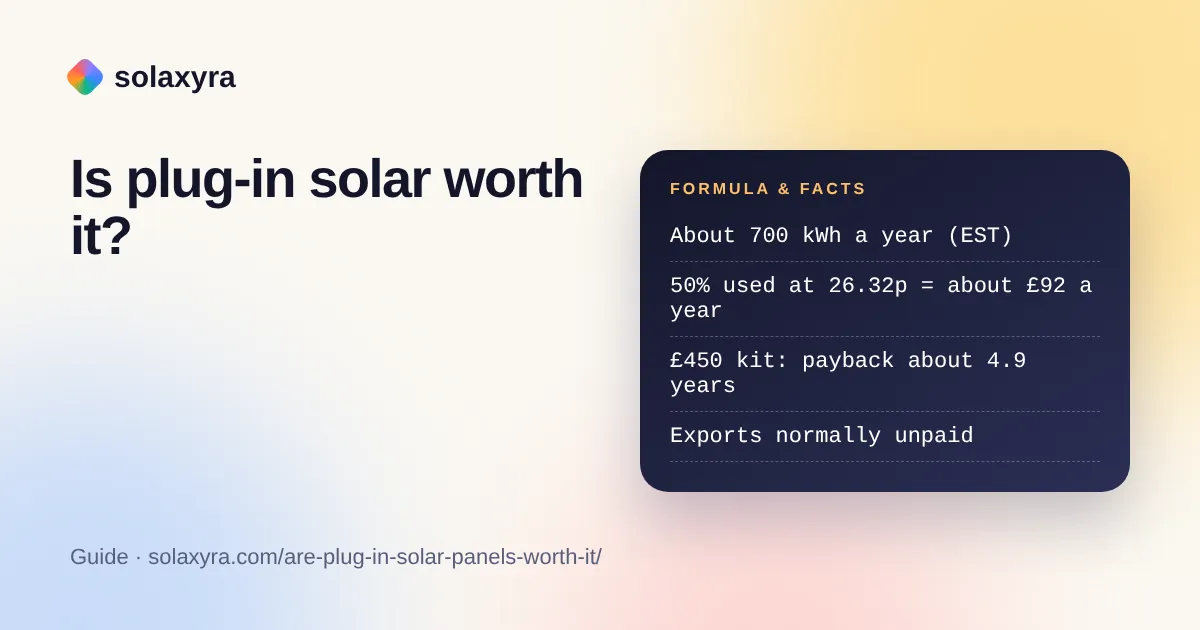
Quick answer: Are plug in solar panels worth it? Often yes, if you use much of the power as it is generated. The Energy Saving Trust estimates about 700 kWh a year from a typical kit. At 26.32p per kWh, using half of that saves about £92 a year, so a £450 kit pays back in roughly five years.
How Much Does a Plug-In Solar Kit Save a Year?
A typical plug-in kit saves about £70 to £110 a year in the UK, depending mainly on whether someone is at home using power during daylight. The Energy Saving Trust puts typical output at around 700 kWh a year and estimates savings of £100 a year for a household at home all day and £70 for one out during the day, while the government announcement quotes savings of up to £110 a year.
Those Energy Saving Trust figures were worked out at 24.7p per kWh. From 1 October to 31 December 2026 the Ofgem price cap unit rate for electricity paid by direct debit is 26.32p per kWh, so the same kWh are now worth a little more. Working backwards from the published figures also reveals the hidden assumption about self-consumption:
| Energy Saving Trust case | Published saving at 24.7p | kWh used at home (saving divided by 24.7p) | Share of 700 kWh used at home | Same kWh valued at 26.32p |
|---|---|---|---|---|
| At home during the day | £100 | about 405 kWh | about 58% | about £107 |
| Out during the day | £70 | about 283 kWh | about 40% | about £75 |
In other words, even a household that is home all day is assumed to use a little under three fifths of what the panels make. The rest flows out to the grid.
Why Does Self-Consumption Decide Whether It Is Worth It?
Self-consumption decides the answer because each kWh you use yourself saves the full unit rate, while a kWh you export earns nothing in most cases. The Energy Saving Trust says an MCS certificate is needed to sell electricity under the Smart Export Guarantee, and plug-in kits do not normally have one, so surplus power is given to the grid for free.
A kit can deliver up to 800 W at midday on a clear day. Your home only absorbs that if something is drawing power at the same moment. The always-on load of a home, often called the baseload, comes from fridges, freezers, routers and devices on standby. Example: if your baseload is 150 W (an example value, check yours on a smart meter display), a kit producing 600 W at noon covers that 150 W and sends the other 450 W to the grid unless you run a washing machine, dishwasher or other appliance at the same time.
Ways to raise your share without breaking the rules:
- run timed appliances such as the dishwasher and washing machine in the middle of the day;
- charge laptops, tools and e-bikes in daylight;
- face the panels east or west if you use more power in the morning or evening, accepting a lower total;
- avoid shading, since a shaded kit produces less of the power you could have used.
You cannot add a battery to store the surplus: the UK rules say a plug-in device must not be used with a battery storage system.
How Long Does Plug-In Solar Take to Pay Back?
Payback can fall anywhere between about 3 and 18 years, and the table shows why the range is so wide. It uses 700 kWh a year from the Energy Saving Trust, the October 2026 cap rate of 26.32p per kWh and three example kit prices; the Energy Saving Trust says complete kits start from around £450. Payback here is simply kit price divided by yearly saving, with no export income.
| Share used at home | kWh used a year | Yearly saving | Payback, £450 kit (example) | Payback, £700 kit (example) | Payback, £1,000 kit (example) |
|---|---|---|---|---|---|
| 30% | 210 | £55 | 8.1 years | 12.7 years | 18.1 years |
| 40% | 280 | £74 | 6.1 years | 9.5 years | 13.6 years |
| 50% | 350 | £92 | 4.9 years | 7.6 years | 10.9 years |
| 60% | 420 | £111 | 4.1 years | 6.3 years | 9.0 years |
| 70% | 490 | £129 | 3.5 years | 5.4 years | 7.8 years |
| 80% | 560 | £147 | 3.1 years | 4.7 years | 6.8 years |
Two cautions apply. First, the 26.32p rate excludes VAT, which Ofgem confirms has been removed from electricity bills only from 1 October 2026 to 31 March 2027, and the cap is reset each quarter, so re-run the sum when your rate changes. Second, 700 kWh is an average: a vertical railing mount, a north-east aspect or heavy shading produces less, while oversized panels behind the 800 W inverter can produce more. For your own location, angle and tariff, the plug-in solar calculator works out kWh, savings and payback in one step, and the solar payback calculator adds price rises over time.
How Many kWh Must You Use for a Kit to Pay Off?
A £450 kit pays back in 5 years if you use about 342 kWh a year of its output yourself, roughly half of a typical 700 kWh. The rule is: kWh needed each year equals kit price divided by the payback years you want, divided by your unit rate in pounds. The table applies it at 26.32p.
| Kit price (example) | kWh you must use a year for 5-year payback | Share of 700 kWh | kWh you must use a year for 10-year payback | Share of 700 kWh |
|---|---|---|---|---|
| £450 | 342 | 49% | 171 | 24% |
| £700 | 532 | 76% | 266 | 38% |
| £1,000 | 760 | more than 100% | 380 | 54% |
A £1,000 kit cannot reach a five-year payback on 700 kWh at today’s rate, whatever your habits. That is the clearest sign of when a kit is not worth it: if the price is high and your daytime use is low, the numbers rarely work. To estimate your daytime share before buying, the self-consumption calculator helps you test different habits.
Is Plug-In Solar Better Value Than Rooftop Solar?
Plug-in solar costs far less but saves far less: the Energy Saving Trust gives around £450 for a kit against an average of around £7,600 for a rooftop system, and the government says rooftop solar can save up to £480 a year compared with up to £110 for plug-in. Rooftop systems are also fitted by certified installers, can usually earn Smart Export Guarantee payments and can be paired with a home battery.
| Factor | Plug-in solar kit | Rooftop solar PV |
|---|---|---|
| Typical cost (Energy Saving Trust) | From around £450 | Around £7,600 on average |
| Yearly saving (government figures) | Up to £110 | Up to £480 |
| Export payments | Normally none (no MCS certificate) | Usually possible under the Smart Export Guarantee |
| Battery | Not allowed | Allowed |
| Installation | Self-install into a fixed socket | Certified installer, electrical work to BS 7671 |
| Moving home | Can be taken with you | Stays with the property |
For a renter, a flat owner without roof access or someone who may move, plug-in solar is often the only realistic way to generate power. For an owner-occupier with a suitable roof who plans to stay, a rooftop system usually saves more in total.
Who Should Not Buy Plug-In Solar?
Plug-in solar is a poor fit if your only space faces north or is heavily shaded, if nobody uses power in daylight, or if the rules rule you out. Before buying, check these points:
- You live in Northern Ireland, where the Energy Saving Trust says plug-in solar is not currently legal.
- You already have a plug-in device; only one is allowed per household.
- You want to store power in a battery, which the rules forbid for plug-in kits.
- Your only mounting option is a timber balcony or certain cladding types, which the government specification excludes.
- Your landlord, freeholder or managing agent will not give permission.
- Your home has an old fuse board without RCD or RCBO protection and you are not willing to pay a registered electrician to check or upgrade it to BS 7671.
How Do You Decide If a Kit Is Worth It for Your Home?
Four checks, done in order, give a reliable answer in a few minutes.
- Confirm you are allowed: Great Britain, one device, permission from the building owner, a fixed socket on a protected circuit.
- Estimate output for your spot. Start from about 700 kWh and lower it for vertical, east, west or shaded positions, or use the calculator.
- Estimate your daytime share. Look at your smart meter’s daytime readings or use 40% if you are out at work and about 58% if someone is home, the shares implied by the Energy Saving Trust figures.
- Divide the kit price by kWh used times your unit rate. If the answer is longer than you are willing to wait, keep looking for a cheaper kit or a better spot.
Frequently Asked Questions
How much do plug-in solar panels save in the UK?
The Energy Saving Trust estimates about £100 a year for a household at home during the day and £70 for one out at work, at 24.7p per kWh. At the October 2026 cap rate of 26.32p, the same use is worth about £107 and £75.
How long do plug-in solar panels take to pay for themselves?
Divide the kit price by your yearly saving. A £450 kit that saves £92 a year pays back in about 4.9 years. If you use only 30% of the output, payback stretches past 8 years, and a £1,000 kit can take over 18 years.
Can I sell the electricity my plug-in solar panels export?
Usually not. The Energy Saving Trust says you need an MCS certificate to be paid under the Smart Export Guarantee, and plug-in kits do not normally have one. Treat exported power as unpaid when you work out whether a kit is worth buying.
Would a battery make plug-in solar more worth it?
A battery would let you store surplus daytime power, but the UK rules do not allow it. The government specification says a plug-in solar device must not be connected to or used with a battery storage system, so savings depend on using power as it is made.
Are plug-in solar panels worth it for renters?
Often, because renters rarely have another way to generate power and the kit can move with them. You need written permission from your landlord or freeholder first, and the payback maths is the same: the more daytime electricity you use, the faster it pays back.
Checked October 2026 by the Solaxyra Editorial Team. Sources: Energy Saving Trust: plug-in solar panels, GOV.UK: plug-in solar panels come to market, Ofgem price cap October to December 2026, DESNZ Plug-in Solar Device Interim Product Specification.