This guide compares an air source heat pump with a gas boiler for homes in England, Scotland and Wales, using the Ofgem price cap from 1 October 2026 so you can see which is cheaper to run, what each costs to fit and which suits your house. The heat pump vs gas boiler question usually comes down to one number, the heat pump’s seasonal efficiency, and we show you how to work out the figure your home needs to reach.
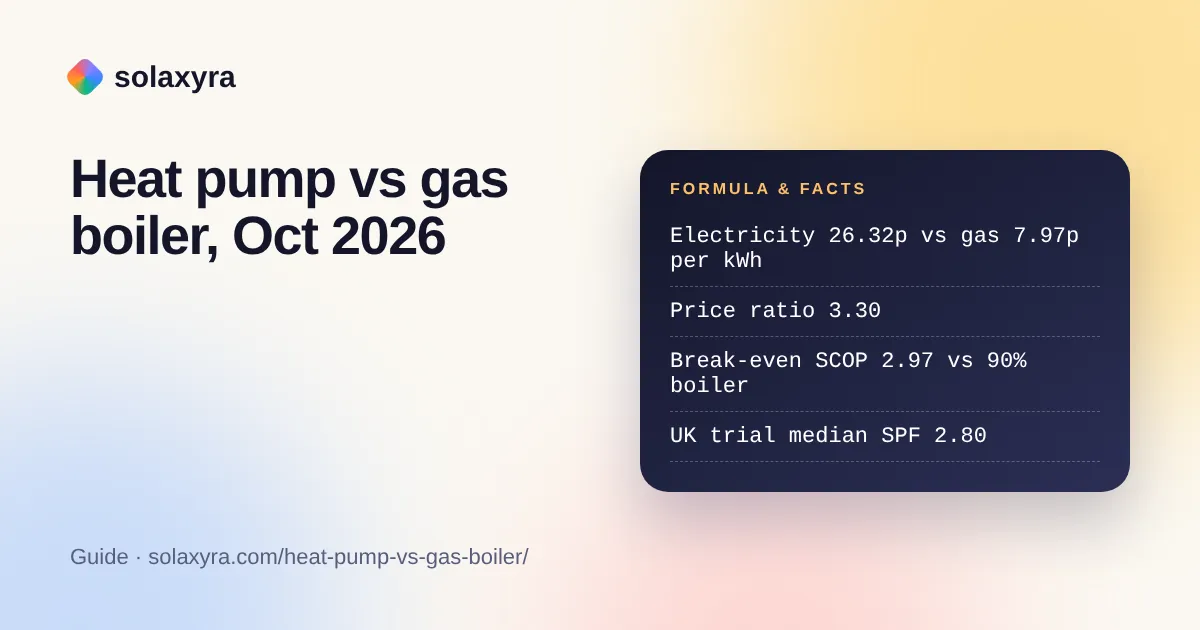
Quick answer: In the heat pump vs gas boiler comparison, efficiency decides running costs. At the October 2026 price cap, electricity costs 3.3 times as much per kWh as gas, so a heat pump needs a seasonal efficiency of about 3.0 to match a 90% efficient boiler. Dropping the gas standing charge lowers that to about 2.6.
How does a heat pump differ from a gas boiler?
A gas boiler burns fuel and turns slightly less than 100% of the energy in the gas into heat, while a heat pump moves heat from the outside air into your home and typically delivers around three units of heat for every unit of electricity it uses. That ratio is called the coefficient of performance (COP) when measured at one moment, and the seasonal coefficient of performance (SCOP) or seasonal performance factor (SPF) when averaged over a year.
Real homes matter more than brochure figures. In the Electrification of Heat demonstration project, funded by the Department for Energy Security and Net Zero, the Energy Systems Catapult reported a median SPF of 2.80 for air source heat pumps across the trial, and a median of 2.44 on the coldest days. A well designed system can do better; a poorly designed one can do worse.
A boiler’s efficiency depends on its age and on how it is set up. A modern condensing boiler running at low return temperatures is more efficient than an older one running hot. In the tables below we use 90% as an example for a modern boiler and 85% and 80% for older or poorly set up ones. These are example values; change them to suit your boiler.
Which is cheaper to run at October 2026 prices?
At the current cap, a heat pump with a SCOP of 3.0 costs about £750 a year to supply 8,550 kWh of heat, against about £757 of gas for a 90% boiler, so the two are close and the gas standing charge decides it. The rates come from Ofgem’s October to December 2026 price cap: 26.32p per kWh for electricity and 7.97p per kWh for gas, with a gas standing charge of 29.68p a day, on direct debit as a Great Britain average.
Example: a home whose gas use is Ofgem’s typical 9,500 kWh a year, all for heating and hot water, with a 90% boiler, needs about 8,550 kWh of useful heat. The table prices that same heat demand every way. The electricity standing charge is not included because you pay it either way.
| Heating option (example) | Fuel bought per year | Fuel cost at the cap | Plus gas standing charge | Yearly total |
|---|---|---|---|---|
| Gas boiler, 90% efficient | 9,500 kWh gas | £757.15 | £108.33 | £865.48 |
| Gas boiler, 85% efficient | 10,059 kWh gas | £801.69 | £108.33 | £910.02 |
| Gas boiler, 80% efficient | 10,688 kWh gas | £851.79 | £108.33 | £960.13 |
| Heat pump, SCOP 2.44 (trial median, coldest days) | 3,504 kWh electricity | £922.28 | £0 if gas is capped off | £922.28 |
| Heat pump, SCOP 2.8 (trial median, whole year) | 3,054 kWh electricity | £803.70 | £0 if gas is capped off | £803.70 |
| Heat pump, SCOP 3.0 | 2,850 kWh electricity | £750.12 | £0 if gas is capped off | £750.12 |
| Heat pump, SCOP 3.5 | 2,443 kWh electricity | £642.96 | £0 if gas is capped off | £642.96 |
| Heat pump, SCOP 4.0 | 2,138 kWh electricity | £562.59 | £0 if gas is capped off | £562.59 |
The SCOP 2.44 row is only a guide, because a whole year never runs at coldest day efficiency. It shows the worst case for a typical installation. If you keep a gas hob, you keep paying the gas standing charge, so add £108.33 back to each heat pump row before you compare. To run these numbers with your own heat demand, efficiency and tariff, use the heat pump and gas boiler running cost calculator.
What SCOP does a heat pump need to beat a gas boiler?
The break-even SCOP equals the electricity price divided by the gas price, multiplied by the boiler efficiency; at October 2026 cap rates that is 26.32 ÷ 7.97 × 0.90 = 2.97 for a 90% boiler. Any heat pump that averages above that figure over the year is cheaper per unit of heat.
| Scenario | Price ratio (electricity ÷ gas) | Break-even SCOP vs 90% boiler | Break-even SCOP vs 85% boiler |
|---|---|---|---|
| October 2026 cap, no VAT on electricity | 3.30 | 2.97 | 2.81 |
| Same, gas standing charge removed (example 8,550 kWh heat) | 3.30 | about 2.60 | about 2.47 |
| Same unit rate with 5% VAT added back (27.64p) | 3.47 | 3.12 | 2.95 |
The third row matters for planning. The government has removed VAT from household electricity only from 1 October 2026 to 31 March 2027, as Ofgem confirms. If it returns at 5%, the bar for a heat pump rises a little. Wholesale prices will also move, so treat the ratio as something to recheck each quarter rather than a fixed fact.
The Energy Saving Trust notes that heat pumps can cost slightly more to run than new gas boilers on standard tariffs, and that heat pump or time of use tariffs can make them cheaper. A cheaper overnight rate effectively lowers the price ratio, which lowers the break-even SCOP. If you also have solar panels, the solar self-consumption calculator helps you estimate how much of the heat pump’s daytime use your own generation could cover.
How do you work out the right comparison for your home?
You can estimate your own break-even point in a few minutes from your annual gas statement. Follow these steps:
- Find your yearly gas use in kWh on your statement or online account.
- Take off an allowance for cooking if you have a gas hob. This is your judgement; for most homes heating and hot water are the bulk of gas use.
- Multiply the remaining figure by your boiler efficiency (for example 0.90) to get useful heat in kWh.
- Divide that heat by a realistic SCOP for a heat pump, such as the trial median 2.8 and a well designed 3.5, to get electricity in kWh.
- Price both at your own unit rates, then decide whether you will keep or cap off the gas supply and adjust for the gas standing charge.
- Ask an MCS certified installer for a heat loss survey; their design figures replace your estimate.
A heat loss survey also tells you whether your radiators are big enough. Heat pumps run most efficiently at lower water temperatures, so some rooms may need larger radiators. That design work is part of what you pay an installer for and is the main reason two similar houses can end up with very different SCOPs.
How much does each cost to install, and is there a grant?
The Energy Saving Trust puts the typical cost of installing an air source heat pump at around £12,000, and the Boiler Upgrade Scheme takes £7,500 off that in England and Wales. On those figures alone, the example net cost would be about £4,500 before any radiator or cylinder work your survey identifies.
- Air source heat pump: £7,500 grant.
- Ground source heat pump, including water source: £7,500 grant.
- Air-to-air heat pump: £2,500 grant.
- Until March 2027, an extra £1,500 towards an air or ground source heat pump if the property uses oil or LPG and has no mains gas.
- Hybrid systems that pair a gas boiler with a heat pump are not funded.
To qualify you must own the property and be replacing fossil fuel heating such as gas, oil, LPG or electric. The installer must be MCS certified, and the installation must be finished within 120 days of the application. Most new builds and social housing are excluded. Our Boiler Upgrade Scheme guide covers the process in detail.
We do not quote a typical gas boiler replacement price because we could not verify one from a primary source today. Get at least two written quotes, and compare the heat pump’s net cost against the boiler quote, not against zero, because a failing boiler has to be replaced with something.
Is your home suitable for a heat pump?
The Energy Saving Trust says air source heat pumps are suitable for most types of homes, and most installations count as permitted development, so planning permission is usually not needed, except in cases such as listed buildings and conservation areas. Suitability is mainly about heat loss, space and emitters:
- Insulation and draughts: the lower your heat loss, the smaller and cheaper the heat pump and the easier it is to reach a good SCOP. The heat loss calculator gives a first estimate.
- Outdoor space for the unit, with airflow around it.
- Indoor space for a hot water cylinder if you currently have a combi boiler.
- Radiators or underfloor heating that can deliver enough heat at lower flow temperatures.
A gas boiler remains the simpler swap where none of this work is possible, for example in a flat with no outdoor space. If you stay with gas, lowering the flow temperature on a condensing boiler can improve its efficiency; see our guide to boiler flow temperature.
Who must install and work on each system?
Any work on a gas boiler or gas pipework must be done by a Gas Safe registered engineer; it is illegal and dangerous to do it yourself. For a heat pump funded by the Boiler Upgrade Scheme, the installer must be MCS certified. The electrical supply to a heat pump, including any new circuit or isolator, must be installed by a qualified electrician and meet BS 7671, the UK wiring regulations. Removing or capping a gas supply is also a job for a Gas Safe registered engineer and your gas network.
Frequently Asked Questions
Is a heat pump cheaper to run than a gas boiler?
It can be, but at standard October 2026 cap rates it is close. A heat pump needs a seasonal efficiency of about 3.0 to match a 90% boiler on unit costs alone. Removing the gas standing charge or using a heat pump tariff makes it cheaper.
What is a good SCOP for a heat pump in the UK?
The DESNZ-funded Electrification of Heat trial found a median of 2.80 for air source heat pumps over the year, and 2.44 on the coldest days. A well designed system with low flow temperatures can achieve more, so ask your installer for a design SCOP.
How much is the Boiler Upgrade Scheme grant?
In England and Wales it is £7,500 for an air source or ground source heat pump and £2,500 for air-to-air. Until March 2027 off-gas homes using oil or LPG can get an extra £1,500. Hybrid systems are not funded.
Do I need to replace my radiators for a heat pump?
Not always. Heat pumps work best at lower water temperatures, so some rooms may need larger radiators to stay warm. An MCS certified installer should carry out a room by room heat loss survey and tell you exactly which radiators, if any, need changing.
Will the end of the electricity VAT holiday change the comparison?
Slightly. VAT is removed from household electricity from 1 October 2026 to 31 March 2027. Adding 5% back to the current unit rate raises the break-even SCOP against a 90% boiler from about 2.97 to about 3.12, if gas prices stay the same.
Checked October 2026 by the Solaxyra Editorial Team. Sources: Ofgem: energy price cap 1 October to 31 December 2026, GOV.UK: Boiler Upgrade Scheme, what you can get, GOV.UK: Boiler Upgrade Scheme eligibility, Energy Saving Trust: air source heat pumps, Energy Systems Catapult: Electrification of Heat findings.