This guide explains when it is cheapest and greenest to run appliances in Great Britain, depending on which tariff you are on: a standard single-rate tariff, Economy 7, a smart time-of-use tariff, or solar panels at home. The best time to use electricity UK households should aim for is not the same for everyone, and for many homes the honest answer is that the clock makes no difference to the bill at all.
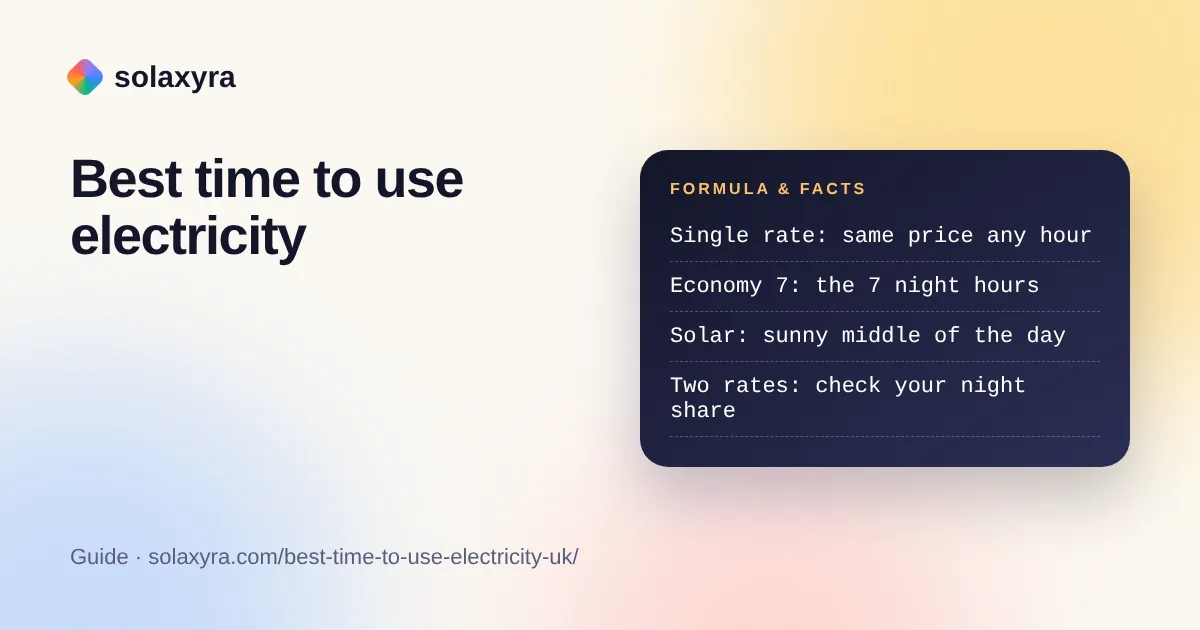
Quick answer: The best time to use electricity UK homes can choose depends on the tariff. On a standard single-rate tariff every kWh costs the same at any hour. On Economy 7 it is the seven night hours. On smart time-of-use tariffs it is the cheap slots the supplier sets, and with solar panels it is the sunny middle of the day.
Does the time of day change your electricity price?
Only if your tariff has more than one rate. Under the Ofgem price cap for October to December 2026, a standard variable single-rate direct debit customer pays on average 26.32p per kWh whatever the time, plus a standing charge of 54.83p a day. Running the washing machine at 3am costs exactly the same as at 3pm on that kind of tariff.
Look at your bill or app. If it shows one unit rate, the best time to use electricity UK prices allow is any time, so focus on using less. If it shows two rates (day and night) or the price changes every half hour, timing matters, and the rest of this guide applies. The electricity cost calculator prices any appliance at whichever rate you enter.
| Your tariff | Best time to use electricity | Times to avoid | How to check |
|---|---|---|---|
| Standard single rate | Any time: the price per kWh is the same | None for cost | One unit rate on the bill |
| Economy 7 | The 7 off-peak hours, usually overnight | All daytime hours (higher day rate) | Two rates on the bill; ask the supplier for your exact hours |
| Economy 10 | The 10 off-peak hours, split across night and part of the day | Hours outside those windows | Supplier confirms the windows |
| Smart time-of-use or EV tariff | The cheap slots the supplier sets, often overnight | The supplier’s peak slots | Supplier app or tariff terms |
| Solar panels (any tariff) | Sunny hours, roughly mid morning to mid afternoon | Evenings, when panels produce little | Inverter or monitoring app |
What is the best time to use electricity UK homes on Economy 7 have?
On Economy 7, the best time to use electricity UK suppliers price cheaply is inside the seven off-peak hours, which usually fall overnight. Council energy advice gives a typical window of about midnight to 7am in winter, but start and end times depend on your meter, region and supplier, so confirm yours rather than assuming. Our guide to Economy 7 hours explains how to find them.
Economy 7 is only cheaper if a large enough share of your electricity is used at night. Ofgem’s 2026 review of typical consumption uses 3,400 kWh a year for a typical multi-rate home and assumes 58% at the peak rate and 42% off-peak. Homes with storage heaters or an electric hot water cylinder are more likely to beat that split than homes without them.
Example: with an example day rate of 30p and night rate of 14p (not current tariffs, change them to yours), a home using 3,400 kWh with Ofgem’s 58/42 split pays £791.52 for its units. The same 3,400 kWh at the 26.32p single rate costs £894.88. Standing charges can differ between the two tariffs, so compare those too. The Economy 7 calculator runs this check with your own readings.
How do you find your break-even night share?
To confirm that night really is the best time to use electricity UK tariffs give you, you need more than (day rate minus single rate) divided by (day rate minus night rate) of your electricity at night for a two-rate tariff to win. These steps give your own figure:
- Find your two-rate tariff’s day and night unit rates on the bill or tariff page.
- Find the single rate you could switch to; the October 2026 cap average is 26.32p per kWh.
- Subtract the single rate from the day rate.
- Subtract the night rate from the day rate.
- Divide step 3 by step 4. Example: (30 − 26.32) ÷ (30 − 14) = 0.23, so you need more than 23% of use at night.
- Compare with your actual night share from your meter readings or smart meter data.
The result changes whenever your tariff rates change, so repeat the check after a price change. If your day rate is close to or below the single rate, almost any night share wins.
Which appliances are worth moving to off-peak hours?
Once you know the best time to use electricity UK tariffs offer you, the appliances worth moving are the ones that use the most kWh per run and do not need you to be there: EV charging, hot water immersion heaters, storage heaters, tumble dryers, washing machines and dishwashers. The saving per run is simply the kWh used multiplied by the gap between your peak and off-peak rates.
| Appliance (example energy per use) | kWh | At 26.32p single rate | At example 30p day rate | At example 14p night rate | Saving per use, day to night |
|---|---|---|---|---|---|
| Washing machine, example cycle | 1.0 | 26.3p | 30.0p | 14.0p | 16.0p |
| Dishwasher, example cycle | 1.2 | 31.6p | 36.0p | 16.8p | 19.2p |
| Tumble dryer, example load | 4.0 | 105.3p | 120.0p | 56.0p | 64.0p |
| Immersion heater, example 3 kW for 2 hours | 6.0 | 157.9p | 180.0p | 84.0p | 96.0p |
| EV, example 7 kW charger for 4 hours | 28.0 | £7.37 | £8.40 | £3.92 | £4.48 |
The kWh per use figures are example values; check the energy label or manual for your own model, or measure with a plug-in monitor. Moving a single washing load saves pence; moving EV charging and hot water saves pounds. The energy consumption calculator shows which of your appliances use the most.
For appliances that run while you sleep or are out, follow the manufacturer’s instructions on unattended use, keep smoke alarms working, and never overload extension leads. Any new circuit, such as one for an EV charger, must be installed by a qualified electrician to BS 7671, and in England and Wales Part P of the Building Regulations applies.
When is the best time to use electricity with solar panels?
With solar panels, the best time to use electricity UK homes can pick is when the panels are generating most, roughly mid morning to mid afternoon on a bright day, because every kWh you use directly saves buying one from the grid. If your export rate is lower than your import rate, using your own power is worth more than exporting it, so compare the two rates on your tariffs.
Running the dishwasher, washing machine or EV charger at midday on a sunny day lifts your self-consumption. The solar self-consumption calculator shows how much of your generation you use at home, and the solar savings calculator turns that into money. A battery moves surplus daytime solar into the evening; the home battery savings calculator estimates whether that pays, and the solar EV charging calculator covers charging a car from your panels.
When is electricity greenest in Great Britain?
Electricity is lowest carbon when wind, solar and nuclear make up a large share of the mix, and that changes by hour, day and season rather than following a fixed clock. National Grid’s guidance on its carbon intensity app says low carbon windows are no longer only overnight; daytime windows are growing as solar expands, and its forecast shows the cleanest times for your region up to 48 hours ahead.
The cheapest time and the greenest time can overlap on smart tariffs whose prices follow wholesale markets, so it is worth checking both signals. On a single-rate tariff, carbon is the only thing that changes the best time to use electricity UK customers choose, since the price is flat. Our guide to dynamic electricity tariffs explains how half-hourly prices work.
Some suppliers also offer cheaper electricity at weekends; Ofgem notes that you could save money if your supplier offers half price or lower cost electricity at weekends. So the best time to use electricity UK customers can find may be a whole day, not just a night window, depending on the offer.
Frequently Asked Questions
Is electricity cheaper at night in the UK?
Only on a tariff with a cheaper night rate, such as Economy 7, Economy 10 or a smart time-of-use tariff. On a standard single-rate tariff, which is what the Ofgem price cap figure of 26.32p per kWh describes, electricity costs the same at night as during the day.
What time is off-peak electricity?
It depends on the tariff and meter. Economy 7 gives seven cheaper hours, usually overnight and often around midnight to 7am, but times vary by region and supplier. Smart tariffs set their own cheap slots. Check your bill, app or supplier.
Is it cheaper to run a washing machine at night?
Only on a tariff with a cheaper night rate. Then the saving is the cycle’s kWh multiplied by the gap between day and night rates. With an example 1 kWh cycle and a 16p gap, that is 16p per wash. On a single-rate tariff it costs the same at any hour.
When is peak time for electricity in the UK?
Peak pricing applies only on tariffs that have it, and each supplier defines its own peak window. On a standard single-rate tariff there is no peak price. Check your tariff terms for the exact hours.
How much of my electricity must be at night for Economy 7 to save money?
Divide (day rate minus single rate) by (day rate minus night rate). With example rates of 30p day, 14p night and the 26.32p cap single rate, the answer is 23%. Ofgem’s typical multi-rate home uses 42% at night, but your own share is what counts.
Checked October 2026 by the Solaxyra Editorial Team. Sources: Ofgem: energy price cap 1 October to 31 December 2026, Ofgem: typical domestic consumption values decision, National Grid: when to plug in, carbon intensity app, Folkestone and Hythe District Council: storage heater factsheet (Economy 7 hours).