This guide tells UK households which temperature to set on a room thermostat, room by room and for different people, what each degree costs at the October 2026 price cap, and how the thermostat differs from the other dials on a heating system. If you keep asking yourself what temperature should I set my thermostat, the short version is a number between 18°C and 21°C, but the right one for you depends on your health, your home and your heating type.
Quick answer: For most people the Energy Saving Trust recommends the lowest comfortable setting between 18°C and 21°C. If you are 65 or over or have a heart or lung condition, keep the rooms you use at 18°C or higher. So what temperature should I set my thermostat? Start at 21°C and lower it one degree at a time.
What temperature should I set my thermostat in the UK?
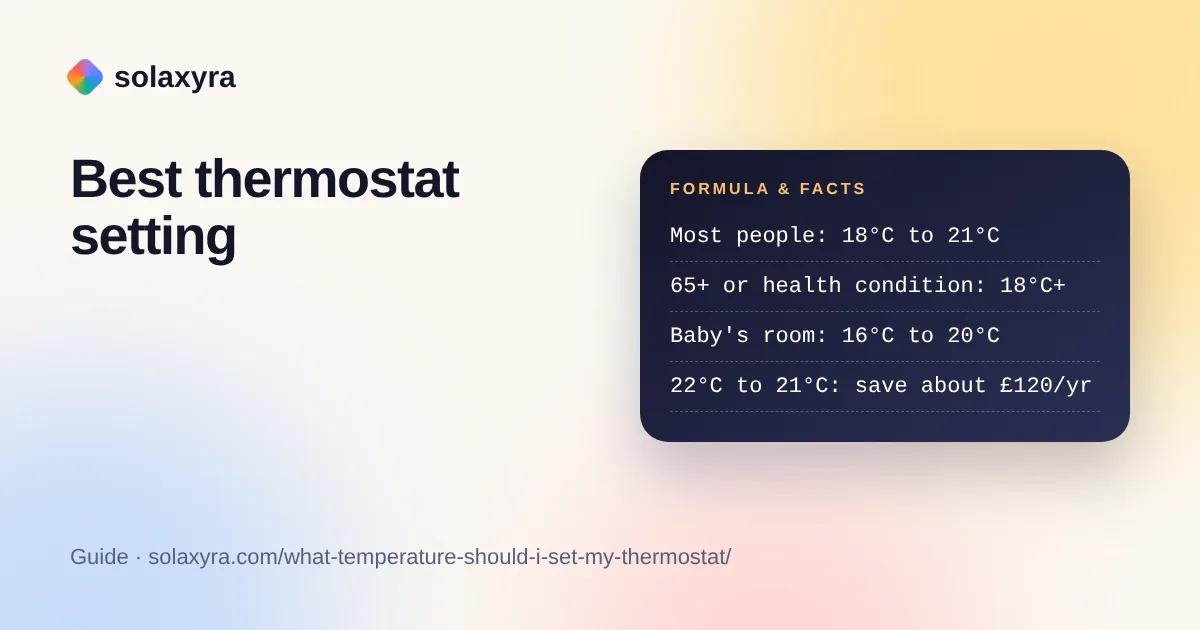
Set the room thermostat to the lowest temperature at which you feel comfortable, which for most people is between 18°C and 21°C according to the Energy Saving Trust heating controls advice. A room thermostat switches the boiler or heat pump off when the air around it reaches the set temperature and back on when it cools, so a higher number does not heat the house faster; it only keeps it warmer for longer and uses more energy.
Health comes before savings. The UK Health Security Agency advises people who are 65 or over or who have a health condition to heat their home to at least 18°C if they can, and the NHS gives the same 18°C figure for people who are not very mobile or have heart or lung disease. Healthy, active adults under 65 can be comfortable a little cooler, provided they wear warm layers and do not feel cold.
What is the right temperature for each room and situation?
Living rooms are usually set at the top of the 18°C to 21°C range, bedrooms and halls lower, and a baby’s room between 16°C and 20°C. The table answers what temperature should I set my thermostat for each room and situation using settings published by UK public bodies, so you can see where each number comes from rather than relying on a single rule.
| Room or situation | Suggested setting | Source |
|---|---|---|
| Main living areas, most adults | Lowest comfortable, usually 18°C to 21°C | Energy Saving Trust |
| Rooms used by people aged 65 or over or with a health condition | At least 18°C | UKHSA cold weather advice |
| Bedroom overnight, older or less mobile people | 18°C if possible, window shut | NHS (111 Wales) |
| Baby’s sleep room | 16°C to 20°C | NHS (111 Wales) |
| Programmable thermostat, morning | 18°C or lower | Energy Saving Trust example |
| Programmable thermostat, evening | 20°C or 21°C | Energy Saving Trust example |
| Out or asleep (set-back) | Around 12°C to 15°C | Energy Saving Trust example |
| Hot water cylinder thermostat | 60°C | Energy Saving Trust |
| Boiler flow temperature with a cylinder | No lower than 65°C | Energy Saving Trust |
The last two rows are not room thermostat settings at all. They control the water in the cylinder and the water leaving the boiler, which is why people often confuse them with the room temperature. The 12°C to 15°C set-back figure is only for people who are healthy enough for a cooler home while asleep or out; the 18°C advice above takes priority for anyone at risk.
How much does turning the thermostat down by 1°C save?
The Energy Saving Trust says turning a room thermostat down from 22°C to 21°C can save about £120 a year in Great Britain and £80 in Northern Ireland. It does not publish the house size or prices behind that figure, so treat it as a guide for a typical gas heated home rather than a promise.
To show the energy behind it: at the Ofgem price cap for October to December 2026 gas costs 7.97p per kWh on direct debit, so £120 is roughly 1,500 kWh of gas (120 ÷ 0.0797). Ofgem’s typical domestic consumption value for gas is 9,500 kWh a year, so this one degree is in the region of a sixth of a typical bill’s gas units. Smaller, better insulated homes will save less in pounds; draughty, larger homes more. That is why cost, as well as comfort, belongs in any decision about what temperature should I set my thermostat.
To cost your own heating at different settings, the central heating cost per hour calculator turns boiler size and gas price into pence per hour, and the heat pump running cost calculator compares a heat pump against a gas boiler for a year of heating.
Should you turn the thermostat up when it is cold outside?
No: a room thermostat set to 20°C aims for 20°C whatever the weather, so you do not need to raise it on cold days. The house will simply take longer to warm up because it loses heat faster, and the Energy Saving Trust suggests starting the heating a little earlier instead of turning the dial higher.
Turning the thermostat right up to warm a cold house quickly does not work on most systems. The boiler already runs at its normal output until the set temperature is reached; a higher setting only means it keeps running after the room is warm enough, which wastes gas.
Thermostat, TRV or boiler flow temperature: which dial does what?
The room thermostat sets the target air temperature for the whole home, the thermostatic radiator valves (TRVs) set the level in each room, and the boiler flow temperature sets how hot the water in the radiators gets. All three affect comfort and cost, but only the first is a room temperature in °C.
- Room thermostat: usually in the hall or living room, marked in °C. Set it to the lowest comfortable temperature. Put it away from radiators, sunlight and draughts so it reads the room fairly.
- TRVs: the numbered heads on each radiator. The Energy Saving Trust explains that most run from 0 (off) to 6 (fully open); the numbers are not degrees and vary by maker. Set each to the lowest number that keeps that room comfortable, and keep the room with the room thermostat on a fairly open setting so the two do not fight.
- Boiler flow temperature: the dial on a combi or system boiler. Lower flow temperatures help condensing boilers run more efficiently; see our guide to boiler flow temperature before changing it, and keep 65°C or more if you have a hot water cylinder.
- Programmer or timer: sets when the heating can come on. It does not set a temperature.
What temperature should I set my thermostat at night and when I am out?
With a programmable thermostat the Energy Saving Trust gives around 12°C to 15°C as an example set-back for when you are out or asleep, then 18°C to 21°C when you are at home. If you or someone in the home is older, less mobile or unwell, keep the bedroom at around 18°C overnight, as the NHS advises, instead of using a deep set-back.
Whether a set-back or switching off saves more depends on your heating type and how well the house keeps its heat; our guide on whether it is cheaper to leave the heating on all day works through the numbers. Whichever you choose, the Energy Saving Trust advises against leaving rooms unheated for long periods.
What temperature should I set my thermostat with a heat pump?
The comfort target is the same 18°C to 21°C, but a heat pump is best left running with a small set-back rather than switched off, because the Energy Saving Trust’s heat pump advice notes it works much harder to recover after the house has cooled by a few degrees. Heat pumps usually run at lower water temperatures, typically around 45°C, so they warm rooms slowly and steadily.
Most heat pumps use weather compensation, which raises the water temperature as the outdoor air gets colder. The Energy Saving Trust says an installer should set this heating curve and that a curve set too high can push up running costs; ask your installer before lowering it.
How do you find your own best thermostat setting?
The most reliable answer to what temperature should I set my thermostat in your own home is to lower it one degree at a time and stop at the lowest setting where you still feel comfortable for a few days. These steps work for gas, oil, electric and heat pump systems:
- Start at 21°C on the room thermostat, or 18°C if you already know you are comfortable there.
- Leave it for two or three days so the house settles and you judge comfort over normal routines.
- If you are comfortable, turn it down by 1°C and repeat.
- Stop when the home feels cool while sitting still, then go back up by one degree.
- Do not go below 18°C in rooms used by anyone aged 65 or over or with a health condition.
- Set the TRVs in bedrooms and spare rooms lower than in the living room.
- Check your smart meter or meter readings after a week to see the change in kWh.
If you use electric heaters for some rooms, the electric heater running cost calculator shows what each heater costs at your thermostat setting and hours of use.
Frequently Asked Questions
Is 21°C too high for a thermostat?
No. 21°C is at the top of the Energy Saving Trust’s 18°C to 21°C range for most people, so it is a normal setting. If you feel comfortable at 20°C or 19°C, the lower setting will use less energy, so it is worth trying one degree lower.
Is 18°C warm enough for a house?
For many healthy adults, yes. UKHSA advises heating your home to at least 18°C if you are 65 or over or have a health condition. Healthy, active people under 65 can be comfortable slightly cooler if they dress warmly and do not feel cold.
What temperature should a baby’s room be?
The NHS advises that babies sleep in rooms heated to between 16°C and 20°C to reduce the risk of sudden infant death syndrome. Use a room thermometer near the cot, because the hall thermostat may read a different temperature.
Does turning the thermostat up heat the house faster?
No. On a normal system the boiler or heat pump runs at the same output until the set temperature is reached. A higher setting only keeps it running for longer once the room is warm, so it uses more energy without warming the house any faster.
What temperature should I set my thermostat when I am out for the day?
The Energy Saving Trust gives around 12°C to 15°C as an example setting for a programmable thermostat while you are out, with 18°C to 21°C when you return. Anyone aged 65 or over or with a health condition should keep the home at 18°C or more.
What number should my radiator valves be on?
TRVs usually run from 0, which is off, to 6, which is fully open. The numbers are not degrees. Set each valve to the lowest number that keeps that room comfortable, lower in bedrooms and spare rooms than in the main living room.
Checked October 2026 by the Solaxyra Editorial Team. Sources: Energy Saving Trust: heating controls, Energy Saving Trust: most economical ways to use central heating, Energy Saving Trust: running a heat pump efficiently, GOV.UK: UKHSA cold weather alert, NHS 111 Wales: how to stay well in winter, Ofgem: energy price cap 1 October to 31 December 2026.