n/a
PV strings carry DC at hundreds of volts that can sustain an arc and cannot be switched off while the sun shines. Design and installation must be done by a competent PV installer or qualified electrician; in the UK the work must meet BS 7671. Always follow the panel, inverter and fuse manufacturers’ data.
Formula and breakdown
n/a
n/a
n/a
n/a
This solar fuse size calculator tells PV designers, installers and informed system owners whether the strings in a solar array need fuses, and if so which gPV fuse current and voltage rating to choose, using the panel’s datasheet values and the methods published by inverter and fuse manufacturers. It is written for European installations that follow IEC rules, with UK notes on BS 7671.
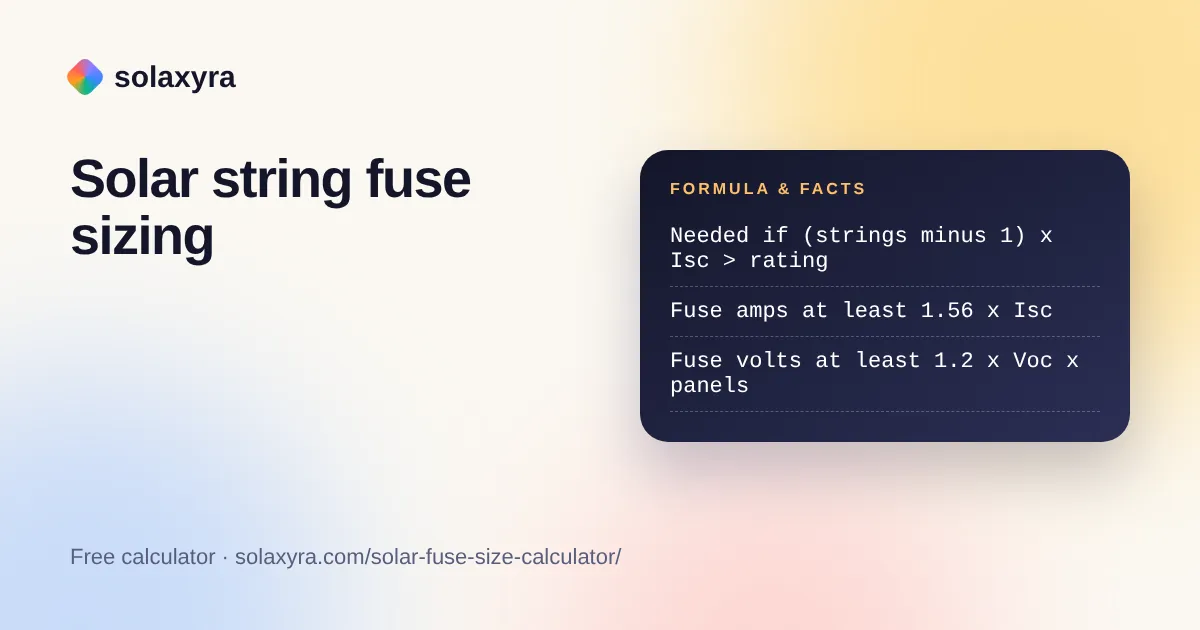
Quick answer: A solar fuse size calculator first checks whether string fuses are needed: they are when (strings minus 1) x Isc exceeds the panel’s maximum series fuse rating. The fuse must be at least 1.56 x Isc, rounded up to a standard size but not above that rating, and rated for at least 1.2 x Voc x panels in series.
What Is a Solar Fuse Size Calculator?
A solar fuse size calculator is a tool that checks whether parallel PV strings need overcurrent protection and works out the fuse current and voltage ratings from the panel’s short circuit current, open circuit voltage and maximum series fuse rating. The formula in plain words: the worst reverse current into one string is the number of strings minus one, times Isc; fuses are needed when that exceeds the panel’s maximum series fuse rating. The fuse current is a multiplier times Isc, rounded up to a standard size and no higher than the panel rating, and the fuse voltage is 1.2 times Voc times the panels in series.
A fuse in a PV string does a different job from a fuse on a mains circuit. Solar panels cannot produce much more than their Isc, so a single string cannot overload itself. The danger comes when several strings are joined in parallel and one develops a fault: the healthy strings can push their current backwards through the faulty one, and that reverse current is what the fuse limits.
How Do You Use the Solar Fuse Size Calculator?
- Find the panel datasheet and enter Isc and Voc at standard test conditions.
- Enter the maximum series fuse rating from the same datasheet. Some makers call it the reverse current rating.
- Enter the number of panels in series in each string and the number of strings joined in parallel at one inverter input or combiner.
- Leave the derating factor at 1 unless the fuse maker’s table gives a factor for a hot enclosure.
- Choose the multiplier that matches your fuse maker: 1.56 from the Eaton guide or 1.4 from ETI for ambient temperatures up to 45°C.
- Read whether fuses are needed, the fuse current and voltage, and the array fuse, then open the breakdown to check each step.
When Do Solar Panels Need String Fuses?
String fuses are needed when the reverse current that the other strings can feed into a faulty string, (strings minus 1) x Isc, is greater than the panel’s reverse current rating. That is the test set out in an SMA technical note on string fuses. With panels of 13.9 A Isc and a 25 A rating, two strings give 13.9 A and pass the test, while three strings give 27.8 A and fail it.
Fuse makers reach the same practical point. The Eaton Bussmann PV application guide says systems with three or more strings connected in parallel need each string protected, and ETI says arrays with three or more strings need fusing because fewer strings cannot produce enough fault current to damage the conductors or panels. Many home systems use one or two strings per MPPT input and need no string fuses at all; the solar fuse size calculator confirms this for a single-string roof array.
What Size Fuse Do You Need for a Solar Panel String?
A string fuse should be at least 1.56 times Isc in the Eaton method, or 1.4 times Isc in ETI’s method for its CH gPV fuses at up to 45°C, rounded up to the next standard size, and it must not exceed the panel’s maximum series fuse rating. The table shows the solar fuse size calculator result for common Isc values; the last column is the reverse current with three strings in parallel.
| Panel Isc | 1.56 x Isc | Fuse at 1.56 | 1.4 x Isc | Fuse at 1.4 | Reverse current, 3 strings |
|---|---|---|---|---|---|
| 9 A | 14.04 A | 15 A | 12.6 A | 15 A | 18 A |
| 10 A | 15.6 A | 16 A | 14.0 A | 15 A | 20 A |
| 11 A | 17.16 A | 20 A | 15.4 A | 16 A | 22 A |
| 12 A | 18.72 A | 20 A | 16.8 A | 20 A | 24 A |
| 13 A | 20.28 A | 25 A | 18.2 A | 20 A | 26 A |
| 14 A | 21.84 A | 25 A | 19.6 A | 20 A | 28 A |
| 16 A | 24.96 A | 25 A | 22.4 A | 25 A | 32 A |
| 18 A | 28.08 A | 30 A | 25.2 A | 30 A | 36 A |
Standard sizes in the table are common gPV ratings; check the range your fuse maker offers. Large modern panels with an Isc of 18 A or more can leave no standard fuse between the minimum and a 25 A panel rating. The fix is to follow the panel maker’s guidance, use an inverter with more MPPT inputs so fewer strings share one input, or redesign the strings with the solar string size calculator.
What Voltage Rating Does a PV Fuse Need?
A PV string fuse needs a DC voltage rating of at least 1.2 times the panel’s Voc times the number of panels in series, according to both the Eaton guide and the ETI gPV fuse selection guide. Ten panels with a Voc of 37.4 V need at least 449 V, so a 1,000 V DC fuse is suitable; 22 panels with a Voc of 49.5 V need 1,307 V and a 1,500 V DC fuse. The 20% margin, which the solar fuse size calculator applies automatically, allows for the rise in panel voltage in cold weather.
Use gPV fuse links made to IEC 60269-6 in holders rated for the same DC voltage. ETI notes that two fuses are normally fitted on each string, one in the positive and one in the negative pole.
How Do You Size the Array or Combiner Output Fuse?
ETI sizes the larger NH gPV fuse on the combined output at no less than 1.5 times Isc times the number of strings, so three strings of 13.9 A need at least 62.6 A and a 63 A fuse. The cable after the combiner must be rated for that current as well; the solar cable size calculator checks cross-section and voltage drop for the DC run to the inverter.
All PV DC work carries a real fire and shock risk. Panels produce voltage whenever light falls on them, DC arcs do not self-extinguish like AC arcs, and an undersized or wrong type of fuse can fail to clear a fault. Design and installation must be done by a competent PV installer or qualified electrician, and in the UK the work must meet BS 7671.
Worked Example: Three Strings on One Inverter Input
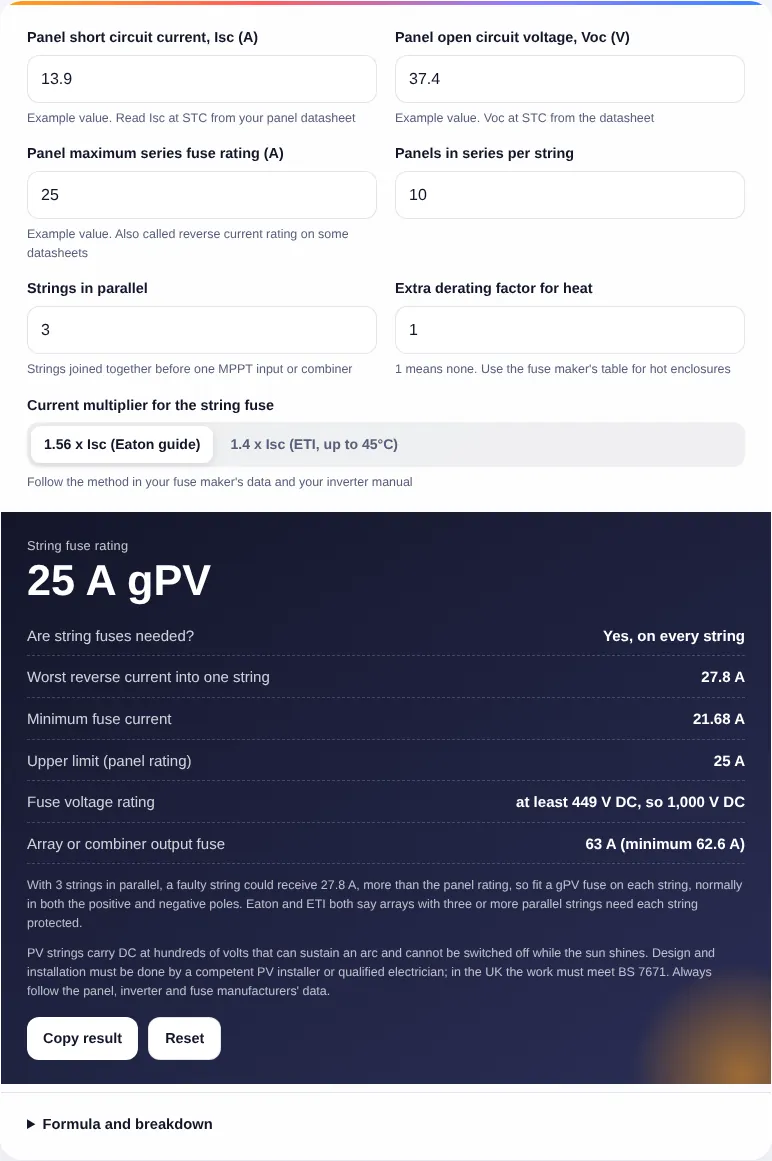
Example: a small commercial roof has three strings of ten panels joined at one combiner. Each panel has Isc 13.9 A, Voc 37.4 V and a maximum series fuse rating of 25 A, taken from its datasheet.
- Reverse current: (3 minus 1) x 13.9 A = 27.8 A. This exceeds the 25 A rating, so each string needs a fuse.
- Fuse current with the Eaton multiplier: 1.56 x 13.9 A = 21.68 A, so the next standard size is 25 A.
- Upper limit check: 25 A is not more than the 25 A panel rating, so the fuse is acceptable.
- Fuse voltage: 1.2 x 37.4 V x 10 = 449 V DC, so a 1,000 V DC gPV fuse is suitable.
- Combiner output: 1.5 x 13.9 A x 3 = 62.6 A, so a 63 A NH gPV fuse.
Switch the solar fuse size calculator to ETI’s 1.4 multiplier and the string fuse would be 1.4 x 13.9 A = 19.46 A, rounded to 20 A, which leaves more margin below the 25 A limit. If the same panels were wired as two strings, the reverse current would be only 13.9 A and string fuses would not be required by the reverse current test. To check the controller or inverter input current for the same array, try the MPPT charge controller calculator.
Frequently Asked Questions
Do I need fuses for two solar strings in parallel?
Usually not for reverse current. With two strings, a faulty string can receive at most one string’s Isc, which is normally below the panel’s maximum series fuse rating. Check the datasheet figure and your inverter manual, because some manufacturers still recommend fuses.
What does the 1.56 multiplier mean?
The Eaton Bussmann PV application guide sets the minimum string fuse current at 1.56 times Isc. The factor leaves headroom above Isc so the fuse does not open in normal use, for example when strong sunlight pushes string current above the value measured under standard test conditions.
What is a panel’s maximum series fuse rating?
It is the largest fuse the manufacturer allows in series with the panel, shown on the datasheet and label. It tells you how much reverse current the panel can take. Your string fuse must not be larger than this figure.
What voltage rating does a solar string fuse need?
Fuse makers Eaton and ETI both use at least 1.2 times the panel open circuit voltage times the number of panels in series. The extra 20% covers the higher voltage panels produce in cold weather. Most string fuses are rated 1,000 V or 1,500 V DC.
What is a gPV fuse?
A gPV fuse is a fuse link made to IEC 60269-6 for photovoltaic DC circuits. It is designed to interrupt DC fault currents in PV strings at high voltage. Use fuse links and holders rated for PV DC duty, not ordinary AC or automotive fuses.
Can I fit solar string fuses myself?
PV strings produce dangerous DC voltage whenever light falls on them and cannot be switched off at the panels. Fuse selection and installation should be done by a competent PV installer or qualified electrician, and in the UK the work must meet BS 7671.
Checked October 2026 by the Solaxyra Editorial Team. Sources: SMA, use of string fuses, Eaton Bussmann photovoltaic application guide, ETI gPV fuses.