This result covers voltage drop only. It does not replace a current-carrying capacity check under BS 7671 or IEC 60364 (installation method, grouping, ambient temperature, insulation type), fault protection or the PV rules in IEC 60364-7-712. A qualified electrician must confirm the final cable and its protection.
Formula and breakdown
n/a
n/a
n/a
This solar cable size calculator finds the smallest standard copper or aluminium cable cross-section, in mm² and AWG, that keeps voltage drop within your limit on a DC solar or battery circuit, for installers and owners of PV, off-grid and van systems in the UK, Europe and beyond.
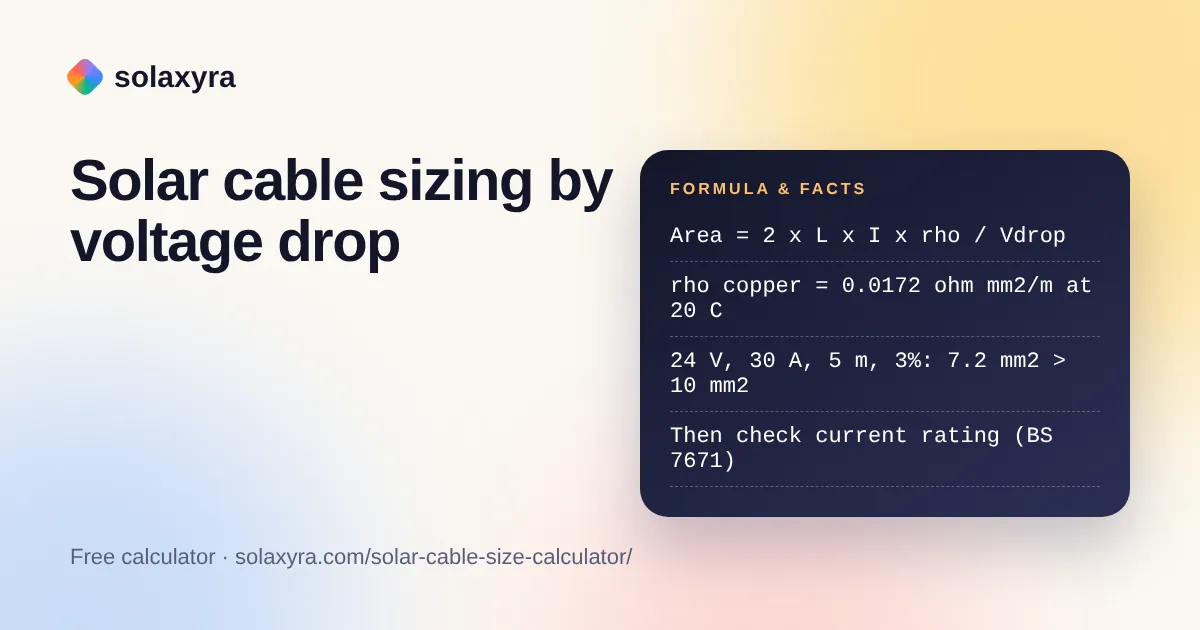
Quick answer: A solar cable size calculator finds the minimum cross-section as 2 x one-way length x current x copper resistivity (0.0172 ohm mm² per metre at 20 °C) divided by the allowed voltage drop in volts. A 24 V, 30 A, 5 m run at 3% needs 7.2 mm², so 10 mm². This covers voltage drop only, not current rating.
What Is a Solar Cable Size Calculator?
A solar cable size calculator is a tool that works out how thick a DC cable must be so the voltage lost along it stays below a chosen percentage. In plain words: a cable’s resistance equals the conductor’s resistivity times the total length of both wires, divided by the cross-sectional area; the voltage drop is that resistance times the current, so the minimum area is resistivity times loop length times current, divided by the drop you can accept.
Voltage drop is only one of the checks a cable must pass. The other, more important one is current-carrying capacity: whether the cable can carry the current without overheating in the way it is installed. This calculator does not perform that check, and the result must be confirmed by a qualified electrician against BS 7671 in the UK or IEC 60364 and the local wiring rules elsewhere. BS 7671 follows the section structure of IEC 60364 closely, and both include a section on solar photovoltaic power supply systems (Section 712).
How Do You Use the Solar Cable Size Calculator?
- Pick the circuit type, or type the voltage. For a PV string, use the string’s maximum power voltage, not its open-circuit voltage, because the drop that matters is at the working point.
- Enter the design current. For a battery cable, use the largest continuous current, such as the output rating from the MPPT charge controller calculator or the inverter’s full-load battery current. For a PV string, a cautious figure is 1.25 times the string short-circuit current.
- Enter the one-way length in metres or feet. The tool doubles it, because current flows out on one conductor and back on the other.
- Set the maximum voltage drop. The default of 3% is an example; choose 1% or 2% for long PV strings to keep losses low.
- Set the conductor temperature and material, then read the standard size, the exact minimum area, the AWG equivalent and the watts lost.
What Size Cable Do You Need for 12 V, 24 V and 48 V Solar?
The lower the voltage, the thicker the cable for the same power: a 12 V system needs four times the cross-section of a 24 V system carrying the same watts over the same distance at the same percentage drop. That is because halving the voltage doubles the current and halves the volts you can afford to lose.
| Circuit | Current | One-way length | Max drop | Minimum area | Standard size |
|---|---|---|---|---|---|
| 12 V battery | 20 A | 3 m | 3% | 5.73 mm² | 6 mm² |
| 12 V battery | 30 A | 5 m | 3% | 14.33 mm² | 16 mm² |
| 24 V battery | 30 A | 5 m | 3% | 7.17 mm² | 10 mm² |
| 48 V battery | 50 A | 5 m | 3% | 5.97 mm² | 6 mm² |
| 350 V PV string | 12 A | 20 m | 1% | 2.36 mm² | 2.5 mm² |
All rows use annealed copper at 20 °C. The sizes are voltage-drop minimums only. A 6 mm² cable might satisfy voltage drop for 50 A at 48 V over 5 m and still be too small to carry 50 A safely when bundled or run through insulation, so the current rating check can push the size up. For PV strings, purpose-made solar cable, commonly 4 mm² or 6 mm², is chosen for its UV and temperature rating as much as its size.
How Much Voltage Drop Is Acceptable on a Solar Cable?
Choose the limit to suit the equipment, and aim lower on battery cables: Victron’s Wiring Unlimited DC wiring guide advises aiming for a voltage drop below 2.5%, counting the length of both the positive and the negative cable. This calculator uses 3% as an editable example and 1% for long PV strings, and a lower figure is always better because every lost volt becomes heat in the cable. On low-voltage battery cables, a large drop can make a controller or inverter that measures voltage at its own terminals misread the battery and cut out early under load.
For the fixed AC wiring of a building, BS 7671 sets its own voltage drop guidance, and in the UK that work must be done or checked by a registered electrician. If you need to check a cable you already have, the voltage drop calculator works the other way round: you enter the size and it returns the volts lost.
Why Does Cable Temperature Change the Size?
Copper’s resistance rises by about 0.39% per degree Celsius, so a cable at 70 °C has roughly 20% more resistance than the same cable at 20 °C, and needs about 20% more area for the same voltage drop. The figures come from the resistivity and temperature coefficient for annealed copper listed in the table of electrical resistivity values: 1.72 x 10⁻⁸ ohm metres at 20 °C with a coefficient of 0.00393 per kelvin.
Cables on a sunny roof or in a hot engine bay run warm, so enter a realistic conductor temperature for those runs. Aluminium has about 64% higher resistivity than copper and needs a correspondingly larger area; it is rare in small solar systems because terminations need special care.
How Do You Convert mm² to AWG?
Use the AWG formula: a wire’s diameter is 0.127 mm times 92 raised to the power (36 minus gauge) divided by 39, and the area follows from the diameter. On that basis 10 AWG is 5.26 mm², 8 AWG is 8.37 mm², 6 AWG is 13.3 mm² and 4 AWG is 21.2 mm², as listed on the American wire gauge reference. The calculator shows the smallest AWG whose area is at or above the minimum, which helps when buying North American cable or reading a US manual.
Worked Example: Aoife’s Cabin Battery Cable in Galway
Aoife in Galway is wiring a 24 V cabin system she sized with the off grid solar calculator. Her MPPT controller can deliver 30 A, and it sits 5 m from the battery bank.
- Allowed drop at 3%: 24 V x 0.03 = 0.72 V.
- Loop length: 2 x 5 m = 10 m.
- Minimum area: 10 m x 30 A x 0.0172, divided by 0.72 V, gives 7.17 mm².
- Next standard size: 10 mm². Its drop is 10 x 30 x 0.0172 divided by 10, which is 0.52 V or 2.15%, and it wastes about 15.5 W at full current.
- Moving the controller to 2 m from the battery would bring the minimum down to 2.87 mm², and 4 mm² would then satisfy voltage drop.
Her electrician then checks the 10 mm² cable’s current rating for its installation method, fits a fuse or breaker close to the battery rated for the cable and the DC fault current, and confirms the work meets the local wiring rules.
Frequently Asked Questions
What size cable do I need for a 100 W solar panel?
A 100 W panel produces only a few amps, so voltage drop is small. For an example panel giving 5.5 A at 18 V over a 5 m run, 2.5 mm² drops about 2.1% and 4 mm² about 1.3%. Check your panel’s datasheet figures.
Why does the calculator double the cable length?
Current flows from the source to the load on one conductor and back on the other, so the resistance that causes voltage drop comes from both. Enter the one-way distance and the tool uses twice that as the loop length.
Is 4 mm² or 6 mm² better for solar panels?
Either can be right. 4 mm² suits most domestic strings on short and medium runs; 6 mm² cuts losses on long runs or higher currents. Run the calculator with your string current and length, then confirm the current rating and connector compatibility.
Does this calculator check current-carrying capacity?
No. It sizes for voltage drop only. Current-carrying capacity depends on installation method, grouping, ambient temperature and insulation, and must be checked against BS 7671 or IEC 60364 by a qualified electrician before the cable is installed.
What voltage should I enter for a PV string?
Enter the string’s maximum power voltage, which is the panel Vmp times the number of panels in series. Open-circuit voltage is higher and is used for insulation and inverter limit checks, not for voltage drop sizing.
Do I need a fuse on solar and battery cables?
Battery cables need overcurrent protection close to the battery, rated for the cable and the battery’s fault current. PV string fusing depends on the number of parallel strings and the panel maker’s rating. A qualified electrician should design the protection.
Checked October 2026 by the Solaxyra Editorial Team. Sources: Electrical resistivity and conductivity, Wikipedia, American wire gauge, Wikipedia, Wiring Unlimited: DC wiring, Victron Energy, IEC 60364, Wikipedia.