Design aid only. PV arrays produce DC voltages that can be lethal and cannot be switched off in daylight. Installation must be designed and carried out by a qualified installer; in the UK with electrical work to BS 7671.
Formula and breakdown
n/a
n/a
n/a
n/a
This solar array calculator works out the voltage, current and power of a set of solar panels wired in series, in parallel or both, and checks the result in cold and hot weather against your inverter or charge controller limits, for installers and owners in the UK, Ireland and Europe.
Quick answer: A solar array calculator multiplies panel voltage by the panels in series and panel current by the strings in parallel, then corrects for temperature. Voc rises in the cold: ten 39.5 V panels with a −0.25%/°C coefficient give 395 V at 25 °C but about 430 V at −10 °C.

What Is a Solar Array Calculator?
A solar array calculator is a tool that combines the electrical ratings of individual panels into the totals for a whole array, including how those totals move with temperature. In plain words: panels in series add their voltages, strings in parallel add their currents, and power is voltage times current. Because panel voltage rises in the cold and falls in the heat, the calculator then corrects the string voltage for your coldest and hottest conditions using the temperature coefficients on the datasheet.
All panel figures come from the datasheet's standard test conditions (STC) column: 1,000 W/m² of sunlight with cells at 25 °C. Real cells are rarely at 25 °C, which is why a string that looks safe on paper can exceed an inverter's voltage limit on a frosty, bright morning.
How Do You Use the Solar Array Calculator?
- Enter how many panels are in each series string and how many strings are connected in parallel on the same inverter input or controller.
- Copy Voc, Vmp, Isc and Imp from the panel datasheet.
- Copy the temperature coefficients of Voc, Pmax and Isc. Voc and Pmax are negative; Isc is a small positive number.
- Enter the coldest daytime air temperature for your site and the hottest cell temperature you expect.
- Enter the inverter or controller limits: maximum DC voltage, MPPT minimum voltage and maximum input current. Enter 0 to skip any of them.
- Read the totals and the check line. A red message names any limit the layout breaks.
How Do You Calculate Solar Array Voltage and Current?
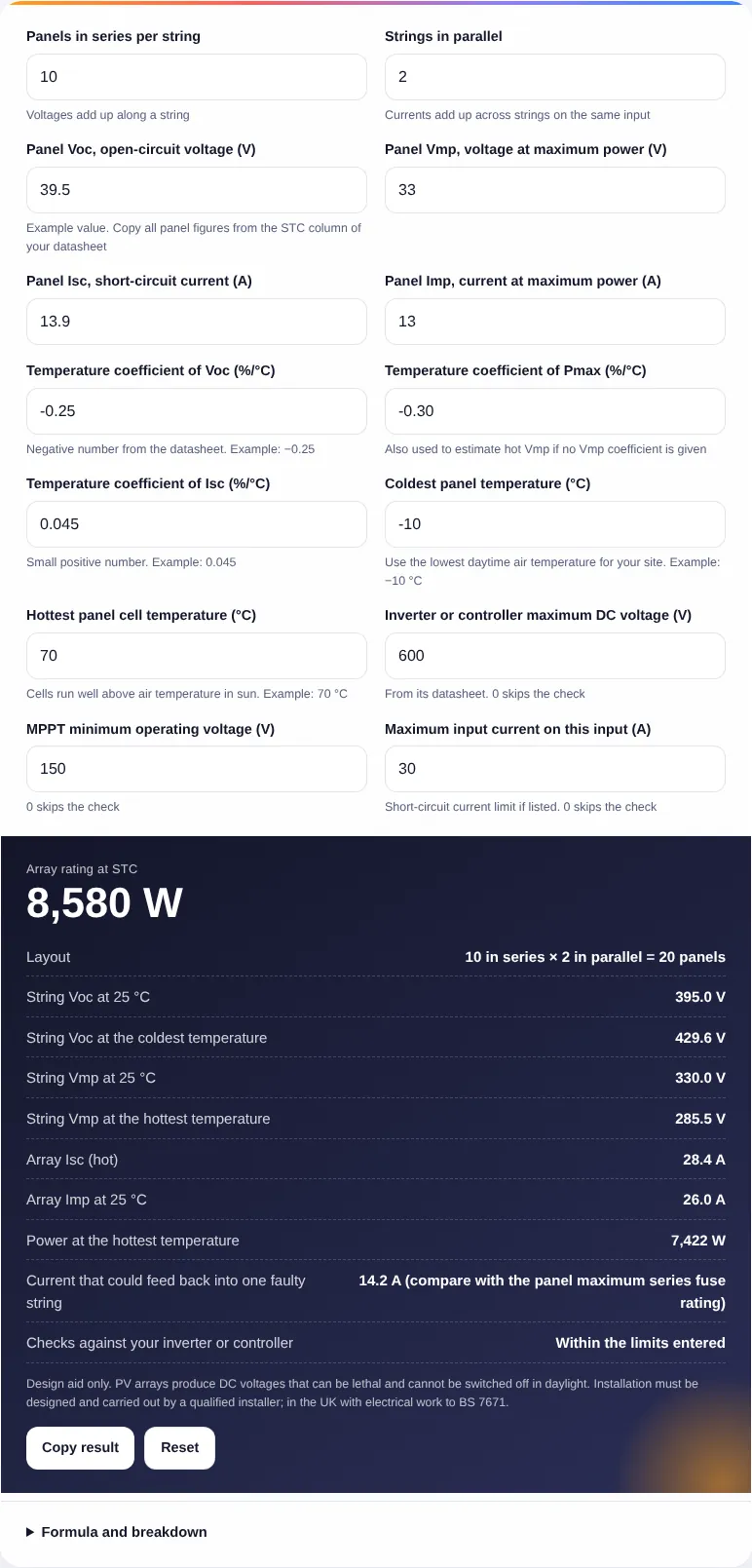
Array voltage = panel voltage × panels in series, and array current = panel current × strings in parallel. Ten panels with a Vmp of 33 V in series give 330 V; two such strings in parallel, each carrying 13 A, give 26 A on the same input. Power at STC is 330 V × 26 A = 8,580 W, the same as 20 panels × 429 W.
The temperature correction follows the method shown in the IAEI Magazine sample PV calculations: multiply the coefficient by the difference from 25 °C and apply it as a percentage. For Voc at −10 °C with a coefficient of −0.25% per °C, the change is −0.25% × (−10 − 25) = +8.75%, so a 39.5 V panel reaches about 42.96 V. The solar array calculator uses the Pmax coefficient as an approximation for hot Vmp when the datasheet does not list a Vmp coefficient; if yours does, enter that figure instead.
Is It Better to Wire Solar Panels in Series or Parallel?
Series wiring gives higher voltage and lower current, so thinner cable and lower losses; parallel wiring keeps voltage low and current high. The table shows the same eight example panels (39.5 V Voc, 33 V Vmp, 13.9 A Isc, 13 A Imp) wired four ways. Power is identical, but the current the cable must carry ranges from 13 A to 104 A.
| Layout | Voc at 25 °C | Voc at −10 °C | Vmp at 25 °C | Isc | Imp | Power at STC |
|---|---|---|---|---|---|---|
| 8 in series × 1 | 316.0 V | 343.6 V | 264 V | 13.9 A | 13 A | 3,432 W |
| 4 in series × 2 | 158.0 V | 171.8 V | 132 V | 27.8 A | 26 A | 3,432 W |
| 2 in series × 4 | 79.0 V | 85.9 V | 66 V | 55.6 A | 52 A | 3,432 W |
| 1 × 8 in parallel | 39.5 V | 43.0 V | 33 V | 111.2 A | 104 A | 3,432 W |
Grid-tied inverters usually want long series strings to reach their MPPT window, while small 12 V or 24 V battery systems often use shorter strings into an MPPT charge controller. Shading matters too: in a series string, one shaded panel can reduce the whole string's output, whereas parallel strings are affected separately. To size the cable for the current you end up with, use the solar cable size calculator.
How Many Panels Can You Put in One String?
The maximum number of panels per string is the inverter's maximum DC voltage divided by one panel's Voc at the coldest temperature, rounded down. For the example 39.5 V panel with a −0.25% per °C coefficient, that gives:
| Coldest temperature | Panel Voc | Maximum in series, 600 V input | Maximum in series, 1,000 V input |
|---|---|---|---|
| 0 °C | 41.97 V | 14 | 23 |
| −5 °C | 42.46 V | 14 | 23 |
| −10 °C | 42.96 V | 13 | 23 |
| −15 °C | 43.45 V | 13 | 23 |
| −20 °C | 43.94 V | 13 | 22 |
The minimum is set by the hot Vmp, which must stay above the MPPT minimum. The solar string size calculator works out both limits directly from your inverter's datasheet, and the MPPT charge controller calculator does the same job for battery systems.
Why Does Array Power Fall on Hot Days?
Array power falls by the Pmax coefficient for every degree the cells run above 25 °C: at −0.30% per °C and 70 °C cells, the loss is 13.5%. An 8,580 W array would then deliver about 7,422 W in full sun. That is normal and is already part of yield estimates, but it matters for the hot Vmp check and for comparing the array with the inverter's AC rating. The solar panel temperature loss calculator estimates cell temperature from air temperature if you do not know it.
What Safety Rules Apply to Solar Arrays?
A solar array produces DC voltage whenever light falls on it, and it cannot be switched off at the panels. Strings of several hundred volts DC can be lethal. Requirements for PV installations are set out in BS EN 60364-7-712 for solar photovoltaic power supply systems. In the UK, electrical work must also meet BS 7671. Design and installation should be carried out by a qualified installer, and the AC connection by a registered electrician. Use this solar array calculator to understand and check a design, not to replace that work.
With several strings in parallel, a fault in one string can be fed by the current of all the others. The solar array calculator shows that current so you can compare it with the maximum series fuse rating on the panel datasheet; the installer will decide whether string fuses are needed.
Worked Example: A 20-Panel Array on a 600 V Inverter
Example: a farm building in Northern Ireland will have 20 example panels rated 39.5 V Voc, 33 V Vmp, 13.9 A Isc and 13 A Imp, with coefficients of −0.25% per °C (Voc), −0.30% per °C (Pmax) and +0.045% per °C (Isc). The inverter input accepts up to 600 V, needs at least 150 V to track maximum power and takes up to 30 A. The design uses 10 panels in series and 2 strings in parallel, with a coldest temperature of −10 °C and hot cells at 70 °C.
- String Voc at 25 °C: 10 × 39.5 = 395 V. At −10 °C: 395 × 1.0875 = 429.6 V, under 600 V.
- String Vmp at 25 °C: 10 × 33 = 330 V. At 70 °C: 330 × (1 − 0.30% × 45) = 330 × 0.865 = 285.5 V, above 150 V.
- Array Isc when hot: 2 × 13.9 × 1.0203 = 28.4 A, under 30 A.
- Power: 10 × 2 × 33 × 13 = 8,580 W at STC, about 7,422 W with cells at 70 °C.
- Current that could feed one faulty string: 1 × 14.2 A.
In this example the layout passes all three checks. Adding four more panels per string would push cold Voc to 608 V at −15 °C, over the limit, which is why the cold check matters.
Frequently Asked Questions
What happens to voltage and current in series and parallel?
Connecting panels in series adds their voltages while the current stays the same as one panel. Connecting strings in parallel adds their currents while the voltage stays the same as one string. Power is voltage times current, so both layouts give the same total watts.
Why does solar panel voltage go up in cold weather?
A panel's open-circuit voltage has a negative temperature coefficient, so it falls as cells warm and rises as they cool. With a coefficient of −0.25% per °C, a panel at −10 °C has a Voc about 8.75% above its 25 °C rating.
Which temperature should I use for the cold Voc check?
Use the lowest air temperature likely during daylight at your site, because panels can sit at air temperature at dawn before the sun warms them. Local climate records give this figure. The solar array calculator's default of −10 °C is an example only, so change it to suit your location.
Why check the hot Vmp?
On hot sunny days cells run well above air temperature and their working voltage drops. If the string's hot Vmp falls below the inverter's MPPT minimum, the inverter cannot track maximum power, so output falls or the inverter stops until the panels cool.
Do I need string fuses?
With several strings in parallel, a fault in one string can be fed by all the others. The calculator shows that current so you can compare it with the maximum series fuse rating on the panel datasheet. A qualified installer decides on fusing under the wiring rules.
Can I install a solar array myself?
PV arrays produce DC voltages that can kill and cannot be switched off while light falls on the panels. In the UK, a solar array should be designed and installed by a qualified installer, with the electrical work meeting BS 7671. Elsewhere, follow your local wiring rules.
Checked October 2026 by the Solaxyra Editorial Team. Sources: IAEI Magazine: PV systems math, BSI: BS EN 60364-7-712.