Savings depend on your tariff staying similar. Smart tariffs and their rates can change.
Formula and breakdown
n/a
n/a
n/a
This battery tariff arbitrage calculator works out how much a home battery saves by charging on a cheap off-peak rate and supplying the house when electricity is expensive. It allows for round-trip losses and shows the payback on the battery’s cost.
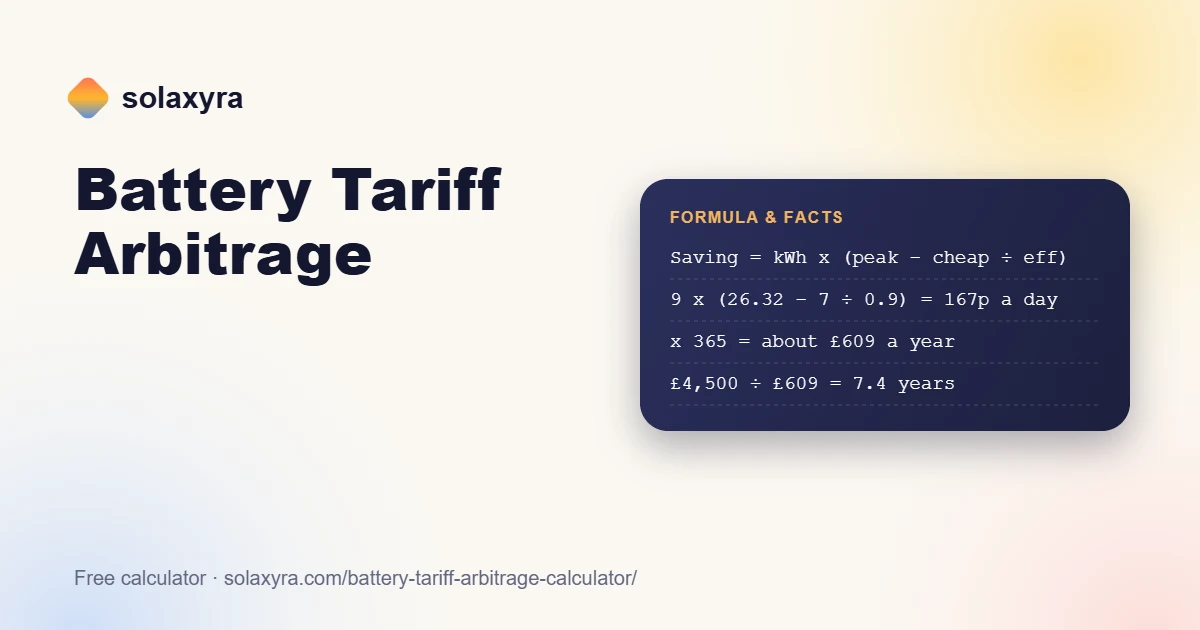
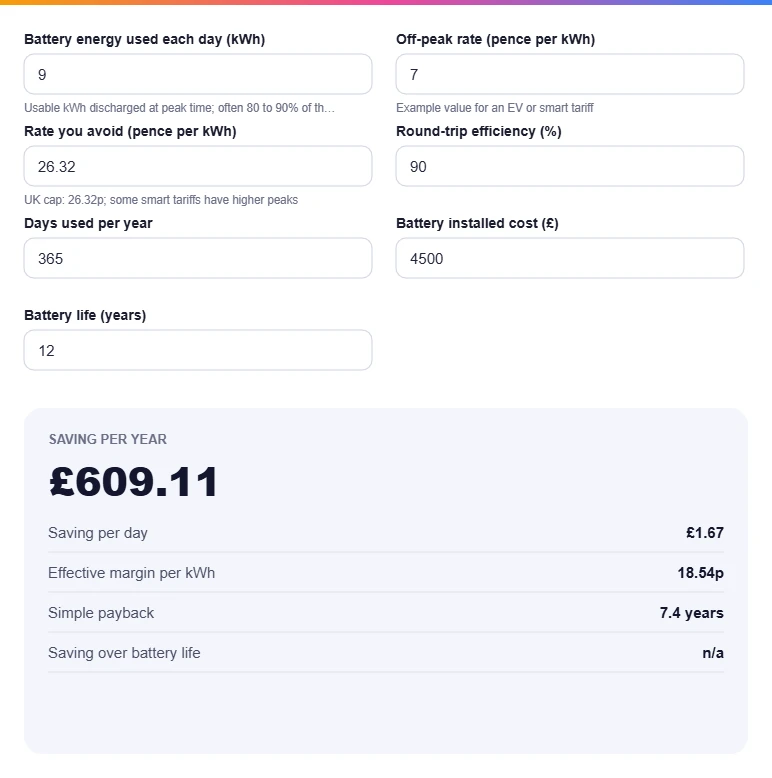
Quick answer: Each kWh you shift saves the peak rate minus the off-peak rate divided by the battery’s efficiency. Shifting 9 kWh a day from 26.32p to 7p with a 90% efficient battery saves about £1.67 a day, roughly £609 a year, so a £4,500 battery pays back in about 7.4 years.
What Is a Battery Tariff Arbitrage Calculator?
Tariff arbitrage means buying electricity when it is cheap, storing it, and using it when it is expensive. With a home battery and a time-of-use or EV tariff, you can charge overnight at a low rate and run the house on that stored energy in the day and evening. This works with or without solar panels.
How Do You Use the Battery Tariff Arbitrage Calculator?
- Enter how many kWh the battery supplies to the house each day. This is limited by both the battery size and your daytime and evening use.
- Enter the off-peak rate you charge at and the rate you avoid paying.
- Enter the round-trip efficiency, usually around 85 to 92% for lithium systems.
- Enter the days used, the installed cost and the expected life.
How Much Can a Battery Save on an Off-Peak Tariff?
At 90% efficiency, 365 days, avoiding 26.32p:
| Daily kWh shifted | Off-peak 7p | Off-peak 10p | Off-peak 15p |
|---|---|---|---|
| 5 kWh | £338 | £278 | £176 |
| 9 kWh | £609 | £500 | £317 |
| 13.5 kWh | £914 | £749 | £476 |
How Does Solar Change It?
In summer, solar may fill the battery during the day, so off-peak charging adds less. In winter, solar output is low, so tariff arbitrage does most of the work. Many systems switch strategy by season, charging from the grid overnight in winter and from solar in summer.
Watch the Smaller Print
- Count only energy you would really have used at peak rate; a battery larger than your evening use does not add savings.
- Batteries lose some capacity each year, so savings fall slowly over time.
- Some tariffs pay well for exports at peak times, which can increase returns, while others change rates often.
Worked Example: A Family Without Solar
Example: a family in Milton Keynes installs a 10 kWh battery and moves to an EV tariff with a 7.5p overnight rate.
- The battery supplies 8.5 kWh a day of the house’s daytime and evening use.
- Saving = 8.5 × 26.32p − 8.5 ÷ 0.9 × 7.5p = £1.53 a day.
- Over a year = £558; at £4,000 installed, payback is about 7.2 years.
Frequently Asked Questions
Can a battery save money without solar?
Yes, if you have a tariff with a big gap between off-peak and peak rates.
How much does battery arbitrage save?
Often £300 to £900 a year for a typical home battery, depending on the rates and use.
What round-trip efficiency should I use?
Around 90% for many lithium home batteries; check the data sheet.
Does battery degradation matter?
Yes; capacity falls gradually, so savings in later years are a little lower.
Checked November 2026 by the Solaxyra Editorial Team. Sources: Ofgem: Energy price cap, 1 October to 31 December 2026, Energy Saving Trust: Battery storage.