Treat an electric fire like any heater: keep the front clear, and do not cover the vents or use it to dry clothes.
Formula and breakdown
n/a
n/a
n/a
This electric fireplace running cost calculator works out what an electric fire or electric stove costs per hour, per day and per year. It handles the heater with its thermostat and the flame effect on its own, which costs only a fraction of a penny an hour on most LED models.
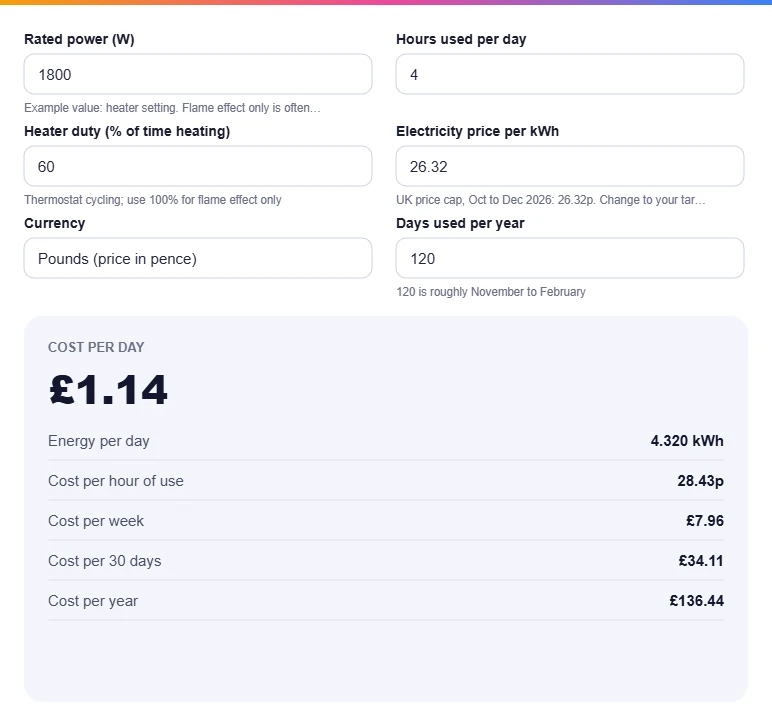
Quick answer: With the heater on, an electric fireplace costs its heater wattage times the hours the element is heating times your unit rate. A 1.8 kW fire on for 4 hours with the thermostat heating 60% of the time uses 4.32 kWh, about £1.14 a day at 26.32p per kWh. Flame effect alone is usually under 1p an hour.

What Is an Electric Fireplace Running Cost Calculator?
An electric fireplace running cost calculator shows the cost of the heat and the flame effect separately. Most electric fires have two parts: a fan heater, usually 1 to 2 kW with one or two settings, and a decorative flame effect lit by LEDs or a small bulb.
The heater is where nearly all the cost is. The flame effect on an LED model typically draws somewhere between 5 and 40 W, so you can run it for an evening for well under 5p.
How Do You Use the Electric Fireplace Running Cost Calculator?
- Enter the heater power from the label or manual. For flame effect only, enter the flame wattage instead.
- Enter the hours the fire is on each day.
- Set the heater duty. Once the room is warm the thermostat may only run the heater 40 to 70% of the time. Use 100% for flame effect only.
- Check the price per kWh and enter how many days a year you use it.
How Much Does an Electric Fire Cost to Run per Hour?
At the October to December 2026 cap of 26.32p per kWh:
| Setting | Power | Per hour, full | Per hour at 60% duty |
|---|---|---|---|
| Flame effect only (LED) | 20 W | 0.53p | 0.53p |
| Low heat | 900 W | 23.69p | 14.21p |
| High heat | 1,800 W | 47.38p | 28.43p |
| High heat | 2,000 W | 52.64p | 31.58p |
Is an Electric Fireplace Cheaper Than Central Heating?
For the whole house, gas central heating is cheaper per unit of heat: roughly 9p per kWh of heat at the October to December 2026 gas cap of 7.97p, against 26.32p for electricity. An electric fire makes sense as a top-up for the room you are in, letting you turn the central heating thermostat down a degree or two.
Electric Fire or Wood-Burning Stove?
An electric fire costs more per kWh of heat than seasoned firewood in many areas, but it needs no flue, no chimney sweeping and produces no smoke in the room. If you mainly want the look of a fire, an electric model on flame effect only costs almost nothing to run.
Tips to Keep the Cost Down
- Use the low heat setting once the room is warm, or let the thermostat do the work.
- Run flame effect only when you want the look rather than the heat.
- Keep doors closed so the heat stays in one room.
- A plug-in energy monitor will show the real duty for your room.
Worked Example: Evenings in a Living Room
Example: a family in Glasgow uses a 2 kW electric stove for 3 hours on winter evenings.
- The thermostat runs the heater about half the time once the room is warm.
- Energy = 2 kW × 3 h × 50% = 3 kWh.
- Cost per evening = 3 kWh × 26.32p = 79p.
- Over 120 evenings = £94.75.
- The same evenings on flame effect only at 20 W would cost about 19p in total.
Frequently Asked Questions
How much does an electric fireplace cost to run per hour?
On a 2 kW heat setting, about 53p an hour at full power at 26.32p per kWh, and less once the thermostat starts cycling.
How much does the flame effect cost on its own?
Usually under 1p an hour. A 20 W LED flame costs about 0.5p an hour at the current cap.
Do electric fires use a lot of electricity?
The heater does, in the same way as any 1 to 2 kW heater. The flame effect uses very little.
Can an electric fireplace heat a whole room?
A 2 kW fire can heat a typical living room, but it will cost more than gas central heating per unit of heat.
Checked November 2026 by the Solaxyra Editorial Team. Sources: Ofgem: Energy price cap, 1 October to 31 December 2026.