Keep at least 1 m clear around the radiator, never dry clothes on it, and plug it straight into a wall socket rather than an extension lead.
Formula and breakdown
n/a
n/a
n/a
This oil-filled radiator running cost calculator works out what a plug-in oil-filled radiator costs per hour, per day, per week and over a winter for homes in the UK, Ireland and Europe. It allows for the thermostat switching the element on and off, which is the reason most real bills come in below the label wattage.
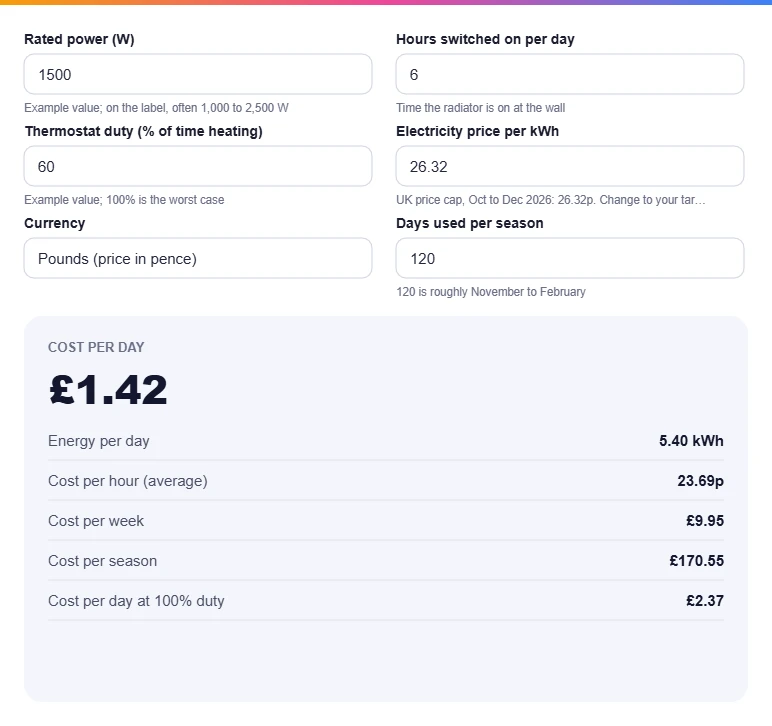
Quick answer: An oil-filled radiator costs its wattage in kW multiplied by the hours the element is actually heating and your unit rate. A 1,500 W radiator on for 6 hours with the element running 60% of the time uses 5.4 kWh, about £1.42 a day at the October to December 2026 cap of 26.32p per kWh.

What Is an Oil-Filled Radiator Running Cost Calculator?
An oil-filled radiator running cost calculator turns the wattage on the rating label into a cost you can compare with your bill. It multiplies power by hours and by your unit rate, then adjusts for the thermostat duty, which is the share of time the element is actually drawing power.
The oil inside never needs topping up and is not burned. It is sealed in and simply stores heat from the electric element, so the running cost is the same per kWh as any other electric heater. What changes is how often the element switches on to hold the temperature you set.
How Do You Use the Oil-Filled Radiator Running Cost Calculator?
- Enter the rated power in watts from the label on the side or base. Radiators with 2 or 3 power settings list each one; use the setting you normally pick.
- Enter how many hours a day the radiator is switched on at the wall.
- Set the thermostat duty. In a reasonably insulated room, 50 to 70% is common once the room is warm. Use 100% for a cold, draughty room or a worst-case figure.
- Check the price per kWh and change it to your own tariff if you know it.
- Enter how many days you use it over the heating season to see the seasonal total.
How Much Does an Oil-Filled Radiator Cost to Run per Hour?
At full power, a radiator costs its kilowatts multiplied by your unit rate. With the thermostat cycling, the average hourly cost is lower. The table uses the October to December 2026 cap rate of 26.32p per kWh.
| Rated power | Per hour, full power | Per hour at 60% duty | 6 hours at 60% duty |
|---|---|---|---|
| 500 W | 13.16p | 7.90p | 47p |
| 1,000 W | 26.32p | 15.79p | 95p |
| 1,500 W | 39.48p | 23.69p | £1.42 |
| 2,000 W | 52.64p | 31.58p | £1.89 |
| 2,500 W | 65.80p | 39.48p | £2.37 |
Lower power settings do not make the heat cheaper per kWh. They just take longer to warm the room, so the element may run for more of the time.
Is an Oil-Filled Radiator Cheaper Than Gas Central Heating?
Usually not per unit of heat. Gas at the October to December 2026 cap is 7.97p per kWh, and a modern condensing boiler turns around 85 to 90% of that into heat, so a kWh of heat costs roughly 9p. An oil-filled radiator turns all of its electricity into heat, but each kWh costs 26.32p.
Where a radiator wins is when you heat one room for a few hours instead of the whole house. Running a 1,500 W radiator in a home office can cost less than firing the central heating for every room, especially in a larger house.
Are Oil-Filled Radiators Cheaper Than Fan Heaters?
Per kWh, no. Every plug-in electric heater is close to 100% efficient at turning electricity into heat. The difference is comfort and timing. A fan heater warms the air quickly and is good for short bursts. An oil-filled radiator takes 20 to 30 minutes to warm up but keeps giving out heat after the element switches off, which feels steadier over a long evening.
How Can You Cut the Cost?
- Use the thermostat rather than the highest setting, and set it a degree or two lower.
- Close the door and curtains so the heat stays in the room you are using.
- Use a plug-in timer so the radiator does not run in an empty room.
- Measure the real use with a plug-in energy monitor for a few days and enter that duty here.
Worked Example: A Home Office Through Winter
Example: someone working from home in Bristol uses a 2,000 W radiator for 8 hours a day on 100 working days.
- The room is small and fairly well insulated, so the thermostat holds the temperature with the element on about half the time.
- Energy per day = 2 kW × 8 h × 50% = 8 kWh.
- Cost per day = 8 kWh × 26.32p = £2.11.
- Over 100 days = £210.56.
- If the room were draughty and the element ran 80% of the time, the same days would cost about £337.
- Draught-proofing the window and door could pay back in a single winter.
Frequently Asked Questions
How much does an oil-filled radiator cost to run per hour?
A 1,500 W radiator costs about 39p an hour at full power at 26.32p per kWh. With the thermostat switching the element off part of the time, the average is often closer to 20 to 30p an hour.
Do oil-filled radiators use a lot of electricity?
They use the same electricity as any heater of the same wattage. A 2,000 W model uses 2 kWh for each hour it heats at full power. The oil only stores and spreads the heat.
Is it cheaper to leave an oil-filled radiator on low all day?
Not usually. Heat lost from the room depends on how warm it is kept and for how long, so heating an empty room all day adds cost. A timer that warms the room shortly before you use it is normally cheaper.
Are oil-filled radiators safe to leave on overnight?
Most have a thermostat and tip-over or overheat protection, but follow the manual, keep them clear of curtains and bedding, and plug them directly into a wall socket.
Do oil-filled radiators ever need refilling?
No. The oil is sealed in at the factory and is not used up. A radiator that leaks oil should be taken out of use.
Checked November 2026 by the Solaxyra Editorial Team. Sources: Ofgem: Energy price cap, 1 October to 31 December 2026, Energy Saving Trust: Heating and hot water.