Cost inputs are example values, not market prices: replace them with your quotes. Running costs exclude standing charges. Electric underfloor heating must be connected by a qualified electrician to BS 7671; boiler work needs a Gas Safe registered engineer. Prices checked October 2026.
Formula and breakdown
n/a
n/a
n/a
n/a
This underfloor heating cost calculator estimates what electric (dry) and wet (water) underfloor heating would cost to install in a room or floor in the UK, then compares what each would cost to run each year and how long the dearer wet system takes to repay its extra cost. Every price in the underfloor heating cost calculator is an editable example, so you can type in the figures from your own quotes and see the result change instantly.
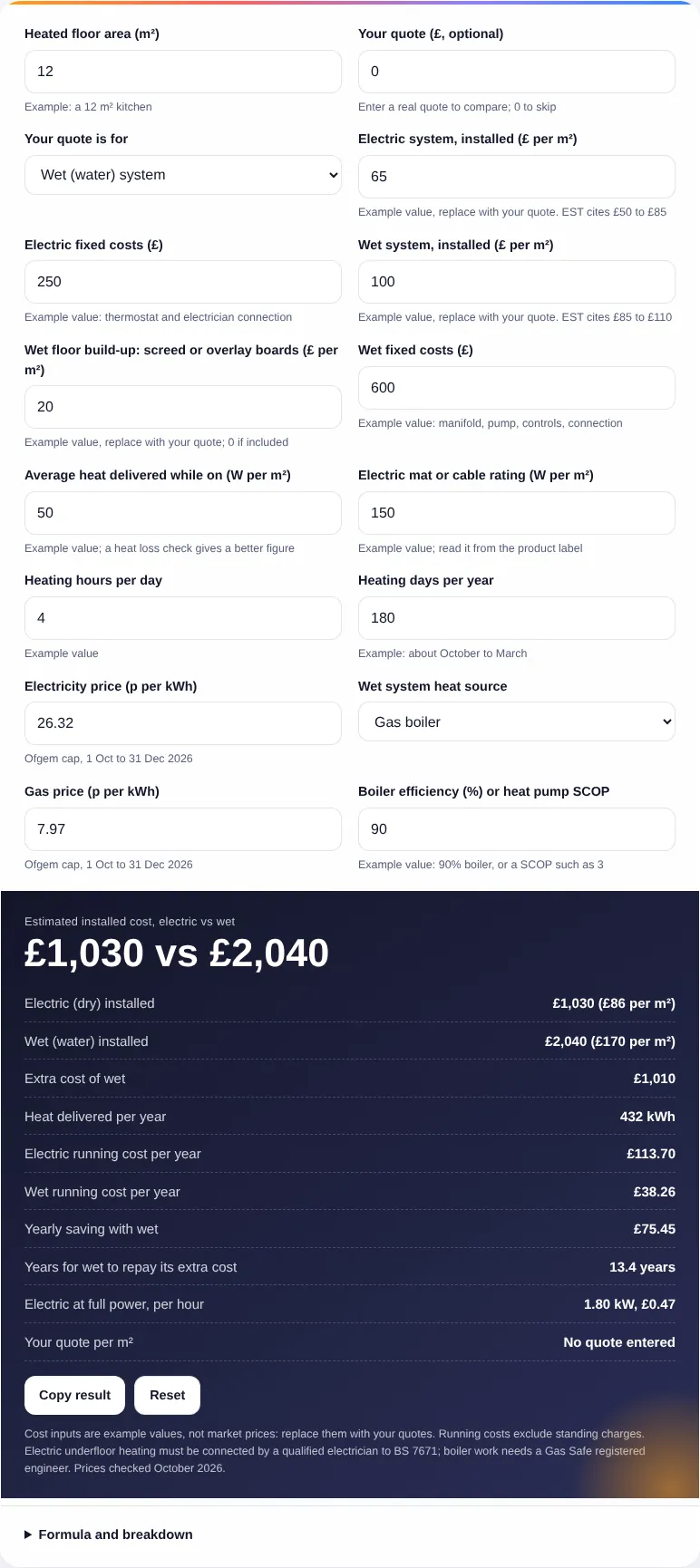
Quick answer: An underfloor heating cost calculator multiplies floor area by the installed price per m² for each system, adds fixed costs, then compares running costs. With example prices, a 12 m² kitchen costs about £1,030 electric or £2,040 wet; wet saves about £75 a year on a gas boiler, repaying the difference in about 13 years.
What Is an Underfloor Heating Cost Calculator?
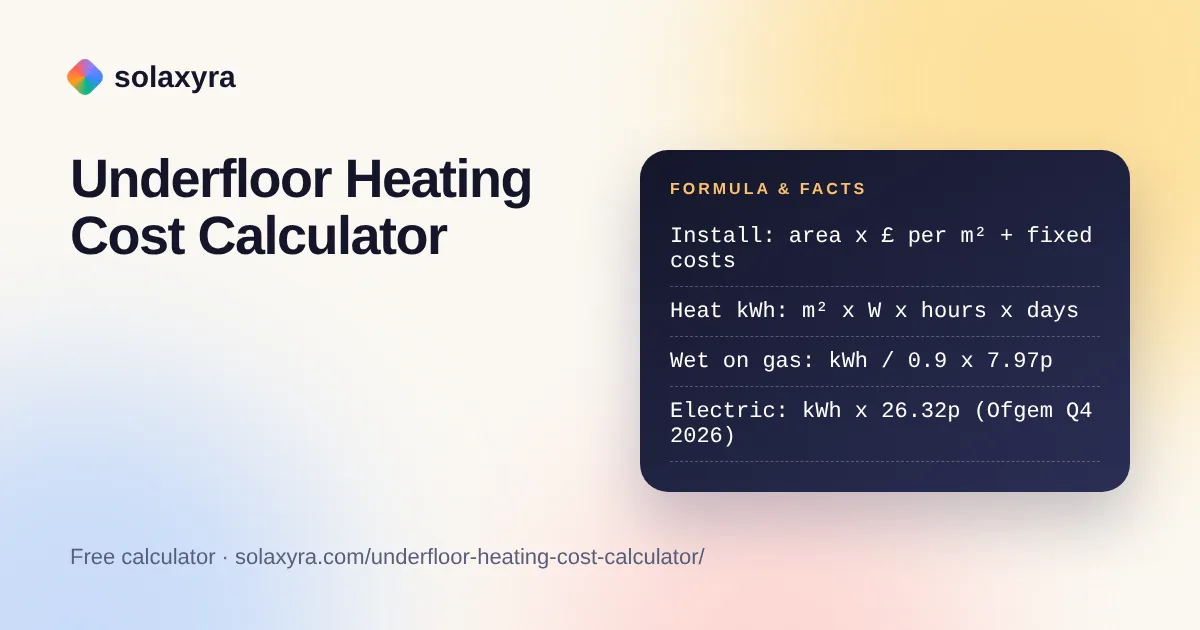
An underfloor heating cost calculator is a tool that turns floor area, installed prices and energy prices into an installation budget and a yearly running cost for electric and wet systems side by side. In plain words: installed cost equals area times price per m² plus fixed costs, and running cost equals the heat the room needs divided by the efficiency of the heat source, times the price of that fuel.
The two systems are built differently. The Energy Saving Trust’s underfloor heating advice describes wet systems as pipes laid under the floor and dry systems as electric mats or cables, and notes that dry systems are generally cheaper to install but more expensive to run. This page puts numbers on that trade-off for your room.
How Do You Use the Underfloor Heating Cost Calculator?
- Enter the floor area you want to heat in square metres. Measure only the open floor, not the space under kitchen units, baths or fitted wardrobes.
- If you already have a quote, enter it and choose whether it is for an electric or a wet system. The tool shows your quote per m² and how far it is from the estimate.
- Replace the example installed prices, the floor build-up cost and the fixed costs with figures from your installer.
- Set the average heat the floor needs to deliver, the heating hours per day and the number of heating days per year.
- Choose a gas boiler or a heat pump for the wet system and enter its efficiency or SCOP. The electricity and gas prices default to the Ofgem cap for October to December 2026.
- Read the installed costs, yearly running costs, the saving and the payback years, then open the breakdown to check each step.
How Much Does Underfloor Heating Cost per m²?
The Energy Saving Trust quotes, citing Checkatrade, about £50 to £85 per m² for dry electric underfloor heating and £85 to £110 per m² for a wet system. These are the only published ranges from an official adviser we could confirm in October 2026, so the underfloor heating cost calculator uses figures inside them as example defaults rather than as market prices.
Your real price can sit well outside those ranges. Trade lead-generation sites publish their own averages, but they rarely say how many quotes sit behind them or whether VAT is included, so we do not present them as fact. Ask each installer for an itemised quote that shows materials, labour, floor preparation, controls and VAT separately, then enter those lines in the underfloor heating cost calculator.
What Drives the Cost of Underfloor Heating?
Floor build-up is usually the biggest swing factor: a wet system laid in a new screed or on overlay boards costs far more per m² than an electric mat tiled straight over an existing floor. The main drivers are:
- System type. Electric mats and cables are thin and quick to lay. Wet systems need pipework, a manifold, a pump and a heat source connection.
- Floor build-up. A wet system needs either a screed or low-profile boards, which raise the floor and can mean trimming doors and adjusting thresholds.
- Insulation below the heating. Boards under the system send more heat up into the room rather than down into the slab.
- Floor finish. The Energy Saving Trust notes that thick carpet slows heat transfer and points to a carpet tog rating of 2.5 or lower, including underlay.
- New build or retrofit. Lifting an existing floor adds labour and waste compared with laying the system during a renovation.
- Controls and connection. Thermostats, zoning, the electrician’s connection for a dry system and the plumber’s or heating engineer’s work for a wet one are fixed costs that weigh more heavily on small rooms.
Is Wet or Electric Underfloor Heating Cheaper to Run?
Wet underfloor heating is cheaper to run in almost every UK home, because a gas boiler or heat pump produces heat for less than electric resistance. At the October to December 2026 Ofgem cap, electricity costs 26.32p per kWh and gas 7.97p per kWh. A unit of heat from an electric mat costs 26.32p, while a 90% efficient boiler delivers it for about 8.9p and a heat pump with a SCOP of 3 for about 8.8p.
The room needs the same amount of heat whichever system provides it, which is why this underfloor heating cost calculator asks for the heat delivered rather than the mat’s rated wattage. A thermostat cycles an electric mat on and off, so it rarely draws its full rating for long. The full-power line in the results shows the maximum it could draw, useful for checking the circuit with your electrician. For a deeper look at running costs alone, try our underfloor heating running cost tool or compare fuels with the heat pump running cost calculator.
How Long Does Wet Underfloor Heating Take to Pay Back?
With the example prices on this page, a wet system repays its extra installation cost in about 10 to 23 years, faster in larger rooms because fixed costs are spread over more floor. The table uses the default inputs: 50 W per m² of heat for 4 hours a day on 180 days, a 90% gas boiler or a SCOP 3 heat pump, and the Ofgem cap prices.
| Floor area | Electric installed | Wet installed | Electric running per year | Wet (gas) running per year | Payback, gas | Payback, heat pump |
|---|---|---|---|---|---|---|
| 4 m² en suite | £510 | £1,080 | £37.90 | £12.75 | 22.7 years | 22.6 years |
| 12 m² kitchen | £1,030 | £2,040 | £113.70 | £38.26 | 13.4 years | 13.3 years |
| 20 m² living room | £1,550 | £3,000 | £189.50 | £63.76 | 11.5 years | 11.5 years |
| 60 m² ground floor | £4,150 | £7,800 | £568.51 | £191.28 | 9.7 years | 9.6 years |
All installed figures are calculated from example prices, not quotes: electric £65 per m² plus £250 fixed, wet £100 per m² plus £20 per m² build-up plus £600 fixed. Change them in the underfloor heating cost calculator to see your own payback. A small bathroom heated for a short time each day rarely repays a wet system, which is why electric mats are common in en suites.
Do You Need an Electrician or Gas Engineer?
Yes: electric underfloor heating must be connected by a qualified electrician and the installation must meet BS 7671, and any work on a gas boiler must be carried out by a Gas Safe registered engineer. In England, Approved Document P covers electrical safety in dwellings and explains when electrical work must be notified to building control. Bathrooms are special locations with extra requirements, so take the full-power figure from the underfloor heating cost calculator to your electrician and check the circuit, protection and thermostat position before you buy a mat.
A wet system connected to a heat pump should be designed from a room-by-room heat loss calculation. Our heat loss calculator gives a first estimate of the watts a room needs, which you can divide by the floor area to set the heat input here.
Worked Example: Underfloor Heating in a 12 m² Kitchen
Example: a household in Bristol is extending its kitchen and wants underfloor heating across 12 m² of open floor. It has a gas combi boiler and pays the Ofgem cap prices. It runs the underfloor heating cost calculator with example prices to compare an electric mat with a wet system before asking installers for quotes.
- Electric installed: 12 m² x £65 = £780, plus £250 fixed = £1,030.
- Wet installed: 12 m² x (£100 + £20 build-up) = £1,440, plus £600 fixed = £2,040. Extra cost of wet: £1,010.
- Heat needed: 12 m² x 50 W x 4 hours x 180 days / 1,000 = 432 kWh a year.
- Electric running: 432 kWh x 26.32p = £113.70 a year.
- Wet running: 432 kWh / 0.90 = 480 kWh of gas x 7.97p = £38.26 a year.
- Saving with wet: £75.45 a year. Payback: £1,010 / £75.45 = 13.4 years.
If the household later fits a heat pump with a SCOP of 3, the wet running cost becomes 144 kWh x 26.32p = £37.90, almost the same as gas at these prices. To estimate what other heaters cost to run, the electric heater running cost calculator uses the same price inputs.
Frequently Asked Questions
How much does underfloor heating cost per square metre in the UK?
The Energy Saving Trust, citing Checkatrade, gives about £50 to £85 per m² for electric (dry) underfloor heating and £85 to £110 per m² for wet systems. Floor build-up, insulation, controls and connection costs come on top, so always compare itemised quotes.
Is electric underfloor heating expensive to run?
It costs about three times as much per unit of heat as a wet system on gas. At the October to December 2026 Ofgem cap, electricity is 26.32p per kWh against about 8.9p for heat from a 90% efficient gas boiler. Small rooms used briefly keep the yearly bill low.
Does the mat wattage decide the running cost?
No. The heat the room loses decides it. A thermostat switches the mat off once the room is warm, so a 150 W per m² mat seldom runs at full power for long. The rating sets the maximum draw and how fast the floor warms up.
Can underfloor heating work with a heat pump?
Yes, and it suits them well. The Energy Saving Trust explains that underfloor heating can run at a lower flow temperature than radiators, which should help a heat pump run more efficiently. Enter the heat pump’s SCOP to see the running cost.
Why are the prices in the calculator only examples?
No official body publishes a current UK price list for installed underfloor heating. We use example values inside the Energy Saving Trust range and label them clearly, so you replace them with your own quotes instead of relying on unverified averages.
Is wet underfloor heating worth it for a small bathroom?
Often not on cost alone. With the example inputs, a 4 m² en suite takes over 22 years to repay the extra cost of a wet system, because fixed costs for the manifold and connection are spread over very little floor.
Checked October 2026 by the Solaxyra Editorial Team. Sources: Energy Saving Trust: Underfloor heating, Ofgem: Energy price cap 1 October to 31 December 2026, GOV.UK: Approved Document P, electrical safety in dwellings, Wikipedia: Underfloor heating, HSE: Domestic gas safety FAQs.