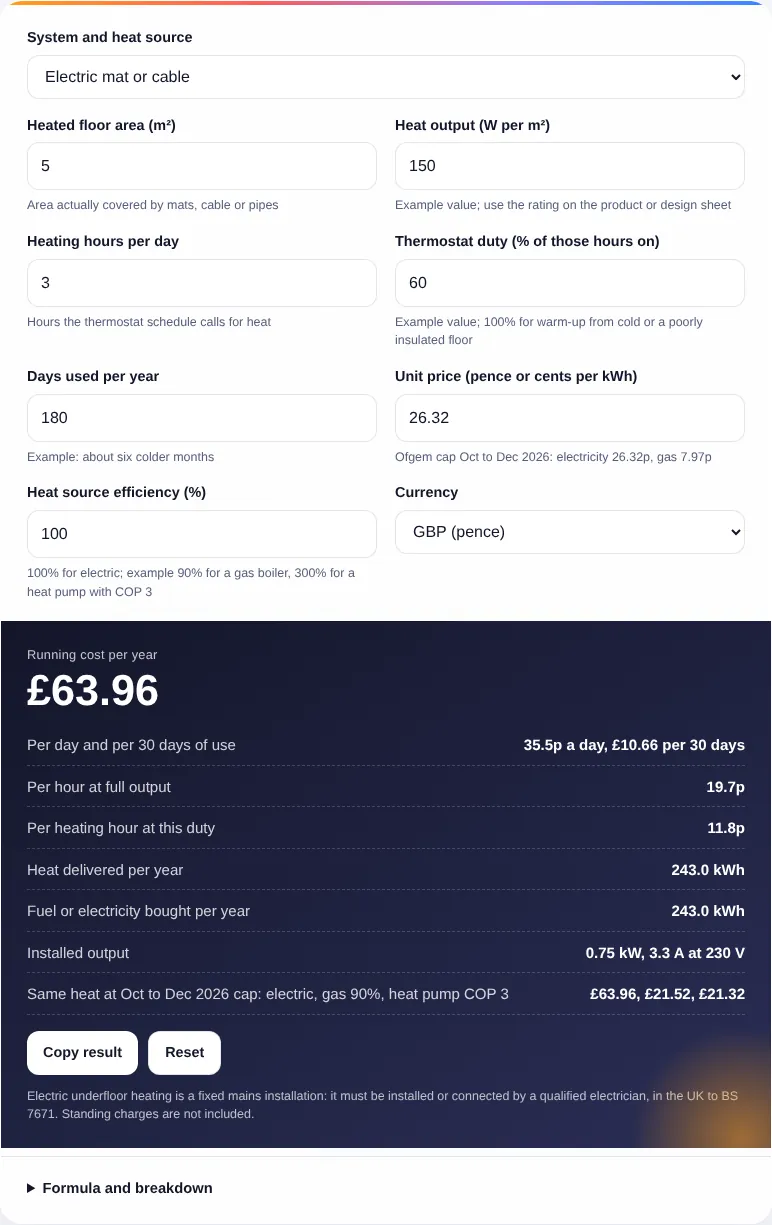
Electric underfloor heating is a fixed mains installation: it must be installed or connected by a qualified electrician, in the UK to BS 7671. Standing charges are not included.
Formula and breakdown
n/a
n/a
n/a
This underfloor heating running cost calculator works out what electric mats or cables, or a wet underfloor system, cost to run per hour, per day and per year, for homeowners and renovators in the UK, Ireland and Europe. It uses the Ofgem price cap for October to December 2026 as the default, models how often the thermostat actually switches the heating on, and prices the same heat from electricity, gas and a heat pump side by side.
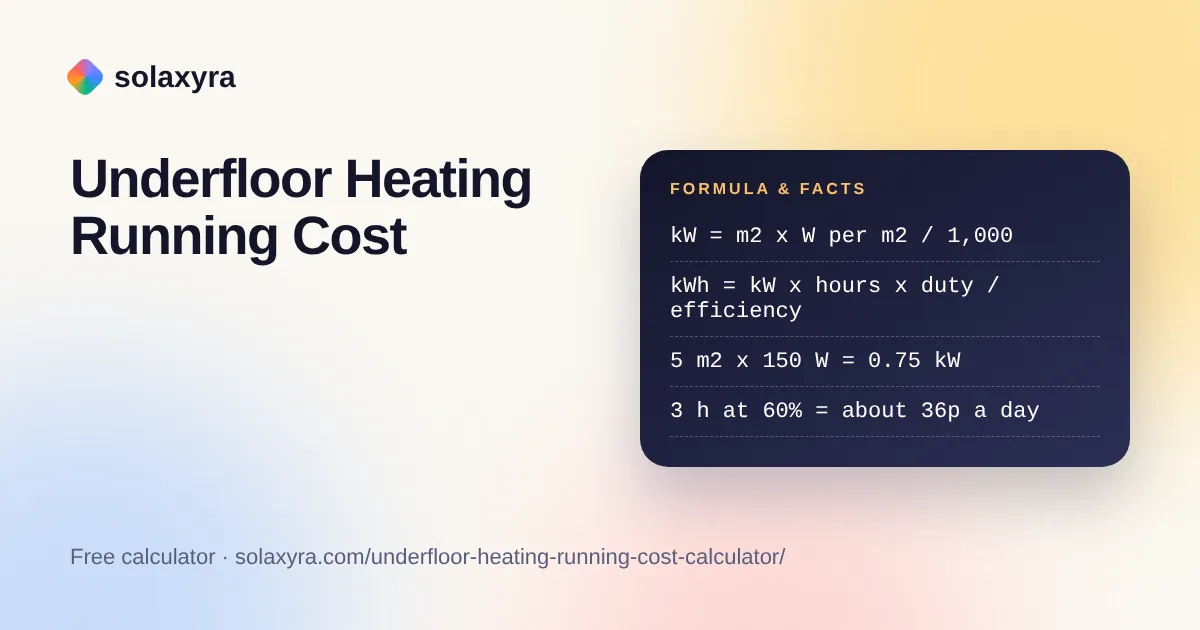
Quick answer: An underfloor heating running cost calculator multiplies heated area by output per square metre, heating hours and thermostat duty, divides by heat source efficiency and applies your unit price. A 5 m2 electric bathroom mat at 150 W per m2, used 3 hours a day at 60% duty, costs about 36p a day at 26.32p per kWh.
What Is an Underfloor Heating Running Cost Calculator?
An underfloor heating running cost calculator is a tool that turns the size and output of a floor heating system, and how long it runs, into energy use and cost. In plain words: installed kW equals area times watts per square metre divided by 1,000; heat per day equals kW times heating hours times the thermostat duty; energy bought equals heat divided by the heat source efficiency; cost equals energy times unit price.
Electric systems turn electricity into heat at 100% efficiency in the room, so every kWh of heat costs one kWh of electricity. Wet systems circulate warm water heated by a boiler or heat pump. The Wikipedia article on underfloor heating notes that electric systems have fewer components and are simpler to install, while water-based systems run at lower water temperatures than radiators, which helps heat pump efficiency.
How Do You Use the Underfloor Heating Running Cost Calculator?
- Choose the system: electric mat or cable, or a wet system with a gas boiler, heat pump or other heat source. The price and efficiency fill in automatically and stay editable.
- Enter the heated floor area, meaning the area covered by mats, cable or pipes rather than the whole room.
- Enter the output per square metre from the product label or design sheet.
- Enter the hours the thermostat schedule calls for heat, and the share of that time the system is actually on.
- Enter the days used per year, then read the yearly, daily and hourly costs and the comparison row.
How Much Does Electric Underfloor Heating Cost to Run?
Every square metre of a 150 W per m2 electric mat costs about 3.9p an hour at full output at 26.32p per kWh, so a 5 m2 bathroom costs about 19.7p an hour flat out and 11.8p at 60% duty. The table uses 150 W per m2, 3 hours a day at 60% duty for 180 days, at the Ofgem cap of 26.32p per kWh for October to December 2026.
| Heated area | Installed output | Per hour at full output | Per hour at 60% duty | kWh per year | Cost per year |
|---|---|---|---|---|---|
| 3 m2 | 0.45 kW | 11.8p | 7.1p | 145.8 | £38.37 |
| 5 m2 | 0.75 kW | 19.7p | 11.8p | 243.0 | £63.96 |
| 8 m2 | 1.20 kW | 31.6p | 19.0p | 388.8 | £102.33 |
| 12 m2 | 1.80 kW | 47.4p | 28.4p | 583.2 | £153.50 |
| 20 m2 | 3.00 kW | 79.0p | 47.4p | 972.0 | £255.83 |
For a portable or panel heater in the same room, the electric heater running cost calculator gives a like-for-like comparison, because both convert electricity to heat one for one.
What Does Thermostat Duty Mean for the Bill?
Thermostat duty is the share of the scheduled hours that the heating is actually drawing power, and the cost scales directly with it: the example bathroom costs £42.64 a year at 40% duty, £63.96 at 60%, £85.28 at 80% and £106.60 at 100%. During warm-up from cold the system runs at 100%; once the floor is at temperature, the thermostat switches it on and off.
Duty depends on how much heat escapes downwards and through the room. Insulation boards under electric mats send more heat up into the room, and floor coverings matter too: Wikipedia notes that carpeted floors need to run at higher temperatures than tile. If you have a plug-in or smart thermostat that reports energy, use its figures to set the duty.
Is Wet Underfloor Heating Cheaper Than Electric?
For the same heat, a wet system on a gas boiler at 90% efficiency or a heat pump with a COP of 3 costs roughly a third of direct electric at the October to December 2026 cap, because gas is 7.97p per kWh and a heat pump delivers about three units of heat per unit of electricity. The comparison row in the underfloor heating running cost calculator shows all three for whatever heat you enter.
Wet systems cost more to install and suit larger areas or whole floors, while electric mats suit small rooms such as bathrooms. The heat pump running cost calculator compares heat pumps with gas boilers for the whole home.
Who Can Install Electric Underfloor Heating?
Electric underfloor heating is a fixed mains installation, so it must be connected by a qualified electrician; in the UK the work must meet BS 7671. Electricians registered with a competent person scheme, listed on the gov.uk competent person scheme page, can self-certify the work instead of applying for building regulations approval. The underfloor heating running cost calculator shows the installed current at 230 V and flags loads above 13 A so you can discuss the circuit and controls with your electrician. Use the watts to amps calculator for other loads. Wet systems connected to a gas boiler involve gas appliance work, which must be done by a Gas Safe registered engineer.
Worked Example: Electric Mat in a Bathroom
Example: a 5 m2 heated area in a bathroom with a 150 W per m2 mat on insulation boards, scheduled for 3 hours a day from October to March (about 180 days), with the thermostat on for an estimated 60% of that time, at 26.32p per kWh.
- Installed output: 5 x 150 = 750 W, which draws 3.26 A at 230 V.
- Heat per day: 0.75 kW x 3 h x 60% = 1.35 kWh, costing 35.5p.
- Per year: 1.35 x 180 = 243 kWh, costing £63.96, or about £10.66 for each 30 days of use.
- Same heat from gas at 90%: about £21.52 a year; from a heat pump at COP 3: about £21.32.
Doubling the scheduled hours doubles the cost, while better insulation that cuts the duty to 40% brings it down to about £42.64.
Frequently Asked Questions
How much does electric underfloor heating cost per hour?
At full output, multiply the installed kilowatts by your unit price. A 5 m2 mat at 150 W per m2 is 0.75 kW, about 19.7p an hour at 26.32p per kWh. Once the floor is warm the thermostat cycles, so the average is lower, about 11.8p at 60% duty.
Is electric underfloor heating expensive to run?
Per unit of heat it costs the same as any direct electric heater, so it is dearer than gas or a heat pump. In a small room used for a few hours it is modest: the example bathroom costs about £64 a year. Large areas heated for long periods become expensive.
Is wet underfloor heating cheaper to run than electric?
Usually, because the water is heated by a gas boiler or heat pump rather than direct electricity. At the October to December 2026 cap, the same heat costs roughly a third as much from gas at 90% efficiency or a heat pump with a COP of 3.
What is thermostat duty in underfloor heating?
It is the share of the scheduled heating time that the heating is actually on. While warming up from cold it runs constantly; once the floor reaches temperature the thermostat switches it on and off. Good insulation under the floor lowers the duty and the cost.
Does floor covering affect running costs?
Yes. Coverings that resist heat, such as thick carpet and underlay, make the system run at a higher temperature or for longer to deliver the same warmth. Tile and stone pass heat more easily. Check the manufacturer’s limits for any covering you plan to use.
Do I need an electrician for electric underfloor heating?
Yes. Electric underfloor heating is a fixed mains installation, so it must be connected by a qualified electrician, and in the UK the work must meet BS 7671. Registered electricians can self-certify through a competent person scheme. Large systems may need a dedicated circuit.
Checked October 2026 by the Solaxyra Editorial Team. Sources: Ofgem, energy price cap 1 October to 31 December 2026, Wikipedia, Underfloor heating, GOV.UK, Competent person schemes.