This guide compares a 12V vs 24V vs 48V solar system for off-grid setups such as campervans, boats, cabins and home battery backups. It explains how system voltage changes the current, cable sizes and losses, and which voltage suits each type of system.
Quick answer: For the same power, a higher voltage means lower current, which allows thinner cables and lower losses. 12 V suits small van and caravan systems up to roughly 1,000 to 1,500 W. 24 V suits mid-sized systems and boats. 48 V is usually best for cabins and larger systems above about 3,000 W.
Why system voltage matters
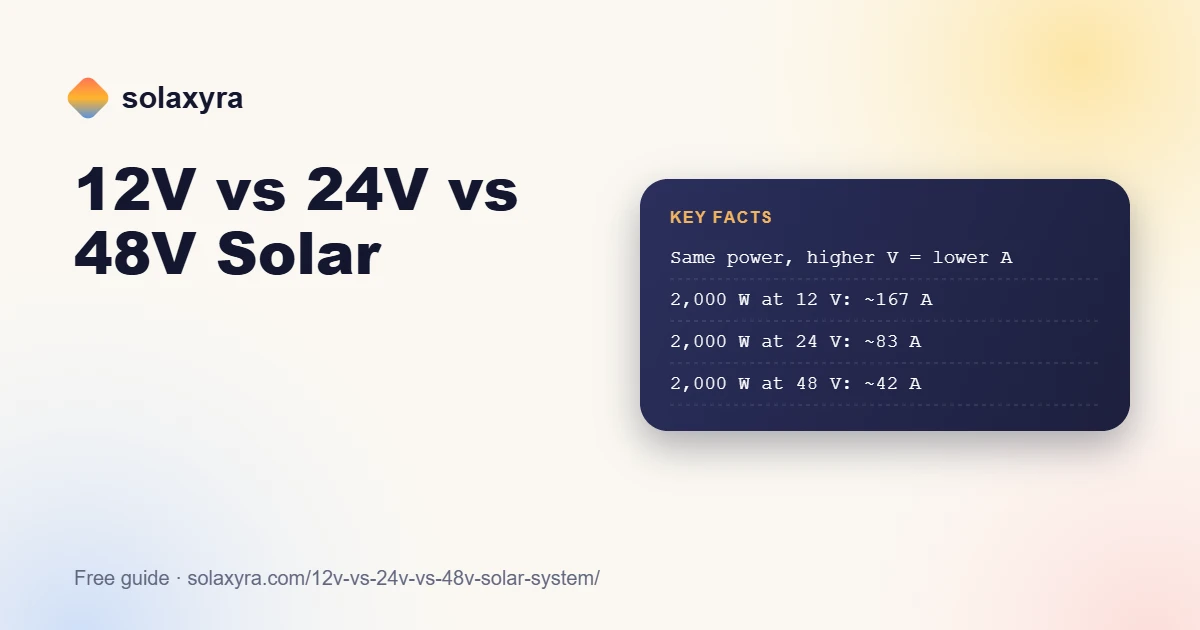
Power equals voltage times current. Doubling the voltage halves the current for the same power. Cable losses rise with the square of the current, so halving the current cuts losses to about a quarter in the same cable, or lets you use a smaller cable.
Current needed at each voltage
| Load | 12 V | 24 V | 48 V |
|---|---|---|---|
| 500 W | 42 A | 21 A | 10 A |
| 1,000 W | 83 A | 42 A | 21 A |
| 2,000 W | 167 A | 83 A | 42 A |
| 3,000 W | 250 A | 125 A | 63 A |
Inverter losses add to these figures.
12 V systems
- Pros: most vehicle and leisure appliances run directly on 12 V; components are easy to find.
- Cons: high currents for larger inverters need very thick cables and large fuses.
- Best for: campervans, caravans and small boats with modest loads.
24 V systems
- Pros: half the current of 12 V; common on larger boats and trucks.
- Cons: 12 V appliances need a converter.
- Best for: mid-sized off-grid systems and boats with bigger inverters.
48 V systems
- Pros: low currents even for 3 to 5 kW inverters; many hybrid inverters and rack batteries are 48 V.
- Cons: fewer direct-use appliances; needs care with higher DC voltages.
- Best for: cabins, workshops, home backup and larger off-grid homes.
Does voltage affect solar panel choice?
Panels are wired in series or parallel to suit the charge controller’s input range, not the battery voltage directly. An MPPT controller can take a higher panel voltage and charge a 12, 24 or 48 V battery efficiently.
Example: running a 2 kW inverter
Running a 2,000 W load through a 90% efficient inverter needs about 2,222 W from the battery: about 185 A at 12 V, 93 A at 24 V or 46 A at 48 V. At 12 V that requires very heavy cable and a large fuse; at 48 V standard sizes are enough.
Frequently Asked Questions
Is 24 V better than 12 V for solar?
For larger systems, yes, because the current is halved; for small vans, 12 V is simpler.
When should I use a 48 V system?
For inverters above about 3,000 W or whole-cabin and home battery systems.
Can I run 12 V appliances on a 24 V system?
Yes, with a DC-DC converter.
Does a higher voltage make solar more efficient?
It reduces cable losses and allows thinner cables; panel efficiency is unaffected.
Checked November 2026 by the Solaxyra Editorial Team. Sources: Battery University, Victron Energy: Wiring Unlimited.