Counts only the gain from a cooler return (more condensing). Shorter cycling and lower pipe losses can add more. Bar shows the saving as a share of space heating gas, full width = 20%.
Formula and breakdown
n/a
n/a
n/a
n/a
This weather compensation savings calculator estimates how much gas and money a UK or European home with a condensing gas boiler and radiators could save by letting the flow temperature follow the outside temperature instead of running at one fixed setting. It works out the flow and return temperatures your radiators actually need on an average heating day, compares boiler efficiency at both return temperatures and turns the difference into kWh and pounds a year, with every assumption visible.
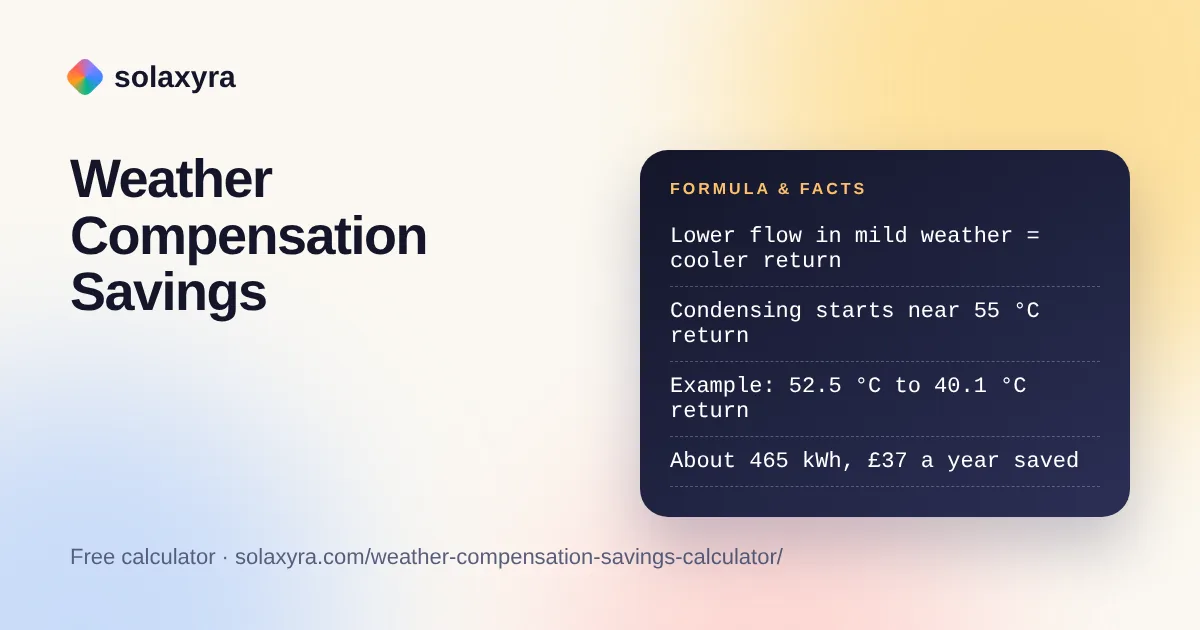
Quick answer: A weather compensation savings calculator compares boiler efficiency at your fixed flow temperature with efficiency at the lower flow a heating curve chooses. For 11,500 kWh of gas, 75% for heating, a fixed 75 °C flow and radiators sized for 70 °C, the return falls from 52.5 °C to 40.1 °C, saving about 465 kWh, or £37 a year.
What Is a Weather Compensation Savings Calculator?
A weather compensation savings calculator is a tool that estimates the fuel saved when a boiler lowers its flow temperature in mild weather, based on how much cooler the water returning to the boiler becomes. In plain words: it finds the water temperature your radiators need at the season's average outside temperature, compares the return temperature with your current fixed setting, reads the boiler efficiency at each, and applies the efficiency gain to the gas you use for space heating.
Weather compensation uses an outdoor sensor and a heating curve. When it is cold outside the boiler sends hotter water to the radiators; when it is mild it sends cooler water, so the radiators run longer at a lower temperature instead of switching on and off at full heat. The Wikipedia article on condensing boilers explains why this matters: a condensing boiler only recovers the extra heat in its flue gases when the return water is around 55 °C or below.
How Do You Use the Weather Compensation Savings Calculator?
- Enter your yearly gas use in kWh from a bill or your smart meter, and the share used for space heating. The default 75% is the figure Nesta uses for an average home.
- Enter your gas unit price. The default is the Ofgem price cap rate for 1 October to 31 December 2026.
- Enter the flow temperature your boiler is set to now for radiators.
- Set your room temperature, the design outside temperature for your area and the average outside temperature through the heating season.
- Enter the flow temperature your radiators need on the design day and the flow to return difference. If your installer sized the radiators for 70 °C flow and 50 °C return, use 70 and 20.
- Replace the two efficiency figures with your boiler's data if you have it, then read the saving and open the breakdown.

How Much Can Weather Compensation Save?
For the default home the weather compensation savings calculator shows about 5.4% of space heating gas, or 4% of total gas use, from the condensing effect alone. Real savings can be larger because a boiler that modulates at a low flow temperature also cycles less and loses less heat from pipes and the boiler casing, and this tool does not count those effects.
A measured result gives a useful upper check. In tests at the University of Salford's Energy House, a traditional two-bedroom terrace inside an environmental chamber at 4.5 °C outside, lowering the boiler flow temperature from 75 °C to 60 °C used 10% less gas for space heating, according to Nesta's Money Saving Boiler Challenge. Claims from manufacturers vary much more widely, so treat any single headline percentage with care.
Why Does a Lower Return Temperature Save Gas?
A lower return temperature saves gas because the cooler water condenses more of the water vapour in the flue gases, recovering latent heat that would otherwise go up the flue. Wikipedia gives around 55 °C return as the point where condensing starts, and Worcester Bosch states that a condensing boiler working below 50 °C can be up to 10% more efficient than at higher temperatures.
The weather compensation savings calculator models this with two editable points: efficiency with the return at 55 °C or above, and efficiency with the return at 30 °C or below, joined by a straight line. The defaults of 86% and 96% are example values chosen to sit inside those published ranges; your boiler's technical data may show a different curve.
What Flow Temperature Does Weather Compensation Choose?
On the design day the heating curve chooses the full design flow temperature, and on milder days it chooses less. The calculator estimates the curve from radiator physics: radiator output rises with the difference between mean water temperature and room temperature raised to the power n, and Stelrad's published radiator correction factors fit an exponent of about 1.3.
| Outside temperature | Heat needed (share of design) | Compensated flow | Compensated return | Fixed 75 °C flow: return |
|---|---|---|---|---|
| Minus 3 °C (design day) | 100% | 70.0 °C | 50.0 °C | 52.5 °C |
| 0 °C | 87% | 64.6 °C | 47.2 °C | 52.5 °C |
| 5 °C | 65% | 55.3 °C | 42.3 °C | 52.5 °C |
| 10 °C | 43% | 45.4 °C | 36.7 °C | 52.5 °C |
| 15 °C | 22% | 34.5 °C | 30.2 °C | 52.5 °C |
These are the weather compensation savings calculator defaults. All rows use the default home: 20 °C rooms, minus 3 °C design temperature, radiators sized for 70 °C flow with a 20 K drop. A fixed setting keeps the return close to 52.5 °C whenever the boiler fires, because the radiators always run hotter than needed and then wait for the thermostat. With compensation the return drops steadily as the weather warms.
Is Weather Compensation Better Than Turning the Flow Temperature Down?
Weather compensation saves more than a lower fixed setting in this model, because it adjusts to every day instead of choosing one compromise. The table runs the weather compensation savings calculator for each fixed setting in the default home, using the same example efficiency points.
| Fixed flow setting | Return while firing | Efficiency fixed | Efficiency compensated | Saving with compensation |
|---|---|---|---|---|
| 80 °C | 55.0 °C | 86.0% | 91.9% | 557 kWh, £44 |
| 75 °C | 52.5 °C | 87.0% | 91.9% | 465 kWh, £37 |
| 70 °C | 50.0 °C | 88.0% | 91.9% | 370 kWh, £29 |
| 65 °C | 47.4 °C | 89.0% | 91.9% | 273 kWh, £22 |
| 60 °C | 44.8 °C | 90.1% | 91.9% | 175 kWh, £14 |
If you already run a low fixed flow, the extra gain from compensation is smaller, but you also avoid cold rooms on the coldest days, because the curve raises the flow when it is needed. Our guide to boiler flow temperature covers the manual approach, and the radiator output calculator shows how much heat each radiator gives at a lower temperature.
Do You Need a Heating Engineer to Fit Weather Compensation?
Weather compensation needs an outdoor sensor or a compatible control that your boiler supports, and fitting one involves boiler wiring and commissioning, so a competent heating engineer should do it. Any work on the gas parts of a boiler must be carried out by a Gas Safe registered engineer, and new electrical circuits must be installed by a qualified electrician to BS 7671. Turning the flow temperature down on the boiler's front panel is different: Nesta's Money Saving Boiler Challenge guides householders through that single setting on a combi boiler.
Before paying for a sensor, compare the weather compensation savings calculator result with the cost of the part and fitting. If you are weighing a new boiler or a heat pump instead, our heat pump running cost calculator compares yearly costs, and heat pumps use the same heating curve idea. The electricity cost calculator helps price the small pump and control loads.
Worked Example: Semi-Detached House With a 75 °C Setting
Example: a three-bedroom semi-detached house in Birmingham uses 11,500 kWh of gas a year, 75% of it for space heating, paying 7.97p per kWh. The combi boiler is set to 75 °C for radiators. The radiators were sized for 70 °C flow and 50 °C return at minus 3 °C outside, rooms are kept at 20 °C and the heating season averages 7 °C outside. Efficiency points are the example 86% and 96%, as set in the weather compensation savings calculator.
- Load at the season average: (20 minus 7) / (20 minus (minus 3)) = 13 / 23 = 0.565.
- Design mean water temperature: 70 minus 10 = 60 °C, which is 40 K above the room.
- Compensated mean water: 20 + 40 x 0.565^(1/1.3) = 45.8 °C, so flow 45.8 + 5.65 = 51.4 °C and return 45.8 minus 5.65 = 40.1 °C.
- Fixed 75 °C: the radiators give 1.12 times design output while firing, a 22.5 K drop, so the return is 52.5 °C.
- Efficiency: 87.0% at 52.5 °C, 91.9% at 40.1 °C.
- Gas saved: 11,500 x 0.75 x (1 minus 87.0 / 91.9) = 465 kWh, about £37 a year at 7.97p.
Frequently Asked Questions
How much does weather compensation save on a gas boiler?
It depends on your current setting and radiators. For the example home on this page, about 5% of space heating gas, or £37 a year, from better condensing alone. A Salford Energy House test reported by Nesta found 10% less space heating gas when flow fell from 75 °C to 60 °C.
What return temperature does a condensing boiler need?
Around 55 °C or below for condensing to begin, according to Wikipedia's condensing boiler article, and Worcester Bosch says efficiency can be up to 10% higher below 50 °C. The lower the return water, the more flue gas vapour condenses and the more heat is recovered.
Why does the calculator use the average outside temperature?
It keeps the model simple and transparent. Using one season average gives a fair estimate of the typical return temperature, because the heating curve is close to a straight line across mild days. A full hour-by-hour weather file would refine the figure but rarely changes the conclusion.
Where do I find my boiler's efficiency at different return temperatures?
Look in the installation and technical manual for an efficiency chart or for the part load efficiency figures in the product data. If you cannot find it, keep the example values and test how much the result changes when you move each one by a few percentage points.
Will my rooms still get warm with weather compensation?
They should, if the heating curve is set correctly, because the flow temperature rises as the weather gets colder. Rooms warm up more slowly from cold, so compensation works best with longer heating periods. If rooms fall short, the curve or design flow temperature needs raising slightly.
Does weather compensation work with a hot water cylinder?
Yes, but the cylinder normally needs a higher temperature than mild-weather radiators, so the boiler switches to a hot water setting while it reheats the cylinder. This calculator covers only space heating gas, which is why it asks what share of your gas goes on heating.
Checked October 2026 by the Solaxyra Editorial Team. Sources: Wikipedia: Condensing boiler, Nesta Money Saving Boiler Challenge: Salford Energy House tests, Worcester Bosch: How to ensure boilers condense, Stelrad: radiator correction factors, Ofgem: energy price cap 1 October to 31 December 2026.