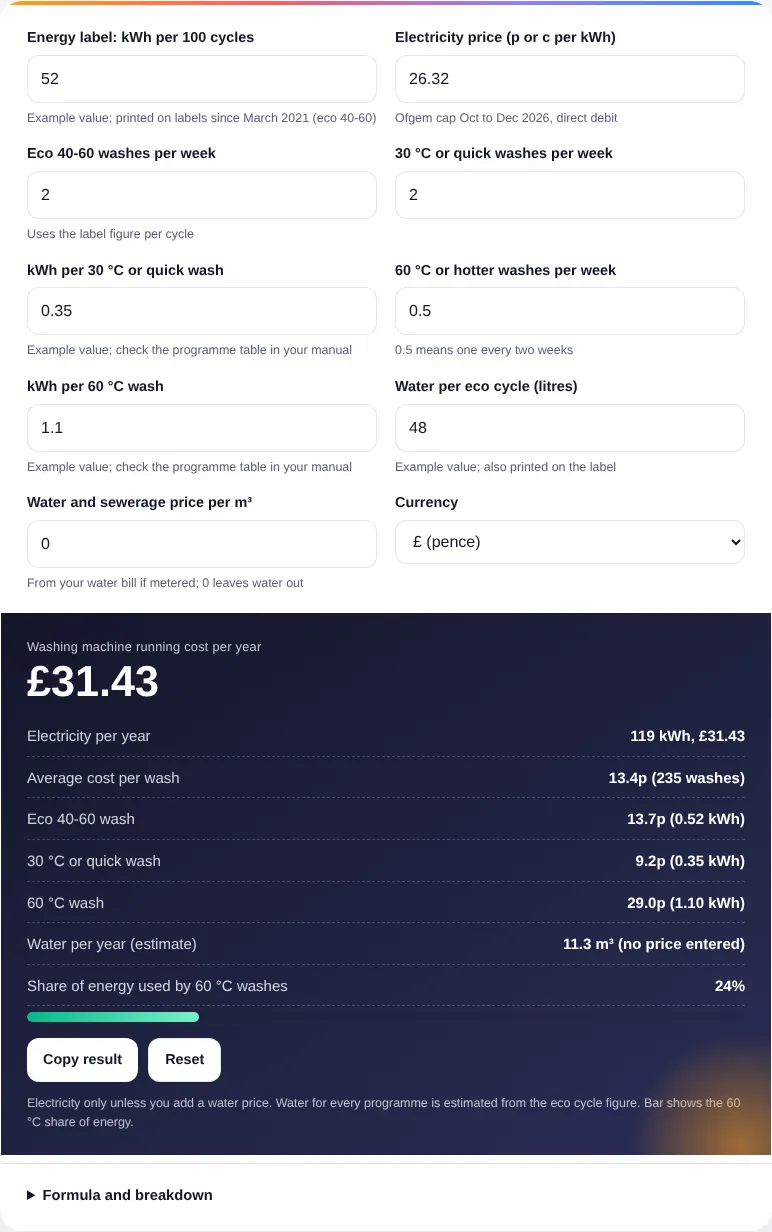
Electricity only unless you add a water price. Water for every programme is estimated from the eco cycle figure. Bar shows the 60 °C share of energy.
Formula and breakdown
n/a
n/a
n/a
This washing machine running cost calculator works out what your washing machine costs per wash and per year in the UK and Europe, starting from the energy figure printed on its label rather than a guess at wattage and hours. It handles a realistic mix of eco, cool and hot washes, shows which programmes use most of the energy and can add the cost of metered water.
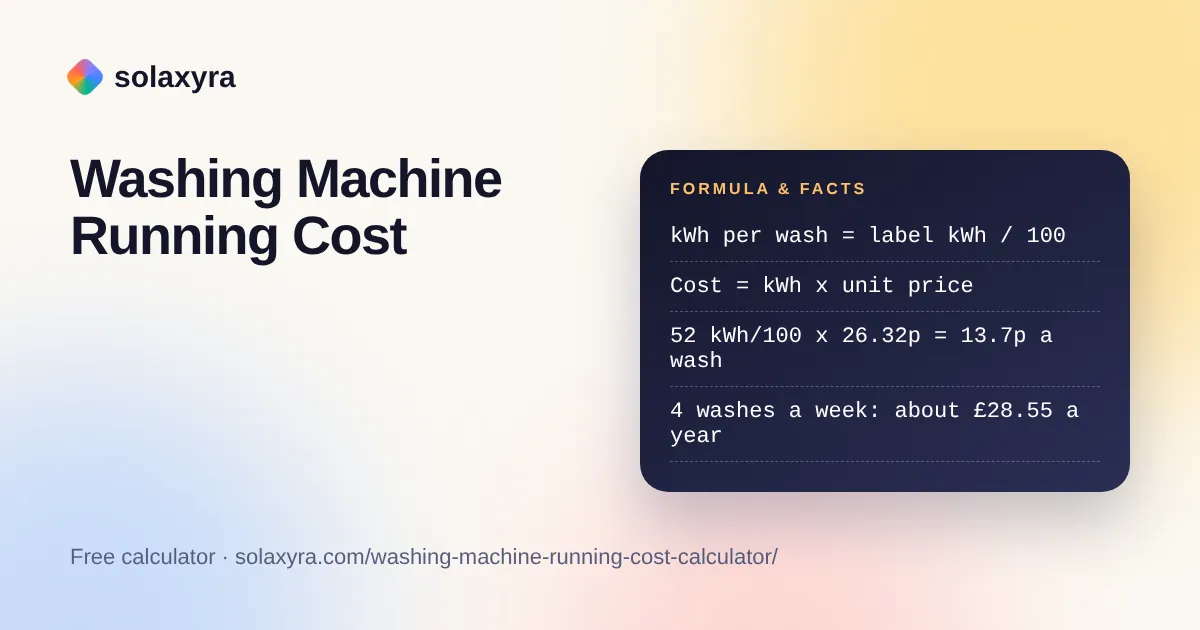
Quick answer: A washing machine running cost calculator divides the energy label’s kWh per 100 cycles by 100 and multiplies by your unit rate. A machine rated 52 kWh per 100 cycles uses 0.52 kWh per eco 40-60 wash, about 13.7p at the 26.32p cap rate, or £28.55 a year at four washes a week.
What Is a Washing Machine Running Cost Calculator?
A washing machine running cost calculator is a tool that converts the electricity a washing machine uses per cycle into a cost per wash and a yearly total at your electricity price. In plain words: kWh per eco wash equals the label’s kWh per 100 cycles divided by 100; yearly kWh equals each programme’s kWh times the washes a week times 52.14; and the cost equals yearly kWh times your unit rate, plus water if you are metered.
The label figure is the key input. The European Commission’s energy label page for washing machines explains that labels since 1 March 2021 show weighted energy consumption per 100 cycles of the eco 40-60 programme, a cycle that must clean normally soiled cotton rated for 40 °C or 60 °C washing. The label also shows water per cycle, rated capacity and programme duration.
How Do You Use the Washing Machine Running Cost Calculator?
- Find the energy figure in kWh per 100 cycles on the label or the product information sheet and enter it.
- Check the electricity price. It defaults to the Ofgem cap average; change it to your tariff.
- Enter how many eco 40-60 washes, 30 °C or quick washes, and 60 °C or hotter washes you run in a typical week.
- For the 30 °C and 60 °C programmes, enter the kWh per cycle from your manual’s programme table if it has one, or keep the example values.
- If your water is metered, enter the litres per cycle from the label and your combined water and sewerage price per cubic metre.
- Read the yearly cost, the cost of each type of wash and the share of energy going on hot washes.
How Much Does a Washing Machine Cost to Run per Wash?
An eco 40-60 wash costs the label figure divided by 100, times your unit rate: at 52 kWh per 100 cycles and the Ofgem cap rate of 26.32p per kWh for October to December 2026, that is 0.52 kWh and 13.7p. Ofgem says VAT is not included in electricity bills on the cap in that period, so the rate already reflects that.
The table converts a range of label figures into cost per eco wash and per year at four eco washes a week, using the same 26.32p rate.
| Label energy (kWh per 100 cycles) | kWh per eco wash | Cost per eco wash | Cost per year, 4 washes a week |
|---|---|---|---|
| 40 | 0.40 | 10.5p | £21.96 |
| 50 | 0.50 | 13.2p | £27.45 |
| 60 | 0.60 | 15.8p | £32.94 |
| 70 | 0.70 | 18.4p | £38.43 |
| 80 | 0.80 | 21.1p | £43.92 |
The gap between a frugal and a thirsty machine is about £22 a year at this usage, so a new machine is rarely worth buying for the electricity saving alone. How often and how hot you wash usually matters more.
Why Do Hotter Washes Cost More?
Hotter programmes cost more because the machine has to heat the water further, and the energy needed rises with the temperature increase. That is why the washing machine running cost calculator treats 60 °C washes separately. With the example inputs, half a 60 °C wash a week accounts for 24% of the yearly energy even though it is only about one wash in nine.
The label only covers the eco 40-60 programme, so use the manual for other programmes where it gives figures. If you want to price any other appliance from its wattage, the electricity cost calculator does that, and the energy consumption calculator adds up a whole household.
Is It Cheaper to Run a Washing Machine at Night or on Solar?
Running it at night only saves money on a tariff with a cheaper night or off-peak rate; on a single-rate tariff every hour costs the same. The time of use tariff calculator shows whether moving laundry and other loads off-peak justifies switching. Check the appliance instructions before leaving any machine running unattended overnight.
With solar panels, running the machine in the middle of a sunny day can use generation you would otherwise export. The solar self consumption calculator estimates how much of your output you use at home, and drying is where laundry costs climb: the tumble dryer running cost calculator prices the next step.
Worked Example: A Family of Four
Example: a family of four in Leicester has a machine labelled 60 kWh per 100 cycles. Each week they run five eco 40-60 washes, three 30 °C quick washes at 0.35 kWh and one 60 °C towel wash at 1.1 kWh. Water is metered at an example price of £4.50 per cubic metre, and the label shows 50 litres per eco cycle.
- Eco energy per wash: 60 / 100 = 0.60 kWh.
- Weekly energy: 5 x 0.60 + 3 x 0.35 + 1 x 1.1 = 3.0 + 1.05 + 1.1 = 5.15 kWh.
- Yearly energy: 5.15 x 52.14 = 268.5 kWh, costing 268.5 x 26.32p = £70.68.
- Water: 9 washes x 52.14 x 50 litres = 23.5 m³ x £4.50 = £105.59.
- Total: about £176.27 a year, of which water is the larger part.
Frequently Asked Questions
How much does one wash cost in the UK?
At the Ofgem cap rate of 26.32p per kWh for October to December 2026, an eco 40-60 wash on a machine rated 52 kWh per 100 cycles costs about 13.7p. A hot 60 °C wash costs more: at an example 1.1 kWh it is about 29p.
What does kWh per 100 cycles mean on the energy label?
It is the weighted electricity use of 100 runs of the eco 40-60 programme, the standard test cycle on labels since 1 March 2021. Divide it by 100 to get kWh per eco wash, then multiply by your unit price for the cost per wash.
Is it cheaper to wash at 30 °C?
Usually yes, because less energy goes into heating water. A cooler programme often uses well under the eco 40-60 figure, but long or intensive cycles can add energy back. If your manual has a programme table with expected kWh, enter those figures.
Why do calculators using watts overstate the cost?
Rated wattage is the most a machine can draw at once, mainly while its heater warms the water. Multiplying it by the whole cycle length assumes full power throughout, which overstates use. The energy label’s kWh is measured over complete cycles, so it is a better guide.
Does the water cost matter?
If your water is metered, yes. The label shows litres per eco cycle, and you pay for both supply and sewerage on that water. Enter the combined price per cubic metre from your water bill to add it; if you pay a fixed water charge, leave it at zero.
Is it cheaper to run a washing machine at night?
Only on a tariff with a cheaper night or off-peak rate, such as Economy 7 or a time of use tariff. On a single-rate tariff the price is the same at any hour. With solar panels, running it in the middle of a sunny day uses your own free generation.
Checked October 2026 by the Solaxyra Editorial Team. Sources: European Commission: Energy label for washing machines, Ofgem: Changes to energy price cap between 1 October and 31 December 2026.