Bar shows the estimated saving as a share of your claimed saving. An estimate from load physics, not a measured result. A voltage optimiser is fitted between the meter and consumer unit and must be installed by a qualified electrician to BS 7671.
Formula and breakdown
n/a
n/a
n/a
n/a
This voltage optimiser savings calculator estimates what a voltage optimiser would really save in a UK home or small business, load by load, from your measured supply voltage, the optimiser's output voltage and how your electricity is split between heating, electronics, motors and old-style lighting. It then sets the result beside the saving the seller claims and works out a payback period from your own quote.
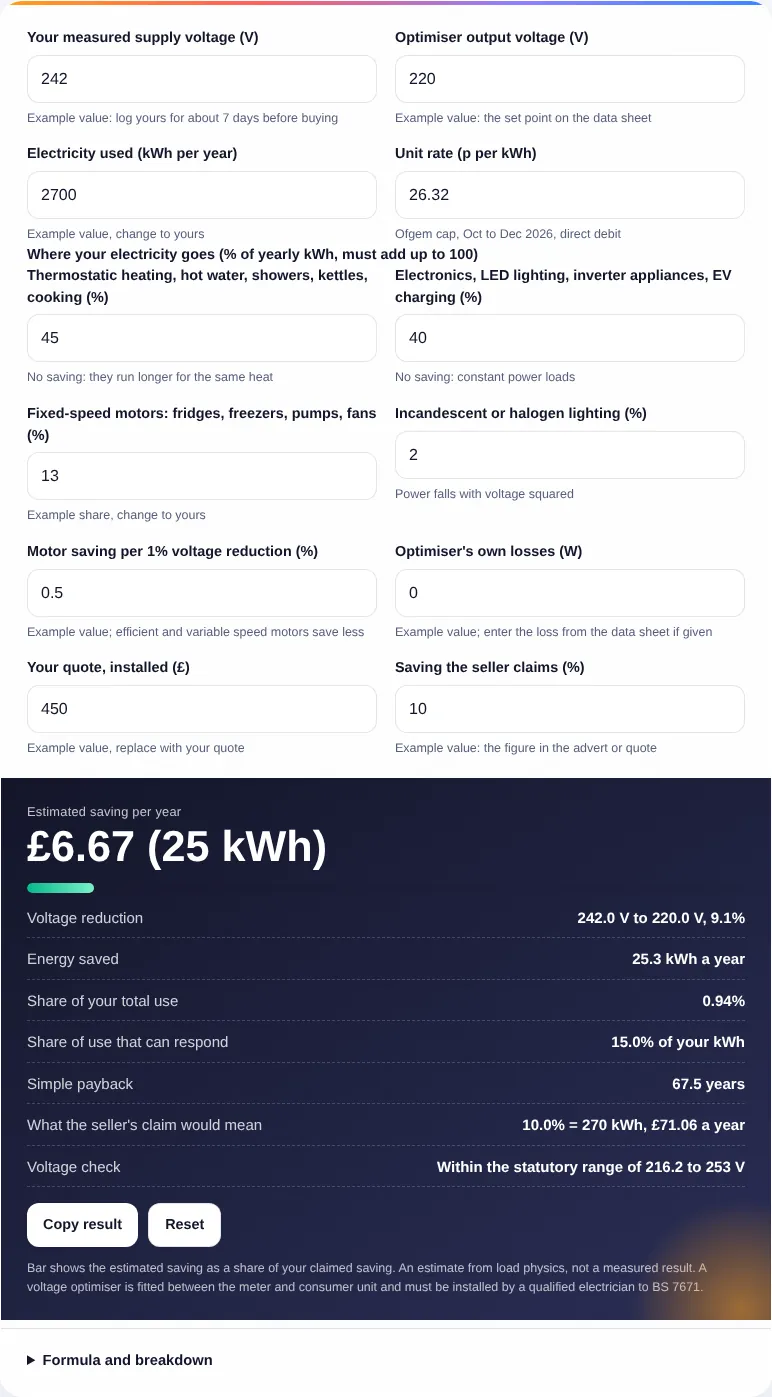
Quick answer: A voltage optimiser only saves energy on loads whose power falls with voltage, mainly fixed-speed motors and incandescent lamps. Kettles, heaters, electronics and LEDs save nothing. In the voltage optimiser savings calculator, a 2,700 kWh home cut from 242 V to 220 V saves about 25 kWh, under 1% and £6.67 a year.
What Is a Voltage Optimiser Savings Calculator?
A voltage optimiser savings calculator is a tool that estimates the yearly kWh and money saved by lowering the voltage supplied to a building, counting only the loads that actually use less energy at a lower voltage. In plain words: savings equal the motor share of your use times a response factor times the percentage voltage drop, plus the incandescent lighting share times one minus the voltage ratio squared, minus the unit's own losses.
A voltage optimiser is essentially a transformer fitted in series between the meter and the consumer unit, so every circuit receives a lower, steadier voltage. In Great Britain the declared supply is 230 V between phase and neutral, allowed to range from 6% below to 10% above, which is 216.2 V to 253 V, under the Electricity Safety, Quality and Continuity Regulations 2002. Many homes sit well above 230 V, as our guide to UK mains voltage explains, and that gap is what these products target.
How Do You Use the Voltage Optimiser Savings Calculator?
- Measure your supply voltage, ideally with a logger over several days, and enter the typical value. The default 242 V is an example.
- Enter the optimiser's output set point from its data sheet, often around 220 V.
- Enter your yearly electricity use from your bills and your unit rate. The default rate is the Ofgem price cap for October to December 2026.
- Split your use into the four groups so they add up to 100%. Electric showers, immersion heaters, kettles, ovens and heaters go in the first group.
- Set the motor response, any losses from the data sheet, your installed quote and the saving the seller claims, then compare the two figures.
Which Appliances Save Energy With a Voltage Optimiser?
Only voltage dependent loads save energy: incandescent and halogen lamps, older fluorescent lights with magnetic ballasts, and lightly loaded fixed-speed motors. Thermostatic and electronic loads do not. The voltage optimiser savings calculator uses the same groups. The table combines the load lists in the IET Wiring Matters article on voltage optimisation in the home with SEAI's measurement and verification guide.
| Load type | Effect of lower voltage | Saving counted in the calculator |
|---|---|---|
| Kettles, immersion heaters, electric showers, ovens, thermostatic heaters | Draw less power but run longer to deliver the same heat | None |
| LED lamps, CFLs, electronic ballasts | Constant power drivers keep the same output | None |
| TVs, computers, chargers and other switch-mode supplies | Current rises to keep power constant | None |
| Inverter and variable speed drives (heat pumps, many washing machines) | Electronics regulate power; current can rise | None |
| Fixed-speed motors in fridges, freezers, pumps and fans | Lower losses when lightly loaded | Your share x response factor x voltage drop |
| Incandescent and halogen lamps | Power falls with voltage squared, and so does light output | Your share x (1 minus voltage ratio squared) |
The IET article puts the theoretical saving for a pure resistance taken from 242 V to 220 V at just over 17%, but it also warns that a kettle simply stays on longer and that switch-mode power supplies give negligible savings. A typical modern home with LED lighting and inverter appliances therefore has only a small share of use that can respond at all, and the voltage optimiser savings calculator shows that share as a percentage of your kWh.
How Much Can a Voltage Optimiser Really Save at Home?
Independent evidence points to a few percent at most for a typical home, not the 10% to 20% often advertised. The Renewable Energy Consumer Code's consumer guidance on add-on equipment offered with solar PV says it found no publicly available robust evidence for claims of 10% to 15% typical savings, that one study judged robust by BRE found an average reduction of around 5%, and that in one case demand actually increased.
The IET article is more positive for homes supplied above 240 V, giving 8% to 13% depending on use, but it adds that results depend on the type of load and recommends a site survey and several months of data before any return on investment is calculated. That is the method the voltage optimiser savings calculator follows: it counts your own load mix rather than applying a headline percentage. Our energy consumption calculator helps you split your kWh by appliance first.
Are Voltage Optimiser Savings Claims Reliable?
Treat any fixed percentage claim with caution: in June 2023 the Advertising Standards Authority upheld a complaint against a leaflet promising "up to 20% saving" on electricity bills from a home voltage optimiser. In its ruling on Fortress Energy Solutions, the ASA found the evidence, a single household case study without a stated method, was not robust enough and that the claims were misleading.
Before buying, ask the seller for logged voltage at your property, the output set point, the unit's losses and how the saving was measured. SEAI's verification guide for business sites measures the eligible loads before and after the change, normalised for weather and operating hours, rather than comparing two bills. Enter the claimed figure in the voltage optimiser savings calculator: the bar shows how much of it your load mix can plausibly deliver.
Is a Voltage Optimiser Worth It With Solar Panels or an EV?
Usually not for the savings alone, because the loads that grow with solar, batteries, heat pumps and EV charging are all electronically controlled and draw the same energy at a lower voltage. RECC's guidance notes that optimisers are sometimes bundled with a solar PV package and suggests comparing the price with a PV-only quote. If high voltage is causing your inverter to trip, that is a matter for your DNO and installer, and the solar panel savings calculator remains the better tool for judging solar returns.
A voltage optimiser carries the whole supply, so it must be correctly rated for your maximum demand. It must be installed by a qualified electrician to BS 7671, and in England and Wales electrical work in homes must also meet Part P of the Building Regulations. Never fit one ahead of the meter or interfere with the DNO's cut-out.
Worked Example: Typical Home at 242 V
Example: a three-bedroom semi in Kent uses 2,700 kWh a year on the October 2026 cap rate of 26.32p per kWh. A logger shows the supply sits around 242 V, and the optimiser on offer sets 220 V for an installed quote of £450, claiming a 10% saving. The household estimates 45% of use for showers, kettle, oven and heating, 40% for electronics and LED lighting, 13% for the fridge freezer and pumps, and 2% for halogen spotlights.
- Voltage ratio: 220 / 242 = 0.9091, a 9.09% reduction.
- Motors: 2,700 x 13% = 351 kWh; at an example response of 0.5% per 1% of voltage drop, 351 x 0.5 x 9.09% = 16.0 kWh.
- Halogen lighting: 2,700 x 2% = 54 kWh; 1 minus 0.9091² = 17.36%, so 54 x 17.36% = 9.4 kWh.
- Total: 25.3 kWh a year, 0.94% of use, worth 25.3 x 26.32p = £6.67.
- Payback: £450 / £6.67 = 67.5 years. The seller's 10% claim would mean 270 kWh and £71.06 a year, more than ten times the estimate from the voltage optimiser savings calculator.
Changing the halogen spotlights to LEDs would save far more than the optimiser does on them; the electricity cost calculator shows the running cost of each lamp.
Frequently Asked Questions
Do voltage optimisers really save money?
Sometimes, but usually far less than advertised in a modern home. Savings come only from voltage dependent loads such as fixed-speed motors and incandescent lamps. RECC found no robust public evidence for 10% to 15% typical savings, and one study judged robust by BRE averaged around 5%.
Does a voltage optimiser save energy on a kettle or electric shower?
No. A kettle, immersion heater or electric shower draws less power at a lower voltage but takes longer to heat the same water, so the energy used is about the same. Thermostatic heaters behave the same way, which is why the calculator counts no saving for them.
Do LED lights save energy with a voltage optimiser?
Generally no. LED lamps and CFLs have electronic drivers that hold their power roughly constant, and SEAI lists them as voltage independent loads. The IET article reports an EA Technology study finding savings of around 8% on certain LED lights, so check the specific product before counting any benefit.
What is the normal mains voltage in the UK?
The declared voltage is 230 V between phase and neutral, and the law allows it to vary from 6% below to 10% above, which is 216.2 V to 253 V. The IET article reports an average incoming voltage of about 242 V, so measure your own supply before estimating any saving.
How much does a home voltage optimiser cost?
RECC's 2015 consumer guidance estimated £300 to £500 for a unit sold alongside solar PV, and noted that none of the models it saw offered a warranty longer than five years. Prices change, so enter your own installed quote in the calculator to work out the payback period.
How do I check a voltage optimiser savings claim?
Ask for your logged supply voltage, the output set point, the unit's own losses and how savings were measured. Then enter your load mix in the voltage optimiser savings calculator. If the claim is much higher than the estimate, ask the seller to justify it with independent, site-specific measurements.
Checked October 2026 by the Solaxyra Editorial Team. Sources: IET Wiring Matters: Is the trend of using voltage optimisation in the home justified?, RECC: Add-on equipment you might be offered alongside your PV system, ASA ruling on Fortress Energy Solutions Ltd (2023), SEAI: Voltage optimisation measurement and verification guide, ESQCR 2002 regulation 27, Wikipedia: Voltage optimisation, Ofgem: Energy price cap 1 October to 31 December 2026.