This guide explains what voltage UK homes are supplied at, why you still see both 230 V and 240 V on appliances and in calculations, and what the difference means for your bills, appliances, solar panels and EV charger, for households in Great Britain and Northern Ireland. The UK mains voltage 230V or 240V question has a simple legal answer and a more interesting practical one.
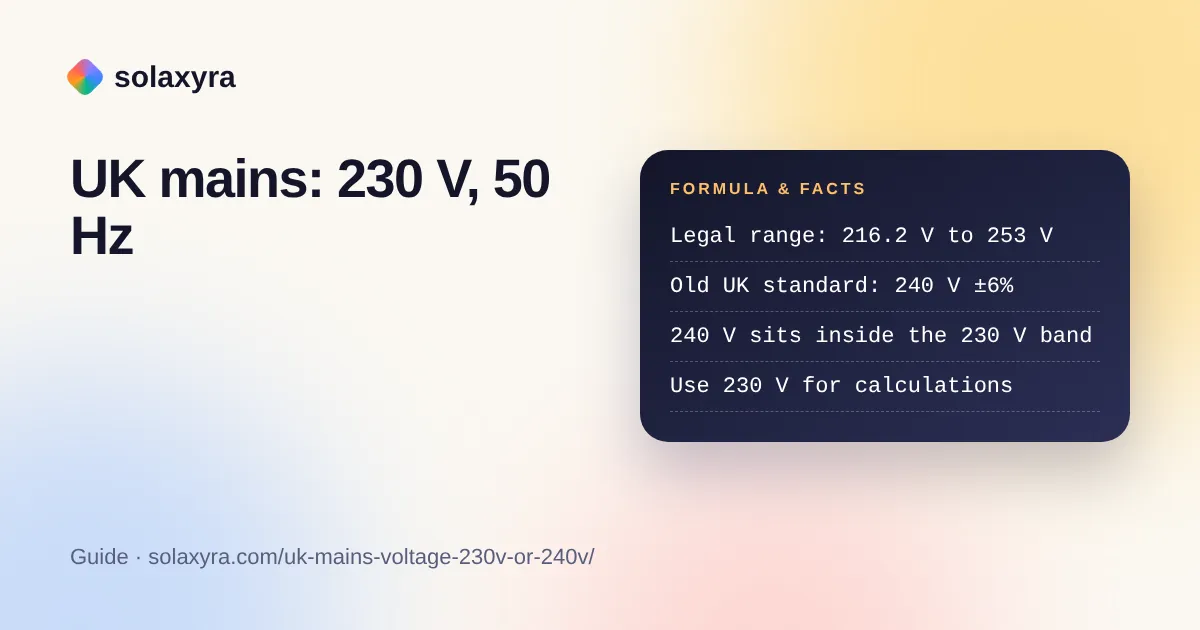
Quick answer: On UK mains voltage 230V or 240V, the official answer is 230 V at 50 Hz, set by the Electricity Safety, Quality and Continuity Regulations 2002, with a legal range of 216.2 V to 253 V. The old 240 V supply falls inside that range, so many homes still measure above 230 V. Use 230 V for calculations.
What is the official UK mains voltage?
The official UK mains voltage is 230 V between phase and neutral, at a frequency of 50 Hz. Regulation 27 of the Electricity Safety, Quality and Continuity Regulations 2002 requires network operators to declare 230 V for low voltage supplies, with a permitted variation of not more than 10% above or 6% below. The frequency must stay within 1% of 50 Hz.
In volts, that legal band is:
- Lowest: 230 V minus 6% = 216.2 V
- Declared: 230 V
- Highest: 230 V plus 10% = 253 V
Any reading of UK mains voltage between 216.2 V and 253 V is a compliant supply. A meter showing 241 V is therefore not “wrong”; it is a 230 V supply running towards the upper part of its range.
Why did the UK change from 240 V to 230 V?
The UK moved its declared voltage from 240 V to 230 V as part of harmonising European supply voltages, but the change was on paper: the tolerance bands were set so that existing supplies did not have to change. According to the mains electricity article, the harmonised European figure comes from IEC 60038:1983, which defined 230 V; before that UK mains voltage was 240 V ±6% and much of continental Europe used 220 V.
| Standard | Nominal | Tolerance | Range |
|---|---|---|---|
| Old UK declaration | 240 V | ±6% | 225.6 V to 254.4 V |
| Old continental Europe (for example Germany) | 220 V | ±10% | 198 V to 242 V |
| UK law today (ESQCR regulation 27) | 230 V | +10% / minus 6% | 216.2 V to 253 V |
| European standard from 2009 | 230 V | ±10% | 207 V to 253 V |
The old UK band and the new UK band overlap almost completely, so network operators did not need to turn voltages down, and many did not. Wikipedia notes that no change in voltage was required in either the UK or continental Europe for this reason. Note the difference in the last two rows: UK law still allows only 6% below 230 V, a tighter lower limit than the general European ±10%.
What voltage do UK homes actually get?
Actual UK mains voltage at a socket varies through the day and from street to street, anywhere within 216.2 V to 253 V, and it is common to see readings above 230 V. Voltage is highest close to the local substation transformer and at times of low demand, and lowest at the far end of a long street cable during busy evenings.
Two newer effects push UK mains voltage around more than before. Rooftop solar exporting on a sunny afternoon raises the voltage at the point where it connects, because current flowing out through the service cable causes a voltage rise in the same way that drawing current causes a drop. Heavy evening loads such as EV chargers and heat pumps pull it down. Solar inverters are designed to disconnect if the voltage at their terminals goes beyond the protection settings in the connection rules, which is why a few systems switch off on bright days in streets that already run high.
To see your own voltage safely, use a plug-in energy monitor that displays volts, or check whether your smart meter’s in-home display shows it. Do not open the meter, the cutout or the consumer unit to measure it. If readings regularly fall outside 216.2 V to 253 V, or lights flicker badly, report it to your distribution network operator (DNO), the company that runs the local cables; you can find its contact details on its website.
Does 230 V or 240 V change your appliances and bills?
A resistive appliance such as a kettle or heater draws more current and delivers more power at a higher voltage, but for appliances controlled by a thermostat the energy used, and so the bill, changes much less than the power rating suggests. Power in a fixed resistance rises with the square of voltage, so 240 V gives about 8.9% more power than 230 V. The table uses a kettle rated 3 kW at 230 V as an example.
| Supply voltage | Peak voltage | Kettle current | Kettle power | Power compared with 230 V |
|---|---|---|---|---|
| 216.2 V | 306 V | 12.3 A | 2,651 W | 88% |
| 230 V | 325 V | 13.0 A | 3,000 W | 100% |
| 240 V | 339 V | 13.6 A | 3,267 W | 109% |
| 250 V | 354 V | 14.2 A | 3,544 W | 118% |
| 253 V | 358 V | 14.3 A | 3,630 W | 121% |
The kettle at 240 V boils faster, but it still needs about the same energy to heat the same water, so the kWh on your bill is much the same. An oven, immersion heater or room heater with a thermostat behaves similarly: it simply switches off sooner. Electronics with switched-mode power supplies (phone chargers, TVs, computers, LED lamps) regulate their own output and draw roughly constant power across the range. This is why savings claims for “voltage optimisation” units in homes deserve scepticism; any benefit depends heavily on what is connected, and the unit itself must be installed by a qualified electrician to BS 7671.
Example: a fan heater rated 2 kW at 230 V running on a 240 V supply produces about 2.18 kW. In a room held at 20 °C by its thermostat, it runs about 8% less of the time, so the energy used for the same comfort stays roughly the same. You can price any appliance’s energy with the electricity cost calculator.
Should you use 230 V or 240 V in calculations?
Use 230 V for design and estimating, because it is the declared UK mains voltage that standards and equipment ratings are based on; use a measured value only when diagnosing a specific problem at a specific address. Our watts to amps calculator and kW to amps calculator default to 230 V for that reason.
The choice changes results by about 4%. A 3 kW load is 13.0 A at 230 V and 12.5 A at 240 V. For circuit and cable design, electricians work from 230 V and then check that the lowest legal voltage, minus the drop in the cables, still suits the equipment. That check is why EV charge points matter here: many contain open PEN detection that disconnects outside 207 V to 253 V, so long cable runs need care, as explained in our guide to BS 7671 voltage drop limits.
For resistance and power checks on a circuit, the Ohm’s law calculator lets you enter any voltage, so you can compare 230 V and 240 V side by side.
Can you use 220 V, 230 V and 240 V appliances in the UK?
Yes: appliances marked 220 to 240 V, 230 V or 240 V at 50 Hz all work normally on UK mains, because each of those ratings overlaps the 216.2 V to 253 V band allowed for UK mains voltage. Check the rating plate for the voltage range and frequency.
The exceptions are equipment made for 100 V to 127 V countries, such as North America or Japan, which needs a transformer unless its label shows a wide input such as 100 to 240 V, as most laptop and phone chargers do. Never cut off a moulded plug and fit a different one unless you are competent; a plug adaptor or a correctly fused BS 1363 plug is the safe route. The 13 A UK plug and its fuse are covered in our guide to 13 amp plug maximum watts. Any change to fixed wiring should be carried out by a qualified electrician to BS 7671.
Frequently Asked Questions
Is UK mains 230 V or 240 V?
Officially 230 V. UK law declares 230 V at 50 Hz with a range of 216.2 V to 253 V. The pre-harmonisation 240 V figure lies inside that range, so a reading of 240 V is normal and fully compliant.
Why does my plug-in monitor show 245 V?
Your supply is running in the upper part of the legal band, which allows up to 253 V. Homes near a substation or on a street with lots of solar export often see higher readings, especially on sunny afternoons when local demand is low.
Does higher voltage increase my electricity bill?
Usually only slightly. Thermostat-controlled heating appliances reach temperature faster and switch off sooner, using similar energy overall, and electronics regulate their own power. Bills are based on kWh used, not on the voltage you receive.
What is the peak voltage of UK mains?
UK mains is quoted as an RMS value. At 230 V RMS the peak is about 325 V, because the peak of a sine wave is the RMS value multiplied by the square root of 2. At 240 V the peak is about 339 V.
Who do I contact if my voltage is too low or too high?
Contact your distribution network operator, which runs the local cables and substations. Report readings that regularly fall outside 216.2 V to 253 V, or persistent flickering lights and appliances switching off. Never open the meter or cutout yourself.
Checked October 2026 by the Solaxyra Editorial Team. Sources: ESQCR 2002 regulation 27, Wikipedia: mains electricity, IET Wiring Matters, July 2023: voltage drop and EV open PEN detection.