This guide explains how much power a standard UK 13 amp plug and socket can safely supply, for anyone in Great Britain or Northern Ireland plugging in heaters, kettles, extension leads or plug-in solar. The 13 amp plug max watts figure is simple to work out, but the real limits also depend on the fuse, the extension lead, the supply voltage and the circuit behind the socket.
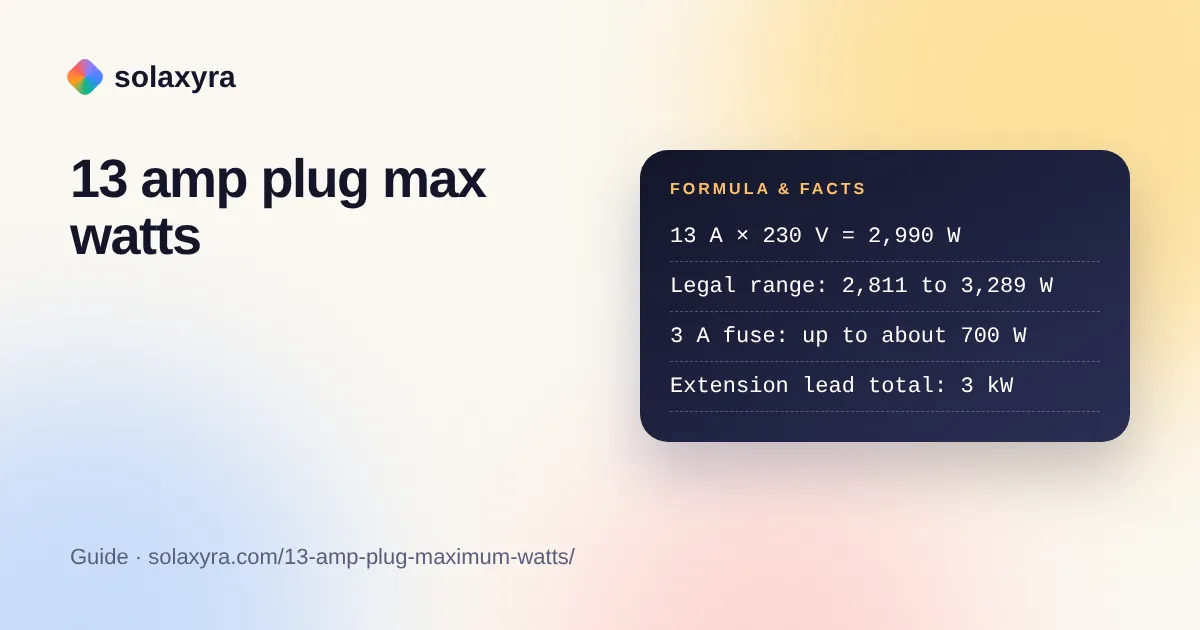
Quick answer: The 13 amp plug max watts figure is about 2,990 W at the UK’s nominal 230 V, because 13 A × 230 V = 2,990 W. Treat 3 kW as the ceiling for everything on one plug, including every socket on an extension lead. Use a 3 A fuse for appliances under about 700 W.
How many watts can a 13 amp plug supply?
A 13 amp plug can supply 2,990 W at 230 V, which most people round to 3 kW. The sum is watts = volts × amps, so 230 × 13 = 2,990. The plug and socket system is defined by BS 1363, one of the British Standards named in the Plugs and Sockets etc. (Safety) Regulations 1994, and the fuse inside the plug follows BS 1362. BS 1363 accessories are rated for up to 250 V and 13 A.
You will also see 3,120 W or 3,250 W on some packaging. Those figures use 240 V or 250 V instead of 230 V. They are not wrong, but the declared UK supply voltage is 230 V, so 2,990 W is the fair planning figure. To convert any appliance’s watts into amps, the watts to amps calculator uses 230 V by default.
Does the maximum change with supply voltage?
Yes: at the legal UK voltage limits, 13 A works out between about 2,811 W and 3,289 W. The Electricity Safety, Quality and Continuity Regulations 2002, regulation 27, declares low voltage supplies at 230 V with a permitted variation of 10% above or 6% below, which is 216.2 V to 253 V.
The voltage also changes what a heating appliance actually draws. A kettle or heater is a fixed resistance, so a higher voltage pushes more current through it. That is why a kettle sold as 3 kW at 230 V can exceed 13 A when your supply runs high.
| Supply voltage | Watts at exactly 13 A | Current drawn by a kettle rated 3 kW at 230 V | Power that kettle actually uses |
|---|---|---|---|
| 216.2 V (legal minimum) | 2,811 W | 12.3 A | 2,651 W |
| 230 V (declared) | 2,990 W | 13.0 A | 3,000 W |
| 240 V (common in practice) | 3,120 W | 13.6 A | 3,267 W |
| 253 V (legal maximum) | 3,289 W | 14.3 A | 3,630 W |
The kettle columns are a worked example using the resistance of a 3,000 W element at 230 V (about 17.6 ohms). A short overshoot like this during a three minute boil is what plugs and fuses are designed to tolerate; it becomes a concern when a load near 13 A runs for hours, as with a heater or a portable EV charging cable. Lower-power appliances are not affected in a way that matters.
Which fuse should go in a 13 amp plug?
Fit a 3 A fuse for appliances up to about 700 W and a 13 A fuse for appliances from about 700 W to 3,000 W, unless the manufacturer specifies another value. Plug makers’ datasheets give this split; one quotes the 3 A plug for loads under 700 W and the 13 A version for 700 to 3,000 W. BS 1362 fuses come in several ratings, but 3 A (red) and 13 A (brown) are the preferred ones, with 5 A also widely sold.
| Fuse rating | Maximum watts at 230 V | Maximum watts at 240 V | Typical use |
|---|---|---|---|
| 3 A (red) | 690 W | 720 W | Lamps, TVs, chargers, computers, fridges (check the label) |
| 5 A (black) | 1,150 W | 1,200 W | Some mid-power appliances where the maker specifies it |
| 13 A (brown) | 2,990 W | 3,120 W | Kettles, heaters, irons, washing machines, extension leads |
The plug fuse protects the flexible cord between the plug and the appliance from overheating under a fault. It does not protect the appliance and it does not protect the wiring in your walls. That job belongs to the circuit breaker or fuse in your consumer unit. Always replace a fuse with the rating the appliance maker states; never fit a higher one to stop a fuse blowing, because that removes the protection for the cord.
How much can you plug into an extension lead or double socket?
An extension lead with a 13 A plug is limited to 13 A, about 3 kW, in total across all its sockets, however many outlets it has. Electrical Safety First also warns that older extensions and cable reels may be rated at 10 A or less, and that cable reels have a much lower rating while wound up, so unwind them fully before using the full rating. Never plug one extension lead into another.
Example: a four-way lead feeding a 2,000 W fan heater, a 1,200 W hair dryer and a 60 W lamp totals 3,260 W, or about 14.2 A at 230 V. That is over the 13 A limit, so the plug fuse may blow or the lead may overheat. Move the heater to its own wall socket. These steps check any lead:
- Read the watts on each appliance’s rating label.
- Add them together for everything that could run at the same time.
- Divide by 230 to get amps, or compare directly with 2,990 W.
- Check the lead’s own rating on its label; if it is 10 A, the limit is about 2,300 W.
- If the total is close to the limit, split high-power appliances across separate wall sockets.
A double wall socket has two outlets, each for a 13 amp plug, but both share the same circuit. The energy consumption calculator lets you list appliances to see their combined load and daily energy use.
What is the limit for all the sockets on one circuit?
Most UK homes feed sockets from a ring final circuit protected by a 30 A or 32 A device, which is about 7.4 kW at 230 V shared by every socket on that ring. Under BS 7671 regulation 433.1.204, as summarised in the Wikipedia article on ring circuits, such a circuit uses cable of at least 2.5 mm² and serves a floor area of up to 100 m². The fused plug exists because that 32 A protection is far more than an appliance flex can carry.
So you can run a 3 kW kettle in the kitchen and a 2 kW heater in the lounge on the same ring at the same time, but several heaters plus a tumble dryer on one ring may trip the breaker. Fixed appliances of 3 kW or more are better on a dedicated circuit, which is why electric showers, cookers, immersion heaters and home EV chargers are wired separately.
Any new circuit, extra socket, or change to the fixed wiring must be designed and installed by a qualified electrician and comply with BS 7671, the UK wiring regulations. If sockets feel warm, show scorch marks, smell of burning or make crackling sounds, stop using them and have an electrician inspect them.
How much does running a socket at full load cost?
A socket delivering its full 2,990 W uses about 3 kWh every hour, which costs about 79p an hour at the Ofgem cap rate of 26.32p per kWh for October to December 2026. The standing charge is extra and does not depend on use.
That figure is a useful upper bound. A 3 kW fan heater left on for five hours a day uses about 15 kWh a day, or roughly £3.95. Thermostats cut that down, because the heater cycles on and off. The electric heater running cost calculator lets you enter a thermostat duty cycle for a more realistic number, and the electricity cost calculator works for any appliance.
Can plug-in solar use a 13 amp socket?
Yes: since 27 August 2026 plug-in solar kits in Great Britain can produce up to 800 W, well inside the 13 A rating of a socket, according to the government announcement. Because a plug-in kit pushes power into the socket rather than drawing from it, follow the kit maker’s instructions exactly, plug it into a fixed wall socket, and do not use an extension lead or adaptor unless the maker explicitly allows it. At 230 V, 800 W is about 3.5 A. The plug-in solar calculator estimates what a kit would generate and save.
Frequently Asked Questions
Can I run a 3 kW heater on a 13 amp plug?
Yes, a 3 kW heater is designed for a 13 amp plug, drawing about 13 A at 230 V. Plug it directly into a wall socket rather than an extension lead, keep the plug and socket clean and tight, and stop using it if the plug or socket becomes hot.
Is a 13 amp socket 3,000 W or 3,120 W?
Both appear on packaging. At the declared UK voltage of 230 V, 13 A gives 2,990 W. At 240 V it gives 3,120 W. Use about 3,000 W as the planning limit, since the legal supply voltage can be as low as 216.2 V.
How many watts can a 4-way extension lead take?
A 13 A extension lead can take about 3,000 W in total, no matter how many sockets it has. Check its label, because some older leads and cable reels are rated at 10 A, about 2,300 W, and cable reels must be fully unwound for full rating.
What fuse do I need for a 1,000 W appliance?
A 1,000 W appliance draws about 4.3 A at 230 V, so a 3 A fuse is too small. Use the fuse the manufacturer states, which is usually 13 A, or 5 A where specified. Never fit a larger fuse than the maker recommends.
Can I charge an electric car from a 13 amp socket?
Only with a cable designed for it and occasional use, following the car and cable maker’s instructions. Charging runs for many hours near the socket’s limit, so a dedicated charge point installed by a qualified electrician to BS 7671 is the safer option for regular charging.
Checked October 2026 by the Solaxyra Editorial Team. Sources: Plugs and Sockets etc. (Safety) Regulations 1994, Schedule 2, ESQCR 2002 regulation 27, Wikipedia: BS 1363, Wikipedia: ring circuit, Electrical Safety First: overloading sockets, GOV.UK: plug-in solar, Ofgem: price cap October to December 2026.