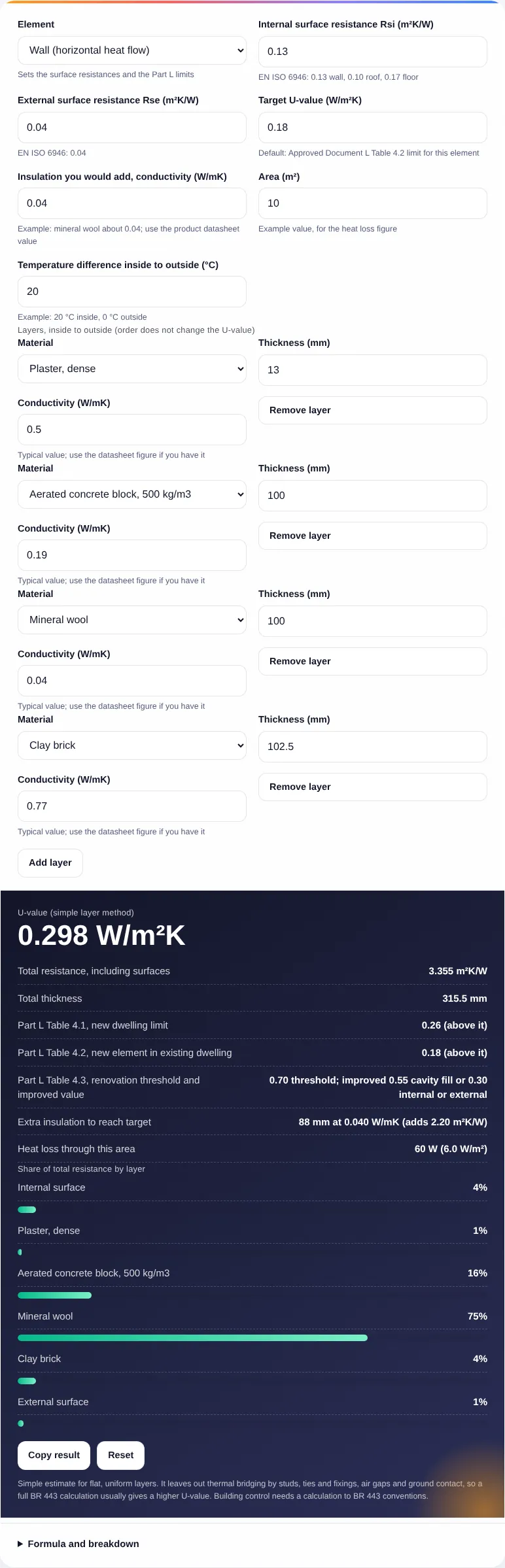
Simple estimate for flat, uniform layers. It leaves out thermal bridging by studs, ties and fixings, air gaps and ground contact, so a full BR 443 calculation usually gives a higher U-value. Building control needs a calculation to BR 443 conventions.
Formula and breakdown
n/a
n/a
n/a
This U value calculator works out the thermal transmittance of a wall, roof or suspended floor from its layers, for homeowners, self-builders and students in the UK, Ireland and Europe, and checks the result against the limits in England’s Approved Document L. Add each layer’s thickness and conductivity to see the U-value, which layer does the work, and how much insulation would reach a target.
Quick answer: A U value calculator adds the thermal resistance of each layer, thickness in metres divided by conductivity, plus inside and outside surface resistances, then takes the reciprocal. A plastered 215 mm solid brick wall gives about 2.1 W/m²K, while new walls in England must reach 0.26 W/m²K or better.

What Is a U Value Calculator?
A U value calculator is a tool that estimates how many watts of heat pass through one square metre of a building element for each degree of temperature difference across it, measured in W/m²K. In plain words: each layer’s resistance is its thickness in metres divided by its thermal conductivity, the resistances are added together with an allowance for the air films on each surface, and the U-value is 1 divided by the total.
The Wikipedia article on thermal transmittance sets out this layer method, notes that ISO 6946 is the standard for calculating walls and roofs, and gives the link to heat loss: heat flow in watts equals area times U-value times the temperature difference. A lower U-value means a better insulated element.
How Do You Use the U Value Calculator?
- Choose the element: wall, roof or ceiling, or suspended floor. This sets the internal surface resistance and the Part L limits.
- Edit the layers. Pick a material to fill in a typical conductivity, then replace it with the figure from the product datasheet if you have one.
- Enter each thickness in millimetres. Add or remove layers as needed; the order does not affect the result.
- Set a target U-value. The default is the Table 4.2 limit for a new element in an existing dwelling.
- Enter the conductivity of the insulation you are considering, the area and the temperature difference.
- Read the U-value, the Part L checks, the extra insulation needed and the heat loss. The share chart shows which layers provide the resistance.
How Do You Calculate a U-Value by Hand?
Divide each layer’s thickness in metres by its conductivity, add the results to the surface resistances, and take the reciprocal: U = 1 / (Rsi + d1/λ1 + d2/λ2 + … + Rse). For a 100 mm layer of mineral wool at 0.04 W/mK, the resistance is 0.1 / 0.04 = 2.5 m²K/W, which on its own is worth more than a metre of solid brick.
The surface resistances depend on which way heat flows. The values given for EN ISO 6946 in the German Wikipedia article on surface resistance are 0.13 m²K/W inside for horizontal heat flow through walls, 0.10 for upward flow through roofs, 0.17 for downward flow through floors, and 0.04 outside in all cases. The table lists the typical conductivities the u value calculator offers as starting points.
| Material | Typical conductivity (W/mK) | Resistance of 100 mm (m²K/W) |
|---|---|---|
| Phenolic foam | 0.018 | 5.56 |
| Polyurethane foam | 0.03 | 3.33 |
| Expanded polystyrene (EPS) | 0.033 | 3.03 |
| Mineral wool | 0.04 | 2.50 |
| Pine timber | 0.10 | 1.00 |
| Plywood | 0.16 | 0.63 |
| Aerated concrete, 500 kg/m3 | 0.19 | 0.53 |
| Plaster, dense | 0.50 | 0.20 |
| Clay brick | 0.77 | 0.13 |
| Concrete, dense (range 0.8 to 2.5) | 1.28 | 0.08 |
Values come from Wikipedia’s list of thermal conductivities and its thermal transmittance and R-value articles. Real products vary, sometimes widely, so a datasheet conductivity (often called the lambda value) is always better than a typical figure.
What U-Values Does Part L Require?
In England, Approved Document L sets maximum U-values of 0.26 W/m²K for walls, 0.16 for roofs and 0.18 for floors in new dwellings, and 0.18, 0.15 and 0.18 for new walls, roofs and floors added to existing dwellings. The figures below come from the 2021 edition incorporating 2023 amendments, Tables 4.1, 4.2 and 4.3.
| Element | New dwelling (Table 4.1) | New element, existing dwelling (Table 4.2) | Renovated element: threshold, improved (Table 4.3) |
|---|---|---|---|
| Roof | 0.16 | 0.15 | 0.35, 0.16 |
| Wall | 0.26 | 0.18 | 0.70, 0.55 for cavity fill or 0.30 for internal or external insulation |
| Floor | 0.18 | 0.18 | 0.70, 0.25 |
| Window | 1.6 | 1.4 or Window Energy Rating Band B | n/a |
| Door | 1.6 | 1.4 (Band B, or Band C if more than 60% glazed) | n/a |
Table 4.3 works as a trigger: when you renovate an element whose U-value is worse than the threshold, it should normally be improved to the improved value. The document allows a lesser standard in some cases, for example where insulating a wall would cut a room’s floor area by more than 5%. A 2026 edition of Approved Document L repeats the same values as Tables 3.1 to 3.3 and applies from 24 March 2027 for most building work in England. Wales, Scotland, Northern Ireland and Ireland have their own rules.
Why Does a Real U-Value Come Out Higher Than the Simple Calculation?
A simple layer sum assumes every layer is uniform, but real walls and roofs are crossed by timber studs and rafters, wall ties, fixings and mortar joints that conduct heat faster than the insulation around them. Approved Document L says U-values should be assessed using the methods and conventions in the Building Research Establishment’s BR 443, which adds corrections for these effects, for air gaps and for ground floors.
So treat this u value calculator’s result as a best case and a way to compare options. For a building regulations submission, ask the insulation manufacturer or a competent energy assessor for a full calculation. Cutting into structure to fit insulation, such as notching joists or rafters, should be checked by a structural engineer and may need building control approval.
How Much Heat Does a Wall Lose?
Heat loss in watts equals U-value times area times the temperature difference: a 10 m² wall at 0.30 W/m²K with 20 °C inside and 0 °C outside loses 0.30 x 10 x 20 = 60 W. An uninsulated solid brick wall at about 2.1 W/m²K loses seven times as much through the same area.
Fabric losses like these set the size of the heating system and its running cost. The heat pump running cost calculator turns a yearly heat demand into a cost, and the electric heater running cost calculator does the same for a room heater. For a whole room, the heat loss calculator combines walls, windows, floor, roof and ventilation.
Worked Example: Insulating a Solid Brick Wall From the Inside
Example: a Victorian terrace in Manchester has a 215 mm solid clay brick external wall with 13 mm of dense plaster on the inside. The owners want to know the current U-value and how much insulation board would bring the wall to the 0.30 W/m²K improved value in Table 4.3.
- Brick: 0.215 / 0.77 = 0.279 m²K/W. Plaster: 0.013 / 0.50 = 0.026 m²K/W.
- Total: 0.13 + 0.026 + 0.279 + 0.04 = 0.475 m²K/W, so U = 1 / 0.475 = 2.10 W/m²K, well above the 0.70 threshold.
- Resistance needed for 0.30: 1 / 0.30 = 3.333 m²K/W. Shortfall: 3.333 minus 0.475 = 2.858 m²K/W.
- With an example board conductivity of 0.022 W/mK from a datasheet: 2.858 x 0.022 = 0.063 m, so about 63 mm of insulation.
- Heat loss through 12 m² of wall at a 20 °C difference falls from 2.10 x 12 x 20 = 505 W to 0.30 x 12 x 20 = 72 W.
Internal insulation on a solid wall changes where condensation can form, so it needs a vapour control layer and careful detailing, and the work may need building control approval, so check with your local building control body first. The u value calculator reproduces these figures if you remove the block and wool layers and set the brick to 215 mm.
Frequently Asked Questions
What is a good U-value for a wall?
In England, a new wall in a new dwelling must not exceed 0.26 W/m²K and a new wall in an existing dwelling 0.18 W/m²K under Approved Document L. An uninsulated solid brick wall is around 2 W/m²K, so lower is better: a lower U-value lets less heat escape.
How do you calculate a U-value?
Divide each layer’s thickness in metres by its thermal conductivity to get its resistance in m²K/W. Add all the layer resistances to the internal and external surface resistances, typically 0.13 and 0.04 for a wall. The U-value is 1 divided by that total.
What is the difference between a U-value and an R-value?
An R-value measures how well a layer resists heat flow, in m²K/W, and R-values of layers add up. A U-value measures how much heat passes through the whole element per square metre per degree, in W/m²K, and equals 1 divided by the total R-value including surfaces.
Why is my calculated U-value lower than the manufacturer’s figure?
A simple layer calculation ignores thermal bridging through timber studs, wall ties, fixings and mortar joints, and air gaps around insulation boards. Calculations to BRE BR 443 conventions add corrections for these, which usually raise the U-value, so treat the simple figure as a best case.
Does the order of the layers change the U-value?
No. Resistances in series add up in any order, so the U-value is the same whichever way round the layers are listed. Order matters for condensation risk, though, which is why vapour control layers belong on the warm side of insulation.
How much insulation do I need to reach a target U-value?
Work out the total resistance the target needs, which is 1 divided by the target U-value, subtract the resistance you already have, and multiply the shortfall by the insulation’s conductivity. The u value calculator does this and shows the thickness in millimetres for the insulation you choose.
Checked October 2026 by the Solaxyra Editorial Team. Sources: gov.uk: Approved Document L, Volume 1, 2021 edition incorporating 2023 amendments, gov.uk: Approved Document L (2026), Volume 1, Wikipedia: Thermal transmittance, Wikipedia (German): surface resistance, Wikipedia: List of thermal conductivities.