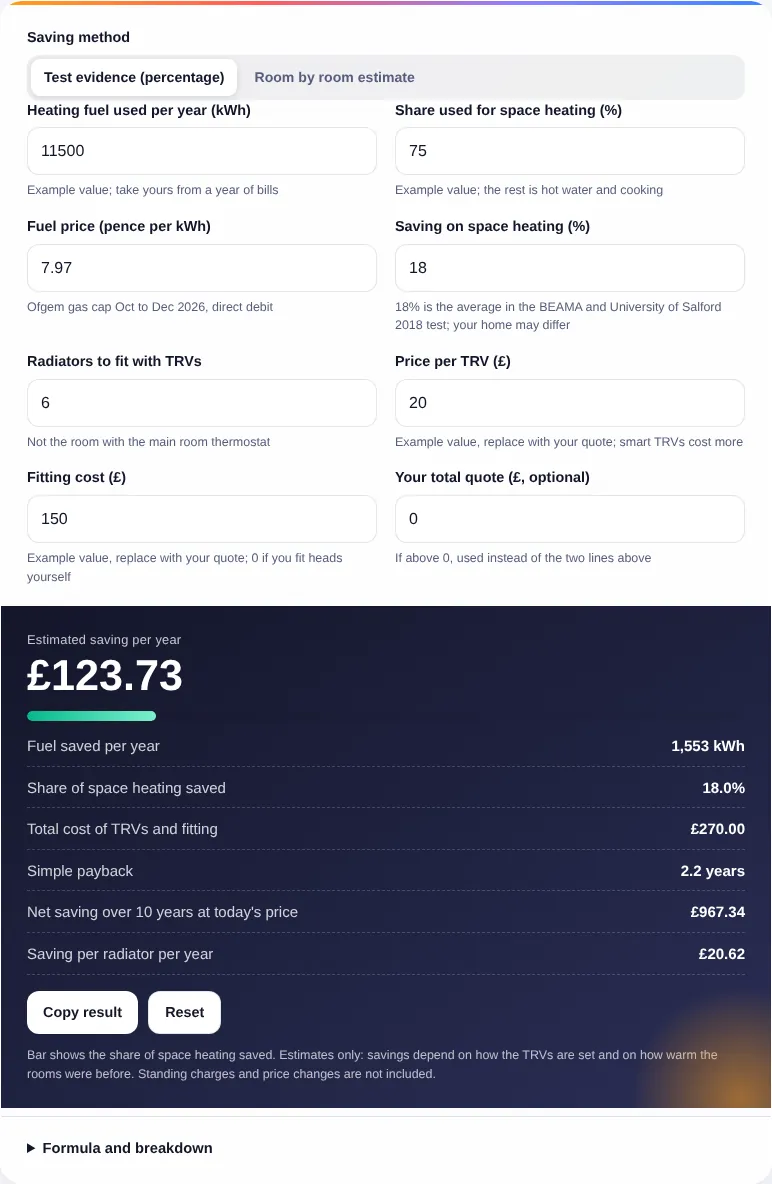
Bar shows the share of space heating saved. Estimates only: savings depend on how the TRVs are set and on how warm the rooms were before. Standing charges and price changes are not included.
Formula and breakdown
n/a
n/a
n/a
This TRV savings calculator estimates how much gas, oil or electricity and money you save a year by fitting thermostatic radiator valves (TRVs) to the radiators in a UK or European home with wet central heating, and how long the valves take to pay back. It offers two methods: the measured average from a whole-house test, or a room by room estimate based on how much cooler you will keep each room.
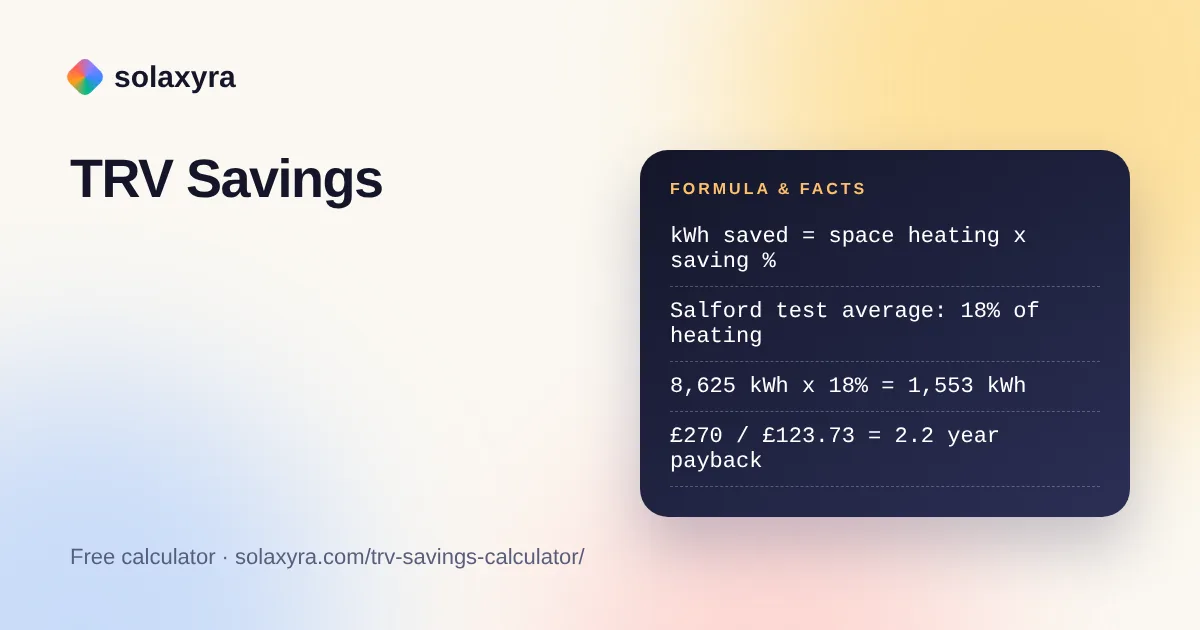
Quick answer: A TRV savings calculator multiplies your yearly space heating use by the expected saving. The BEAMA and University of Salford 2018 test found an average saving of 18% of heating. For 8,625 kWh of space heating at the October 2026 gas cap of 7.97p, that is 1,553 kWh or £123.73 a year.
What Is a TRV Savings Calculator?
A TRV savings calculator is a tool that estimates the heating energy saved when thermostatic radiator valves stop rooms from overheating, and compares that saving with the cost of the valves and fitting. In plain words: saving in kWh equals yearly space heating kWh x the saving percentage, the yearly saving in pounds equals that kWh x your fuel price, and payback equals the total cost divided by the yearly saving.
A TRV has a wax or liquid sensor in its head that expands as the room warms and closes the valve, so each radiator only gives out heat until its room reaches the chosen setting. Without TRVs, every radiator runs flat out whenever the room thermostat in one room calls for heat, so bedrooms and halls often end up warmer than needed. The saving comes from those rooms no longer overheating.
How Do You Use the TRV Savings Calculator?
- Enter your yearly heating fuel use in kWh and the share that goes on space heating.
- Enter your fuel price in pence per kWh.
- Choose a method: keep the 18% test average, enter another percentage, or switch to the room by room estimate.
- For the room by room estimate, enter the share of heat loss in rooms you will keep cooler, how many degrees cooler, and average indoor and outdoor temperatures.
- Enter how many radiators need TRVs, the price per valve and the fitting cost, or type your total quote.
- Read the yearly saving, payback and 10-year net saving, and open the breakdown to check each step.
How Much Do TRVs Save?
The best UK evidence is a whole-house test: the BEAMA report on TRV tests at the Salford Energy House concludes that the average energy saving potential for TRVs in homes is 18% of heating costs. The test was run independently by the University of Salford for BEAMA Heating Controls, a manufacturers’ association, with BRE advising on the test specification.
The saving changed a lot with the outdoor temperature, because overheating in the other rooms matters more when less heat is needed overall. The table shows the measured savings and what each would mean for the example home in the TRV savings calculator.
| Outdoor temperature in the test | Measured saving from TRVs | kWh saved (8,625 kWh space heating) | Saving at 7.97p per kWh |
|---|---|---|---|
| minus 4 °C | 0% (baseline) | 0 | £0.00 |
| 5 °C | 14% | 1,208 | £96.24 |
| 7 °C | 19% | 1,639 | £130.61 |
| 9 °C | 18% | 1,553 | £123.73 |
| 12 °C | 28% | 2,415 | £192.48 |
| 15 °C | 41% | 3,536 | £281.84 |
The report uses an average UK heating season outdoor temperature of about 7.6 °C to arrive at 18%. Prices come from the Ofgem cap for October to December 2026; the report itself used 2016 prices.
Will Your Home Save as Much as the Test House?
Probably not exactly: the test house was an uninsulated Victorian end terrace with solid brick walls and single glazing, and in the baseline the rooms without TRVs ran about 2 to 3 °C warmer than intended. A home where the bedrooms are already kept cool, or where radiators are already turned down by hand, has less overheating to remove, so it saves less.
That is why the TRV savings calculator also has a room by room method. It treats the saving as a setback in part of the home: share of heat loss in the cooler rooms x degrees cooler / (indoor minus outdoor temperature). With 60% of the heat loss in rooms kept 2 °C cooler, 20 °C inside and 7 °C outside, the saving is 9.2%, or £63.45 a year in the example. The thermostat setback savings calculator uses the same physics for time-based setbacks, and the heat loss calculator helps you judge each room’s share of the heat loss.
How Much Do TRVs Cost to Fit, and What Is the Payback?
Payback equals the total cost of the valves and fitting divided by the yearly saving; with the example values of £20 per valve, six radiators and £150 fitting, £270 pays back in about 2.2 years at the 18% saving. These prices are example values, not market data: replace them with your own quote, because prices vary with the valve type and whether the system has to be drained.
Smart TRVs cost more per valve but add room schedules, so a spare room can stay cool all week. In the TRV savings calculator, enter the higher price and, if you will use schedules, a higher saving or a deeper room by room setback. If the radiators already have valve bodies that accept TRV heads, only the heads may need changing, which cuts the fitting cost.
Do You Need TRVs When You Replace a Boiler?
In England and Wales, yes in most cases: the BEAMA TRV factsheet states that each room should be provided with thermostatic room controls when a boiler is replaced in an existing home, a requirement that applies in England from June 2022 and in Wales from November 2022. TRVs are the usual way to meet it, and your installer will confirm what applies to your home.
Do not fit a TRV to the radiator in the room with the main room thermostat, because the two controls would fight each other; leave that radiator on a lockshield or manual valve. Changing valve bodies means draining at least part of the heating system, which is a job for a competent plumber or heating engineer, and any work on a gas boiler itself must be done by a Gas Safe registered engineer. Many systems with TRVs on most radiators also need an automatic bypass valve so the boiler keeps a minimum flow; check the boiler manual.
Worked Example: Six TRVs in a Gas-Heated Home
Example: a gas-heated home uses 11,500 kWh a year, of which 75% is for space heating, at the cap price of 7.97p per kWh. TRVs are fitted to six radiators at an example £20 each, with an example £150 for fitting. The saving is taken as the 18% test average.
- Space heating: 11,500 x 75% = 8,625 kWh.
- Saving: 8,625 x 18% = 1,553 kWh a year.
- Money: 1,553 kWh x 7.97p = £123.73 a year, about £20.62 per radiator.
- Cost: 6 x £20 + £150 = £270.
- Payback: £270 / £123.73 = 2.2 years; net saving over 10 years at today’s price is £967.34.
With the more cautious room by room estimate of 9.2%, the same home saves £63.45 a year and pays back in about 4.3 years. Either way, the TRV savings calculator shows a short payback compared with most heating upgrades. For a whole heating system, the heat pump running cost calculator and energy consumption calculator put the saving in context.
Frequently Asked Questions
How much money do TRVs save a year?
Using the 18% average from the BEAMA and University of Salford test, a home using 8,625 kWh of gas for space heating saves about 1,553 kWh, or £123.73 a year at the October 2026 cap price of 7.97p per kWh. Homes with cool bedrooms already will save less.
Are thermostatic radiator valves worth it?
Usually, because the payback is short. With example costs of £270 for six valves and fitting, the payback is about 2.2 years at an 18% saving and about 4.3 years at a more cautious 9.2%. Get a real quote and enter it in the TRV savings calculator.
Should I put a TRV on every radiator?
Fit them to every radiator except the one in the room with the main room thermostat. A TRV there would fight the thermostat. Check whether your boiler needs an automatic bypass valve so it keeps a minimum flow when most TRVs close.
What number should I set my TRV to?
The numbers on a TRV head are a scale, not degrees, and each maker’s scale differs. Set it, wait a day, check the room with a thermometer and adjust. Lower settings in bedrooms and unused rooms save the most, but keep rooms people use at a healthy temperature.
Do smart TRVs save more than ordinary TRVs?
They can, if you use their room schedules to keep empty rooms cooler for longer. An ordinary TRV holds one setting all day. Enter the higher cost of smart valves and a deeper room by room setback in the calculator to see whether the extra saving pays for them.
Do TRVs work with a heat pump?
Yes. Heat pumps run most efficiently at low, steady flow temperatures, so the right TRV settings depend on how the system was designed. Follow your heat pump installer’s advice on TRV settings rather than turning every room down hard, and check the result in the calculator.
Checked October 2026 by the Solaxyra Editorial Team. Sources: BEAMA: Assessing the energy savings from TRVs in a whole house test facility (2018), BEAMA: TRV factsheet for householders (May 2022), Ofgem: price cap 1 October to 31 December 2026.