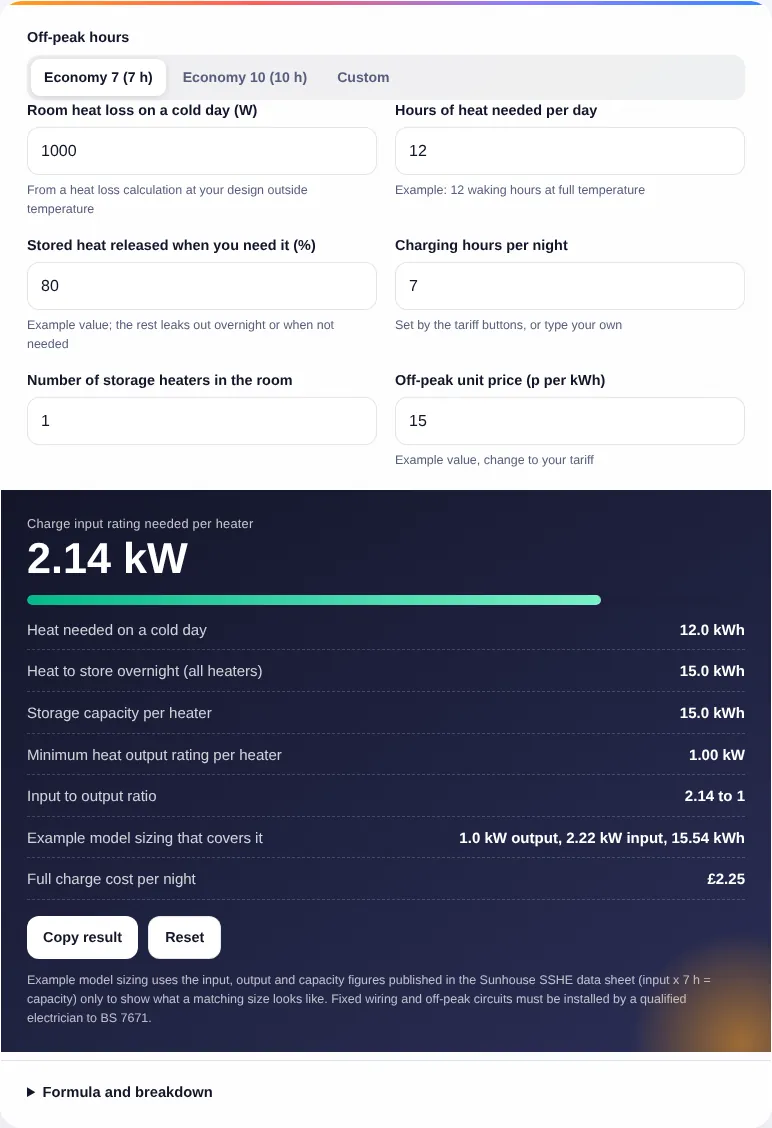
Example model sizing uses the input, output and capacity figures published in the Sunhouse SSHE data sheet (input x 7 h = capacity) only to show what a matching size looks like. Fixed wiring and off-peak circuits must be installed by a qualified electrician to BS 7671.
Formula and breakdown
n/a
n/a
n/a
This storage heater size calculator works out the charge input rating, storage capacity and heat output a night storage heater needs for one room, for UK households on Economy 7, Economy 10 or a similar off-peak tariff who are replacing old heaters or heating a new room. It starts from the room’s heat loss and the hours of warmth you need, allows for heat that leaks out when you do not need it, and splits the result across one or more heaters.
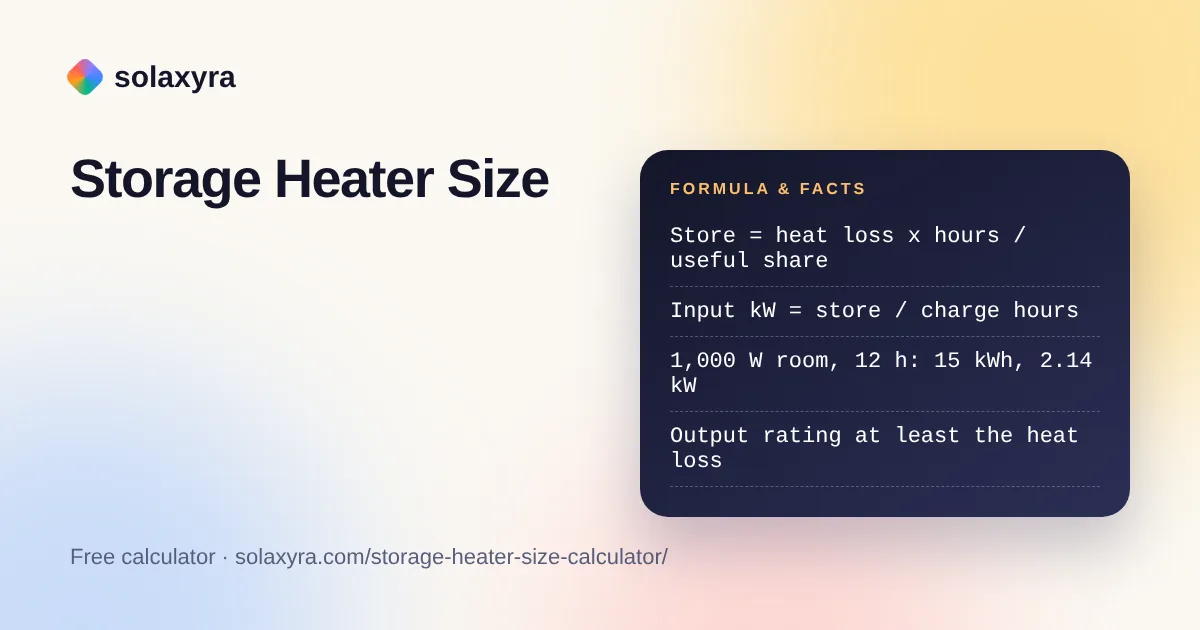
Quick answer: A storage heater size calculator multiplies the room’s cold-day heat loss by the hours of heat needed, divides by the share of stored heat that is useful, then by the charging hours. A room losing 1,000 W heated for 12 hours needs about 15 kWh stored, so roughly 2.1 kW of input on Economy 7 and at least 1 kW of output.
What Is a Storage Heater Size Calculator?
A storage heater size calculator is a tool that estimates how large a storage heater must be to hold a day’s worth of heat for a room, charged during cheaper off-peak hours. In plain words: the heat the room needs in a cold day, in kWh, divided by the share of stored heat you actually benefit from, gives the storage capacity; that capacity divided by the charging hours gives the input rating in kW.
A storage heater has two ratings that are easy to mix up. The input rating is the electrical power the elements draw while charging overnight. The output rating is the heat it is designed to give into the room during the day. In the Sunhouse SSHE data sheet, for example, a heater with a 1.00 kW output has a 2.22 kW input and a maximum storage capacity of 15,540 Wh, which is exactly 2.22 kW times 7 hours.
How Do You Use the Storage Heater Size Calculator?
- Choose your off-peak period: Economy 7, Economy 10 or a custom number of charging hours.
- Enter the room’s heat loss in watts on a cold day. If you do not have it, work it out first with a heat loss calculation for the room.
- Enter how many hours a day the room needs to be at full temperature.
- Set the share of stored heat that is released when you need it. The default 80% is an example value; older static heaters leak more heat overnight.
- Enter how many heaters will share the room and your off-peak unit price.
- Read the input rating, storage capacity and output rating for each heater, and open the breakdown to check the arithmetic.
What Size Storage Heater Do I Need for My Room?
For a room that loses 1,000 W on a cold day and needs 12 hours of heat, you need about 15 kWh of storage and a charge input of about 2.1 kW on Economy 7. The table shows the storage heater size calculator results for other rooms with the 80% example useful share and a 7 hour charge.
| Room heat loss | 8 hours of heat | 12 hours of heat | 16 hours of heat |
|---|---|---|---|
| 500 W | 5.0 kWh, 0.71 kW input | 7.5 kWh, 1.07 kW input | 10.0 kWh, 1.43 kW input |
| 750 W | 7.5 kWh, 1.07 kW input | 11.3 kWh, 1.61 kW input | 15.0 kWh, 2.14 kW input |
| 1,000 W | 10.0 kWh, 1.43 kW input | 15.0 kWh, 2.14 kW input | 20.0 kWh, 2.86 kW input |
| 1,500 W | 15.0 kWh, 2.14 kW input | 22.5 kWh, 3.21 kW input | 30.0 kWh, 4.29 kW input |
| 2,000 W | 20.0 kWh, 2.86 kW input | 30.0 kWh, 4.29 kW input | 40.0 kWh, 5.71 kW input |
Above about 3.3 kW of input, the largest model in the data sheet used here, the storage heater size calculator result is a sign to split the load between two heaters or to reduce the room’s heat loss first with insulation and draught-proofing.
Why Can You Not Size a Storage Heater by Floor Area?
Because a storage heater must hold a whole day’s heat, not just match the room’s heat loss at one moment. Stiebel Eltron’s room heater guide gives a watts per square metre method for convector and fan heaters and states plainly that it should not be applied to storage heaters. A room’s floor area tells you nothing about how long you need heat for, or how much of the stored heat escapes before the evening.
The Wikipedia article on storage heaters describes sizing as a compromise between the coldest weather you plan for and how long it lasts: an undersized heater runs out and you top up at the day rate, while an oversized one costs more and takes up wall space. That is why the storage heater size calculator uses the cold-day heat loss and your own heating hours.
What Is the Difference Between Input and Output Rating?
The input rating is how fast the heater stores energy while charging, and the output rating is how fast it is designed to release heat to the room; input is always higher because the whole day’s heat has to go in during a few off-peak hours. In the SSHE data sheet the ratio is about 2.2 to 1 across the range, from 1.02 kW input for 0.5 kW output to 3.30 kW input for 1.5 kW output.
| Output rating | Input rating | Maximum storage | Boost element |
|---|---|---|---|
| 0.50 kW | 1.02 kW | 7.14 kWh | 340 W |
| 0.70 kW | 1.56 kW | 10.92 kWh | 520 W |
| 1.00 kW | 2.22 kW | 15.54 kWh | 740 W |
| 1.25 kW | 2.76 kW | 19.32 kWh | 920 W |
| 1.50 kW | 3.30 kW | 23.10 kWh | 1,100 W |
Figures are from the Sunhouse SSHE data sheet, shown as one manufacturer’s example; storage is listed there in Wh and equals input times 7 hours. Other ranges use different ratios, so check the data sheet for the model you are considering.
How Many Hours Do Storage Heaters Charge?
On Economy 7 storage heaters charge for 7 off-peak hours a night, and on Economy 10 there are 10 off-peak hours spread across the day, according to the Wikipedia article on Economy 7. The night period may not be one continuous block and its timing varies by region and meter. A longer charge window lowers the input rating needed for the same stored heat, which the storage heater size calculator shows when you switch tariff.
Storage heaters are often on a separate circuit that is only switched on at the off-peak rate. New or altered circuits must be designed and installed by a qualified electrician to BS 7671, and in England and Wales Part P of the Building Regulations applies to that work. To compare tariffs, try the electricity cost calculator, and for a portable top-up heater the electric heater running cost calculator shows what daytime boost heat costs.
How Do I Reduce the Size of Storage Heater I Need?
Lower the room’s heat loss or shorten the hours it needs full heat; both scale the required storage directly, so cutting heat loss by a quarter cuts the input rating by a quarter. Modern heaters also help: the Wikipedia article notes that high heat retention models must keep at least 45% of their heat 24 hours after a full charge, so less escapes overnight and more of what you pay for arrives when you need it.
Our heat loss calculator gives the watts figure the storage heater size calculator needs, and the storage heater running cost calculator estimates the yearly bill once you have chosen a size. Our guide on how to use storage heaters covers the input and output controls.
Worked Example: Living Room in a Flat on Economy 7
Example: a living room in a purpose-built flat loses 1,000 W at the design outside temperature. The household wants it warm for 12 hours a day and is replacing an old static heater with one modern heater. They take 80% of stored heat as useful and pay an example off-peak price of 15p per kWh on Economy 7. These are the default inputs of the storage heater size calculator.
- Heat needed on a cold day: 1.0 kW x 12 hours = 12 kWh.
- Heat to store: 12 / 0.80 = 15 kWh.
- Input rating: 15 kWh / 7 hours = 2.14 kW.
- Output rating: at least 1.0 kW, the room’s heat loss.
- Matching example size: the 1.0 kW output, 2.22 kW input model in the SSHE data sheet stores 15.54 kWh, just above the 15 kWh needed.
- A full charge costs 15 x 15p = £2.25 a night at the example price.
Frequently Asked Questions
How do I work out what size storage heater I need?
Multiply the room’s heat loss in kW on a cold day by the hours of heat you need, divide by the share of stored heat that is useful, then divide by your charging hours. A 1,000 W room heated for 12 hours needs about 15 kWh stored and 2.1 kW of input on Economy 7.
What does the kW rating on a storage heater mean?
Product names usually quote one rating only. The SSHE100, sold as a 1 kW storage heater, has a 1.00 kW output but draws 2.22 kW while charging and stores 15.54 kWh. Always check the data sheet to see whether a name refers to input or output.
Is one big storage heater better than two small ones?
Two smaller heaters spread heat more evenly in a large or long room and keep each unit within the size of a normal range. One larger heater costs less to install. The calculator splits the stored heat and output equally when you enter more than one heater.
How much heat does a storage heater lose overnight?
It depends on the model and its insulation. High heat retention models must keep at least 45% of a full charge after 24 hours, according to Wikipedia. The calculator’s useful share setting, 80% as an example, lets you allow for older heaters that leak more heat before you need it.
Does Economy 10 need a smaller storage heater?
It needs a lower input rating for the same storage, because the charge is spread over 10 hours instead of 7. The heat stored per day does not change. A 15 kWh store needs 2.14 kW of input on Economy 7 but only 1.5 kW over 10 hours.
Can I fit a storage heater myself?
Storage heaters are heavy and usually need a dedicated off-peak circuit. New circuits and changes to fixed wiring must be designed, installed and certified by a qualified electrician to BS 7671, and Part P of the Building Regulations applies in England and Wales.
Checked October 2026 by the Solaxyra Editorial Team. Sources: Sunhouse SSHE storage heater data sheet, Stiebel Eltron: which room heater guide, Wikipedia: Storage heater, Wikipedia: Economy 7.