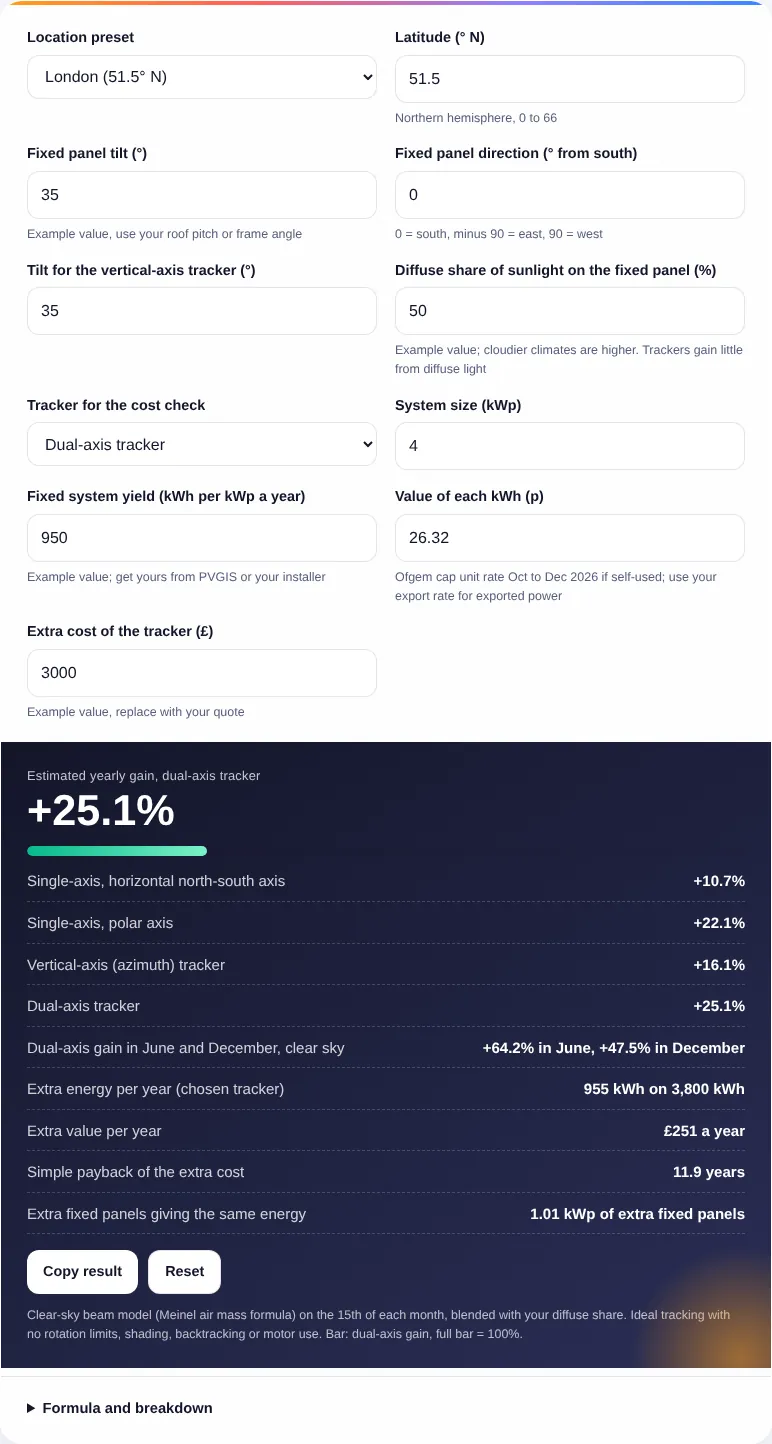
Clear-sky beam model (Meinel air mass formula) on the 15th of each month, blended with your diffuse share. Ideal tracking with no rotation limits, shading, backtracking or motor use. Bar: dual-axis gain, full bar = 100%.
Formula and breakdown
n/a
n/a
n/a
n/a
This solar tracker gain calculator estimates how much more electricity a single-axis or dual-axis solar tracker produces than a fixed panel at your latitude, and whether the extra energy pays back the extra cost. It is built for homeowners, farmers and small businesses in the UK and Europe weighing a ground-mounted tracker against a fixed frame or simply adding more panels, and it shows the sun-position model behind every percentage.
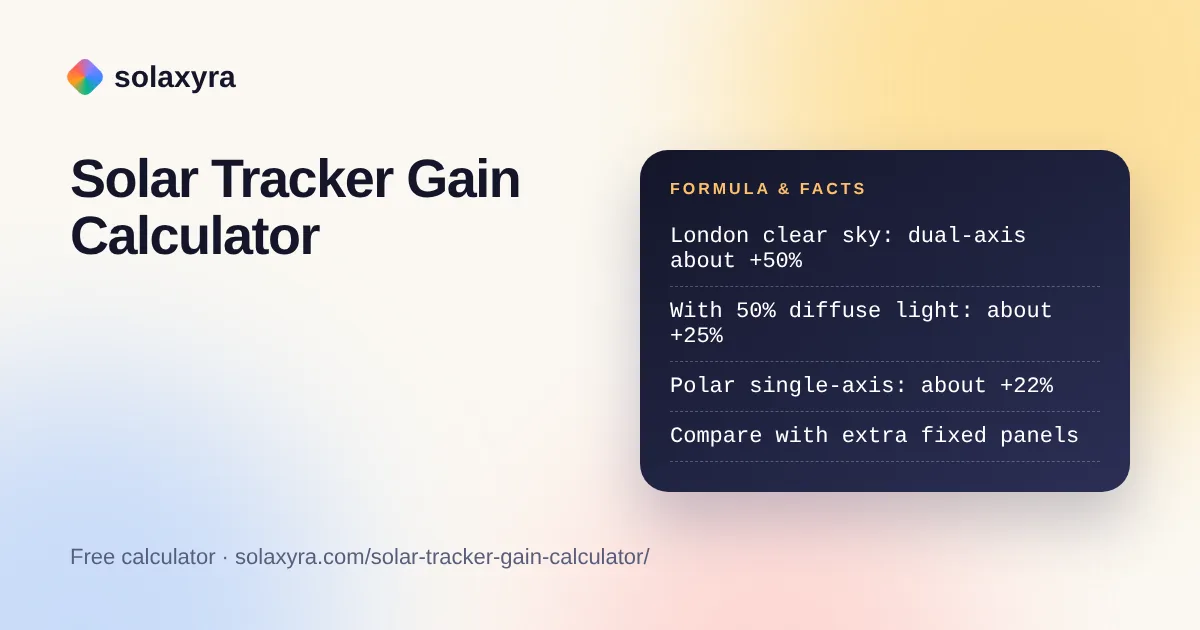
Quick answer: A solar tracker gain calculator compares sunlight on a moving panel with a fixed one. On clear days in London a dual-axis tracker collects about 50% more direct sunlight than a south-facing panel at 35°. Because trackers gain little from diffuse light, the yearly gain falls to about 25% if half the fixed panel’s light is diffuse.
What Is a Solar Tracker Gain Calculator?
A solar tracker gain calculator is a tool that estimates the percentage increase in yearly energy when panels follow the sun instead of staying at one angle. In plain words: model where the sun is for every few minutes of a typical day in each month, work out how strong the direct beam is after passing through the atmosphere, then compare how squarely that beam hits a fixed panel and each type of tracker. The beam ratio is then blended with the share of light that arrives as diffuse skylight, which a tracker cannot aim at.
The tool compares four tracker types at once: a single-axis tracker rotating east to west on a horizontal north-south axis, a single-axis polar tracker whose axis is tilted to point at the pole, a vertical-axis (azimuth) tracker that turns a tilted panel to face the sun’s direction, and a dual-axis tracker that always faces the sun.
How Do You Use the Solar Tracker Gain Calculator?
- Choose a location or type your latitude.
- Enter the tilt and direction of the fixed panel you are comparing against, such as your roof or a fixed ground frame.
- Set the tilt of the vertical-axis tracker if you are considering that type.
- Enter the share of sunlight that is diffuse. Cloudy climates are higher; the 50% default is an example value.
- For the cost check, choose a tracker type and enter system size, fixed yield, the value of each kWh and the extra cost from your quote.
- Read the gain for every tracker type, the extra kWh and pounds, payback and the size of extra fixed array that would give the same energy.
How Much More Energy Does a Solar Tracker Produce?
In this model a dual-axis tracker collects 46% to 54% more direct clear-sky sunlight than a south-facing fixed panel at 35° across latitudes from Madrid to Edinburgh, and a single-axis polar tracker gets most of that benefit. The table runs the solar tracker gain calculator with the fixed panel at 35° facing south and a 50% diffuse share as an example.
| Location | Clear-sky beam gain, dual-axis | Horizontal single-axis | Polar single-axis | Vertical-axis | Dual-axis |
|---|---|---|---|---|---|
| Madrid, 40.4° N | +45.9% | +12.4% | +20.0% | +15.9% | +22.9% |
| Paris, 48.9° N | +48.7% | +10.9% | +21.3% | +15.9% | +24.4% |
| Penzance, 50.1° N | +49.4% | +10.8% | +21.6% | +16.0% | +24.7% |
| London, 51.5° N | +50.3% | +10.7% | +22.1% | +16.1% | +25.1% |
| Manchester, 53.5° N | +51.7% | +10.7% | +22.7% | +16.4% | +25.8% |
| Edinburgh, 55.9° N | +53.7% | +11.0% | +23.7% | +16.9% | +26.8% |
The same 50% diffuse share is used for every row to isolate the effect of latitude. Sunny climates such as central Spain have a lower diffuse share, so their real gains sit closer to the clear-sky column. Published studies land in the same range: a 2009 Hungarian study by Plesz and colleagues calculated a yearly gain of about 33% for two-axis tracking, and a 2023 field test in Adana, Turkey, reported 24% for single-axis and 32% for dual-axis tracking.
Why Do Trackers Gain Less in Cloudy Climates?
A tracker only helps with direct sunlight, so the cloudier the climate, the smaller the gain. Diffuse light comes from the whole sky, and pointing a panel at the sun’s disc does little to collect more of it. The table shows the London result from the solar tracker gain calculator as the diffuse share changes.
| Diffuse share (example) | Horizontal single-axis | Polar single-axis | Vertical-axis | Dual-axis |
|---|---|---|---|---|
| 30% | +15.0% | +30.9% | +22.6% | +35.2% |
| 50% | +10.7% | +22.1% | +16.1% | +25.1% |
| 60% | +8.6% | +17.6% | +12.9% | +20.1% |
| 70% | +6.4% | +13.2% | +9.7% | +15.1% |
This is why many UK and US guides quote gains of 25% to 40% that do not hold on an overcast British day. If you know the diffuse fraction for your site from a tool such as PVGIS, enter it; otherwise test a range.
How Does the Model Work?
The sun’s declination is taken as minus 23.45° x cos(360/365 x (day + 10)) and its elevation from sin(elevation) = sin(declination) x sin(latitude) + cos(declination) x cos(latitude) x cos(hour angle), both from the PVEducation solar geometry pages. The direct beam is 1.353 x 0.7^(AM^0.678) kW/m², where AM is the air mass from the Kasten and Young formula, as given on the PVEducation air mass page.
For each 6-minute step on the 15th of every month, the solar tracker gain calculator takes the cosine of the angle between the sun and each panel’s normal. A dual-axis tracker always scores 1. A single-axis tracker scores the square root of 1 minus the square of the sun’s component along the axis, which for a polar axis reduces to the cosine of the declination. The model assumes ideal tracking with no rotation limits, row shading, backtracking or motor consumption, so treat it as an upper bound before those losses.
Is a Solar Tracker Worth It?
For most UK homes, no: adding fixed panels usually gives the same extra energy for less money and no moving parts. The last result row in the solar tracker gain calculator shows how many extra kWp of fixed panels would match the tracker’s gain, so you can price both options. Trackers make more sense where space is tight and ground mounting is already planned, or in sunnier climates with a low diffuse share.
Check yields and orientation for a fixed array with the solar panel output calculator and the solar panel angle calculator, and test the full investment with the solar payback calculator. A ground-mounted tracker is a structure with moving parts, so foundations and wind loading should be designed by a competent installer or structural engineer, the electrical connection must be made by a qualified electrician to BS 7671, and you should check planning rules with your local planning authority before buying.
Worked Example: Dual-Axis Tracker in Manchester
Example: a smallholding near Manchester (53.5° N) is choosing between a 3 kWp fixed ground frame at 35° facing south and the same panels on a dual-axis tracker. As example values, the fixed yield is 850 kWh per kWp, 60% of the light is diffuse, each kWh is worth 15p on average across self-use and export, and the tracker adds £4,000.
- Clear-sky beam ratio, dual-axis to fixed: 1.517.
- Blended gain: (1 minus 0.6) x 1.517 + 0.6 minus 1 = 20.7%.
- Fixed output: 3 x 850 = 2,550 kWh. Extra from tracking: 2,550 x 20.7% = 527 kWh a year.
- Value: 527 x 15p = £79 a year. Payback: £4,000 / £79 = about 51 years.
- Equivalent fixed array: 527 / 850 = 0.62 kWp, roughly one or two extra panels.
On these example numbers the tracker would not pay back within a typical panel life, while one or two extra fixed panels would deliver the same energy far more cheaply.
Frequently Asked Questions
How much more power does a dual-axis solar tracker produce?
In this model a dual-axis tracker collects about 50% more direct sunlight than a fixed 35° south-facing panel in clear weather in the UK. With half the light diffuse, a typical example for a cloudy climate, the yearly gain is about 25%. Real systems lose a little more to shading and motor use.
Is a single-axis tracker almost as good as dual-axis?
A polar single-axis tracker gets most of the benefit: about 22% against 25% for dual-axis in London at a 50% diffuse share. A horizontal north-south axis tracker gains much less at UK latitudes, about 11%, because the low winter sun is far from the panel’s tilt.
Why are tracker gains bigger in summer?
In summer the sun rises in the north-east and sets in the north-west, so a fixed south-facing panel misses long morning and evening hours that a tracker catches. In the London example the clear-sky dual-axis gain is about 64% in June and 48% in December.
Do solar trackers work in the UK?
They work, but the gain is smaller than in sunny climates because much of the UK’s light is diffuse. Moving parts also need maintenance. Run the solar tracker gain calculator with your own diffuse share and quote to compare a tracker with simply adding fixed panels.
What diffuse share should I use?
Use a figure from an irradiation database such as PVGIS for your site if you can. Otherwise test a range: this page uses 50% as an example for a cloudy climate and shows results for 30% to 70% so you can see how sensitive the gain is.
Can I put a solar tracker on my roof?
Trackers are normally ground-mounted because they need clearance to move and strong foundations against wind. Any structure should be designed by a competent installer or structural engineer, wiring must meet BS 7671, and you should check planning rules with your local planning authority first.
Checked October 2026 by the Solaxyra Editorial Team. Sources: PVEducation: Air mass, PVEducation: Declination angle, PVEducation: Elevation angle, Plesz, Sági and Timár-Horváth (2009), Proceedings of ECOpole, Demirdelen et al. (2023), Energies, Ofgem: Energy price cap, 1 October to 31 December 2026.