Monthly estimate, not a design. A solar thermal system needs a suitable cylinder and must be installed by a competent installer; any work on a gas boiler needs a Gas Safe registered engineer.
Formula and breakdown
n/a
n/a
| Month | Solar heat (kWh) | Demand (kWh) | Solar share |
|---|
This solar thermal calculator estimates how much of a household’s hot water a solar water heating system can supply, month by month, and what that saves against a gas boiler or an electric immersion, for homes in the UK, Ireland and the rest of Europe. You set the collector area, the yearly sunlight it receives and the system efficiency, and it shows the solar fraction, the heat that goes to waste in summer and the simple payback.
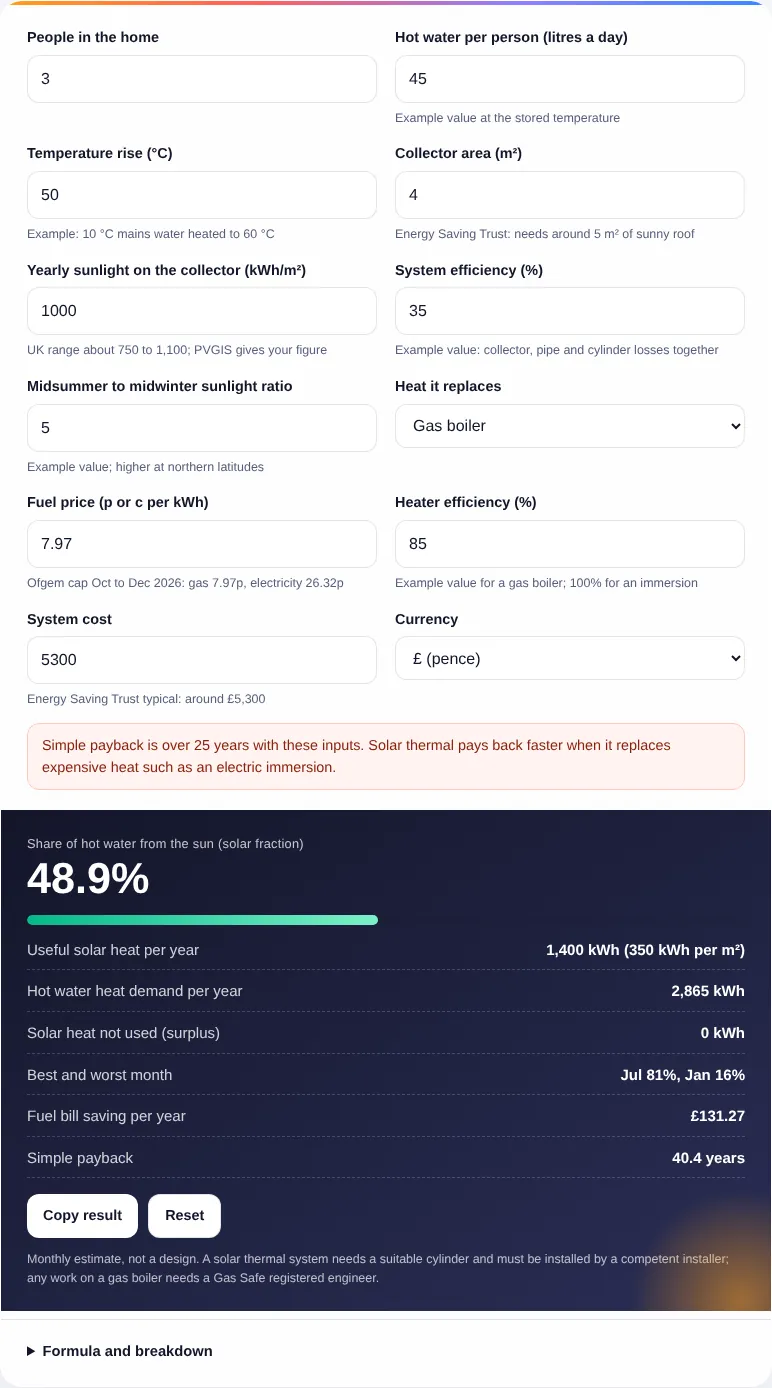
Quick answer: A solar thermal calculator multiplies collector area by yearly sunlight and system efficiency, then compares the heat with your hot water demand month by month. Example: 4 m² at 1,000 kWh/m² and 35% gives 1,400 kWh, about 49% of a 3-person home’s hot water, close to the Energy Saving Trust’s figure of roughly half.
What Is a Solar Thermal Calculator?
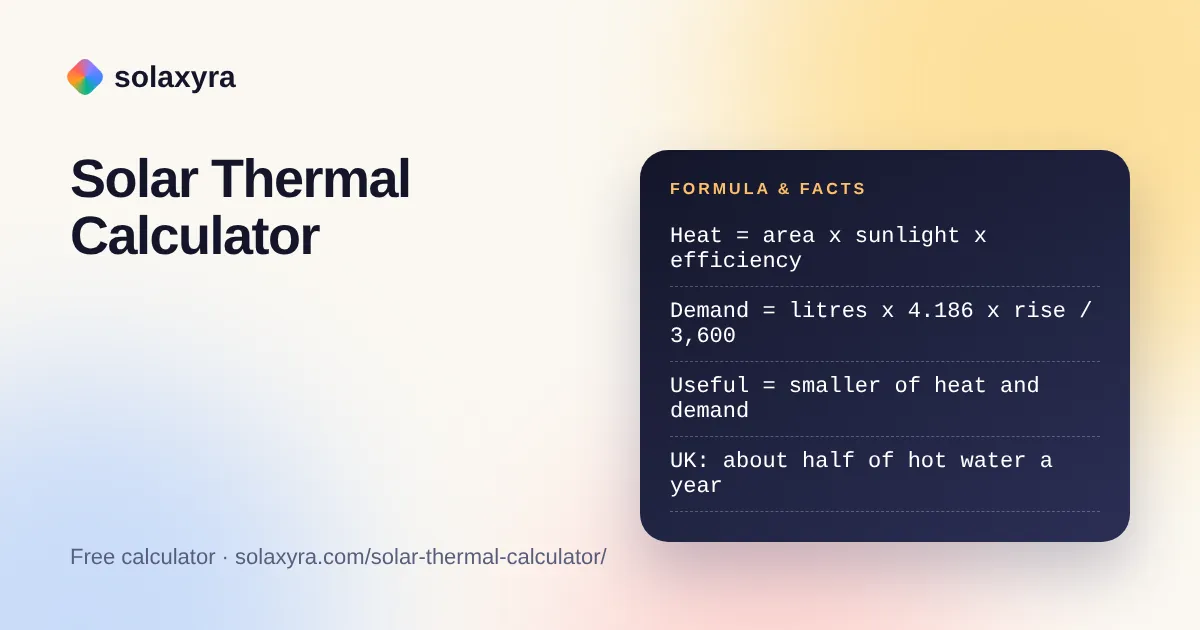
A solar thermal calculator is a tool that estimates the useful heat a solar water heating collector delivers to a hot water cylinder and the share of the household’s hot water demand it covers. In plain words: heat collected equals collector area times the sunlight falling on it times the system efficiency, demand equals litres used times 4.186 kJ per litre per °C times the temperature rise, and each month the useful heat is the smaller of the two.
That last step is what most simple tools leave out. In summer a collector often makes more heat than the household can use, and the cylinder cannot store it for winter, so the surplus is wasted. Working month by month shows the real share, which the industry calls the solar fraction.
How Do You Use the Solar Thermal Calculator?
- Enter the number of people, the hot water each uses a day and the temperature rise from cold mains water to the cylinder setting.
- Enter the collector area in m² from the quote or datasheet.
- Enter the yearly sunlight on the collector in kWh/m². The PVGIS tool from the European Commission gives this for your location, tilt and direction.
- Set the system efficiency, which covers losses in the collector, pipes and cylinder, and the midsummer to midwinter sunlight ratio.
- Choose the heat it replaces, check the price and heater efficiency, and enter the system cost.
- Read the solar fraction, yearly saving and payback, and open the breakdown for the 12-month table.
How Much Hot Water Can Solar Thermal Provide in the UK?
About half of a household’s hot water over a year, according to the Energy Saving Trust’s solar water heating advice, with roughly 90% in summer and 25% in winter. The same page gives a typical cost of around £5,300 and says a system needs around five square metres of roof that gets direct sunlight for most of the day.
The UK’s yearly sunlight ranges from about 750 to 1,100 kWh per square metre, according to the Wikipedia article on solar power in the United Kingdom, which also gives London 0.52 kWh/m² a day in December and 4.74 in July. That large seasonal swing is why the solar thermal calculator spreads the yearly figure across the months using a summer to winter ratio you can change.
What Size Solar Thermal System Do You Need?
Size the collector to your hot water demand: once summer output exceeds what you use, extra area mostly adds wasted heat. The table uses the solar thermal calculator’s defaults for a 3-person home (45 litres each a day, 50 °C rise, 1,000 kWh/m² a year, 35% system efficiency, ratio 5) and replaces gas at 7.97p per kWh with an 85% boiler.
| Collector area | Solar fraction | Useful heat per m² | Gas saving per year |
|---|---|---|---|
| 2 m² | 24.4% | 350 kWh | £65.64 |
| 3 m² | 36.7% | 350 kWh | £98.45 |
| 4 m² | 48.9% | 350 kWh | £131.27 |
| 5 m² | 60.8% | 349 kWh | £163.39 |
| 6 m² | 68.2% | 325 kWh | £183.08 |
| 8 m² | 77.2% | 276 kWh | £207.35 |
Above about 5 m² for this household, each extra square metre delivers less, because June and July are already fully covered. Orientation matters as much as area: a collector facing south at a sensible tilt collects the most, and the solar panel orientation calculator and solar panel angle calculator show how much a less ideal roof loses.
Is Solar Thermal Worth It Compared With Gas or Electric Heating?
Solar thermal pays back fastest when it replaces expensive heat. At the Ofgem price cap for October to December 2026, gas costs 7.97p per kWh and electricity 26.32p. With the default 4 m² system, the 1,400 kWh of useful heat saves £131.27 a year against an 85% efficient gas boiler, a simple payback of about 40 years on £5,300, but £368.48 a year against an electric immersion, a payback of about 14 years.
If you are also weighing up a heat pump, the heat pump running cost calculator compares heating costs with a gas boiler. A roof can carry solar PV instead of, or as well as, solar thermal; the solar panel output calculator estimates what PV would generate from the same space.
Which Collector Type and Cylinder Do You Need?
There are two main collector types: flat plate collectors fixed to or built into the roof, and evacuated tubes. The Wikipedia article on solar thermal collectors notes that evacuated tubes suit cold ambient temperatures and low sunlight, while in most climates flat plates are generally more cost-effective. Enter the efficiency your installer models for the product you are offered.
The system heats water stored in a cylinder, so it suits homes with a conventional or system boiler; the Energy Saving Trust says few combi boilers are compatible, and the existing cylinder often needs replacing. Systems should be checked thoroughly every five years. Installation involves roof work and connection to the hot water system, so use a competent installer, and any work on a gas boiler must be done by a Gas Safe registered engineer.
Worked Example: A Single Occupant With an Immersion Heater
Example: a retired person living alone in a bungalow near Exeter heats water with an electric immersion and uses 30 litres a day at a 50 °C rise. An installer offers 8 m² of collector, and the PVGIS figure for the roof is 1,100 kWh/m² a year; the example system efficiency is 45%.
- Demand: 1 x 30 x 4.186 x 50 / 3,600 = 1.744 kWh a day, or 637 kWh a year.
- Solar heat available: 8 x 1,100 x 45% = 3,960 kWh a year.
- Even in January the collector beats demand (about 112 kWh against 54 kWh), so the solar fraction is 100%, but useful heat is only 637 kWh and 3,323 kWh is surplus.
- Saving: 637 kWh x 26.32p = £167.56 a year; at £5,300, a simple payback of about 32 years.
Run the same inputs with 2 m² and the solar fraction is still about 89%, saving £148.33 a year from a quarter of the collector area, which is why the solar thermal calculator warns when more than half the heat would go unused.
Frequently Asked Questions
How much hot water does solar thermal provide in the UK?
The Energy Saving Trust says a solar water heating system provides roughly half of a home’s hot water over a year, with around 90% in summer and 25% in winter. Your share depends on collector area, orientation, shading and how much hot water you use.
What size solar thermal system do I need?
Size it to your hot water use rather than your roof. The Energy Saving Trust says a system needs around 5 m² of roof that gets direct sun for most of the day. Use the calculator to see where extra area stops adding much, because summer surplus is wasted.
Does solar thermal work with a combi boiler?
Usually not. The Energy Saving Trust notes that few combi boilers are compatible with solar thermal, because they are not designed to heat water stored in a cylinder. A system boiler or conventional boiler with a hot water cylinder suits it better, often with the cylinder replaced.
Is solar thermal better than solar PV for hot water?
They do different jobs. Solar thermal only heats water, while solar PV makes electricity you can use anywhere in the home or export, and a diverter can send surplus to an immersion. Compare the yearly saving of each for the same roof space and your hot water demand.
How much does solar thermal cost?
The Energy Saving Trust gives a typical installed cost of around £5,300. Savings depend on the heat it replaces: replacing an electric immersion saves far more per kWh than replacing an efficient gas boiler, which is why payback varies so widely.
Do solar thermal systems need maintenance?
Yes. The Energy Saving Trust says systems should be checked thoroughly every five years, with the system flushed and the fluid mix replaced. Ask the installer what the warranty requires, and have any work on a gas boiler done by a Gas Safe registered engineer.
Checked October 2026 by the Solaxyra Editorial Team. Sources: Energy Saving Trust: Solar water heating, Wikipedia: Solar thermal collector, Wikipedia: Solar power in the United Kingdom, Ofgem: Changes to energy price cap between 1 October and 31 December 2026.