Most heat pump use falls in winter when solar output is lowest, so direct coverage is far below 100% even if the yearly totals match.
Formula and breakdown
n/a
n/a
n/a
This solar panels for heat pump calculator estimates how much electricity a heat pump uses in a year and the solar system that would match it on paper. It then shows the more realistic share solar can supply directly, because heat pumps work hardest in winter when solar output is lowest.
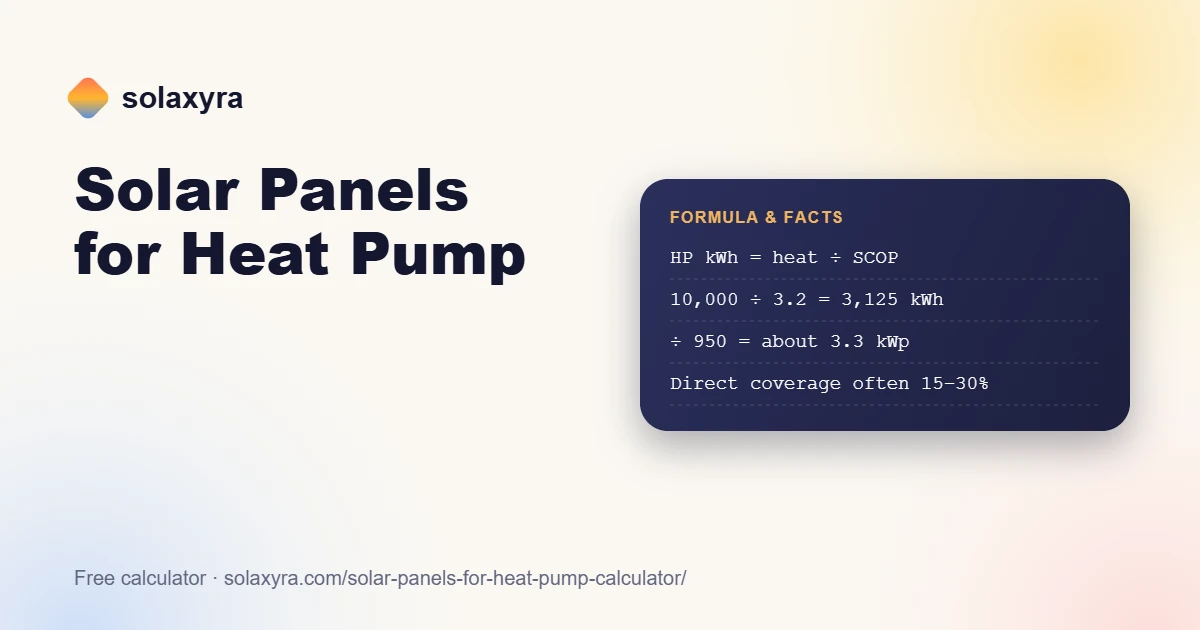
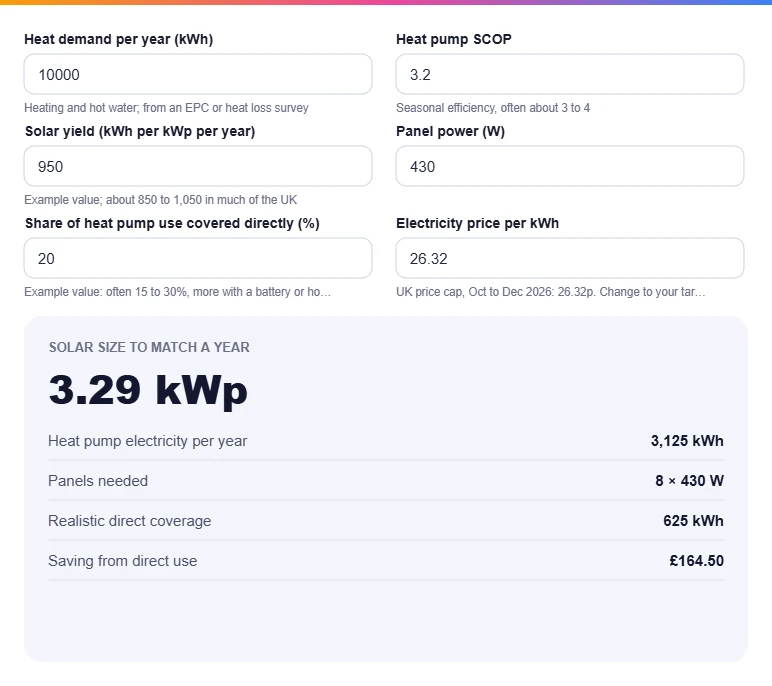
Quick answer: Divide your heat demand by the SCOP, then by your solar yield. A home needing 10,000 kWh of heat with a SCOP of 3.2 uses about 3,125 kWh of electricity, which about 3.3 kWp of solar matches over a year. In practice solar may cover only around 20% of the heat pump’s use directly.
What Is a Solar Panels for Heat Pump Calculator?
A solar panels for heat pump calculator links two numbers that are often confused: the size of solar system that would generate as much electricity in a year as a heat pump uses, and the share of the heat pump’s use that solar can actually supply at the time it is needed.
How Do You Use the Solar Panels for Heat Pump Calculator?
- Enter your yearly heat demand for heating and hot water.
- Enter the heat pump’s seasonal coefficient of performance, SCOP.
- Enter the solar yield for your location and roof, and your panel size.
- Set the share of heat pump use solar covers directly. The default 20% is a cautious starting point.
How Much Solar Matches a Heat Pump?
With a SCOP of 3.2 and 950 kWh per kWp:
| Heat demand | Heat pump electricity | Solar to match | 430 W panels |
|---|---|---|---|
| 6,000 kWh | 1,875 kWh | 1.97 kWp | 5 |
| 10,000 kWh | 3,125 kWh | 3.29 kWp | 8 |
| 14,000 kWh | 4,375 kWh | 4.61 kWp | 11 |
| 20,000 kWh | 6,250 kWh | 6.58 kWp | 16 |
Why Can’t Solar Run a Heat Pump in Winter?
In the UK, most heating happens from November to March. A solar system may produce only around a fifth of its yearly output in those months, and much of it around midday. Solar helps most with hot water in summer and with heating in spring and autumn.
Ways to Get More From Solar With a Heat Pump
- Time the hot water cylinder to heat around midday.
- Pre-heat the house a little during sunny afternoons in shoulder months.
- Add a battery to shift some solar output into the evening.
- Use a smart tariff to buy cheaper electricity overnight in winter.
Worked Example: A Semi-Detached Home
Example: a household in Leeds has a heat pump with a SCOP of 3.5 and needs 12,000 kWh of heat a year.
- Heat pump electricity = 12,000 ÷ 3.5 = 3,429 kWh.
- Solar to match at 900 kWh per kWp = 3.8 kWp.
- With hot water timed to solar, direct coverage might reach 25%: 857 kWh, worth about £226 a year at 26.32p.
Frequently Asked Questions
How many solar panels do I need to run a heat pump?
Around 8 to 12 panels match a typical heat pump’s yearly use, but they cannot cover winter demand directly.
Can solar panels power a heat pump in winter?
Only partly, on sunny days. Most winter use comes from the grid or a battery.
Is it worth getting solar with a heat pump?
Often yes, because the solar also covers household use and summer hot water.
Does a battery help a heat pump with solar?
Yes, it can shift daytime solar into the evening, though winter output stays limited.
Checked November 2026 by the Solaxyra Editorial Team. Sources: Energy Saving Trust: Air source heat pumps, PVGIS (European Commission).