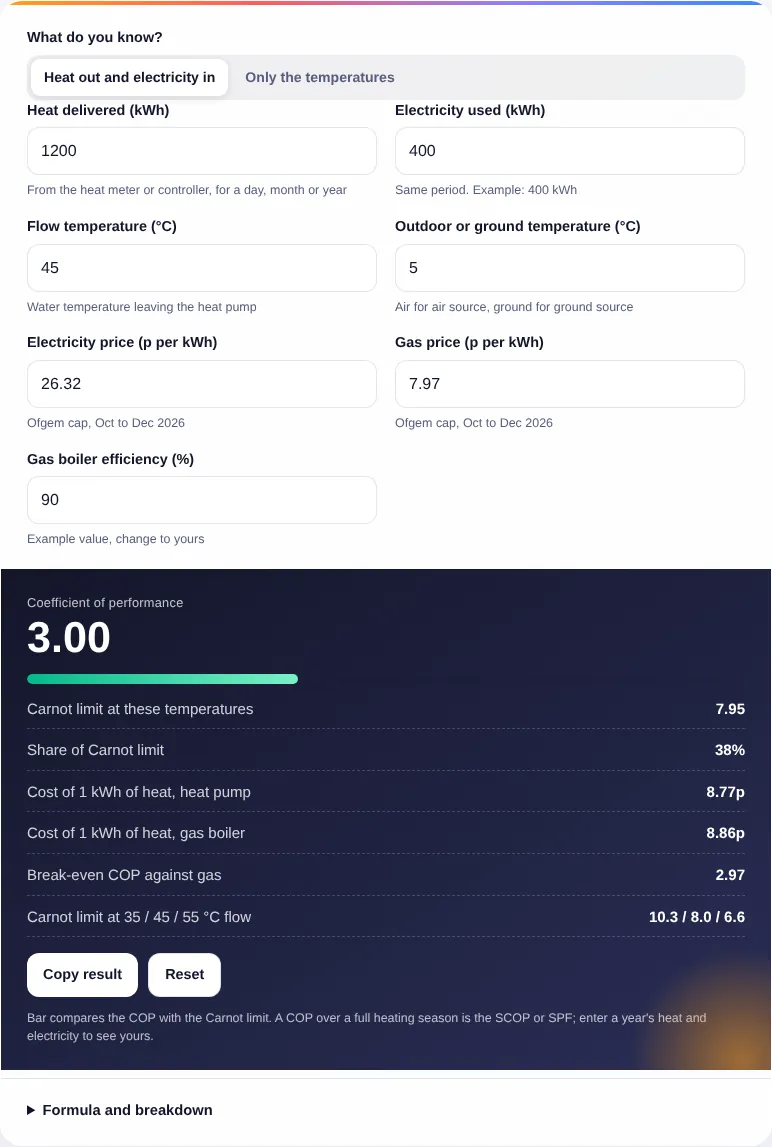
Bar compares the COP with the Carnot limit. A COP over a full heating season is the SCOP or SPF; enter a year’s heat and electricity to see yours.
Formula and breakdown
n/a
n/a
n/a
This heat pump COP calculator works out the coefficient of performance of an air source or ground source heat pump from the heat it delivers and the electricity it uses, or estimates it from the flow and outdoor temperatures, for heat pump owners and people considering one in the UK, Ireland and Europe. It also shows the Carnot limit for your temperatures, the cost of each kWh of heat compared with a gas boiler, and the break-even COP at current prices.
Quick answer: A heat pump COP calculator divides heat delivered by electricity used: 1,200 kWh of heat from 400 kWh of electricity is a COP of 3.0. At the October 2026 Ofgem cap (26.32p electricity, 7.97p gas) a heat pump beats a 90% efficient gas boiler on running cost once its COP is above about 2.97.
What Is a Heat Pump COP Calculator?
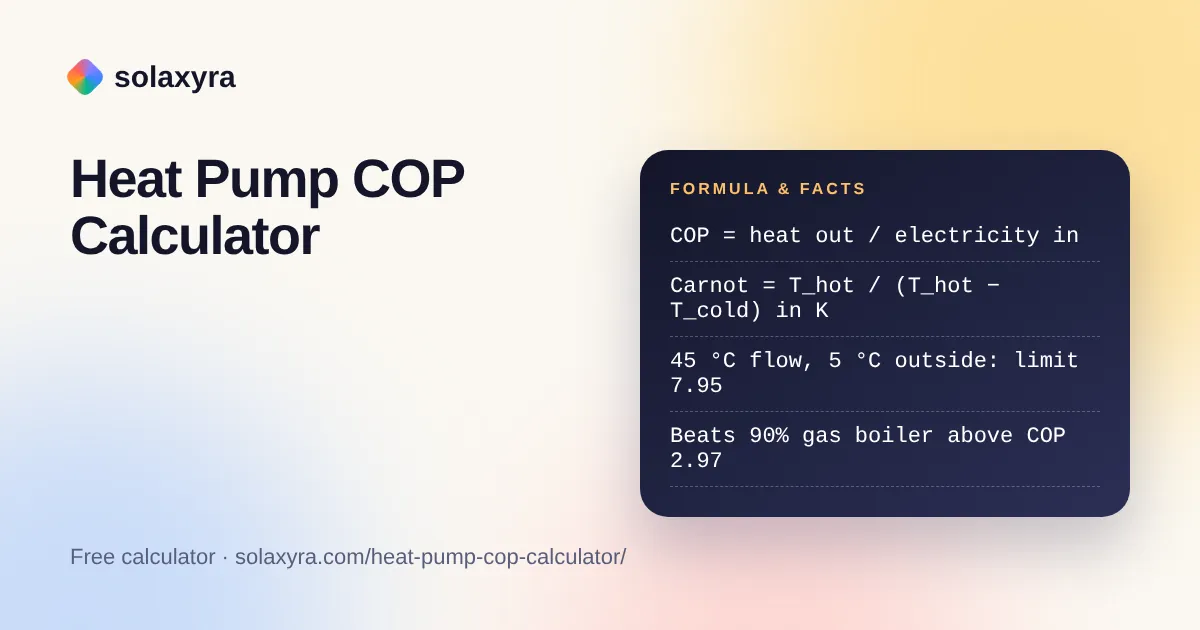
A heat pump COP calculator is a tool that measures how many units of heat a heat pump produces for each unit of electricity it uses. In plain words: COP = heat delivered in kWh / electricity used in kWh, so a COP of 3 means 3 kWh of heat for every 1 kWh of electricity.
The Wikipedia article on coefficient of performance gives the theoretical maximum for heating as T_hot / (T_hot − T_cold), with both temperatures in kelvin. This Carnot limit is never reached in practice, and the article notes that measured values for real systems are always significantly lower, but it shows clearly why the COP falls as the gap between the outdoor temperature and the flow temperature grows.
How Do You Use the Heat Pump COP Calculator?
- Choose whether you have meter readings or only the temperatures.
- With readings, enter the heat delivered and electricity used over the same period. Many heat pump controllers and heat meters show both.
- Enter the flow temperature and the outdoor air temperature, or the ground temperature for a ground source heat pump.
- Without readings, enter the share of the Carnot limit your heat pump achieves; 40% is an example value.
- Check the electricity and gas prices and your old or alternative boiler's efficiency.
- Read the COP, the Carnot limit, the cost per kWh of heat and the break-even COP.
What Is a Good COP for a Heat Pump?
A good COP is one that comfortably beats the break-even figure against your alternative fuel, which at the October 2026 cap prices is about 2.97 against a 90% efficient gas boiler. Below it, each kWh of heat from the heat pump costs more than from gas; above it, the heat pump is cheaper to run. The Ofgem price cap for 1 October to 31 December 2026 sets electricity at 26.32p and gas at 7.97p per kWh for direct debit customers.
The break-even COP is electricity price x boiler efficiency / gas price. With an 85% boiler it is 2.81, and with a 95% boiler 3.14. A cheaper heat pump or off-peak electricity tariff lowers it; a cheaper gas price raises it. For a full year's comparison, including standing charges, use the heat pump running cost calculator.
Why Does COP Fall When It Is Cold Outside?
COP falls in cold weather because the heat pump has to lift heat across a larger temperature gap, and the Carnot limit shrinks as that gap widens. With a 45 °C flow, the limit is 8.0 at 5 °C outside but 6.4 at minus 5 °C. Lowering the flow temperature raises the COP for the same outdoor temperature, which is why heat pumps are paired with larger radiators or underfloor heating.
| Outdoor temperature | Carnot limit, 35 °C flow | Carnot limit, 45 °C flow | Carnot limit, 55 °C flow | Example COP at 40% of limit, 35 / 45 / 55 °C |
|---|---|---|---|---|
| −5 °C | 7.7 | 6.4 | 5.5 | 3.08 / 2.55 / 2.19 |
| 0 °C | 8.8 | 7.1 | 6.0 | 3.52 / 2.83 / 2.39 |
| 5 °C | 10.3 | 8.0 | 6.6 | 4.11 / 3.18 / 2.63 |
| 10 °C | 12.3 | 9.1 | 7.3 | 4.93 / 3.64 / 2.92 |
Carnot limits use flow and outdoor temperatures as the hot and cold sides. Inside the machine the refrigerant runs hotter than the flow and colder than the outdoor air, so the true limit is lower. The 40% column is an illustration, not a measured figure for any product.
How Is SCOP Different From COP and SPF?
COP is the ratio at one moment or under one test condition, while SCOP, the seasonal coefficient of performance, and SPF, the seasonal performance factor, describe performance over a whole heating season. A heat pump might show a COP of 4 on a mild day and 2.5 on a frosty one; the seasonal figure is the heat delivered over the year divided by the electricity used over the year.
SCOP on a product label comes from a standard test calculation for a stated climate and flow temperature. SPF is usually measured in a real home, and depends on what is counted: some measurements include pumps and backup heaters, others do not. Enter a full year of heat and electricity readings in the heat pump cop calculator to get your own seasonal figure.
Real-world monitoring backs up the potential. The Energy Systems Catapult's Electrification of Heat demonstration, which installed 742 heat pumps in a wide range of British homes, reports that air source heat pumps can operate with high efficiencies even in cold weather, and found no property type or era unsuitable for a heat pump.
Is Heating COP the Same as Cooling COP?
No: for the same heat pump at the same conditions, heating COP is one higher than cooling COP, because the heat delivered indoors in heating mode is the heat taken from outside plus the electricity used (heat out = heat in + work). A unit that moves 3 kWh of heat from outside air using 1 kWh of electricity delivers 4 kWh of heat, a heating COP of 4.0, while the same cycle used for cooling has a cooling COP of 3.0.
This heat pump cop calculator works in heating mode only, which is the figure that matters for space heating and hot water in the UK and most of Europe. Cooling ratings on air conditioners, such as EER and SEER, are a different measure and should not be entered here.
How Can I Improve My Heat Pump's COP?
The most effective step is usually to run the lowest flow temperature that keeps the home warm: in the table, cutting the flow from 55 °C to 45 °C at 5 °C outside raises the example COP from 2.63 to 3.18. Other steps include weather compensation, which lowers the flow temperature on mild days, keeping radiator valves open so the system runs steadily, and keeping the outdoor unit clear of leaves and snow.
Radiators sized for a gas boiler may not heat rooms at a low flow temperature. A heating engineer can check room heat losses and radiator outputs before changes are made. Electrical work on the heat pump supply must be done by a qualified electrician to BS 7671 in the UK, and any work on a gas boiler by a Gas Safe registered engineer. To see how much a single electric heater costs by comparison, which has a COP of 1, try the electric heater running cost calculator.
Worked Example: Checking a Year of Meter Readings
Example: a three-bedroom semi in Leeds has an air source heat pump whose controller recorded 10,500 kWh of heat for space heating and hot water over a year, using 3,600 kWh of electricity. The previous gas boiler was about 85% efficient, used here as an example value.
- Seasonal performance: 10,500 / 3,600 = 2.92.
- Cost of heat from the heat pump at 26.32p: 26.32 / 2.92 = 9.02p per kWh.
- Cost of heat from the old boiler at 7.97p: 7.97 / 0.85 = 9.38p per kWh.
- Break-even COP: 26.32 x 0.85 / 7.97 = 2.81, so the heat pump is slightly ahead.
- Yearly energy cost: 3,600 x 26.32p = £947.52 for the heat pump, against 10,500 / 0.85 x 7.97p = £984.53 of gas, before standing charges.
Lowering the flow temperature or moving to a heat pump tariff would widen the gap. Removing the gas meter would also save the gas standing charge of 29.68p a day under the same cap.
Frequently Asked Questions
How do you calculate heat pump COP?
Divide the heat delivered by the electricity used over the same period, both in kWh. If a heat pump delivers 1,200 kWh of heat using 400 kWh of electricity, its COP for that period is 3.0. Over a whole year the same ratio gives the seasonal performance factor.
What is the Carnot COP of a heat pump?
It is the theoretical maximum: hot temperature divided by the difference between hot and cold temperatures, both in kelvin. For a 45 °C flow and 5 °C outdoor air it is 318.15 / 40 = 7.95. Real heat pumps reach well below this limit, but it falls in the same way as the gap widens.
What COP does a heat pump need to beat gas?
Divide the electricity price by the gas price and multiply by the boiler efficiency. At 26.32p electricity, 7.97p gas and a 90% boiler, the break-even COP is about 2.97. Above that, each kWh of heat from the heat pump costs less than from the gas boiler.
Is SCOP the same as COP?
No. COP is a ratio at one set of conditions, while SCOP is a seasonal figure that averages performance over a heating season for a stated climate and flow temperature. SCOP is the better guide to running costs, but your own home's measured seasonal figure is better still.
Why is my heat pump COP lower than the label?
Common reasons are a higher flow temperature than the label assumes, colder weather, frequent short cycling, hot water heating at high temperature, backup heaters running, or meters that count different things. Compare heat and electricity over the same period and check the flow temperature first.
Can a heat pump COP be above 5?
Yes, at small temperature gaps, such as a low flow temperature on a mild day, because the Carnot limit is then very high. Over a whole season the figure is lower, because cold days and hot water at higher temperatures pull the average down. A COP above the Carnot limit always means a measurement error.
Checked October 2026 by the Solaxyra Editorial Team. Sources: Wikipedia: Coefficient of performance, Ofgem: price cap 1 October to 31 December 2026, Energy Systems Catapult: Electrification of Heat demonstration.