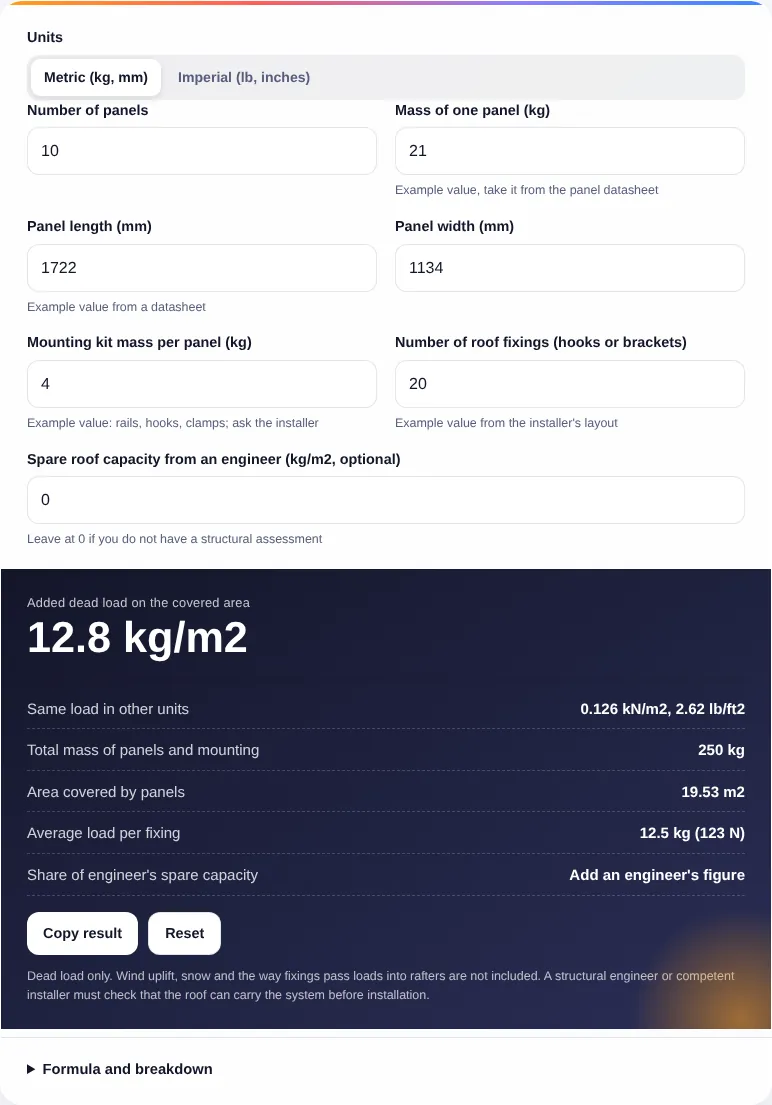
Dead load only. Wind uplift, snow and the way fixings pass loads into rafters are not included. A structural engineer or competent installer must check that the roof can carry the system before installation.
Formula and breakdown
n/a
n/a
n/a
This solar panel roof load calculator works out the extra dead load that solar panels and their mounting add to a roof, in kg/m2, kN/m2 and lb/ft2, plus the total mass and the average load on each fixing, for home owners, installers and surveyors in the UK, Ireland and Europe. It gives the figures a structural engineer or competent installer will ask for; it does not replace their check of the roof.
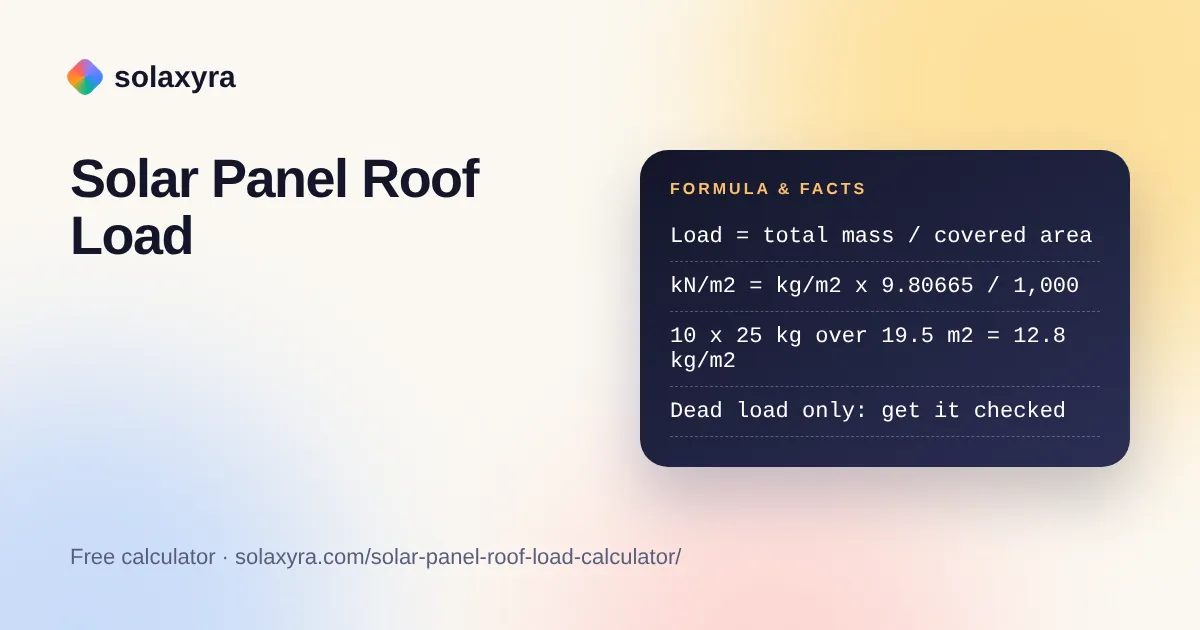
Quick answer: A solar panel roof load calculator divides the total mass of panels and mounting by the roof area they cover. Example: 10 panels of 21 kg with 4 kg of mounting each, each 1,722 by 1,134 mm, weigh 250 kg over 19.5 m2, which is 12.8 kg/m2 or 0.126 kN/m2.
What Is a Solar Panel Roof Load Calculator?
A solar panel roof load calculator is a tool that converts the weight of a solar array into a load per square metre of roof, the form in which structural loads are usually assessed. In plain words: load in kg/m2 equals the number of panels times the mass of each panel and its share of the mounting, divided by the number of panels times the area of one panel.
To express the load as a pressure in kN/m2, multiply kg/m2 by standard gravity and divide by 1,000. Standard gravity is fixed by ISO 80000 at 9.80665 m/s2, as the Wikipedia article on standard gravity records, so 1 kg/m2 equals 0.0098 kN/m2.
How Do You Use the Solar Panel Roof Load Calculator?
- Choose metric or imperial units.
- Enter the number of panels and the mass, length and width of one panel from its datasheet.
- Enter the mass of the mounting kit per panel: rails, roof hooks or brackets and clamps. Your installer can give this from the kit list.
- Enter the number of roof fixings to see the average load on each one.
- If a structural engineer has given you a spare capacity for the roof, enter it to see the share used.
Do You Need a Structural Engineer for Solar Panels?
In England and Wales the roof’s ability to carry the panels must be checked and proven, because building regulations normally apply to solar panels on a roof. The Planning Portal guidance on building regulations for solar panels says strengthening work may be needed, and recommends using an installer who belongs to a competent person scheme.
A competent installer will normally assess the roof structure as part of the survey and will call in a structural engineer when the roof is old, altered, damaged, built with unusual timbers or close to its limit. Do not rely on this solar panel roof load calculator alone to decide that a roof is strong enough, and never cut, notch or remove rafters, trusses or bracing to fit panels. In Scotland, Northern Ireland and Ireland, follow the local building standards.
How Much Weight Do Solar Panels Add to a Roof?
For a 1,722 by 1,134 mm panel weighing 18 to 28 kg with 4 kg of mounting, the dead load is about 11 to 16 kg/m2 of covered roof, as the table shows. The panel masses are example values, so use the figure on your own panel’s datasheet.
| Panel mass (example) | Panel only (kg/m2) | With 4 kg mounting per panel (kg/m2) | With mounting (kN/m2) |
|---|---|---|---|
| 18 kg | 9.2 | 11.3 | 0.110 |
| 21 kg | 10.8 | 12.8 | 0.126 |
| 24 kg | 12.3 | 14.3 | 0.141 |
| 28 kg | 14.3 | 16.4 | 0.161 |
The load is spread over the covered area only. The rest of the roof carries nothing extra, which is why the total mass and the load per fixing matter as much as the kg/m2 figure.
Do Glass-Glass Panels or an Older Roof Change the Result?
Yes: the panel type changes the mass you enter, and the roof’s age and condition change what it can safely carry, so both need checking before you rely on a kg/m2 figure. Glass-glass (bifacial or double-glass) panels are often heavier than glass-backsheet panels of the same size, so always take the mass from the datasheet of the exact model rather than a typical figure.
Comparing quotes by mass per kilowatt-peak helps when panel sizes differ. Example: a 430 W panel weighing 21 kg with 4 kg of mounting carries 25 kg for 0.43 kWp, or about 58 kg per kWp; a 4 kWp array of similar panels and mounting therefore weighs about 230 kg in total.
An older roof may have undersized or notched rafters, decayed timber, sagging, or a heavier covering such as concrete tiles that already uses much of its capacity. Building regulations normally apply to rooftop solar, and the roof’s ability to carry the extra load must be checked, with strengthening where needed. Ask the installer for the structural survey, and use a structural engineer if the roof shows any defect.
Why Does the Load per Fixing Matter?
Panels do not press evenly on the tiles: their weight passes through rails into a limited number of hooks or brackets, which transfer it into the rafters or battens. In the default example, 250 kg over 20 fixings is 12.5 kg, about 123 N, on each fixing from gravity alone.
That is the smallest force a fixing sees. Wind can push down on or lift up a panel, and snow adds weight on top, so the installer chooses the number and spacing of fixings from the mounting manufacturer’s design method for the site’s wind and snow conditions. More fixings reduce the load on each one.
Are Wind and Snow Loads Included?
No: this solar panel roof load calculator gives the permanent dead load only. Wind can lift panels as well as press on them, and snow can settle on panels or slide off them differently from the roof covering. These depend on location, height, roof shape and exposure, and must be worked out by the installer or a structural engineer to the applicable standards.
Before the structural check, plan the layout with the solar panel roof area calculator to see how many panels fit, and the solar panel calculator to see how many you need.
Worked Example: Roof Load for a 16-Panel Array
Example: a detached house in Derby plans 16 panels with a datasheet mass of 24 kg and a size of 1,762 by 1,134 mm. The installer’s kit list gives 5 kg of mounting per panel and 32 roof hooks.
- Total mass: 16 x (24 + 5) = 464 kg.
- Covered area: 16 x 1.762 x 1.134 = 31.97 m2.
- Dead load: 464 / 31.97 = 14.5 kg/m2, which is 14.5 x 9.80665 / 1,000 = 0.142 kN/m2, or 2.97 lb/ft2.
- Per hook: 464 / 32 = 14.5 kg, about 142 N, before wind and snow.
- The installer passes these figures to a structural engineer, who confirms the rafters can take the added load or specifies strengthening.
On a flat roof, ballasted frames rely on added weight to hold the panels down, and the tilt changes how wind acts on them, so ballast systems need a specific design. The solar panel angle calculator shows the tilt trade-off.
Frequently Asked Questions
How much does a solar panel weigh per square metre?
Divide the panel mass by its area. A 21 kg panel measuring 1,722 by 1,134 mm covers 1.95 m2, so it weighs 10.8 kg/m2, or 12.8 kg/m2 with 4 kg of mounting. Panel masses vary, so use your datasheet figures in the calculator.
Can my roof take the weight of solar panels?
Many roofs can, but it must be checked for each property. In England and Wales building regulations normally apply, and the roof’s ability to carry the panels must be checked and proven. A competent installer assesses the structure and calls in a structural engineer where needed.
How do I convert kg/m2 to kN/m2?
Multiply kg/m2 by standard gravity, 9.80665 m/s2, and divide by 1,000. A load of 12.8 kg/m2 equals 0.126 kN/m2. For pounds per square foot, multiply kg/m2 by about 0.2048, giving 2.62 lb/ft2 for the same load.
Does the calculator include wind and snow loads?
No, it calculates the permanent dead load of panels and mounting only. Wind uplift, wind pressure and snow loads depend on the site, building height, roof shape and edge zones, and must be calculated by the installer or a structural engineer using the applicable design standards.
What is the load on each roof hook?
Divide the total mass of panels and mounting by the number of hooks. In the default example, 250 kg on 20 hooks is 12.5 kg, about 123 N, each. This is gravity alone; wind and snow can increase the force considerably, which is why fixing numbers come from the mounting design.
Do I need building regulations approval for solar panels?
Building regulations normally apply to solar panels on a roof in England and Wales, covering the structure and the electrical installation. Using an installer registered with a competent person scheme is the usual route. Planning permission is a separate question with its own rules.
Checked October 2026 by the Solaxyra Editorial Team. Sources: Planning Portal: Solar panels, building regulations, Wikipedia: Standard gravity (ISO 80000).