This guide explains what happens to voltage, current, shading losses and cable size when you wire solar panels in series, in parallel or in a mix of both, for campervan, boat, shed and off-grid owners in the UK and Europe and for anyone reading a rooftop quote. The series vs parallel solar panels choice is not about which is “better” in general; it is about matching the array to your charge controller or inverter, your cable run and the shade on your site.
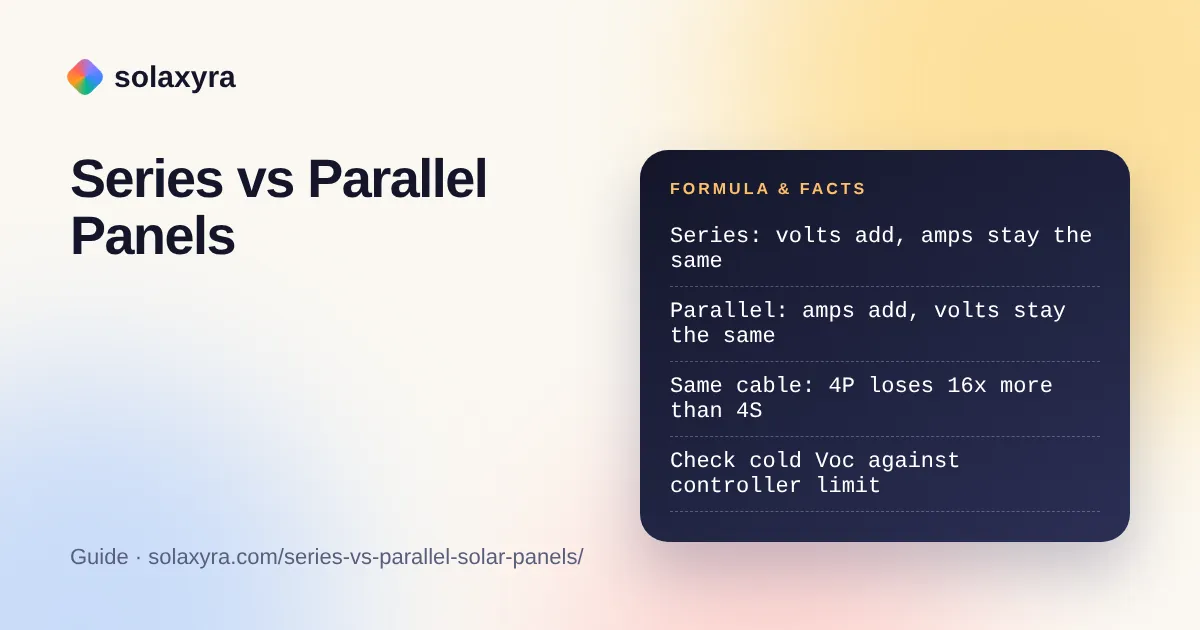
Quick answer: In series vs parallel solar panels, series wiring adds the panel voltages while the current stays the same, and parallel wiring adds the currents while the voltage stays the same. Series suits MPPT controllers, long cables and unshaded sites; parallel suits low-voltage controllers and partly shaded sites. Always check cold-weather voltage against the controller limit.
What is the difference between series and parallel solar panel wiring?
In series, panels are joined positive to negative in a chain, so their voltages add and the current is the same through every panel; in parallel, all positives are joined together and all negatives together, so the voltage stays at one panel’s value and the currents add. This is basic circuit physics, described in the Wikipedia article on series and parallel circuits, and it applies to solar panels just as to any other source.
The power is the same either way, before losses. Four 100 W panels give about 400 W whether they are wired in series, in parallel, or as two series pairs connected in parallel (often written 2S2P). What changes is how that power is delivered: high voltage and low current, or low voltage and high current. That difference is the heart of the series vs parallel solar panels decision: it decides which controller you can use, how thick the cables must be, and how the array behaves in shade.
Solar installers use the word “string” for a chain of panels in series. Larger arrays are usually built from several strings connected in parallel, which is how most rooftop and off-grid systems combine the strengths of both methods.
How do voltage and current change in each layout?
When comparing series vs parallel solar panels, each layout trades voltage for current in a fixed way: series multiplies voltage by the number of panels, parallel multiplies current by the number of panels, and series-parallel does a bit of both. The table uses the 100 W, 36-cell panel from Victron Energy’s controller technical note (18 V and 5.56 A at maximum power, 21.6 V open circuit). The cold column assumes a cell temperature of −10°C and an open-circuit voltage coefficient of −0.35% per °C, which is an example value: use the figure on your own panel’s datasheet.
| Layout of four panels | Voltage at maximum power | Open-circuit voltage at 25°C | Open-circuit voltage at −10°C (example) | Current at maximum power | Cable loss in the same cable (relative) |
|---|---|---|---|---|---|
| 4 in series (4S) | 72 V | 86.4 V | about 97 V | 5.56 A | 1× |
| 2 in series, 2 strings in parallel (2S2P) | 36 V | 43.2 V | about 48.5 V | 11.1 A | 4× |
| 4 in parallel (4P) | 18 V | 21.6 V | about 24.2 V | 22.2 A | 16× |
The last column follows from the fact that resistive loss rises with the square of the current. Doubling the current in the same cable multiplies the loss by four, so four panels in parallel lose sixteen times as much in a shared cable as the same panels in series. To keep losses equal you need much thicker cable for parallel, which the solar cable size calculator can show for your run length.
Series vs parallel solar panels: which is better for shade?
Parallel wiring usually copes better with partial shade, because a shaded panel in parallel only reduces its own current, while in a series string the shared current is pulled down towards that of the weakest panel. Bypass diodes reduce this problem: they let current flow around a shaded panel or section, so the string loses roughly that panel’s voltage rather than collapsing.
Most modern panels have bypass diodes in the junction box, so a single shaded panel in a series string no longer stops the whole string, but the string still loses output and the controller has to find a new maximum power point. Victron’s controller literature lists partial shading detection as a feature of its MPPT chargers for this reason.
In practice, series vs parallel solar panels compare like this:
- On an open campervan roof or field mount with little shade, series or 2S2P gives the best balance of cable size and harvest.
- Where one panel is regularly shaded by a roof vent, aerial or chimney while the others are in sun, parallel or separate strings on separate controller inputs lose less.
- On house roofs with uneven shade, installers may use microinverters or optimisers so each panel works independently; see our guides to microinverters vs string inverters and solar optimisers.
Do series or parallel panels work with my charge controller?
A PWM controller needs parallel wiring of panels matched to the battery voltage, while an MPPT controller works with series or series-parallel arrays as long as the coldest open-circuit voltage stays below the controller’s maximum PV input voltage. That limit is the most important number when you wire in series.
Using the table above with a 12 V battery, here is how series vs parallel solar panels fare on each controller:
- 4S on a 100 V MPPT controller: about 97 V open circuit at −10°C leaves only about 3 V of headroom. A colder morning or a panel with a larger coefficient could exceed 100 V and damage the controller, so a 150 V controller is the safer choice.
- 2S2P on a 100 V controller: about 48.5 V cold leaves wide headroom, and 36 V at maximum power is comfortably above the battery.
- 4P on an MPPT controller: works, but Victron’s SmartSolar manual says charging starts only when PV voltage is 5 V above battery voltage. With a 13 V battery that means about 18 V, and Victron’s coefficients put this panel’s maximum power voltage at about 16.3 V when the cells are at 45°C, so start-up and harvest suffer on warm days.
- 4P on a PWM controller: the natural match for 36-cell panels and a 12 V battery, at the cost of thicker cable and the PWM losses explained in our MPPT vs PWM guide.
The solar string size calculator works out the minimum and maximum number of panels in series for your panel datasheet, temperature range and controller or inverter, and the MPPT charge controller calculator sizes the charge current.
How do you choose a wiring layout step by step?
Start from the controller or inverter limits, then check temperature, shade and cable length; the layout that passes every check with the fewest parallel strings is usually the right one. These steps settle series vs parallel solar panels for any small system:
- From each panel’s datasheet, note Vmp, Voc, Imp, Isc and the Voc temperature coefficient.
- From the controller or inverter datasheet, note the maximum PV input voltage, the MPPT operating range and the maximum input current.
- Choose the lowest cell temperature you expect at sunrise (example: −10°C for an exposed UK site; check local records) and calculate the cold Voc per panel.
- Find the largest number of panels in series that keeps cold Voc below the maximum input voltage with a margin.
- Check that the string’s Vmp on a hot day stays above the controller’s minimum or start-up voltage.
- Add strings in parallel until you reach the array size you want, keeping total current within the controller limit.
- Size the cables for the current and run length, and fit string fuses where required.
Can you mix different solar panels in series or parallel?
You can, but mismatched panels waste power: in series the string current is limited by the panel with the lowest current, and in parallel the shared voltage is set close to the panel with the lowest voltage. The safest rule is to wire only identical panels together in one string, and to put a different panel type on its own string or on a separate controller.
Example: a 100 W panel rated at 5.56 A wired in series with a 175 W panel rated at about 9 A (example values) forces the larger panel down to about 5.56 A, so it delivers well under its rating. In parallel, two panels with similar voltage but different wattage work reasonably well, because each contributes its own current.
What safety rules apply to series and parallel arrays?
Series vs parallel solar panels need different protection. When three or more strings are connected in parallel, each string generally needs its own fuse, because a fault or shaded string can otherwise receive the combined reverse current of all the others. The panel and controller manuals give the maximum series fuse rating to use.
Series wiring raises voltage quickly. A short string on a van stays below 100 V, but a house roof string of ten or more panels can reach several hundred volts DC, and DC arcs do not extinguish as easily as AC. Panels produce voltage whenever light falls on them, so they cannot simply be switched off at the roof. Rooftop and building-connected systems must be designed and installed by a competent installer, with the electrical work carried out or checked by a qualified electrician; in the UK that work must meet BS 7671. Never connect or disconnect connectors under load.
Frequently Asked Questions
Do solar panels produce more power in series or parallel?
Neither layout creates more power on its own. Four 100 W panels make about 400 W either way. Series usually delivers more in practice because lower current means lower cable losses, while parallel can deliver more when one panel is regularly shaded.
Can I wire solar panels in series to a 12 V battery?
Yes, with an MPPT controller that steps the higher string voltage down to battery voltage. Check that the string’s open-circuit voltage on the coldest morning stays below the controller’s maximum PV input voltage. With a PWM controller, series wiring wastes the extra voltage.
What happens if one panel is shaded in a series string?
The shaded panel limits the current through the whole string. Bypass diodes in the panel’s junction box let current flow around the shaded cells, so the string loses roughly that panel’s share of voltage instead of most of its output. Parallel wiring limits the loss to the shaded panel only.
Why does panel voltage rise in cold weather?
A solar cell’s voltage falls as its temperature rises and rises as it cools. On a frosty, sunny morning a panel’s open-circuit voltage can be several per cent above its 25°C rating, which is why string limits are always checked at the lowest expected temperature.
Do I need fuses when wiring panels in parallel?
With three or more strings in parallel, each string generally needs a fuse to stop reverse current from the other strings flowing into a faulty or shaded one. Use the fuse rating given on the panel datasheet and follow the controller manual.
Checked October 2026 by the Solaxyra Editorial Team. Sources: Wikipedia: series and parallel circuits, Wikipedia: solar panel, Victron Energy: PWM or MPPT technical information, Victron Energy: SmartSolar MPPT manual.