Solar panels rarely deliver their full rated power. In the UK, 50 to 70% of the rating in good sun is common.
Formula and breakdown
n/a
n/a
n/a
This power station charging time calculator estimates how long a portable power station takes to recharge from mains, from solar panels or from a car’s 12 V socket. It includes charging losses and, for solar, how many days of sun the charge needs.
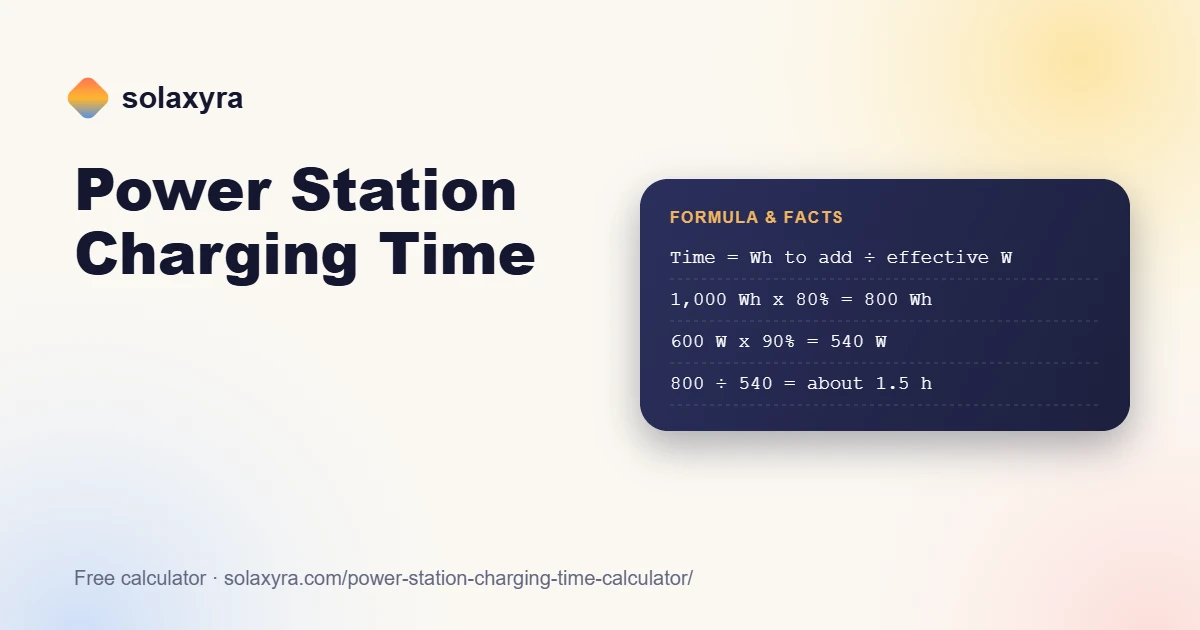
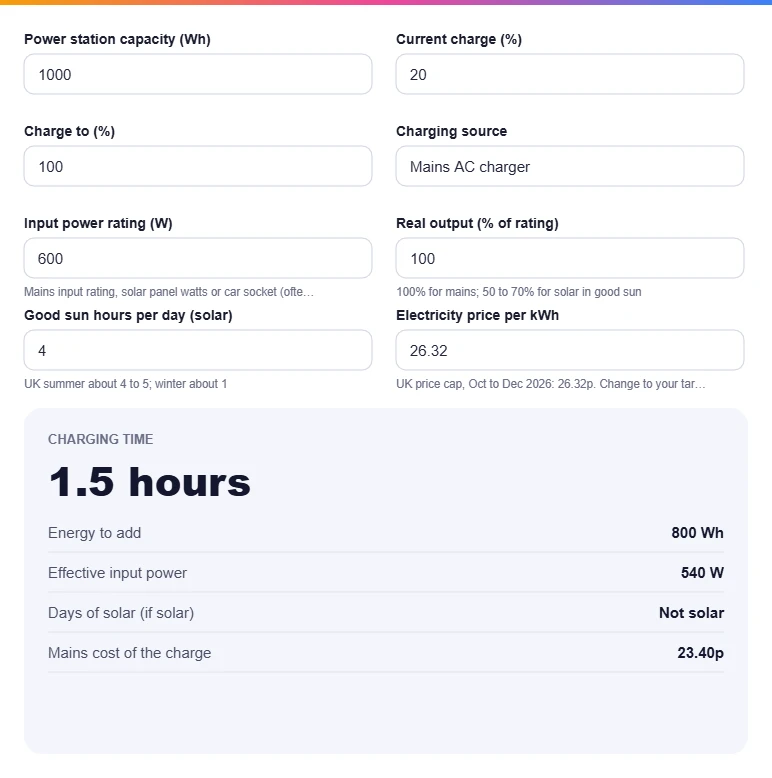
Quick answer: Divide the energy you need to add by the real charging power, allowing about 10% for losses. Charging a 1,000 Wh station from 20% to 100% needs 800 Wh; at 600 W from the mains that takes about 1.5 hours. From a 200 W solar panel giving 60% in good sun it takes about 7.4 hours of sun.
What Is a Power Station Charging Time Calculator?
A power station charging time calculator works out how long it takes to put energy back into a portable power station. Capacity is measured in watt-hours and charging inputs in watts, so the time is simply energy divided by power, with an allowance for the energy lost as heat in the charger and battery.
How Do You Use the Power Station Charging Time Calculator?
- Enter the capacity in Wh and the current and target charge levels.
- Choose the charging source and enter its rated power.
- Set the real output. Use 100% for mains. For solar, panels typically deliver a fraction of their rating, depending on sun, angle and temperature.
- For solar, enter the number of good sun hours per day where you are.
Typical Charging Times for a 1,000 Wh Power Station (20% to 100%)
| Source | Real input | Approx. time |
|---|---|---|
| Mains, fast charging, 1,200 W | 1,080 W | 0.7 h |
| Mains, standard, 600 W | 540 W | 1.5 h |
| Solar, 400 W at 60% | 216 W | 3.7 h of good sun |
| Solar, 200 W at 60% | 108 W | 7.4 h of good sun |
| Car socket, 120 W | 108 W | 7.4 h of driving |
Can You Charge a Power Station With Solar in Winter?
Yes, but slowly. In a UK winter there may only be around 1 hour of strong sun a day, so a 200 W panel might add 100 Wh or so on a good day. Plan on mains top-ups in winter, and use solar to stretch time between them.
Mains Charging Cost
Charging 800 Wh from the mains takes about 0.89 kWh from the socket, around 23p at the October to December 2026 cap of 26.32p per kWh. Even daily use costs little.
Tips for Faster Charging
- Use the fastest mains mode your power station supports, if the battery maker allows it.
- Combine solar and car charging at the same time where the unit supports dual inputs.
- Angle solar panels towards the sun and keep them cool and clean.
Worked Example: A Weekend Camping Trip
Example: a family from Bristol takes a 1,500 Wh power station camping in July, with a 200 W folding panel.
- They use about 600 Wh a day.
- The panel gives about 120 W real output for 4.5 hours of good sun: about 486 Wh after losses.
- They also charge from the car on the drive, adding about 250 Wh.
- They arrive home with plenty of charge after two nights.
Frequently Asked Questions
How long does it take to charge a 1,000 Wh power station?
About 1 to 2 hours on fast mains charging, or most of a sunny day with a 200 W panel.
Can I charge a power station from my car?
Yes, from a 12 V socket, but usually at only about 100 to 120 W.
How many solar panels do I need for a power station?
A 200 to 400 W panel suits most 1 to 2 kWh units for summer use.
Does fast charging damage a power station?
Units are designed for their rated speeds; using slower modes can be gentler on the battery.
Checked November 2026 by the Solaxyra Editorial Team. Sources: Ofgem: Energy price cap, 1 October to 31 December 2026, Energy Saving Trust: Solar panels.