This guide explains what off grid solar UK projects really involve, for owners of cabins, outbuildings, smallholdings and the occasional whole house, with a month-by-month sizing method that shows why UK winters, not summers, decide the size and cost of the system. It also covers backup power, safety and when staying connected to the grid is the better choice.
Quick answer: Off grid solar in the UK works well for cabins and outbuildings with small loads, but whole houses are hard. An array that covers a load in June needs more than five times the panel power in December. Most fully off-grid UK homes pair solar with a large battery and a generator or wind turbine.
Is off grid solar realistic in the UK?
Off grid solar is realistic in the UK for loads of a few kWh a day or less, and possible but expensive for a typical home, because winter sunshine is a small fraction of summer sunshine. An off-grid system has no mains connection at all: solar panels charge a battery bank, an inverter supplies 230 V to the building, and anything the sun cannot provide must come from a generator, a wind or hydro turbine, or cutting use.
That is very different from a normal grid-tied system with a home battery, which still imports from the grid when the battery is empty and can earn Smart Export Guarantee payments for surplus. The table shows which suits common UK situations.
| Situation | Usually the best fit | Why |
|---|---|---|
| Weekend cabin, workshop or garden office far from the supply | Off-grid solar and battery | Small loads, and a new grid connection can cost more than the system |
| Smallholding or remote house with no mains supply | Off-grid hybrid: solar, battery and generator (wind if the site suits it) | Winter shortfall must be covered reliably |
| Ordinary house already on the grid | Grid-tied solar, optionally with a battery | Grid covers winter; exports earn money; no generator needed |
| House wanting power during power cuts | Grid-tied with battery and a backup (islanding) function | Keeps essentials running without giving up the grid |
How much electricity will you need each day?
Daily energy in watt-hours is the sum of each appliance’s watts multiplied by its hours of use, and it is the number every other part of the design depends on. Ofgem’s typical domestic consumption value for electricity is 2,500 kWh a year, about 6.8 kWh a day, for a home with gas heating; an off-grid house heated electrically would need far more, which is why off-grid homes almost always heat with wood, oil or LPG instead.
Make a list room by room, use average rather than peak power for anything with a thermostat, and note the largest appliances that may run at the same time, because they set the inverter size. The energy consumption calculator adds up a list of appliances into daily and yearly kWh.
How do you size an off-grid solar array for UK winters?
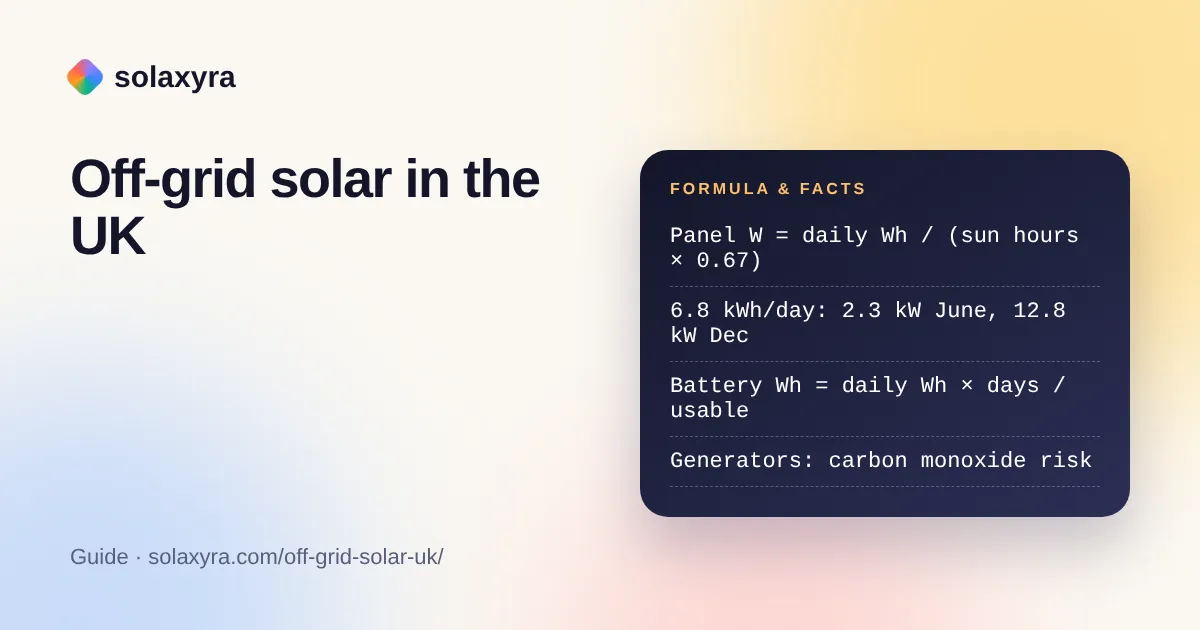
Panel watts needed = daily Wh ÷ (peak sun hours for the design month × 0.67), where 0.67 is the whole-system performance ratio the EU’s PVGIS service uses for off-grid systems. The key decision is the design month: size for June and the system runs short for half the year; size for December and it is several times larger and wastes energy in summer.
The table applies the formula to two loads. The peak sun hours are example values for a south-facing, steeply tilted off grid solar array in southern England; check PVGIS for your exact location, and expect lower winter figures in Scotland and the north.
| Design month (example peak sun hours) | Example A: cabin, 1.5 kWh a day | Example B: house, 6.8 kWh a day (Ofgem typical) |
|---|---|---|
| June, 4.5 hours | about 500 W | about 2.3 kW |
| March or September, 2.8 hours | about 800 W | about 3.7 kW |
| December, 0.8 hours | about 2.8 kW | about 12.8 kW |
For the cabin, a December design of about 2.8 kW is affordable and fits on a small ground frame. For the house, nearly 13 kW of panels, with all the space it needs, is rarely sensible, so most designs settle on a spring or autumn month and cover the winter gap another way. To estimate yearly output from any array, the solar panel output calculator works from kWp and your local yield, and the solar panel angle calculator shows why off grid solar arrays are usually tilted more steeply than roof systems to favour the low winter sun.
How big should the battery bank be?
Battery capacity in Wh = daily Wh × days of autonomy ÷ usable fraction. PVGIS’s default discharge cutoff for lead-acid batteries is 40%, so only about 60% of a lead-acid bank should be used; lithium iron phosphate (LiFePO4) banks can use more, so take the figure from the datasheet.
Example: three days of autonomy with a LiFePO4 bank at an example 90% usable.
- Cabin: 1,500 Wh × 3 ÷ 0.9 = 5,000 Wh, so a 5 kWh bank.
- House: 6,850 Wh × 3 ÷ 0.9 = about 22,800 Wh, so about 23 kWh.
Battery days do not fix a long winter deficit; they only carry you through a few dull days. The battery bank size calculator converts the result into amp-hours and series or parallel strings, and the off-grid solar calculator sizes panels, battery, inverter and controller together from one set of inputs.
Which system voltage and inverter do you need?
Higher battery voltage keeps currents and cable sizes manageable: 3,000 W drawn from a 12 V battery is 250 A, from 24 V it is 125 A, and from 48 V it is 62.5 A. That is why small off grid solar systems for cabins often run at 12 or 24 V and house-sized systems almost always use 48 V.
The inverter must handle the largest combination of loads that run together, plus the start-up surge of motors such as pumps, fridges and power tools. Choose a pure sine wave inverter for household appliances. The solar inverter size calculator has an off-grid mode for continuous and surge loads.
How do you cover the winter shortfall?
Most off grid solar homes in the UK cover winter with a generator, sometimes with a small wind turbine where the site is exposed and windy enough. Example: the house above with a 4 kW array in December gives about 4,000 × 0.8 × 0.67 = 2.1 kWh a day against a 6.8 kWh need, a shortfall of about 4.7 kWh a day or about 146 kWh across the month. A generator charging the batteries at 3 kW would need to run about 1.6 hours a day.
Generators produce carbon monoxide, an invisible gas that can kill. The NHS guidance on carbon monoxide poisoning lists portable generators among the appliances that produce it and warns against running engines in enclosed spaces such as garages. Run a generator outdoors, well away from doors, windows and vents, never in a garage, shed or porch, and fit carbon monoxide alarms in the building. Connecting a generator to a building’s wiring needs a proper changeover arrangement installed by a qualified electrician; never backfeed through a socket.
What safety rules and permissions apply?
The 230 V side of an off grid solar system is a fixed electrical installation and must be designed and installed by a qualified electrician to BS 7671, the UK wiring regulations; in England and Wales new circuits in dwellings are also notifiable under Part P of the Building Regulations. Large battery banks store a lot of energy, so install them in a well-ventilated, fire-separated location away from escape routes, following the manufacturer’s instructions. DC cabling from panels and batteries needs correctly rated fuses or breakers and isolators.
Roof-mounted panels on a house are often permitted development in England, but ground-mounted arrays have their own size, height and boundary limits, and listed buildings, conservation areas and other UK nations have different rules. Our guide to planning permission for solar panels explains how to check, and if panels go on an older roof or a timber frame, ask a structural engineer whether it can take the load.
How do you plan an off-grid system step by step?
Plan an off grid solar system in this order, so each decision rests on the one before:
- List every load and calculate daily Wh, separately for summer and winter.
- Cut the load where you can: LED lighting, efficient fridge, non-electric heating and cooking.
- Pick the design month and size the array with PVGIS data for your site.
- Choose days of autonomy and size the battery bank.
- Choose system voltage, inverter and charge controller.
- Size the backup: generator power, fuel storage and expected run hours.
- Check planning and building regulations, and get a qualified electrician to design and install the 230 V side.
Frequently Asked Questions
Can a UK house run on solar alone all year?
Rarely. Using the example figures in this guide, a house using 6.8 kWh a day would need about 12.8 kW of panels to cover December, against about 2.3 kW in June. Most off-grid homes add a generator or wind turbine for winter.
Do I need planning permission for off-grid solar?
Roof panels on a house are often permitted development in England, but ground-mounted arrays have their own limits, and listed buildings and conservation areas need extra care. Rules differ in Scotland, Wales and Northern Ireland, so check with your local planning authority.
Can I install an off-grid system myself?
Planning and sizing, yes. The 230 V installation, generator changeover and battery bank should be installed by a qualified electrician to BS 7671, and in England and Wales new circuits in dwellings are notifiable under Part P. DC wiring also needs correct fusing.
Can I get Smart Export Guarantee payments off-grid?
No. Smart Export Guarantee payments are for electricity exported to the grid, so a system with no grid connection cannot earn them. Surplus summer power off-grid is simply not captured once the battery is full.
Is a generator safe as off-grid backup?
Yes, if it is run outdoors well away from openings and never in a garage or shed, because generators produce carbon monoxide. Fit carbon monoxide alarms and have a qualified electrician install a proper changeover so it cannot backfeed.
Checked October 2026 by the Solaxyra Editorial Team. Sources: European Commission JRC: PVGIS user manual, Ofgem: revised typical domestic consumption values 2026, NHS: carbon monoxide poisoning, Wikipedia: BS 7671.