This guide helps UK households with solar panels, or planning them, decide whether adding a home battery pays for itself, using the current price cap, real installation costs and a simple per-kWh test you can repeat with your own quote and export rate. Whether the answer to is a home battery worth it is yes or no for your home depends mainly on three numbers: what a battery costs per kWh it will ever deliver, what you pay to import electricity, and what you are paid to export it.
Quick answer: Is a home battery worth it with solar? Only when the value of each stored kWh beats the battery’s lifetime cost per kWh. At the October 2026 cap rate of 26.32p and the Energy Saving Trust’s £4,600 for 5 kWh, solar storage alone rarely pays back; a time of use tariff, low export rate or cheaper quote can change that.
What does a home battery actually save with solar panels?
A battery saves you the difference between the import price you avoid and the export payment you give up, because every kWh of solar you store is a kWh you would otherwise have exported. Without a battery, surplus daytime solar goes to the grid and earns your Smart Export Guarantee rate; with a battery, it is stored and used in the evening instead of buying from the grid.
Some energy is lost on the way in and out, which the Energy Saving Trust’s battery storage advice acknowledges when it notes that using stored energy is less efficient than using it directly. So the saving on each kWh you store is:
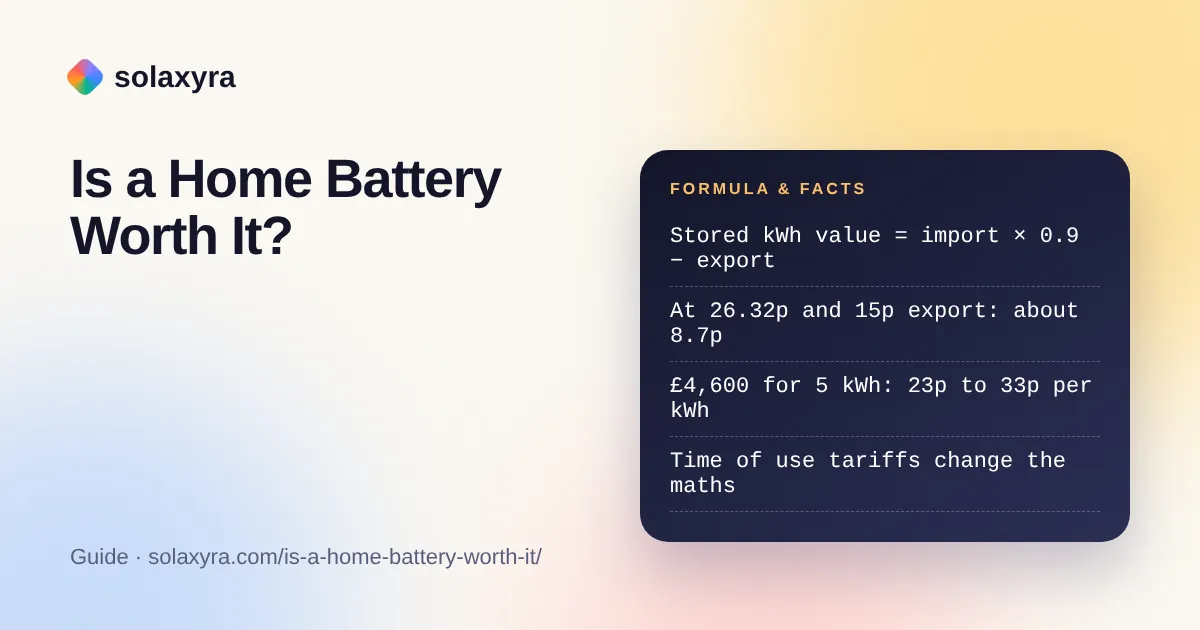
Value per stored kWh = import price × round-trip efficiency minus export rate
Example: with the Ofgem cap average unit rate of 26.32p for October to December 2026, an example round-trip efficiency of 90% and an example export rate of 15p, each kWh you store is worth 26.32 × 0.9 minus 15, which is about 8.7p. The same kWh exported would have earned 15p; used from the battery it avoids buying 0.9 kWh at 26.32p.
How much is each stored kWh worth at different export rates?
Your export rate is a big part of the answer to “is a home battery worth it?” The lower your export rate, the more a battery is worth: at 26.32p import and 90% efficiency, a stored kWh is worth about 23p if you export at 1p, but under 9p if you export at 15p. SEG rates are set by each supplier, and Ofgem’s SEG rules only require that they are above zero, so the export rates below are examples to replace with your own.
| Export rate (example) | Value per stored kWh | Yearly saving, 1,250 kWh stored (example) | Saving over 11 years | Compared with £4,600 cost |
|---|---|---|---|---|
| 1p | 22.7p | £284 | £3,120 | Does not pay back |
| 4p | 19.7p | £246 | £2,707 | Does not pay back |
| 10p | 13.7p | £171 | £1,882 | Does not pay back |
| 15p | 8.7p | £109 | £1,195 | Does not pay back |
The table assumes a 5 kWh battery filled from solar on 250 days a year (1,250 kWh), an example, because UK winter days often leave little surplus to store. Eleven years is the middle of the Energy Saving Trust’s typical battery life of 10 to 12 years, and £4,600 is the trust’s figure for a 5 kWh system. No price rises are included; if import prices rise, savings rise with them. On these example figures, the answer to is a home battery worth it for solar storage alone is no at every export rate shown.
The worst case for export is earning nothing at all, for example a home with no export tariff, or a home in a country where net metering is being phased out. Then each stored kWh is worth the full import price less losses: 26.32p × 0.9 = about 23.7p.
Example: 1,250 kWh stored a year saves about £296, or £3,257 over 11 years, still short of £4,600. Only if the battery is filled and emptied every day of the year (1,825 kWh) does it reach about £4,755 over 11 years and just pay back. The same formula works in any currency: put in your own import price, export payment and battery price.
What is the lifetime cost of storing a kWh in a battery?
A £4,600, 5 kWh battery costs about 23p per kWh delivered even if it is fully cycled every day for 11 years (£4,600 ÷ (5 × 365 × 11) kWh), and about 33p per kWh at 250 full cycles a year. This is the single most useful number for the decision, because it turns is a home battery worth it into a simple comparison: if the value of a stored kWh is lower than its lifetime cost, the battery cannot pay for itself on bill savings alone.
Work it out for your own quote with these steps:
- Take the installed price of the battery from your quote (not the whole solar system).
- Find the usable capacity in kWh on the datasheet.
- Estimate full cycles a year: how many days your surplus solar, or cheap-rate charging, will actually fill it.
- Multiply usable kWh × cycles a year × expected life in years to get lifetime kWh delivered.
- Divide the price by that total to get the cost per kWh in pence.
- Compare it with the value per stored kWh from the formula above. If the value is higher, the battery pays back; the gap tells you by how much.
The home battery savings calculator runs the yearly savings and payback, and the solar self-consumption calculator estimates how much of your generation you can use at home with and without a battery.
When does a battery make financial sense with solar?
In money terms, the answer to “is a home battery worth it?” is usually yes when the battery can be cycled close to every day of the year at a good margin, which with UK weather normally means pairing solar with a time of use tariff that lets you charge cheaply from the grid in winter. In summer the battery stores solar; in winter, when the panels produce little, it charges overnight at an off-peak rate and runs the house at peak times.
Example: on a time of use tariff with an example 8p off-peak rate, each kWh charged from the grid and used instead of 26.32p electricity is worth 26.32 minus 8 ÷ 0.9, about 17.4p. Combined with summer solar storage, that raises the number of useful cycles and the value per cycle together. Our guide to a home battery without solar covers the grid-charging side in detail.
Other conditions that favour a battery:
- A low export rate, so stored solar is worth much more than exported solar.
- High evening and overnight use, for example from an electric car charged at home, a heat pump or a large family.
- A quote well below £4,600 per 5 kWh, or a larger battery at a lower cost per kWh.
- Installing the battery at the same time as the panels, so one installer visit and one hybrid inverter cover both.
What does a real UK solar and battery home show?
A review published on the University of Oxford’s energy website describes a home with 4 kWp of solar and a 10 kWh battery costing about £12,000 in total, which saved roughly £500 a year and had a payback of about 12 years, close to the battery’s warranty period. The panels generated most of the household’s annual electricity demand, and the home used an off-peak time of use tariff.
That result fits the per-kWh test: the combined system pays back, but slowly, and it did so with a cheap-rate tariff in the mix rather than solar storage alone. Treat any single home as an example rather than a forecast, and check your own numbers with the solar payback calculator.
What other costs and rules should you check?
Batteries installed in homes currently carry 0% VAT: HMRC’s VAT Notice 708/6 applies the temporary zero rate to batteries fitted with solar, retrofitted to existing solar, or installed on their own, until 31 March 2027. Check that your quote reflects it and that installation is completed before that date if the saving matters to you.
Before you sign, also check:
- Installer: the Energy Saving Trust recommends at least three quotes from MCS certified installers. The electrical work must meet BS 7671.
- Location: the BSI specification PAS 63100:2024 rules out bedrooms, escape routes such as landings and stairs, and lofts or roof spaces.
- Network notification: MCS guidance says systems up to 16 A per phase are notified to the network operator within 28 days of commissioning (G98), and larger systems need approval before installation (G99). Batteries count towards these limits.
- Inverter: a battery added to existing panels may need a hybrid inverter or its own AC-coupled inverter; see our guide to solar inverter lifespan for timing a replacement.
- Warranty: check the capacity guaranteed at the end of the warranty and any throughput limit.
Is a home battery worth it for reasons other than money?
For some households a battery is worth it even when the bill savings alone do not pay it back, because it can provide backup during power cuts (if the system has that function), raise self-sufficiency and reduce exposure to future price rises. These benefits are real, but they have to be weighed against the cost honestly.
Backup is not automatic: a standard grid-connected battery switches off in a power cut unless it is installed with a backup or emergency power function. If backup is the main reason you want a battery, make it a written requirement in the quote, and see how many hours it would cover in our guide to how long a 10 kWh battery lasts.
Frequently Asked Questions
Does a solar battery pay for itself in the UK?
Sometimes. A battery pays back only if each stored kWh is worth more than its lifetime cost per kWh. At the October 2026 cap rate and the Energy Saving Trust’s £4,600 for 5 kWh, solar storage alone rarely does; adding a time of use tariff or a cheaper quote can.
How much does a home battery cost in the UK?
The Energy Saving Trust says batteries range from £1,500 to £10,000, with a 5 kWh system costing around £4,600. Batteries currently have 0% VAT until 31 March 2027 under HMRC’s VAT Notice 708/6. Always compare at least three quotes from MCS certified installers.
Is it better to export solar or store it in a battery?
Store it if the import price you avoid, multiplied by the round-trip efficiency, is clearly above your export rate. At 26.32p import and 90% efficiency, storing beats exporting at any rate below about 23.7p, but the battery’s own cost per kWh must also be covered.
How long does a home battery last?
The Energy Saving Trust gives a typical lifespan of about 10 to 12 years. Capacity fades gradually, so check the warranty for the share of capacity guaranteed at the end of the warranty period and any limit on total energy throughput.
What size battery should I get with solar panels?
Size it to your evening and overnight use and your typical summer surplus, not to the largest battery you can afford. A battery that is rarely filled or emptied has a higher cost per kWh delivered. A sizing calculator using your smart meter data gives the best answer.
Checked October 2026 by the Solaxyra Editorial Team. Sources: Energy Saving Trust: battery storage, Ofgem: energy price cap 1 October to 31 December 2026, Ofgem: Smart Export Guarantee, HMRC: VAT Notice 708/6, MCS: notifying DNOs, BSI: PAS 63100:2024, University of Oxford energy review: residential battery and solar.