This guide answers both versions of the question UK households ask about a 10 kWh home battery: how many hours or days it will run your home on one charge, and how many years it will keep working before its capacity fades. To work out how long will a 10kWh battery last you need three numbers: the usable capacity, the power your home draws, and the battery’s power limit.
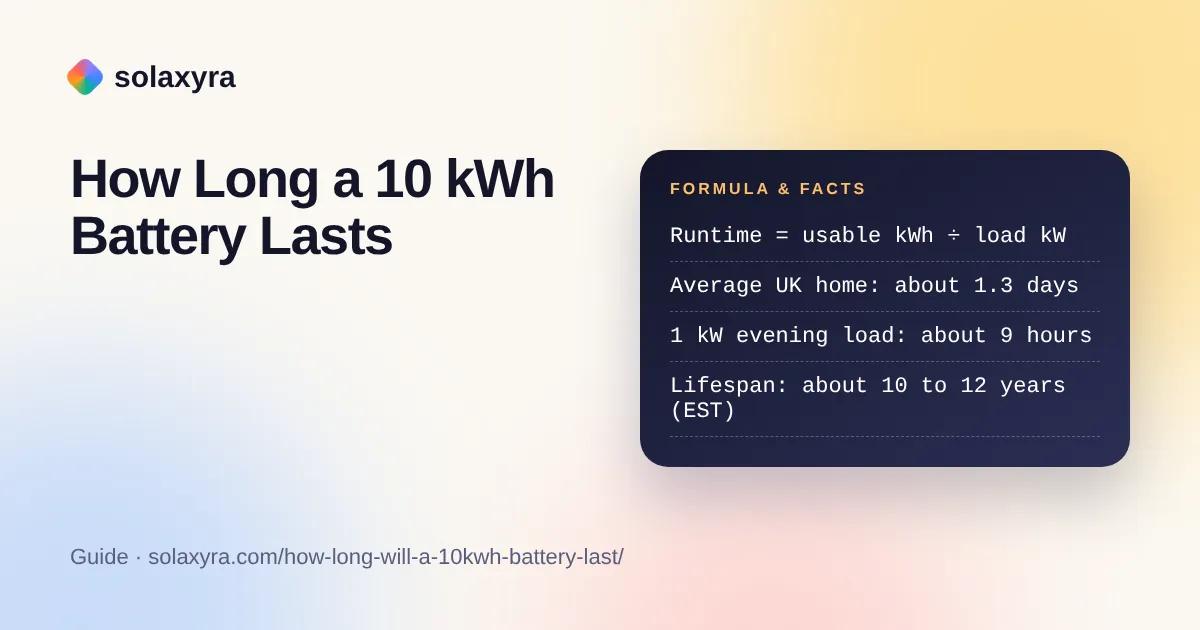
Quick answer: How long will a 10kWh battery last depends on your load. With about 9 kWh usable after limits and losses (example), it runs an average UK home using 6.8 kWh a day for about 1.3 days, a 1 kW evening load for about 9 hours, or essentials for over two days. It lasts about 10 to 12 years.
How do you work out how long a 10 kWh battery will last?
To answer “how long will a 10kWh battery last?” in hours, divide the energy the battery can actually deliver, in kWh, by the power you draw, in kW. A kW is a rate of use and a kWh is an amount, so 9 kWh of deliverable energy feeding a steady 1 kW load lasts 9 ÷ 1 = 9 hours.
The deliverable energy is less than the 10 kWh on the label for two reasons:
- Usable capacity: many batteries keep a reserve to protect the cells, so the usable figure on the datasheet can be below the nominal one.
- Conversion losses: the energy passes through an inverter to become mains AC, and the Energy Saving Trust notes that using stored energy is less efficient than using it directly from the grid or panels.
This guide uses 9 kWh of deliverable energy as an example value. Check the usable capacity and efficiency on your own battery’s datasheet, and enter them in the battery runtime calculator for your exact figures.
How long will a 10kWh battery last in a typical UK home?
A 10 kWh battery with about 9 kWh deliverable runs an average UK home for roughly 31 hours, because Ofgem’s typical consumption of 2,500 kWh a year works out at an average draw of only about 0.29 kW. Real homes do not draw a steady average: they use very little overnight and much more when cooking, so the runtime depends heavily on what is switched on.
| Load on the battery (example) | Average power | Runtime from 9 kWh |
|---|---|---|
| Power cut essentials: fridge-freezer, router, a few LED lights, gas boiler controls and pump | 0.15 kW | about 60 hours |
| Overnight standby and fridge only | 0.2 kW | about 45 hours |
| Ofgem typical home, 2,500 kWh a year spread evenly | 0.29 kW | about 31 hours |
| Busy evening: lights, TV, laptop, some cooking | 1 kW | about 9 hours |
| Electric oven plus hob ring and lights | 2.5 kW | about 3.6 hours |
| Battery at an example 5 kW maximum output | 5 kW | about 1.8 hours |
The power values are examples; check your appliances’ labels or add them up in the energy consumption calculator. Ofgem’s typical domestic consumption value of 2,500 kWh a year applies from 1 July 2026 and works out at about 6.8 kWh a day.
How many days will a 10 kWh battery last?
A 10 kWh battery with about 9 kWh deliverable covers about 1.3 days of an average UK home’s electricity (9 ÷ 6.8), so on its own it is a one-day store, not a multi-day one. A home using twice the typical amount, for example with an electric car or electric heating, would empty it in well under a day.
With solar panels the picture changes by season. On a long summer day the panels may refill the battery before it runs flat, so it effectively lasts indefinitely for the house’s evening and overnight use. In December, UK solar output is much lower, and the battery may only be partly recharged each day. Many owners in winter charge it from the grid on a cheap overnight rate instead.
Example: a 3-bedroom semi using 2,500 kWh a year (6.8 kWh a day) with a 4 kWp solar array uses about half its electricity between 4 pm and 8 am (an example share). That is about 3.4 kWh a night, so a 10 kWh battery with 9 kWh deliverable covers every evening and night with room to spare, and only a home using roughly 18 kWh a day with the same evening share would need all of it overnight. The solar battery size calculator runs this check for your own evening use.
Why can a 10 kWh battery not run everything at once?
Every battery has a power limit in kW as well as a capacity in kWh, and if your appliances together draw more than that limit, the shortfall comes from the grid or, in a power cut, the system may shut down. A full 10 kWh battery cannot run a 9.5 kW electric shower (example rating) and a 3 kW kettle together if its inverter is limited to, for example, 5 kW.
Check the continuous power rating (kW) on the datasheet, and the peak or surge rating for motors such as pumps and compressors. If you charge an electric car at 7 kW (example rating), it usually makes little sense to let the home battery discharge into it: at that rate 9 kWh would be gone in about 1.3 hours, while the car’s own battery is far larger.
Will a 10 kWh battery keep the lights on in a power cut?
Only if the system has a backup or emergency power supply function; a standard grid-connected battery switches off when the grid fails, as grid-connected generation must not feed a dead network. Backup usually needs extra hardware, such as a switch unit that isolates your home from the grid, and some systems back up only selected circuits.
If backup matters to you, ask the installer:
- Does the battery and inverter combination provide backup, and is it whole-home or selected circuits?
- What is the backup power limit in kW, which may be lower than the normal output?
- How quickly does it switch over, and will the gas boiler, fridge and router restart on their own?
- Can the solar panels keep recharging the battery during a long power cut?
- How much charge does it keep in reserve for outages, and can you change that setting?
With the essentials-only load in the table above, 9 kWh lasts about 60 hours, enough for most UK power cuts. Running an electric heater or cooker shortens that to a few hours.
How many years will a 10 kWh battery last?
Measured in years, the answer to “how long will a 10kWh battery last?” is typically about 10 to 12 years, the home battery lifespan given in the Energy Saving Trust’s battery storage advice, updated on 6 October 2026. It does not stop suddenly at that point: its capacity fades gradually as it is cycled, so a 10 kWh battery holds a little less each year.
Manufacturer warranties show what to expect. The Tesla Powerwall warranty for Europe, for example, runs for ten years and guarantees 80% of the original energy capacity at year 10 for systems in the UK and Ireland. Applied to a 10 kWh battery, a warranty on those terms would mean at least 8 kWh at year 10, so the runtimes in the table above would be about one fifth shorter by then.
One full charge and discharge a day for 10 years is about 3,650 cycles. Some warranties set a cycle or energy throughput limit as well as a time limit, so check both. Heat speeds up ageing, which is one reason installers avoid hot lofts.
Where can a 10 kWh battery be installed safely?
In UK homes, a battery should be installed in a location allowed by the BSI fire safety specification PAS 63100:2024, which rules out rooms where people sleep, escape routes such as landings, staircases and corridors, and roof spaces or lofts. Garages, external walls and utility rooms are common choices, as the Energy Saving Trust notes.
Installation involves mains wiring, a battery that can deliver very high currents, and network operator notification, so it must be carried out by a qualified installer; in the UK the electrical work must meet BS 7671, and the Energy Saving Trust recommends getting quotes from MCS certified installers.
Frequently Asked Questions
How long will a 10 kWh battery run a fridge?
A typical fridge-freezer cycles on and off and might average about 0.05 to 0.1 kW (example values; check its kWh per year label and divide by 8,760). With 9 kWh deliverable, that is roughly 90 to 180 hours, or about four to seven days, if nothing else is running.
Is a 10 kWh battery enough for a UK home?
For most homes it covers evening and overnight use comfortably. Ofgem’s typical home uses about 6.8 kWh a day in total, and only part of that falls after dark. Homes with an electric car, heat pump or storage heaters may want more capacity or a time of use tariff.
Can a 10 kWh battery power a house for a whole day?
Yes for an average home: with about 9 kWh deliverable it covers about 1.3 days of Ofgem’s typical 6.8 kWh a day. High-use homes will run it down faster, and the battery’s kW limit means large appliances used together may still draw from the grid.
How many years does a 10 kWh home battery last?
The Energy Saving Trust gives a typical lifespan of about 10 to 12 years. Capacity fades gradually rather than failing suddenly; for example, Tesla’s European Powerwall warranty guarantees 80% of original capacity at ten years for UK installations.
Does a 10 kWh battery work in a power cut?
Only if the system includes a backup or emergency power function. A standard grid-connected battery turns off when the grid fails. Ask your installer whether backup covers the whole home or selected circuits, and what its kW limit is.
Checked October 2026 by the Solaxyra Editorial Team. Sources: Energy Saving Trust: battery storage, Ofgem: typical domestic consumption values from 1 July 2026, Tesla: Powerwall warranty (Europe), BSI: PAS 63100:2024.