Bar shows how much of the wall’s heat loss the insulation removes. Internal insulation makes the wall behind it colder, so it needs a moisture control plan from a specialist to avoid condensation. Rates checked 22 October 2026.
Formula and breakdown
n/a
n/a
n/a
This internal wall insulation cost calculator estimates the price of insulating solid outside walls from the inside, room by room, and shows the floor space you lose, the new wall U-value, the yearly saving and the payback, for homeowners and landlords in the UK. It suits people comparing insulated plasterboard or a stud wall against external insulation, or checking a quote before a renovation.
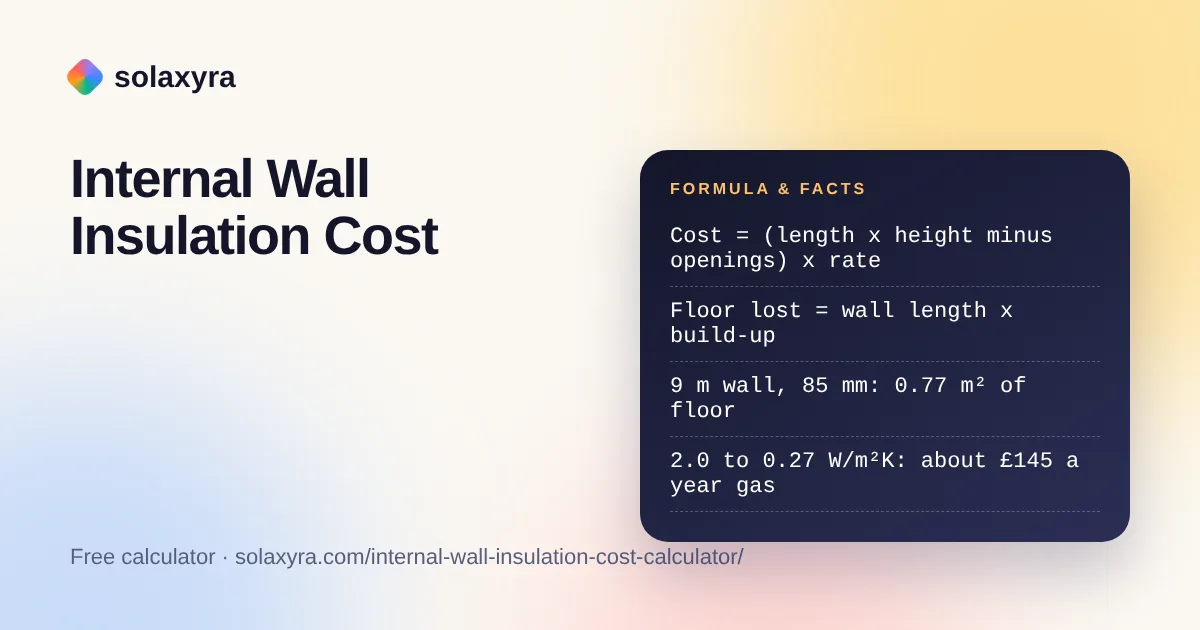
Quick answer: An internal wall insulation cost calculator multiplies the insulated wall area by the price per m², adds making good, then compares heat lost before and after. With example prices, 18.6 m² of wall at £90 per m² plus £800 costs £2,474, saves about £145 a year with gas and takes 0.77 m² of floor.
What Is an Internal Wall Insulation Cost Calculator?
An internal wall insulation cost calculator is a tool that prices insulation fixed to the inside face of external walls and works out what it saves. In plain words: the insulated area is the wall length times the ceiling height, minus windows and doors. Cost is area times the installed rate, plus making good such as moving radiators, sockets and skirting, plus VAT.
The new U-value is 1 divided by the old wall’s resistance (1 / U) plus the insulation’s resistance (thickness / conductivity), the reciprocal rule described in the Wikipedia article on thermal transmittance. Heat saved equals the drop in U-value times area times heating degree days times 24, divided by 1,000. Floor space lost equals the wall length times the total thickness added.
How Do You Use the Internal Wall Insulation Cost Calculator?
- Measure the length of each outside wall you will insulate along its inside face, add them together and enter the ceiling height.
- Enter the area of windows and doors in those walls, and the floor area of the rooms.
- Enter the installed price per m² and the making good cost from your quote, or keep the labelled examples.
- Choose the VAT rate for your installation date and enter any grant.
- Pick a board type, or enter the insulation thickness, conductivity and total build-up from the product datasheet.
- Enter the wall’s current U-value, heating degree days and heating type, then read the cost, floor space lost, savings and payback.

How Much Does Internal Wall Insulation Cost per m²?
No government body publishes a current national price. Bath and North East Somerset Council’s retrofit guidance quotes BEIS data giving an estimated £55 to £140 per m² for internal wall insulation, without a date, so the internal wall insulation cost calculator uses £90 per m² only as a labelled example. Making good often adds a fixed sum per room, which is why small jobs cost more per m².
The table runs the internal wall insulation cost calculator for example board choices on the default job: 9 m of outside wall, 2.4 m ceilings, 3 m² of windows and doors, a 15 m² floor, a 2.0 W/m²K wall, gas at 85% efficiency and 7.97p per kWh, and 2,000 degree days. Thickness and conductivity values are examples; use the datasheet for the product on your quote.
| Board (example values) | U-value after | Floor lost | Heat saved per year | Gas saving per year |
|---|---|---|---|---|
| PIR plasterboard, 70 mm at 0.022, 85 mm total | 0.27 | 0.77 m² (5.1%) | 1,543 kWh | £145 |
| PIR plasterboard, 50 mm at 0.022, 65 mm total | 0.36 | 0.59 m² (3.9%) | 1,464 kWh | £137 |
| EPS plasterboard, 80 mm at 0.035, 95 mm total | 0.36 | 0.86 m² (5.7%) | 1,465 kWh | £137 |
| Stud wall with mineral wool, 90 mm at 0.035, 130 mm total | 0.33 | 1.17 m² (7.8%) | 1,495 kWh | £140 |
The savings barely change between boards, because most of the gain comes from covering a very poor wall at all. The real differences are floor space and whether the result meets the 0.30 W/m²K improved value.
How Much Room Space Does Internal Wall Insulation Take?
Every metre of wall loses floor area equal to the total build-up: 85 mm of insulation, board and skim along 9 m of wall takes 0.77 m², about 5% of a 15 m² room. A stud wall at 130 mm takes 1.17 m² from the same room. The internal wall insulation cost calculator shows the loss in square metres and as a share of the floor.
Thinner, lower conductivity boards save space but usually cost more per m². Check door frames, window reveals, kitchen units and built-in wardrobes, which may need to be moved or rebuilt, and include that in the making good figure.
Does Internal Wall Insulation Cause Condensation?
It can if it is badly designed or installed, because insulating the inside of a solid wall makes the wall itself colder. The Energy Saving Trust solid wall insulation advice explains that water vapour moving out from the room may then condense inside the wall, and that every project needs a moisture control strategy from an experienced specialist: either breathable insulation or a continuous vapour barrier.
Bath and North East Somerset Council’s guidance on internally applied insulation adds that insulation should be carried into window and door reveals and floor voids to avoid cold spots, that ventilation must be adequate, and that permeable materials suit traditional buildings. Fix existing damp before any work starts. Moving sockets or switches is electrical work that must meet BS 7671, so use a qualified electrician.
Is Internal Wall Insulation Worth It?
It usually pays back faster than external insulation per room, but saves less in total because it covers less wall: the default job costs £2,474 and saves £144.69 a year with gas, a simple payback of 17.1 years. With direct electric heating at 26.32p per kWh the same job saves about £406 a year, because each kWh of heat costs nearly three times as much.
It makes most sense when rooms are being replastered or renovated anyway, which cuts the making good cost. HMRC’s VAT Notice 708/6 zero-rates the installation of wall insulation until 31 March 2027, then 5% applies. The internal wall insulation cost calculator has a VAT switch for both. To compare against insulating outside, use the external wall insulation cost calculator; for heating costs, the electric heater running cost calculator and the heat pump running cost calculator use the same prices.
What Rules Apply to Internal Wall Insulation?
Planning permission is not normally needed, because the Planning Portal says insulation that does not change the external appearance generally does not require it. Listed buildings are different: Bath and North East Somerset Council states that Listed Building Consent is required for internal wall insulation, and homes in conservation areas should check with the local planning authority.
Building regulations apply when you renovate a wall. Table 3.3 of the 2026 edition of Approved Document L, which takes effect in England on 24 March 2027, gives an improved U-value of 0.30 W/m²K and a threshold of 0.70 for walls insulated internally or externally; the internal wall insulation cost calculator checks against both. You can build a detailed U-value from the wall layers with the U-value calculator.
Worked Example: Insulating a Front Bedroom
Example: a bedroom in a solid brick terrace has 9 m of outside wall, 2.4 m ceilings, 3 m² of window and a 15 m² floor. The quote uses an example £90 per m² for 70 mm PIR insulated plasterboard at 0.022 W/mK, 85 mm in total, plus £800 to move a radiator, sockets and skirting, installed before April 2027. The wall is an example 2.0 W/m²K, heated by an 85% gas boiler. The internal wall insulation cost calculator works through it like this:
- Insulated area: 9 x 2.4 = 21.6 m², minus 3 m² = 18.6 m².
- Cost: 18.6 x £90 = £1,674, plus £800 = £2,474, with 0% VAT. That is £133.01 per m² overall.
- Floor lost: 9 m x 0.085 m = 0.77 m², 5.1% of the room.
- New U-value: 1 / (0.5 + 0.07 / 0.022) = 0.272 W/m²K, which meets the 0.30 improved value.
- Heat saved: (2.0 minus 0.272) x 18.6 x 2,000 x 24 / 1,000 = 1,543 kWh; gas saved 1,815 kWh x 7.97p = £144.69 a year.
- Payback: £2,474 / £144.69 = 17.1 years.
Frequently Asked Questions
How much does internal wall insulation cost per room?
For an example bedroom with 18.6 m² of outside wall at £90 per m² plus £800 of making good, about £2,474 with zero VAT. Council guidance quoting BEIS data gives £55 to £140 per m², so enter your own quote for an accurate figure.
How much space will I lose with internal wall insulation?
Multiply the wall length by the total thickness added. An 85 mm build-up along 9 m of wall takes 0.77 m² of floor, about 5% of a 15 m² room. A 130 mm stud wall along the same wall takes 1.17 m².
Does internal wall insulation cause damp?
It can if moisture is not managed, because the wall behind becomes colder and vapour may condense inside it. The Energy Saving Trust advises a moisture control strategy from a specialist, using breathable insulation or a continuous vapour barrier, and fixing existing damp first.
Is internal or external wall insulation cheaper?
Internal insulation is usually cheaper per job and needs no scaffolding, but it takes floor space and disrupts rooms. Council guidance quoting BEIS data gives £55 to £140 per m² for internal and £55 to £180 per m² for external. Compare quotes for both in the two calculators.
Do I pay VAT on internal wall insulation?
Not if it is installed by 31 March 2027. HMRC Notice 708/6 zero-rates the installation of insulation for walls from 1 May 2023 to 31 March 2027. From 1 April 2027 the rate is 5%, which the calculator’s VAT switch applies.
What U-value should internal wall insulation reach?
Table 3.3 of the 2026 edition of Approved Document L, in force in England from 24 March 2027, sets an improved value of 0.30 W/m²K with a threshold of 0.70 for walls insulated internally. In the example, 70 mm of PIR at 0.022 reaches 0.27.
Checked October 2026 by the Solaxyra Editorial Team. Sources: Energy Saving Trust: Solid wall insulation, HMRC VAT Notice 708/6, Approved Document L (gov.uk), 2026 edition Table 3.3, Planning Portal: Insulation, planning permission, Bath and North East Somerset Council: Internally applied solid wall insulation, Ofgem: Price cap October to December 2026, Wikipedia: Thermal transmittance.