Bar shows needed wattage as a share of installed wattage. A sizing estimate from rule-of-thumb rates, not a heat loss survey. Fixed wiring for panels must be installed by a qualified electrician to BS 7671.
Formula and breakdown
n/a
n/a
n/a
This infrared heating panel size calculator works out how many watts of infrared panel a room needs from its floor area, ceiling height and insulation level, then turns that into a number of panels and a yearly running cost, for UK and European homeowners comparing panels with other electric heating. Every rate it uses is visible and editable, so you can replace a rule of thumb with your own heat loss figure.
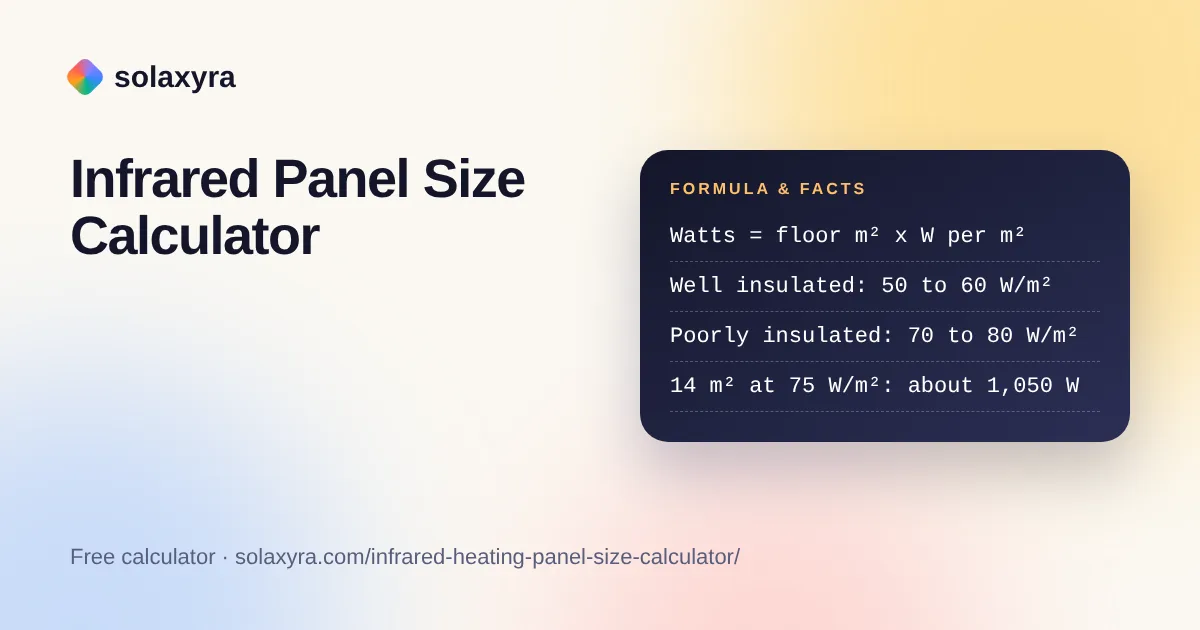
Quick answer: The infrared heating panel size calculator multiplies floor area by a watts per m² rate. Manufacturer guides give 50 to 60 W/m² for a well insulated room and 70 to 80 W/m² for a poorly insulated one, so a 4 x 3.5 m room at 75 W/m² needs about 1,050 W, or two 600 W panels.
What Is an Infrared Heating Panel Size Calculator?
An infrared heating panel size calculator is a tool that estimates the total panel wattage a room needs so that the panels can keep it warm on a cold day. In plain words: watts needed equals floor area times a watts per square metre rate for your insulation level, scaled up for ceilings above about 2.4 m and for any extra margin, and the number of panels is that total divided by the rating of one panel, rounded up.
Infrared panels heat in a different way from fan or convector heaters. The Wikipedia article on infrared heaters explains that far infrared panels are large, flat, low temperature emitters that warm people, walls and furniture by radiation rather than heating the air directly. The electricity still becomes heat one for one, so a 600 W panel running for an hour uses 0.6 kWh, the same as any other 600 W heater.
How Do You Use the Infrared Heating Panel Size Calculator?
- Choose metres or feet, then enter the room length, width and ceiling height.
- Pick the insulation level closest to your room, or type your own watts per m² if you have a heat loss result.
- Add an extra margin for corner rooms, large windows or exposed sites if you want headroom.
- Enter the wattage of the panel model you are looking at to see how many you need.
- Set heating hours, thermostat on time, heating days and your electricity price to see running costs.
- Read the wattage, panel count and costs, then open the breakdown to check each step.
How Many Watts of Infrared Heating Do I Need per m²?
Most published guidance falls between 50 and 80 W per m² of floor for insulated rooms, rising to 100 to 150 W per m² for rooms with uninsulated solid walls. The sources disagree, which is why the infrared heating panel size calculator shows the rate as an input instead of hiding it. The table puts the published rules on one scale.
| Source type | Published rule | As W per m² of floor |
|---|---|---|
| UK infrared heater maker (Tansun), well insulated room | 50 to 60 W/m² | 50 to 60 |
| UK infrared heater maker (Tansun), poorly insulated room | 70 to 80 W/m² | 70 to 80 |
| UK installer guide, well insulated home | 50 W/m² | 50 |
| UK installer guide, uninsulated solid walls or unfilled cavities | 100 to 150 W/m² | 100 to 150 |
| US panel maker coverage table, 8 ft ceiling, average insulation | 500 W covers 71 sq ft | about 75 |
| UK retailer guide for panel heaters as main heat | 70 to 100 W/m² | 70 to 100 |
The presets use 55, 75, 80 and 125 W per m², one point inside each published range. None of these figures is a measured heat loss for your home, so treat them as starting points. A room by room calculation such as our heat loss calculator gives a figure based on your own walls and windows; divide its watts by the floor area and enter that as a custom rate.
What Size Infrared Panel Do I Need for My Room?
A typical 12 m² bedroom needs about 660 to 960 W of infrared panels depending on insulation, so one 900 W panel or two smaller panels usually covers it. The table below, worked out with the infrared heating panel size calculator, shows the watts needed for common room sizes at each preset rate, with a 2.4 m ceiling and no extra margin.
| Floor area | Well insulated, 55 W/m² | Average, 75 W/m² | Poorly insulated, 80 W/m² | Solid walls, 125 W/m² |
|---|---|---|---|---|
| 6 m² (small bathroom or box room) | 330 W | 450 W | 480 W | 750 W |
| 9 m² (single bedroom) | 495 W | 675 W | 720 W | 1,125 W |
| 12 m² (double bedroom) | 660 W | 900 W | 960 W | 1,500 W |
| 16 m² (living room) | 880 W | 1,200 W | 1,280 W | 2,000 W |
| 20 m² (large living room) | 1,100 W | 1,500 W | 1,600 W | 2,500 W |
| 25 m² (open plan kitchen diner) | 1,375 W | 1,875 W | 2,000 W | 3,125 W |
Two smaller panels often suit a large or L-shaped room better than one big panel, because infrared warms what it can see. Spread panels so that seating and beds are in line of sight, and ceiling panels give the most even spread in rooms up to about 3 m high.
How Much Does It Cost to Run Infrared Heating Panels?
An infrared panel costs its rating in kW times your unit price for each hour it draws power, so a 600 W panel costs about 15.8p an hour at the Ofgem cap rate of 26.32p per kWh. The Ofgem price cap for 1 October to 31 December 2026 sets that average direct debit electricity rate, with VAT removed from electricity bills until 31 March 2027.
A thermostat switches panels on and off once the room is warm, so real use is lower than the full rating times the hours. The infrared heating panel size calculator applies a thermostat on time percentage for that reason. The 50% default is an example value, not a measured figure; a smart plug with energy monitoring or your meter will show your real share. To compare panels with other heaters at the same price, try the electric heater running cost calculator, or check any single appliance in the electricity cost calculator.
Do Higher Ceilings Need Bigger Infrared Panels?
Yes, a ceiling above about 2.4 m adds air and wall area, so the infrared heating panel size calculator raises the wattage in proportion to height, giving 25% more for a 3 m ceiling. The published W per m² rules and the US coverage table assume ceilings of about 2.4 m (8 ft), and one UK installer guide says domestic panels work best in rooms up to 3 m high. The proportional scaling is our own simple assumption; above 3 m, ask the panel maker for a layout.
Do Infrared Panels Need an Electrician?
Plug-in panels need only a suitable socket, but any hardwired panel, fused spur or new circuit must be installed by a qualified electrician to BS 7671, and in England Approved Document P explains when such work must be notified under Part P of the Building Regulations. Bathrooms have extra zone rules, so check the panel’s IP rating with the installer. Several panels on one circuit add up quickly: three 700 W panels draw about 9.1 A at 230 V, which the watts to amps calculator confirms.
Worked Example: Infrared Panels for a Double Bedroom
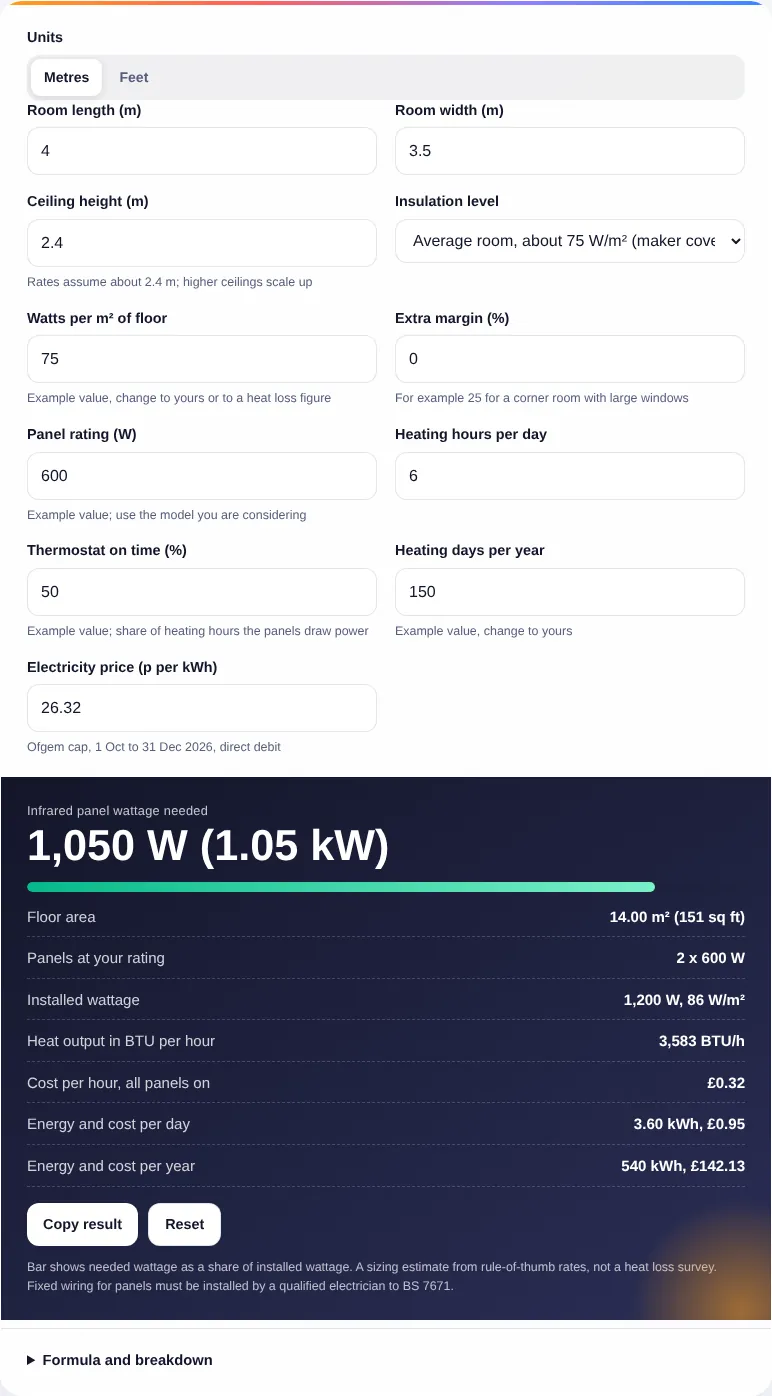
Example: a double bedroom measures 4 x 3.5 m with a 2.4 m ceiling and average insulation. The owner is looking at 600 W panels, expects 6 hours of heating a day over 150 days, and the thermostat is assumed to keep panels on half the time. Electricity costs 26.32p per kWh. These are the default inputs of the infrared heating panel size calculator.
- Floor area: 4 x 3.5 = 14 m².
- Watts needed: 14 x 75 W/m² = 1,050 W, about 3,583 BTU/h. The ceiling is 2.4 m, so no height correction.
- Panels: 1,050 / 600 = 1.75, rounded up to 2 panels, 1,200 W installed.
- Cost per hour with both panels on: 1.2 kW x 26.32p = 31.6p.
- Energy per day: 1.2 kW x 6 h x 50% = 3.6 kWh, about 95p.
- Energy per year: 3.6 x 150 = 540 kWh, about £142.13.
With good insulation at 55 W/m² the same room needs 770 W, so two smaller panels would do, and the running cost falls if the thermostat cuts in sooner.
Frequently Asked Questions
How many watts of infrared heating do I need per square metre?
Published guides give 50 to 60 W per m² for a well insulated room, 70 to 80 W per m² for a poorly insulated one and 100 to 150 W per m² for uninsulated solid walls. A heat loss calculation for your own room is more reliable than any of these rules.
What size infrared panel do I need for a 12 m² room?
At 55 W per m² a well insulated 12 m² room needs about 660 W, and at 80 W per m² a poorly insulated one needs about 960 W. One 700 W panel or one 900 W panel, or two smaller panels, would usually cover that range.
Is one big infrared panel better than two small ones?
Often two are better. Infrared warms surfaces in line of sight, so two panels spread around a large or L-shaped room give more even warmth than one large panel. The total wattage matters for heat output; the layout matters for comfort.
How much does a 600 W infrared panel cost to run?
At 26.32p per kWh, the Ofgem cap rate for October to December 2026, a 600 W panel costs about 15.8p for each hour it draws full power. With a thermostat cycling it off half the time, a six-hour evening costs about 47p.
Can infrared panels be the main heating in a house?
They can, if the total wattage matches the heat loss of each room and the electrics can carry the load. Size every room separately, check the circuits with a qualified electrician, and compare running costs with other options before replacing an existing system.
Does this infrared heating panel size calculator replace a heat loss survey?
No. It uses published rule-of-thumb rates per square metre. A room by room heat loss calculation using real U-values and air leakage gives a better wattage, and you can enter that result as a custom rate in the calculator.
Checked October 2026 by the Solaxyra Editorial Team. Sources: Ofgem: Changes to energy price cap between 1 October and 31 December 2026, Wikipedia: Infrared heater, Tansun: What size infrared heater do I need, WarmlyYours: infrared panel coverage table.