This guide explains how long solar batteries last, in years and in charge cycles, how capacity fades over time, what a typical warranty promises and what you can do to help a home battery last longer.
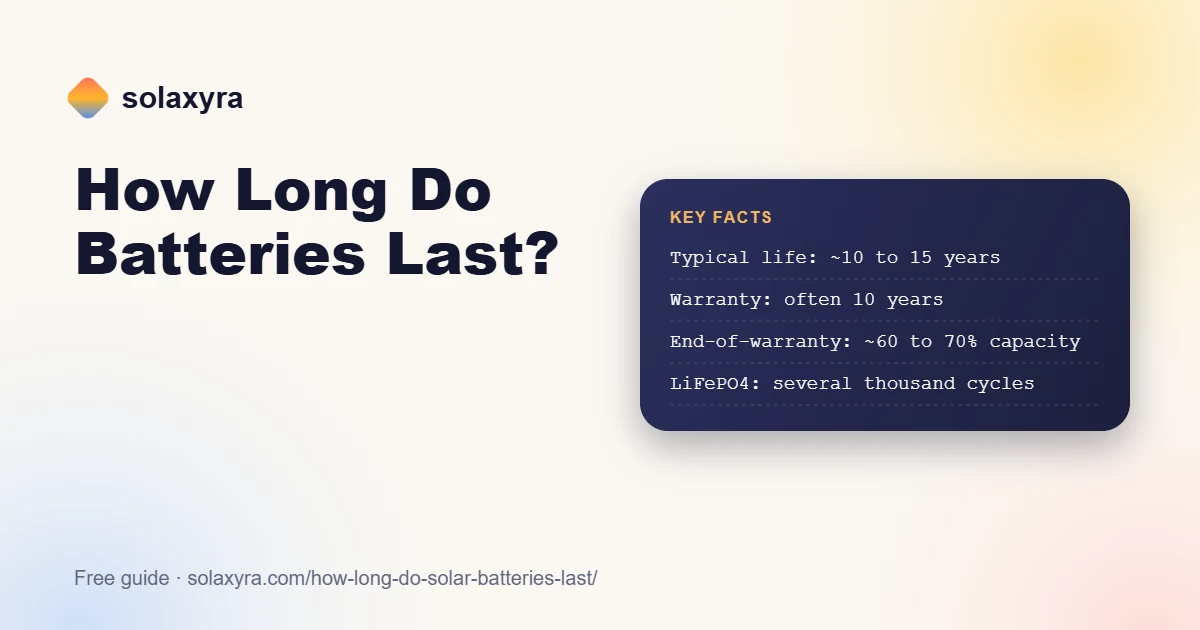
Quick answer: Most lithium home batteries are expected to last around 10 to 15 years. Warranties are commonly 10 years and often guarantee about 60 to 70% of the original capacity at the end. Lithium iron phosphate (LiFePO4) batteries are typically rated for several thousand cycles, so a battery cycled once a day can last well over a decade.
Years or cycles?
Battery life is limited by both age and use. Each full charge and discharge is a cycle. A battery used once a day completes about 365 cycles a year. Calendar ageing also wears batteries slowly even when they are not cycled hard, especially if kept full or hot.
Typical lifespans
| Battery type | Typical cycle rating | Daily cycling lifespan |
|---|---|---|
| Lithium iron phosphate (LiFePO4) | about 4,000 to 8,000 cycles | about 10 to 20 years |
| Lithium NMC | about 2,000 to 4,000 cycles | about 6 to 12 years |
| Lead-acid (AGM or gel) | about 300 to 1,200 cycles | about 1 to 4 years |
Figures vary by manufacturer and depend on depth of discharge and temperature.
What does a battery warranty cover?
Home battery warranties often run for 10 years and promise a minimum remaining capacity, such as 60 or 70%, or a minimum total energy throughput in MWh, whichever comes first. Read the terms: a battery cycled very heavily on a time-of-use tariff can reach its throughput limit before the time limit.
How does capacity fade?
Capacity usually falls gradually, often a few per cent a year. A 10 kWh battery at 70% capacity still stores 7 kWh, so it remains useful long after its warranty, just with less storage each evening.
How to make a solar battery last longer
- Avoid keeping it at 100% for long periods if the system allows a lower ceiling.
- Avoid very deep discharges on chemistries where the maker advises against them.
- Install it somewhere cool, dry and frost-free, within its rated temperature range.
- Keep firmware up to date and follow the manufacturer’s settings.
What does it mean for the cost per kWh?
A battery’s lifetime cost per kWh is its price divided by the energy it will deliver. For example, a £4,600 battery delivering 5 kWh a day for 10 years at 90% efficiency supplies about 16,400 kWh, roughly 28p per kWh before charging costs. Our battery cost per kWh calculator works it out for your figures.
Frequently Asked Questions
How long does a home solar battery last?
Usually around 10 to 15 years for lithium batteries.
How many cycles does a LiFePO4 battery last?
Often 4,000 to 8,000 cycles to around 70 to 80% capacity.
What happens when a solar battery gets old?
It stores less energy but usually keeps working.
Is a battery warranty based on years or cycles?
Often both: years and a minimum energy throughput, whichever comes first.
Checked November 2026 by the Solaxyra Editorial Team. Sources: Battery University, Energy Saving Trust: Solar panels.