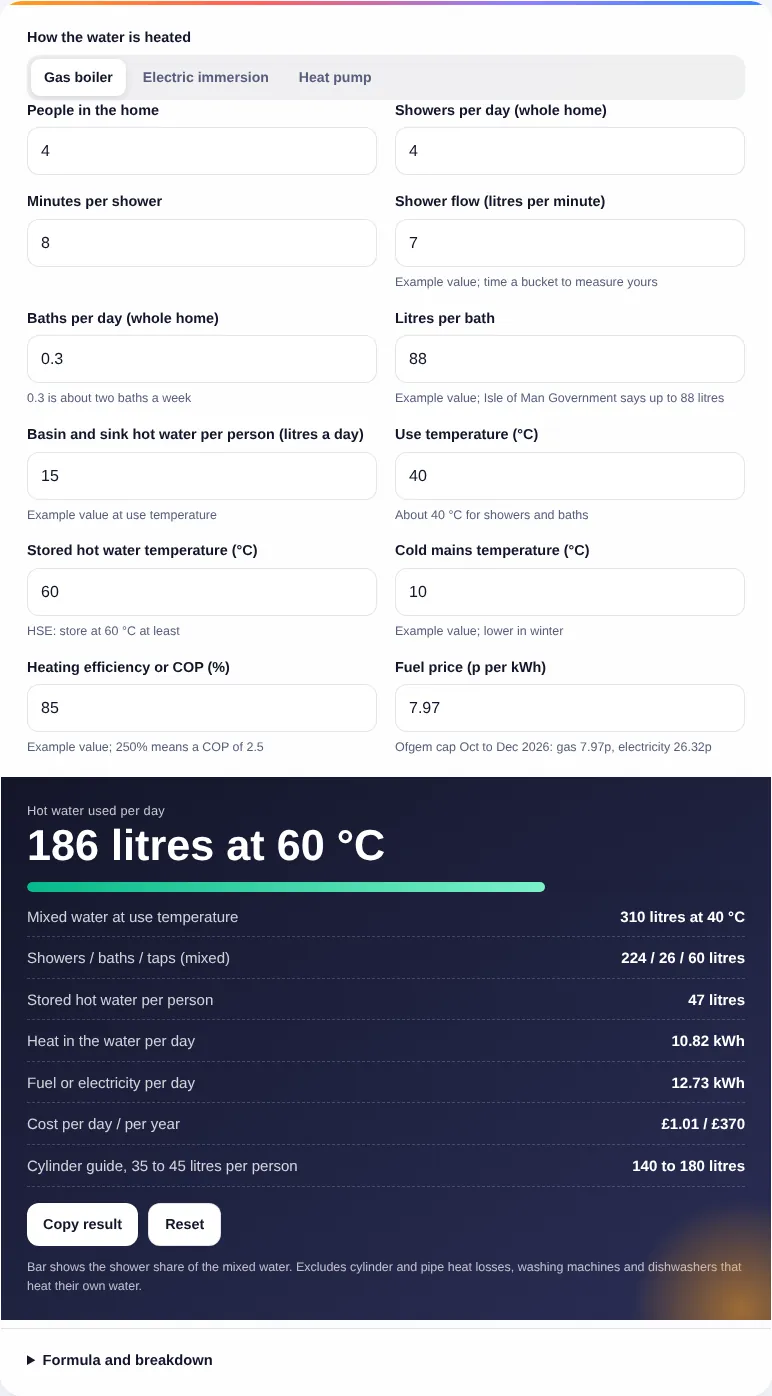
Bar shows the shower share of the mixed water. Excludes cylinder and pipe heat losses, washing machines and dishwashers that heat their own water.
Formula and breakdown
n/a
n/a
n/a
This hot water usage calculator estimates how many litres of hot water a household uses each day from showers, baths and taps, how much energy it takes to heat that water and what it costs with a gas boiler, an electric immersion heater or a heat pump, for UK and European homes. It converts water at shower temperature into litres of stored 60 °C water, so you can compare the result with a cylinder size or a combi boiler, and every habit and price is editable.
Quick answer: A hot water usage calculator adds up shower, bath and tap water, then converts it to stored hot water and kWh. Four people taking four 8 minute showers a day at 7 litres a minute, about two baths a week and basin use need about 186 litres of 60 °C water and 10.8 kWh of heat a day.
What Is a Hot Water Usage Calculator?
A hot water usage calculator is a tool that turns a household's washing habits into a daily volume of hot water and the energy and cost of heating it. In plain words: shower litres are showers times minutes times flow rate, bath litres are baths times the fill volume, and tap use is people times litres each; that mixed water at about 40 °C is then split into hot and cold, and the heat is litres times 4.184 kJ times the temperature rise from the cold mains.
The 4.184 figure is the heat needed to warm one litre of water by one degree, from the Wikipedia article on specific heat capacity, which gives liquid water about 4,184 J per kg per kelvin at 20 °C. Dividing kilojoules by 3,600 gives kWh, the unit on your energy bill.
How Do You Use the Hot Water Usage Calculator?
- Choose how your water is heated. The button fills in an example efficiency and the Ofgem price cap rate for gas or electricity.
- Enter the number of people, then the number of showers taken in the whole home each day and their average length.
- Enter your shower's flow rate. To measure it, time how long the shower takes to fill a bucket of known size.
- Enter baths per day for the whole home and how many litres a bath holds when you fill it.
- Enter hot tap water per person for washing up and hand washing, then check the use, stored and cold mains temperatures.
- Read the litres of hot water, the kWh and the cost, and open the breakdown to check each step.
How Much Hot Water Does a Household Use per Day?
A four-person household uses about 200 litres of hot water a day, according to the Hot Water Association, which gives 30 to 50 litres per person as average use. The hot water usage calculator's default home lands at 186 litres of 60 °C water, or 47 litres each, inside that range.
Habits matter far more than household size. The same body describes low use as 20 to 30 litres per person and high use as 50 to 70 litres. One long shower on a mains-pressure system can use more hot water than a whole family's taps in a day, which is why the hot water usage calculator asks for showers, minutes and flow separately instead of using a fixed figure per person.
How Much Hot Water Does a Shower or Bath Use?
An 8 minute shower at 7 litres a minute uses 56 litres at about 40 °C, of which about 34 litres is 60 °C water from the cylinder or boiler; a bath of 88 litres uses about 53 litres of 60 °C water. The table compares common cases with 10 °C cold mains.
| Use | Mixed water at 40 °C | Hot water at 60 °C | Heat | Gas boiler cost | Immersion cost |
|---|---|---|---|---|---|
| 4 minute shower, 7 litres a minute | 28 litres | 17 litres | 0.98 kWh | 9.2p | 25.7p |
| 8 minute shower, 7 litres a minute | 56 litres | 34 litres | 1.95 kWh | 18.3p | 51.4p |
| 8 minute shower, 10 litres a minute | 80 litres | 48 litres | 2.79 kWh | 26.2p | 73.4p |
| 8 minute shower, 18 litres a minute | 144 litres | 86 litres | 5.02 kWh | 47.1p | 132.1p |
| Bath, 88 litres | 88 litres | 53 litres | 3.07 kWh | 28.8p | 80.8p |
| Bath, 100 litres | 100 litres | 60 litres | 3.49 kWh | 32.7p | 91.8p |
Gas costs use 7.97p per kWh and an example boiler efficiency of 85%; immersion costs use 26.32p per kWh at 100%, both Ofgem price cap rates for 1 October to 31 December 2026. The 88 litre bath and 7 litres a minute shower come from the Isle of Man Government's water advice, the 18 litres a minute and 100 litre bath from the Hot Water Association's figures for mains-pressure systems.
What Do Building Regulations Say About Shower and Bath Sizes?
In England, Approved Document G sets fittings limits for new homes of 10 litres a minute for showers, 185 litres for baths, 6 litres a minute for basin taps and 8 litres a minute for kitchen sink taps, aiming at no more than 125 litres of water per person per day. These are limits for new dwellings, not a measure of how much water existing homes use.
The same Approved Document G requires the hot water supply to a bath in a new home to be limited to 48 °C. A 185 litre bath is the capacity, and most people fill well below it, so enter what you actually use in the hot water usage calculator rather than the tub size.
What Temperature Should Hot Water Be Stored At?
Stored hot water should be kept at 60 °C at least to kill legionella bacteria, and it should reach at least 50 °C within a minute at the tap, according to the HSE guidance on legionella. The hot water usage calculator warns if you set the store below 60 °C.
The storage temperature changes how many litres you draw, not the energy used. Hotter stored water is mixed with more cold water at the outlet, so 60 °C water covers more showers than 50 °C water. Energy depends on the mixed volume and the rise from the cold mains, which is why winter, with colder mains water, costs more for the same showers.
How Do I Use the Result to Size a Cylinder or Boiler?
For a cylinder, the Hot Water Association suggests 35 to 45 litres per occupant for a typical household, shown in the results for comparison, but a cylinder that reheats during the day can be smaller than the daily total. Our hot water cylinder size calculator sizes the tank, and the immersion heater running cost calculator prices electric reheating.
To check the daily kWh from the hot water usage calculator against an immersion element, the watts to kWh calculator converts heater power and time into energy, and the electricity cost calculator prices any electric use. Work on unvented cylinders must be done by a competent installer, and new electrical circuits for immersion heaters must be installed by a qualified electrician to BS 7671.
Worked Example: Family of Four With a Gas Combi Boiler
Example: a family of four in Cardiff takes four 8 minute showers a day on a 7 litre a minute shower, has about two baths a week of 88 litres, and uses 15 litres of hot tap water each. These are the hot water usage calculator defaults. The combi boiler is taken as 85% efficient, gas costs 7.97p per kWh, the mains is at 10 °C and hot water is produced at 60 °C.
- Showers: 4 x 8 x 7 = 224 litres. Baths: 0.3 x 88 = 26.4 litres. Taps: 4 x 15 = 60 litres. Total 310.4 litres at 40 °C.
- Hot share: (40 minus 10) / (60 minus 10) = 0.6, so 186 litres of 60 °C water, 47 litres per person.
- Heat: 310.4 x 4.184 x 30 / 3,600 = 10.82 kWh a day.
- Gas: 10.82 / 0.85 = 12.73 kWh, costing £1.01 a day or about £370 a year.
- Showers are 72% of the mixed water, so shorter showers save the most.
Frequently Asked Questions
How many litres of hot water does a person use per day?
The Hot Water Association gives 30 to 50 litres per person as average, with 20 to 30 litres for low use and 50 to 70 for high use. The example household on this page uses 47 litres of 60 °C water each, mostly in the shower.
How do I measure my shower flow rate?
Hold a bucket of known size under the shower at your usual setting and time how long it takes to fill. Divide the litres by the seconds and multiply by 60 to get litres per minute. Mains-pressure showers can run at about 18 litres a minute, while low-flow shower heads use 4 or 5.
Why does the calculator show two different litre figures?
Mixed water is what comes out of the shower at about 40 °C. Stored hot water is the 60 °C share drawn from the cylinder or boiler before cold water is blended in. Cylinder sizes refer to stored hot water, so compare that figure with a tank.
How much does it cost to heat hot water per day?
For the example family, about £1.01 a day with an 85% efficient gas boiler at 7.97p per kWh. The same 10.82 kWh from an immersion heater at 26.32p per kWh costs about £2.85 a day, and a heat pump with an example COP of 2.5 about £1.14.
Does the calculator include cylinder heat losses?
No. It counts only the heat in the water you use. A stored cylinder also loses heat through its insulation and pipework, so a cylinder system uses somewhat more energy than shown. Combi boilers heat on demand and avoid most storage losses.
Does cold mains water temperature change the result?
Yes. Colder mains water in winter needs a larger temperature rise, so the same shower takes more energy. Change the cold mains figure to see the effect: dropping it from 10 °C to 5 °C raises the heat for the example family by about 17%.
Checked October 2026 by the Solaxyra Editorial Team. Sources: Hot Water Association: sizing a hot water cylinder, Isle of Man Government: water advice, Approved Document G with 2024 amendments (gov.uk), HSE: legionella, things to consider, Wikipedia: Specific heat capacity, Ofgem: energy price cap 1 October to 31 December 2026.