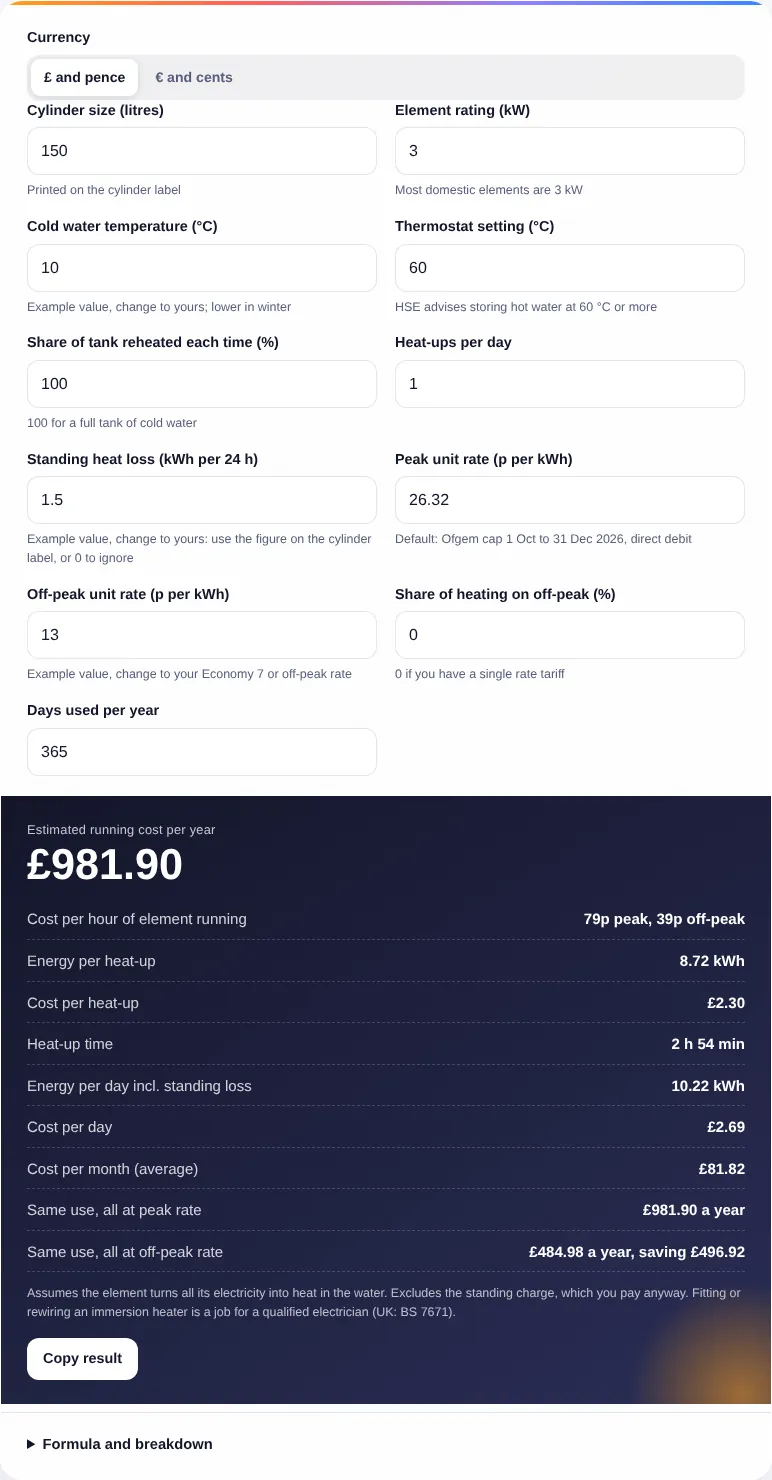
Assumes the element turns all its electricity into heat in the water. Excludes the standing charge, which you pay anyway. Fitting or rewiring an immersion heater is a job for a qualified electrician (UK: BS 7671).
Formula and breakdown
n/a
n/a
n/a
This tool estimates what an electric immersion heater costs to run per hour, per tank, per day and per year, for homes in the UK and Ireland with a hot water cylinder, and works in euro for the rest of Europe. The immersion heater running cost calculator starts from the physics of heating water (cylinder size and temperature rise), adds the cylinder's standing heat loss, and splits the energy between peak and off-peak rates so you can see what a timer on Economy 7 is worth.
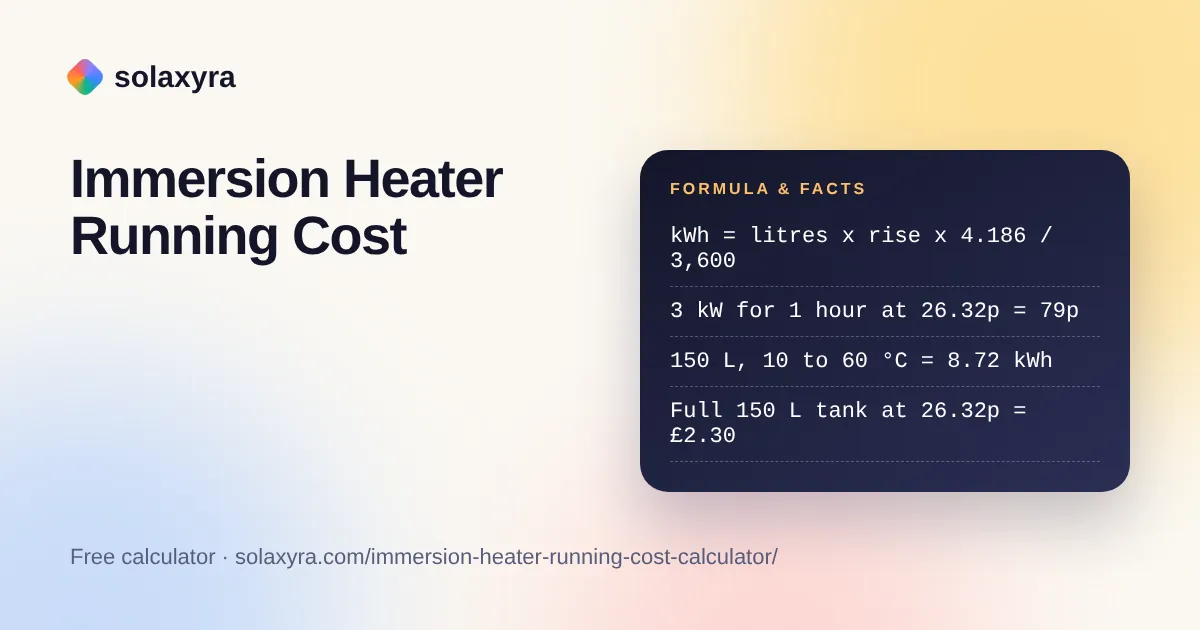
Quick answer: An immersion heater running cost calculator multiplies the energy used by your unit rate. A 3 kW element uses 3 kWh an hour, about 79p at the Ofgem cap rate of 26.32p per kWh. Heating 150 litres from 10 to 60 °C takes about 8.72 kWh, roughly £2.30 at that rate.
What Is an Immersion Heater Running Cost Calculator?
An immersion heater running cost calculator is a tool that works out the electricity an immersion element uses to heat stored water and turns it into a cost at your tariff. In plain words: litres of water heated, multiplied by the temperature rise and by 4.186 kJ per litre per degree, divided by 3,600 gives kWh; add the heat the cylinder loses while standing; multiply by your price per kWh.
The 4.186 figure is the specific heat capacity of water, about 4,186 joules per kilogram per degree, and one litre of water weighs close to one kilogram. Dividing by 3,600 converts kilojoules to kWh. An immersion element is a resistance heater, so almost all the electricity it draws ends up as heat in the water; the losses that matter are the heat escaping from the cylinder and pipes afterwards.
How Do You Use the Immersion Heater Running Cost Calculator?
- Choose pounds or euro.
- Enter the cylinder size in litres and the element rating in kW from the label.
- Check the cold water temperature and the thermostat setting. The default of 60 °C follows HSE guidance on stored hot water.
- Enter how much of the tank you reheat each time and how many times a day. A household that runs the tank cold once a day might enter 100% and 1.
- Enter the standing heat loss from the cylinder label in kWh per 24 hours, or 0 to leave it out.
- Enter your peak and off-peak unit rates and the share of heating done on the cheap rate.
- Read the yearly cost, and the rows for cost per hour, per heat-up, per day, and the all peak versus all off-peak comparison.
How Much Does an Immersion Heater Cost per Hour?
A 3 kW immersion heater costs about 79p an hour at the Ofgem price cap unit rate of 26.32p per kWh for 1 October to 31 December 2026, because it uses 3 kWh for every hour the element is on. The figure scales directly: a 2 kW element costs about 53p an hour and a 6 kW pair about £1.58. Ofgem's price cap announcement sets these average direct debit rates for Great Britain; your own tariff may differ, so change the rate in the immersion heater running cost calculator.
Cost per hour only tells you part of the story, because the thermostat switches the element off once the water reaches temperature. That is why the immersion heater running cost calculator works from the water you heat, not from the hours you guess.
How Long Does an Immersion Heater Take to Heat a Tank?
A 3 kW element takes about 2 hours 54 minutes to heat a 150 litre cylinder from 10 °C to 60 °C, because that needs about 8.72 kWh and the element delivers 3 kWh an hour. A 120 litre tank takes about 2 hours 20 minutes and a 180 litre tank about 3 hours 30 minutes. If a tank is only partly cold, the time shortens in proportion, which is why the share reheated is an input.
Is It Cheaper to Run an Immersion Heater on Economy 7?
Running an immersion heater on an off-peak rate is cheaper in direct proportion to the price gap: if your night rate is half your day rate, heating the tank overnight halves the cost of that energy. The immersion heater running cost calculator's last two rows show the yearly cost if all heating is at the peak rate and if all of it is at the off-peak rate, with the difference. Off-peak rates vary by supplier and region, so the default is a labelled example; use the rate on your bill. The electricity cost calculator helps if you want to price other appliances on the same tariff.
If you have solar panels, surplus daytime generation can heat the tank instead. A diverter sends spare solar power to the immersion element; the solar self-consumption calculator shows how much generation you use at home, and the solar diverter calculator estimates the hot water value directly.
How Can You Cut Immersion Heater Running Costs?
The Energy Saving Trust recommends a cylinder jacket at least 80 mm thick and estimates that adding one to a tank with 25 mm of factory foam saves about £45 a year in Great Britain, based on January 2024 prices for a typical gas heated three-bedroom semi. Other steps that reduce cost:
- Use a timer so the element runs once, ahead of when you need hot water, rather than all day.
- Insulate the hot pipes near the cylinder.
- Shift heating to off-peak hours if your tariff has them.
- Keep the thermostat at 60 °C rather than higher. Do not set it lower than 60 °C for stored water: HSE guidance is that stored hot water should be kept at 60 °C or above to control Legionella.
Cost to Heat Common Cylinder Sizes
Heating from 10 °C to 60 °C with a 3 kW element. The off-peak column uses an example rate of 13p per kWh; check your own.
| Cylinder (litres) | Energy (kWh) | Heat-up time, 3 kW | Cost at 26.32p | Cost at 13p (example) |
|---|---|---|---|---|
| 90 | 5.23 | 1 h 45 min | £1.38 | 68p |
| 120 | 6.98 | 2 h 20 min | £1.84 | 91p |
| 150 | 8.72 | 2 h 54 min | £2.30 | £1.13 |
| 180 | 10.46 | 3 h 29 min | £2.75 | £1.36 |
| 210 | 12.21 | 4 h 4 min | £3.21 | £1.59 |
| 250 | 14.53 | 4 h 51 min | £3.83 | £1.89 |
Worked Example: A 150 Litre Cylinder Heated Once a Day
Example: a household heats a 150 litre cylinder from 10 °C to 60 °C once a day with a 3 kW element, and the cylinder label gives a standing loss of 1.5 kWh per 24 hours.
- Energy per heat-up: 150 x 50 x 4.186 / 3,600 = 8.72 kWh.
- Heat-up time: 8.72 / 3 = 2.91 hours, about 2 hours 54 minutes.
- Energy per day: 8.72 + 1.5 = 10.22 kWh.
- All at 26.32p: 10.22 x 26.32p = £2.69 a day, or £981.90 over 365 days.
- With 80% of heating moved to an example off-peak rate of 13p: blended rate = 26.32 x 20% + 13 x 80% = 15.66p, so 10.22 x 15.66p = £1.60 a day, or £584.36 a year.
In this example the timer and off-peak rate save close to £400 a year. Where a home has a heat pump or gas boiler that can heat the cylinder instead, compare the cost per kWh of heat using the heat pump running cost calculator.
Who Should Install or Repair an Immersion Heater?
An immersion heater is a fixed mains appliance, usually on its own circuit with a double pole switch, and the cylinder holds hot water under pressure in many homes. Replacing an element, fitting a timer or adding a circuit should be done by a qualified electrician working to BS 7671; in England, Approved Document P explains when domestic electrical work must be notified under Building Regulations. Unvented (mains pressure) cylinders also need an engineer qualified for unvented systems for any work on the cylinder and its safety devices. Do not open the element housing yourself while the circuit is live.
Frequently Asked Questions
How much does it cost to run a 3 kW immersion heater for an hour?
About 79p at the Ofgem cap unit rate of 26.32p per kWh for October to December 2026, because a 3 kW element uses 3 kWh in an hour. On an off-peak rate of 13p per kWh, an example figure, it would cost about 39p.
How many kWh does it take to heat a hot water cylinder?
Multiply litres by the temperature rise and by 4.186, then divide by 3,600. A 150 litre cylinder heated from 10 °C to 60 °C needs about 8.72 kWh. A 120 litre cylinder needs about 6.98 kWh and a 180 litre cylinder about 10.46 kWh.
Is it cheaper to leave the immersion heater on all the time?
Usually not. Keeping the tank hot all day means the element keeps replacing the heat the cylinder loses. Heating once, shortly before you need the water, and on an off-peak rate where possible, normally costs less. Good cylinder insulation reduces the difference.
What temperature should an immersion heater be set to?
Set the thermostat to 60 °C. HSE guidance states that stored hot water should be kept at 60 °C or above to control Legionella, with water reaching at least 50 °C at outlets within a minute. Higher settings waste energy and raise scalding risk.
Does an immersion heater use a lot of electricity?
It is one of the highest power appliances in a home at around 3 kW. Daily use depends on how much hot water you draw: heating a full 150 litre tank once a day uses about 8.7 kWh, which is more than many homes use for everything else in a day.
Can I heat my immersion heater with solar panels?
Yes. A solar diverter sends surplus solar electricity to the immersion element instead of exporting it, which can heat much of a cylinder on sunny days. A qualified electrician should fit the diverter, working to BS 7671 in the UK.
Checked October 2026 by the Solaxyra Editorial Team. Sources: Ofgem, energy price cap 1 October to 31 December 2026, HSE, Legionnaires' disease things to consider, Energy Saving Trust, insulating tanks, pipes and radiators, Wikipedia, specific heat capacity, GOV.UK, Approved Document P.