This guide explains how to choose a safe location for a home battery in the UK, what the BSI fire safety specification PAS 63100:2024 allows and forbids, who must install the system and what you should check yourself once it is running. Home battery safety depends far more on correct product choice, location and installation than on the battery chemistry alone, and most of the decisions are made before the installer arrives.
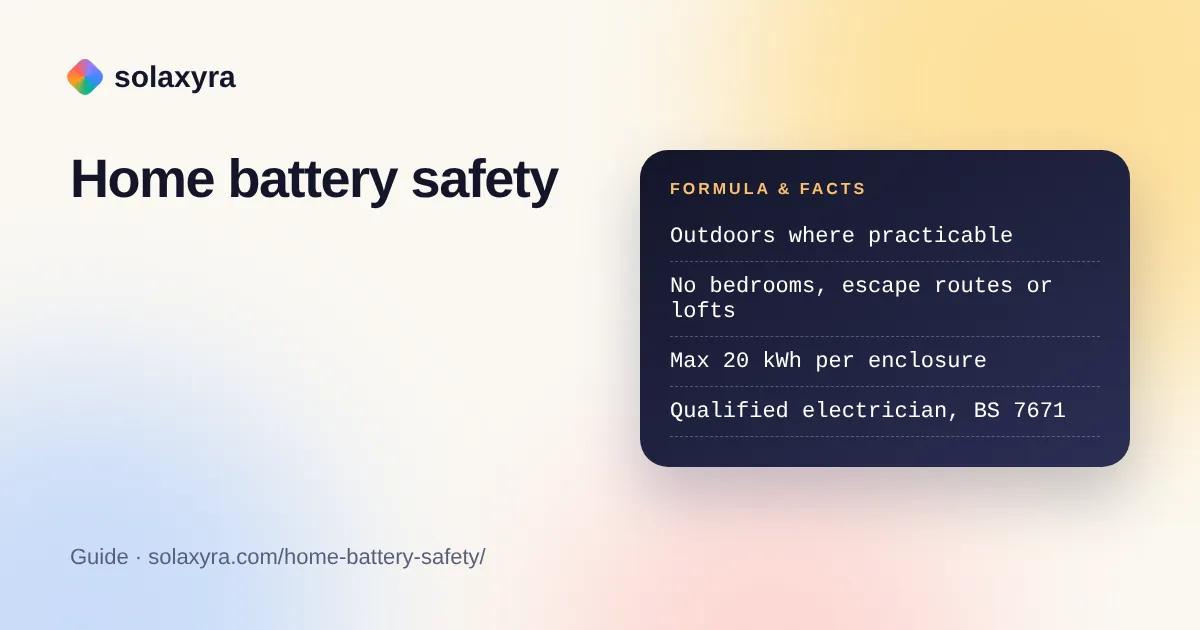
Quick answer: Home battery safety in the UK is guided by BSI PAS 63100:2024: batteries should go outdoors where practicable, and must not be fitted in bedrooms, escape routes such as hallways and stairs, or lofts and roof voids. Installation must be by a qualified electrician working to BS 7671, ideally an MCS certified installer.
Are home batteries safe?
A home battery that is a certified product, correctly sized, installed in a permitted location by a qualified installer and monitored is a low fire risk, but the risk is not zero, which is why a UK fire safety specification now governs where batteries go. The main hazard with lithium-ion batteries is thermal runaway: a cell overheats, releases flammable gas and heats its neighbours, and the fire can be hard to put out.
Modern home batteries reduce that risk with a battery management system (BMS) that monitors cell voltage, current and temperature and disconnects the battery if something goes outside its limits. Many home batteries use lithium iron phosphate cells, which are among the more thermally stable lithium chemistries; our comparison of LiFePO4 and lead acid explains the chemistry. The BMS and chemistry help home battery safety, but they do not replace a safe location and a good installation.
What does PAS 63100:2024 say about where a battery can go?
PAS 63100:2024 says storage batteries should be installed outdoors where practicable, and lists indoor places where they must not be installed: rooms where people sleep, escape routes, the corridors, stairs and lobbies of protected escape routes, and voids, roof spaces and lofts. The BSI summary of PAS 63100:2024, first published in March 2024, covers small-scale battery systems in dwellings.
Where a battery has to go indoors, the specification sets conditions such as fire resisting separation from the rest of the home, fresh-air ventilation to outdoors and suitable fire detection, with smoke or multi-sensor detectors to BS 5839-6 in rooms that are visited infrequently. It also limits how much energy can be stored in one place: no more than 20 kWh in a single battery enclosure, up to 80 kWh in total in a detached garage, outbuilding or outdoors, and up to 40 kWh in other indoor locations.
The table turns those home battery safety rules into a quick location check. It is a summary to help you talk to your installer, not a substitute for the full specification, which your installer should follow in detail.
| Location | Allowed under PAS 63100:2024? | What to check |
|---|---|---|
| Outside wall, in a weather-rated enclosure | Yes, preferred where practicable | Product’s outdoor rating, temperature range, protection from impact and tampering |
| Detached garage or outbuilding | Yes | Total up to 80 kWh; impact protection near vehicles |
| Integral or attached garage | Yes, with conditions | Fire separation from the house, detection, impact protection rated IK10 near vehicles |
| Utility room or plant room | Usually, with conditions | Not an escape route; fire separation, ventilation, detection; total up to 40 kWh |
| Under the stairs or in a hallway or landing | No, if it forms part of an escape route | Escape routes must stay free of batteries |
| Bedroom | No | Rooms where people sleep are excluded |
| Loft or roof space | No | Voids, roof spaces and lofts are excluded |
The specification does not apply to every product or home; for example, it excludes dwellings over 200 m² in floor area, and small batteries built into products such as alarm systems. If your installer proposes a location you are unsure about, ask them which clause of PAS 63100 they are relying on.
Who is allowed to install a home battery?
A home battery connected to your electrical installation must be installed by a qualified electrician, with the work meeting BS 7671, the UK wiring regulations; choosing an MCS certified installer adds a further check on design and paperwork. The Energy Saving Trust’s battery storage advice, updated on 6 October 2026, recommends getting quotes from MCS certified installers.
A battery is not a plug-in appliance. It involves DC cabling at high current or high voltage, protective devices, an inverter that can feed power back into the home and the grid, and notification to the network operator. For home battery safety, never install, open, move or rewire a battery yourself. If a battery inverter can export to the grid, its rating also counts towards the network limits explained in our G98 vs G99 guide.
What should you check before you buy?
Check that the product is designed and certified for home energy storage, that its datasheet temperature range suits the chosen location, and that the installer will design the location to PAS 63100:2024 and the wiring to BS 7671. A short home battery safety checklist before you buy:
- Choose a battery made for home energy storage with a built-in BMS, not a converted car pack or loose cells.
- Read the datasheet for the operating and charging temperature range and compare it with the location in winter and summer.
- Ask the installer where the battery will go and how that location meets PAS 63100:2024.
- Confirm the installer is a qualified electrician working to BS 7671, and whether they are MCS certified.
- Ask what fire detection will be fitted near the battery if it is indoors, and whether warning labels will be fixed at the consumer unit and meter position.
- Ask for the commissioning certificate, electrical installation certificate, manuals and network operator paperwork at handover.
Size matters for home battery safety as well as cost: a battery much larger than you need stores more energy in your home for no benefit. The solar battery size calculator estimates a sensible capacity from your evening use, and the Energy Saving Trust gives about 10 kWh as a typical home system.
Example: a three-bedroom house with no suitable outside wall is quoted a 10 kWh battery in the integral garage. Under the location table that is acceptable with conditions, so the questions to ask are: is there fire resisting separation between the garage and the house, what detection will be fitted, and will the battery be protected from car impact? If the alternative offered is the cupboard under the stairs on the only escape route, that location should be rejected on safety grounds.
How should you look after a home battery once it is installed?
Keep the area around the battery clear, keep its monitoring connected, act on any alarm or error code, and leave all internal work to the installer or manufacturer. Simple habits that support home battery safety:
- Do not store paint, fuel, cardboard or other combustible materials against or near the battery.
- Keep ventilation openings clear and do not box the battery in.
- Keep the battery’s app or monitoring online so faults and firmware updates reach you.
- Test any smoke or multi-sensor detector near the battery regularly.
- Look for warning signs: swelling of the casing, unusual smells, hissing or popping, scorch marks or repeated fault codes.
- Register the product with the manufacturer so you hear about recalls.
If you see warning signs, stop using the battery if the manufacturer’s instructions allow you to switch it off safely from outside the enclosure, and contact the installer. Do not open the case or try to repair it.
What should you do if a home battery catches fire?
Get everyone out of the building, close doors behind you, call 999 and tell the fire service there is a lithium battery storage system and where it is. Do not try to fight a battery fire yourself. Lithium battery fires can reignite and give off toxic and flammable gases, so stay out until the fire service says it is safe.
The warning labels required by PAS 63100:2024 at the origin of the electrical installation and at distribution boards exist so that firefighters and electricians know a battery is present. Make sure they are fitted and not covered.
Does home battery safety affect cost, VAT or insurance?
Safe installation adds cost, such as fire resisting enclosures, detectors or a longer cable run to an outside wall, but home battery safety should not be the place to save money. Under HMRC VAT Notice 708/6, installing electrical storage batteries in homes qualifies for a temporary zero rate from 1 February 2024 to 31 March 2027, including retrofits to solar and standalone grid batteries. Tell your home insurer about the installation and keep the certificates. To see whether a battery pays back once safety costs are included, use the home battery savings calculator.
Frequently Asked Questions
Can I put a home battery in my loft?
No. PAS 63100:2024 lists voids, roof spaces and lofts among the indoor locations where storage batteries must not be installed. A fire there could spread unseen and is hard for firefighters to reach. Ask your installer for an outdoor, garage or other permitted location instead.
Can a home battery go under the stairs?
Not if the stairs or hallway are part of the escape route, which they usually are in a house. PAS 63100:2024 excludes escape routes and the corridors, stairs and lobbies of protected escape routes, so that a battery fire cannot block the way out.
Is it safer to install a battery outside?
PAS 63100:2024 says batteries should be installed outdoors where practicable. The battery must be rated for outdoor use and for the temperatures at that spot, and protected from impact and tampering. Check the datasheet’s charging temperature range for winter conditions.
Do I need a smoke alarm near my home battery?
For indoor locations that are not visited often, PAS 63100:2024 calls for fire detection, such as smoke or multi-sensor detectors meeting BS 5839-6. Your installer should specify and fit the right detection as part of the installation.
Can I install a home battery myself?
No. A home battery connects to your fixed wiring and often to the grid, so it must be installed by a qualified electrician working to BS 7671, with the network operator notified. DIY installation risks fire, electric shock and invalid insurance.
How large a battery can I have in my home?
PAS 63100:2024 limits a single battery enclosure to 20 kWh, with up to 40 kWh in total in indoor locations and up to 80 kWh in a detached garage, outbuilding or outdoors. Most homes need far less; a typical system is about 10 kWh.
Checked October 2026 by the Solaxyra Editorial Team. Sources: BSI: PAS 63100:2024 summary, Energy Saving Trust: solar panel battery storage, HMRC: VAT Notice 708/6, MCS: notifying DNOs.