This guide compares lithium iron phosphate and lead acid batteries for solar storage, campervans, boats, sheds and off-grid systems in the UK and Europe, using manufacturers’ published cycle data to show what each chemistry really costs per kWh it delivers. The LiFePO4 vs lead acid choice is not just about price on the shelf: usable capacity, cycle life, weight, cold weather charging and ventilation all change the answer.
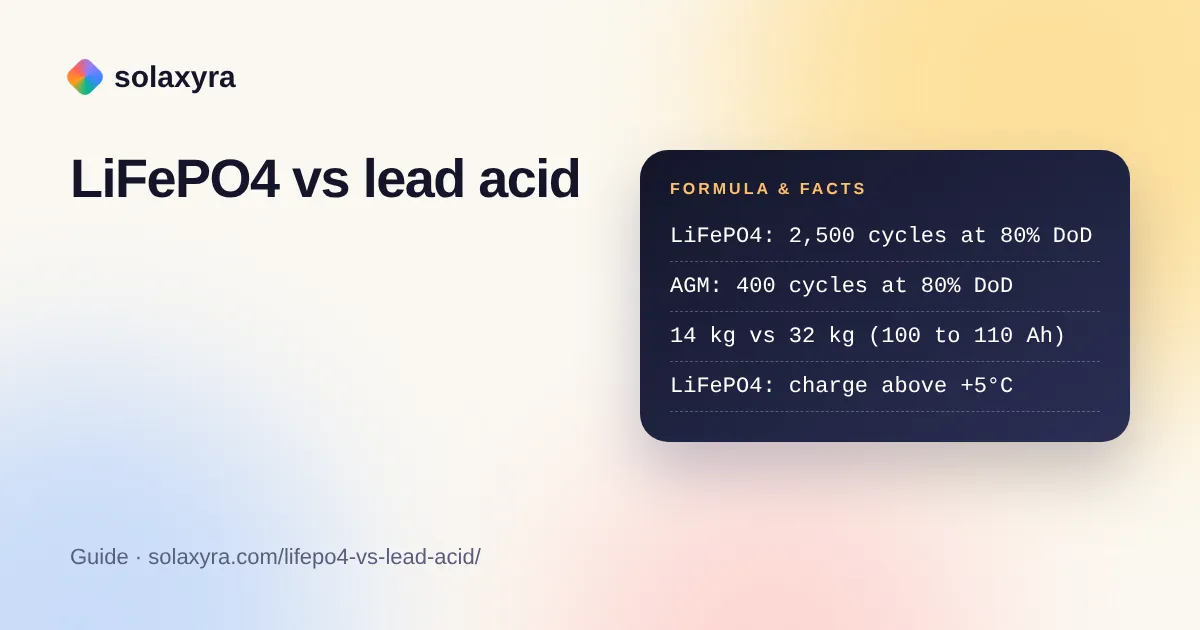
Quick answer: In LiFePO4 vs lead acid, LiFePO4 costs more to buy but delivers far more usable energy over its life: one maker’s 12.8 V 100 Ah LiFePO4 is rated 2,500 cycles at 80% depth of discharge against 400 cycles for its AGM battery. LiFePO4 is lighter and more efficient, but must not be charged below about 5°C without heating.
What is the difference between LiFePO4 and lead acid batteries?
LiFePO4 (lithium iron phosphate) is a lithium-ion chemistry with a nominal 3.2 V cell, while lead acid uses lead plates in sulphuric acid with a nominal 2.1 V cell; four LiFePO4 cells make a 12.8 V battery and six lead acid cells make a 12 V battery. According to Wikipedia’s lithium iron phosphate article, the 12.8 V nominal voltage and the chemistry’s thermal stability are why LiFePO4 is widely used as a drop-in replacement for lead acid in solar and vehicle systems.
Lead acid comes in several forms. Flooded (wet) batteries need topping up with water and vent gas. AGM (absorbed glass mat) and gel batteries are sealed, valve regulated designs that need no topping up. All three share the same basic limit: deep discharges shorten their life sharply, and a lead acid battery left partly discharged suffers sulphation, which Wikipedia notes has no independently verified cure.
LiFePO4 batteries always include a battery management system (BMS) that protects the cells from over-charge, over-discharge, over-current and charging at low temperature. That BMS is part of what you pay for, and it is also why a LiFePO4 battery needs a charger profile set for lithium.
How do the specifications compare?
For the same nominal capacity, a LiFePO4 battery weighs less than half as much, delivers about six times as many 80% cycles and loses less energy in each charge and discharge. The table compares LiFePO4 vs lead acid using two batteries from one manufacturer’s published datasheets, so the test conditions are as similar as possible.
| Specification | LiFePO4 12.8 V 100 Ah (Victron Smart) | AGM deep cycle 12 V 110 Ah (Victron) |
|---|---|---|
| Nominal energy | 1,280 Wh | 1,320 Wh (12 V × 110 Ah) |
| Weight | 14 kg | 32 kg |
| Cycles at 80% depth of discharge | 2,500 | 400 |
| Cycles at 50% depth of discharge | 5,000 | 600 |
| Round-trip efficiency (maker’s figure) | 92% | 80% (stated by the maker for lead acid) |
| Charge temperature range | +5°C to +50°C | Can charge in cold, with temperature compensation outside 10 to 30°C |
| Self-discharge | Low, check datasheet | Under 2% a month at 20°C, doubling every 10°C warmer |
| Maintenance | None; BMS required | None for AGM; avoid leaving partly charged |
Figures are from the Victron 12.8 V LiFePO4 Smart datasheet and the Victron gel and AGM datasheet, used here because one maker publishes both chemistries on the same basis. Other brands differ, so always check the datasheet of the battery you are buying.
How much usable energy do you get over the battery’s life?
Multiply the nominal Wh by the depth of discharge and by the rated cycles: the LiFePO4 battery above delivers about 2,560 kWh over its rated life at 80% depth of discharge, while the AGM battery delivers about 396 kWh at 50%. That lifetime energy is the fairest way to compare LiFePO4 vs lead acid on price.
- Work out nominal energy in Wh: volts × amp-hours. The Ah to kWh calculator does this conversion.
- Multiply by the depth of discharge you will use to get usable Wh per cycle.
- Multiply by the rated cycles at that depth from the datasheet to get lifetime energy.
- Divide the battery’s price by the lifetime kWh to get cost per kWh delivered.
Example: using example prices of £250 for the AGM battery and £700 for the LiFePO4 battery (example values, change to the prices you are quoted), the LiFePO4 vs lead acid cost per kWh of storage delivered works out as follows.
| Battery and depth of discharge | Usable Wh per cycle | Rated cycles | Lifetime kWh | Cost per kWh delivered |
|---|---|---|---|---|
| AGM 110 Ah at 30% | 396 | 1,500 | 594 | £0.42 |
| AGM 110 Ah at 50% | 660 | 600 | 396 | £0.63 |
| AGM 110 Ah at 80% | 1,056 | 400 | 422 | £0.59 |
| LiFePO4 100 Ah at 50% | 640 | 5,000 | 3,200 | £0.22 |
| LiFePO4 100 Ah at 70% | 896 | 3,000 | 2,688 | £0.26 |
| LiFePO4 100 Ah at 80% | 1,024 | 2,500 | 2,560 | £0.27 |
Two caveats keep this LiFePO4 vs lead acid comparison honest. Rated cycles assume good conditions, and a battery that sits unused will age by calendar time long before it reaches its cycle count; a weekend campervan battery may never use 2,500 cycles. And this is storage cost only: it does not include charger changes, wiring or the energy lost in each cycle.
How big a battery bank do you need with each chemistry?
To get the same usable energy you need a lead acid bank roughly 1.5 to 2 times the nominal size of a LiFePO4 bank, because lead acid is usually kept to about 50% depth of discharge for reasonable life. That is where much of the LiFePO4 vs lead acid weight difference comes from.
Example: a campervan needs 1 kWh of usable energy a day. With AGM at 50% depth of discharge you need 2,000 Wh nominal, which is two of the 110 Ah batteries above (1.52 rounded up), weighing 64 kg. With LiFePO4 at 80% depth of discharge you need 1,250 Wh nominal, which one 100 Ah battery (1,280 Wh) covers at 14 kg. The battery bank size calculator runs this for your loads and days of autonomy, and the campervan solar calculator adds panels and charging.
Which works better in cold UK winters?
Lead acid can be charged in cold weather with temperature compensation, while LiFePO4 must not be charged below its minimum charge temperature, which is +5°C for the Victron Smart range, unless the battery has built-in heating or is kept in a warm space. LiFePO4 can still discharge well below freezing; the Victron datasheet allows discharge down to minus 20°C.
In practice the LiFePO4 vs lead acid cold difference matters for unheated sheds, garages, boats and vans in winter. A good LiFePO4 BMS will block charging when cells are too cold, which protects the battery but means your solar panels may not charge it on a frosty morning. Options are a battery with built-in heating, a location inside the insulated space, or a charger and BMS that communicate temperature. Lead acid has the opposite cold weakness: its usable capacity falls in the cold, and a discharged lead acid battery can freeze.
LiFePO4 vs lead acid: which is safer?
Both are safe when correctly specified and installed, but the hazards differ: lead acid can release hydrogen when overcharged and contains corrosive acid, while LiFePO4 relies on its BMS and is among the most thermally stable lithium chemistries. The Wikipedia lead acid article notes that overcharging produces hydrogen and oxygen, which is why flooded batteries in particular need ventilation and must be kept away from sparks.
LiFePO4 does not vent hydrogen in normal use, and its cathode does not release oxygen the way some other lithium chemistries do, which reduces thermal runaway risk. It still stores a lot of energy and can deliver very high short-circuit currents, so every battery needs correctly rated fuses or breakers as close to the terminal as practical, and correctly sized cable. Any battery connected to a home’s fixed wiring, a hybrid inverter or a building’s consumer unit must be installed by a qualified electrician, with UK work meeting BS 7671. For home battery location rules, see our home battery safety guide.
When does lead acid still make sense?
Lead acid still makes sense for very low budgets, for backup batteries that are rarely cycled, for engine starting, and where charging in sub-zero temperatures without heating is unavoidable. A standby battery that sits on float and discharges a few times a year never uses LiFePO4’s cycle advantage, so cost per kWh delivered stops being the right way to judge LiFePO4 vs lead acid.
Lead acid is also very widely recycled; Wikipedia reports that 99% of battery lead in the US was recycled between 2017 and 2021. At end of life, take either type to a proper battery recycling point; never put batteries in household waste.
Can you swap lead acid for LiFePO4 in an existing system?
Often yes, but you must check the charger, solar charge controller and alternator charging are set for lithium, and you should not mix the two chemistries in one bank. The Victron datasheet recommends 14.2 V charging for its 12.8 V battery, while its AGM batteries absorb at 14.6 to 14.9 V and float at 13.5 to 13.8 V, so a lead acid profile is wrong for LiFePO4. Vehicle alternators may need a DC to DC charger to limit current. Replace the whole bank at once, check fuse ratings for LiFePO4’s higher current capability, and update the battery runtime calculator inputs with the new usable capacity.
Frequently Asked Questions
Is LiFePO4 better than lead acid for solar?
For systems that cycle daily, usually yes. LiFePO4 delivers more usable energy per cycle, many more cycles and better round-trip efficiency, so its cost per kWh delivered is lower despite the higher price. Lead acid can still suit rarely used backup systems or very tight budgets.
Can I charge LiFePO4 below freezing?
Not unless the battery is designed for it. Many LiFePO4 batteries, including the Victron Smart range, specify a minimum charge temperature of +5°C. Use a battery with built-in heating, keep it in a warm space, or rely on a BMS that blocks charging when cells are too cold.
Can I use my lead acid charger for a LiFePO4 battery?
Only if it has a lithium or user-adjustable profile matching the battery maker’s recommended voltages. Lead acid profiles use higher absorption voltages and float or equalisation stages that are wrong for LiFePO4. Check the battery datasheet and the charger manual before connecting.
How much lighter is LiFePO4 than lead acid?
Much lighter. In Victron’s datasheets a 12.8 V 100 Ah LiFePO4 battery weighs 14 kg and a 12 V 110 Ah AGM battery weighs 32 kg. Because you can use more of the LiFePO4 capacity, the saving for the same usable energy is larger still.
Do LiFePO4 batteries need ventilation?
They do not gas in normal use like flooded lead acid, but they still need the space, airflow and temperature range in the maker’s manual. Any fixed installation in a home must follow the maker’s instructions and be installed by a qualified electrician to BS 7671.
Checked October 2026 by the Solaxyra Editorial Team. Sources: Victron: 12.8 V LiFePO4 Smart datasheet, Victron: gel and AGM datasheet, Wikipedia: lithium iron phosphate battery, Wikipedia: lead acid battery.