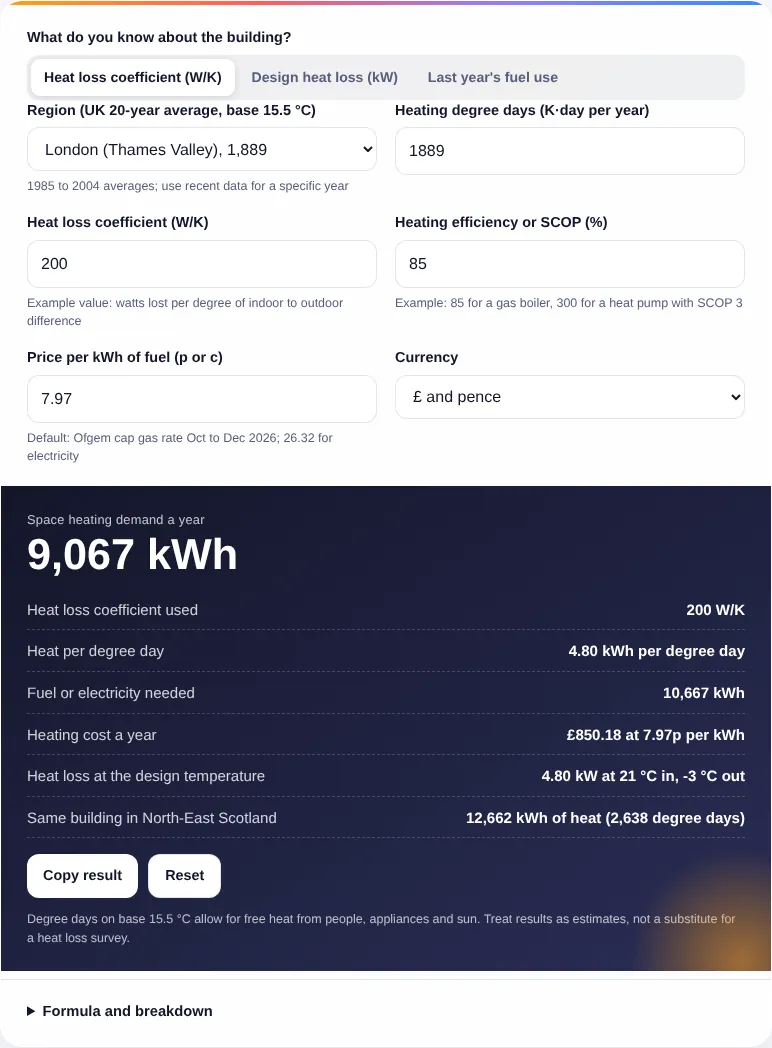
Degree days on base 15.5 °C allow for free heat from people, appliances and sun. Treat results as estimates, not a substitute for a heat loss survey.
Formula and breakdown
n/a
n/a
n/a
This heating degree days calculator turns a building’s heat loss and the local heating degree days into a yearly space heating demand in kWh, the fuel or electricity needed and the cost, for UK and European homeowners, heat pump buyers and energy assessors. It also works backwards from last year’s bills to estimate a home’s heat loss coefficient.
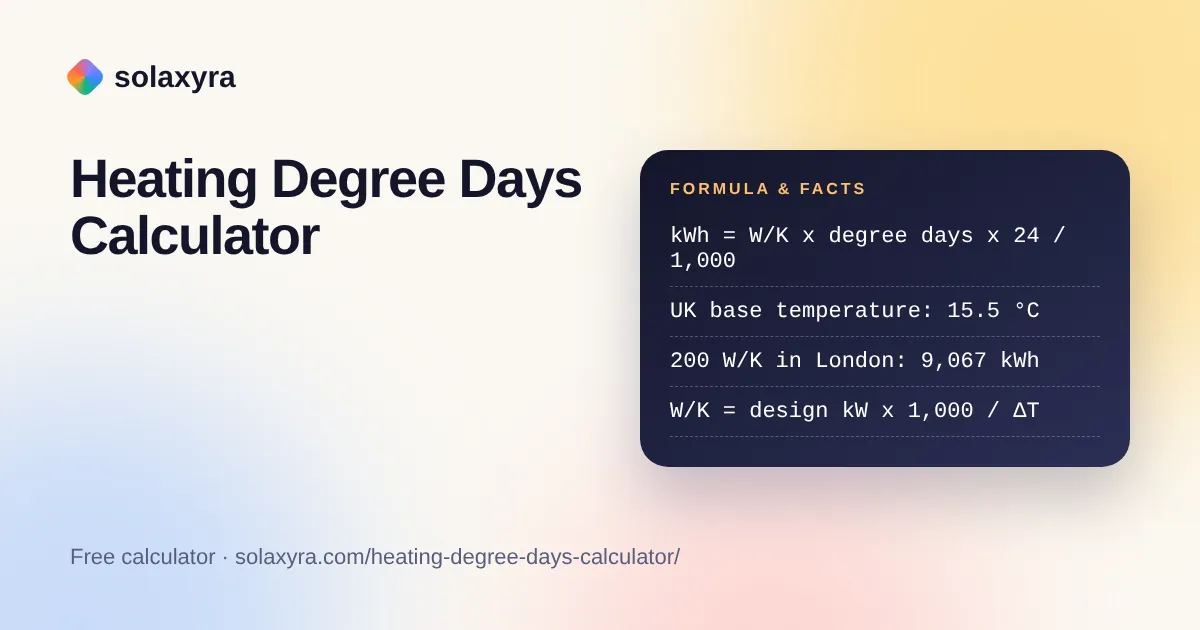
Quick answer: A heating degree days calculator multiplies the heat loss coefficient in W/K by the yearly degree days and by 24 hours, then divides by 1,000. A house losing 200 W/K in London, with 1,889 degree days on the UK 15.5 °C base, needs about 9,067 kWh of heat a year.
What Is a Heating Degree Days Calculator?
A heating degree days calculator is a tool that estimates how much heat a building needs over a period by combining how fast it loses heat with how cold, and for how long, the weather was. In plain words: yearly heat demand in kWh equals the heat loss coefficient in watts per kelvin, times the heating degree days, times 24, divided by 1,000.
A heating degree day is one degree of difference between a base temperature and the day’s mean outdoor temperature, counted only on days colder than the base. The Open University’s course notes on degree days give the UK base as 15.5 °C (60 °F) and the same formula with a worked case: 127.3 W/K in London, at 1,889 degree days, gives 127.3 x 1,889 x 24 / 1,000 = 5,771 kWh a year. The heating degree days calculator reproduces that result exactly when you enter 127.3 W/K.
How Do You Use the Heating Degree Days Calculator?
- Pick your region from the UK list or type degree days for your own location and year.
- Choose what you know: a heat loss coefficient in W/K, a design heat loss in kW from a survey, or last year’s fuel or electricity use.
- For design heat loss, enter the indoor and outdoor design temperatures from the survey; the heating degree days calculator divides kW by the difference to get W/K.
- For last year’s use, enter the kWh from your bills and the share used for space heating rather than hot water or cooking.
- Enter the heating efficiency: around 85% for a gas boiler as an example, or a heat pump’s SCOP times 100.
- Enter the fuel price and read the heat demand, the fuel needed, the cost and the heat per degree day.
Why Is the UK Base Temperature 15.5 °C?
The UK base is 15.5 °C because a typical home heated to about 18 to 21 °C gets the last few degrees free from people, cooking, appliances and sunshine, so heating only has to cover the gap below roughly 15.5 °C. The UK has used this 60 °F base for a long time, while the United States uses 65 °F (18.3 °C) and some European countries use other values. The Wikipedia article on heating degree days lists several national bases, and gives the same energy formula, E = H x D x 24 / 1,000.
Because of that built-in allowance for free heat, combine 15.5 °C degree days with a heat loss coefficient measured or calculated at the full indoor temperature, which is what heat loss surveys produce. A very well insulated house has a lower real balance point, so degree days on a 15.5 °C base will overstate its demand; a draughty, poorly heated house can be the other way round.
How Many Heating Degree Days Does the UK Have?
UK regions range from about 1,800 to over 2,600 heating degree days a year on the 15.5 °C base, so the same house needs around 47% more heat in north-east Scotland than in the south-west. The regional 20-year averages for 1985 to 2004 in the Open University notes are below, with heat demand for two example houses and an example gas cost.
| Region | Degree days (1985 to 2004 average) | Heat demand at 150 W/K | Heat demand at 250 W/K | Gas cost at 250 W/K, 85% boiler, 7.97p |
|---|---|---|---|---|
| South Western | 1,794 | 6,458 kWh | 10,764 kWh | £1,009 |
| London (Thames Valley) | 1,889 | 6,800 kWh | 11,334 kWh | £1,063 |
| Midlands | 2,290 | 8,244 kWh | 13,740 kWh | £1,288 |
| Northern Ireland | 2,342 | 8,431 kWh | 14,052 kWh | £1,318 |
| Borders | 2,443 | 8,795 kWh | 14,658 kWh | £1,374 |
| North-East Scotland | 2,638 | 9,497 kWh | 15,828 kWh | £1,484 |
Degree days change from year to year, so use these long-term averages for comparing places rather than as a forecast for a particular winter. For month-by-month UK figures, the Department for Energy Security and Net Zero publishes heating degree days in Energy Trends section 7, updated monthly. The gas price in the table is the Ofgem cap unit rate for October to December 2026.
How Do I Find My Home’s Heat Loss Coefficient?
Divide a surveyed design heat loss by the design temperature difference: 6 kW at 21 °C inside and −3 °C outside is 6,000 / 24 = 250 W/K. A room-by-room heat loss survey, which a heat pump installer should carry out before fitting, gives you the design figure; our heat loss calculator gives a first estimate from floor area and insulation.
Without a survey, the bills mode works backwards: heat delivered equals fuel kWh times the space heating share times boiler efficiency, and the heat loss coefficient equals that heat times 1,000, divided by degree days times 24. Use degree days for the same months as the bills. This is the reverse of the forward formula, so results are only as good as the space heating share and efficiency you assume.
Can Degree Days Compare a Heat Pump With a Gas Boiler?
Yes: the heat demand is the same whichever system supplies it, so divide it by each system’s efficiency and multiply by each fuel price. At 13,740 kWh of heat, a heat pump with an SCOP of 3 needs 4,580 kWh of electricity, which costs £1,205.46 at the 26.32p cap rate, while an 85% gas boiler needs 16,165 kWh of gas costing £1,288.33 at 7.97p. The heat pump running cost calculator adds standing charges and other details to that comparison.
Both prices come from the Ofgem price cap for October to December 2026, which also removes VAT from electricity bills from 1 October 2026 to 31 March 2027. Any change to a gas boiler must be made by a Gas Safe registered engineer, and a heat pump should be sized from a proper heat loss survey, not from this estimate alone.
Worked Example: Estimating a Heat Pump’s Running Cost From Gas Bills
Example: a semi-detached house in the Midlands used 13,500 kWh of gas last year, an estimated 80% of it for space heating, with an 85% efficient boiler. Heat delivered = 13,500 x 0.80 x 0.85 = 9,180 kWh. With 2,290 degree days, the heat loss coefficient = 9,180,000 / (2,290 x 24) = 167 W/K, or about 4.0 kW at 21 °C inside and −3 °C outside.
A heat pump with an SCOP of 3 would need 9,180 / 3 = 3,060 kWh of electricity for the same heat, costing £805.39 at 26.32p, against £860.76 for the 10,800 kWh of gas now used for space heating at 7.97p. The same house would need about 10,575 kWh of heat in north-east Scotland and about 7,192 kWh in the south-west. Hot water and standing charges are left out, and the electric heater running cost calculator covers rooms heated by plug-in heaters instead.
Frequently Asked Questions
What is a heating degree day?
A heating degree day measures how far, and for how long, the outdoor temperature falls below a base temperature. A day with a mean of 10.5 °C counts as 5 degree days on the UK base of 15.5 °C. Adding up the days gives a monthly or yearly total that tracks heating demand.
How do you calculate heating energy from degree days?
Multiply the heat loss coefficient in W/K by the degree days and by 24 to convert days to hours, then divide by 1,000 to get kWh. A house losing 200 W/K with 2,000 degree days needs 200 x 2,000 x 24 / 1,000 = 9,600 kWh of heat.
What base temperature should I use?
Use 15.5 °C for UK comparisons, because that is the standard UK base and it allows for free heat from people, appliances and the sun. Very well insulated homes have a lower balance point, so a lower base would suit them better if your data source offers it.
Where can I get degree day data?
UK monthly heating degree days are published by the Department for Energy Security and Net Zero in its Energy Trends weather tables. Long-term regional averages are useful for comparing places, while data for the same months as your bills is better for analysing your own home.
Why does my calculated demand differ from my gas bill?
Gas bills include hot water and sometimes cooking, the boiler wastes part of the energy, and your thermostat settings and hours may differ from the assumptions behind degree days. Enter the share used for space heating and your boiler efficiency to compare like with like.
Can I use degree days to size a heat pump?
Degree days estimate yearly energy, not the peak output a heat pump needs on the coldest day. Sizing needs a room-by-room heat loss survey at the design outdoor temperature, carried out by a qualified installer. Use this heating degree days calculator for running costs and comparisons, not for choosing the unit.
Checked October 2026 by the Solaxyra Editorial Team. Sources: The Open University: degree days, Wikipedia: Heating degree day, DESNZ: Energy Trends section 7, weather, Ofgem: price cap 1 October to 31 December 2026.