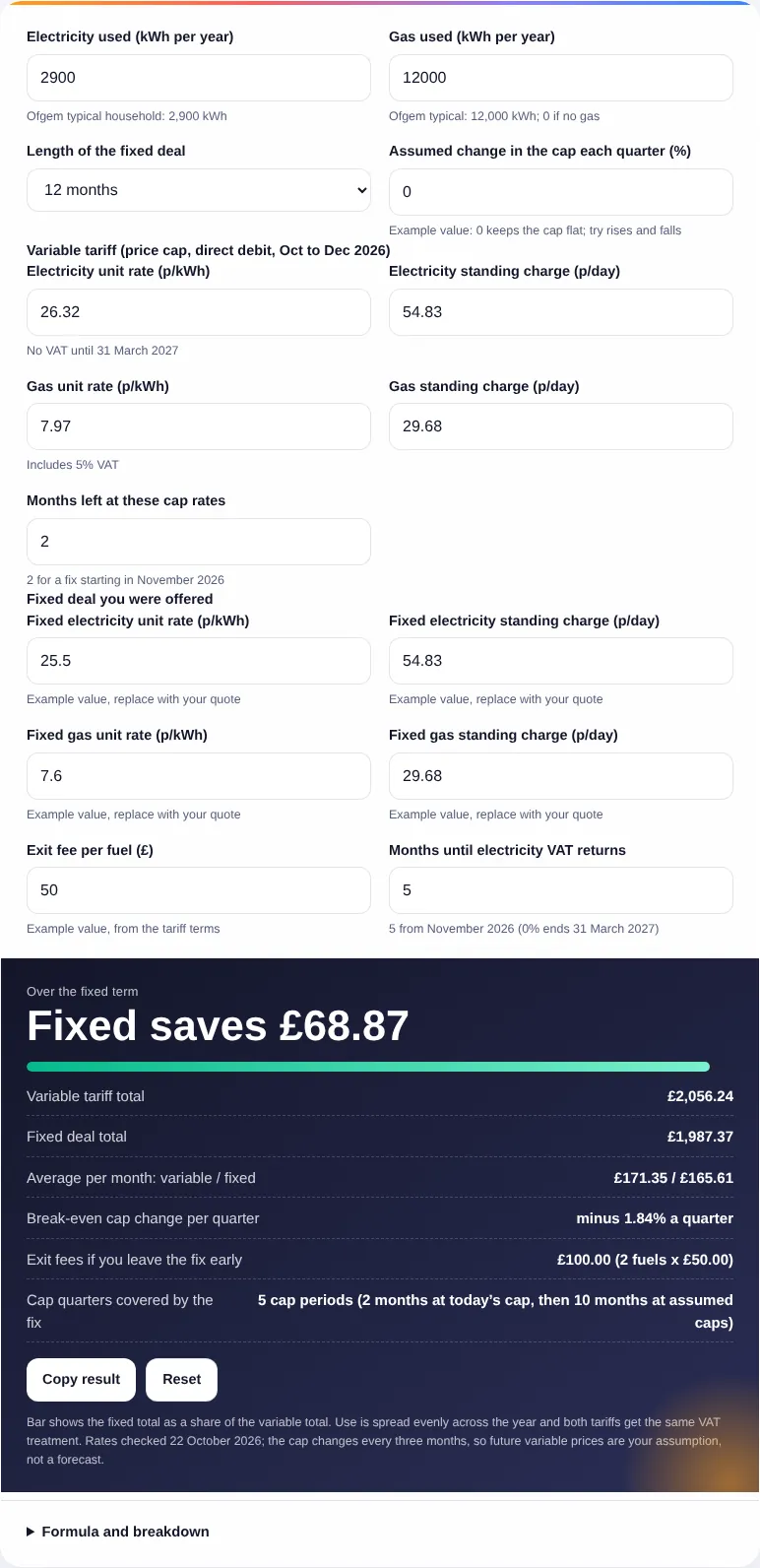
Bar shows the fixed total as a share of the variable total. Use is spread evenly across the year and both tariffs get the same VAT treatment. Rates checked 22 October 2026; the cap changes every three months, so future variable prices are your assumption, not a forecast.
Formula and breakdown
n/a
n/a
n/a
n/a
This fixed vs variable energy tariff calculator compares the total cost of a fixed energy deal with staying on the price-capped standard variable tariff for households in Great Britain, month by month over 12, 18 or 24 months. You enter your own use and the fixed quote, choose how you think the Ofgem price cap will move each quarter, and the calculator shows which option costs less, the break-even cap change and the exit fees you would face if you left early.
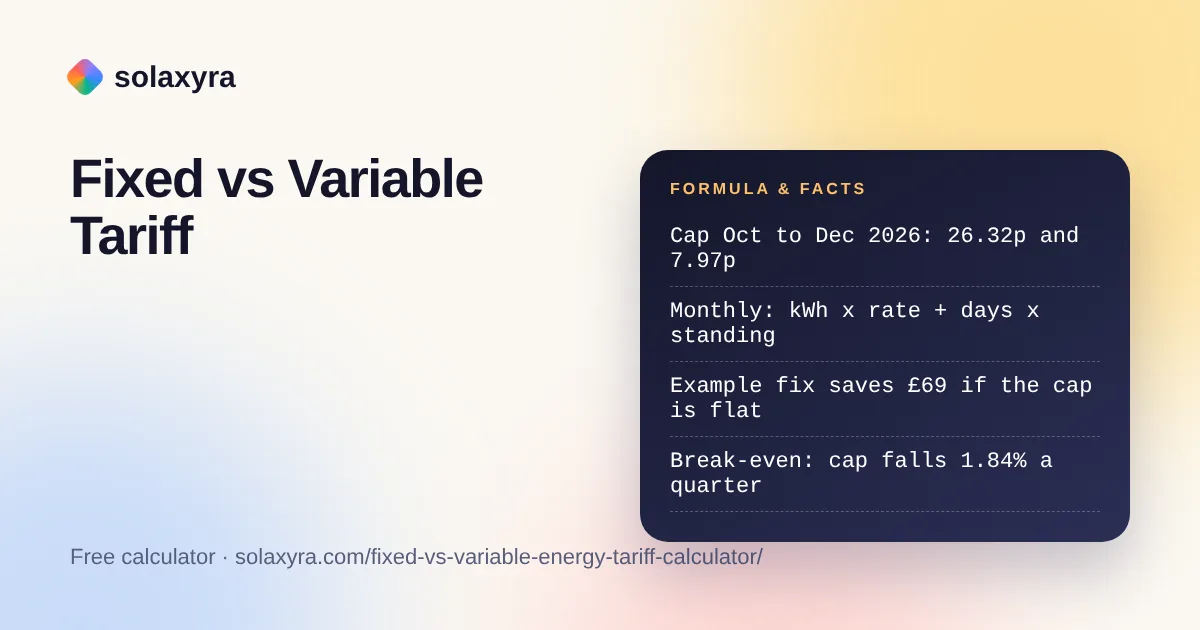
Quick answer: With the October to December 2026 cap at 26.32p per kWh for electricity and 7.97p for gas, the fixed vs variable energy tariff calculator shows that an example 12-month fix at 25.5p and 7.6p saves a typical household about £69 if the cap stays flat, and costs more if the cap falls about 1.8% a quarter.
What Is a Fixed vs Variable Energy Tariff Calculator?
A fixed vs variable energy tariff calculator is a tool that adds up what a household would pay on a fixed-price deal and on a standard variable tariff over the same period, using the same energy use, so the two can be compared fairly. In plain words: for each month, cost equals kWh used times the unit rate plus days times the standing charge; the fixed deal keeps its rates, while the variable rates change each time the price cap changes.
A standard variable tariff is a default tariff whose unit rates and standing charges can go up or down with the market, within the limit set by Ofgem’s price cap. A fixed tariff locks the rates you agreed for its term. The Ofgem energy price cap page explains that the cap is set every three months, limits unit rates and standing charges rather than your total bill, and does not apply if you have agreed a fixed tariff with your supplier.
How Do You Use the Fixed vs Variable Energy Tariff Calculator?
- Enter your yearly electricity and gas use from your bills or annual statement. Use 0 for gas if the home is all electric.
- Pick the length of the fixed deal you were offered.
- Check the variable rates. The defaults are the price cap for direct debit customers from 1 October to 31 December 2026; your region’s figures on your bill are better.
- Enter the fixed deal’s unit rates, standing charges and exit fee per fuel from the tariff information.
- Set an assumed change in the cap each quarter, then try a few values, such as minus 5%, 0% and plus 5%, to see how sensitive the answer is.
- Read which tariff costs less, the break-even quarterly change and the exit fees, then open the breakdown for the monthly working.
What Is the Price Cap From October to December 2026?
From 1 October to 31 December 2026, a typical direct debit customer pays on average 26.32p per kWh for electricity with a standing charge of 54.83p a day, and 7.97p per kWh for gas with 29.68p a day. Ofgem’s announcement of the October to December 2026 cap says the electricity figures exclude VAT because the government has removed VAT from electricity bills from 1 October 2026 to 31 March 2027, while gas still includes 5% VAT.
The next cap, for 1 January to 31 March 2027, is due to be announced on 25 November 2026. Because nobody knows what later caps will be, the fixed vs variable energy tariff calculator does not use a forecast: you set the quarterly change yourself. It also assumes electricity VAT returns at 5% after 31 March 2027 and applies that to both tariffs, so it does not distort the comparison. Our guide to the energy price cap covers how each level is set.
Is a Fixed Energy Tariff Cheaper Than the Price Cap?
A fixed tariff is cheaper only if its rates stay below what the capped variable rates turn out to be over the whole term, which depends on future caps. The table shows the same example household and the same example fix under five cap paths, worked with the fixed vs variable energy tariff calculator.
| Cap change each quarter | Variable total, 12 months | Fixed total, 12 months | Result |
|---|---|---|---|
| Minus 5% | £1,874.15 | £1,987.37 | Variable saves £113.22 |
| Minus 2% | £1,981.59 | £1,987.37 | Variable saves £5.78 |
| No change | £2,056.24 | £1,987.37 | Fixed saves £68.87 |
| Plus 2% | £2,133.39 | £1,987.37 | Fixed saves £146.02 |
| Plus 5% | £2,253.91 | £1,987.37 | Fixed saves £266.54 |
All rows use 2,900 kWh of electricity and 12,000 kWh of gas a year, Ofgem’s figures for a typical household, with the cap rates above and an example fix of 25.5p and 7.6p per kWh and the same standing charges as the cap. The break-even point is a fall of about 1.84% a quarter: if you expect the cap to fall faster than that, the variable tariff wins.
How Do Standing Charges Change the Comparison?
A fixed deal with a lower unit rate but a higher standing charge can still cost more, especially for low users, because the standing charge is paid every day whatever you use. At the cap, electricity and gas standing charges together come to 84.51p a day, about £308 a year, before any energy is used. The fixed vs variable energy tariff calculator includes both parts for each fuel, which is why it asks for four rates on each side rather than one price.
For a quick check of a single bill, the electricity cost calculator shows the unit cost of each appliance, and the energy consumption calculator helps estimate your yearly kWh if you do not have a full year of bills. The guide to standing charges explains why they vary by region.
What About Exit Fees and Switching?
You may have to pay your supplier an exit fee if you leave a fixed tariff before it ends, according to Ofgem’s guide to switching your home energy supplier. The amount is set in each tariff’s terms and is usually charged per fuel, so the fixed vs variable energy tariff calculator multiplies your figure by the number of fuels. It shows the fee separately rather than adding it to the fixed total, because you only pay it if you leave early.
Ofgem also says a switch must be completed within 5 working days, or the new supplier must pay you £40. If the cap falls sharply during your fix, compare the remaining saving with the exit fee before moving. Check in the tariff terms what you will be moved to when the fix ends, and diarise the end date so you can compare again.
Worked Example: Typical Dual Fuel Home Offered a 12-Month Fix
Example: a three-bedroom terraced house in Manchester uses 2,900 kWh of electricity and 12,000 kWh of gas a year on direct debit. In late October 2026 it is offered a 12-month fix at 25.5p per kWh for electricity and 7.6p for gas, with standing charges equal to the cap and a £50 exit fee per fuel, starting in November.
- Variable, first month: electricity 2,900 / 12 x 26.32p + 30.42 days x 54.83p = £80.28; gas 1,000 x 7.97p + 30.42 x 29.68p = £88.73; total £169.01.
- Electricity VAT at 5% is applied to both tariffs from the sixth month, April 2027.
- Over 12 months with a flat cap: variable £2,056.24, fixed £1,987.37, so the fix saves £68.87, about £5.74 a month.
- Break-even: the variable tariff only wins if the cap falls by more than about 1.84% each quarter from January 2027.
- Leaving early would cost £100 in exit fees, larger than the expected saving, so the household should only fix if it is happy to stay for the full year.
Running the same figures through the fixed vs variable energy tariff calculator with your own regional rates and a range of cap assumptions gives a clearer answer than any single forecast. For time-of-use deals, use the time of use tariff calculator instead.
Frequently Asked Questions
Should I fix my energy tariff or stay on the price cap?
Fix if the deal’s rates beat the cap and you value certainty, or if you expect the cap to rise. Stay variable if you expect falls or may move soon. Enter your use, the fixed quote and a few cap assumptions in the fixed vs variable energy tariff calculator to see the break-even point before deciding.
Does the price cap apply to fixed tariffs?
No. Ofgem says you are not affected by changes to the energy price cap if you have changed to a fixed rate tariff. The cap protects customers on standard variable and default tariffs and limits their unit rates and standing charges, not their total bill.
How often does the energy price cap change?
Ofgem sets the cap every three months. The rates for 1 October to 31 December 2026 are 26.32p per kWh for electricity and 7.97p for gas on direct debit, and the cap for January to March 2027 is due to be announced on 25 November 2026.
What is a break-even cap change?
It is the quarterly rise or fall in the price cap at which the fixed deal and the variable tariff cost exactly the same over the fixed term. If you expect the cap to move above that figure, fixing wins; below it, staying on the variable tariff costs less.
Can I leave a fixed energy tariff early?
Yes, but you may have to pay an exit fee to your supplier if you leave before the fixed term ends. The fee is set in the tariff terms, usually per fuel. Ofgem says a switch to a new supplier must be completed within 5 working days.
Is VAT included in the price cap rates?
For October to December 2026, the electricity rates exclude VAT because the government removed it from electricity bills from 1 October 2026 to 31 March 2027. Gas rates still include 5% VAT. The calculator adds 5% to electricity on both tariffs once that period ends.
Checked October 2026 by the Solaxyra Editorial Team. Sources: Ofgem: Changes to the energy price cap between 1 October and 31 December 2026, Ofgem: Energy price cap, Ofgem: Switch your home energy supplier, Ofgem: Average gas and electricity use explained.