This guide explains EV charger types in the UK: the connectors you will meet, the speed categories used by public networks, the difference between AC and DC charging, and what to look for in a home charger.
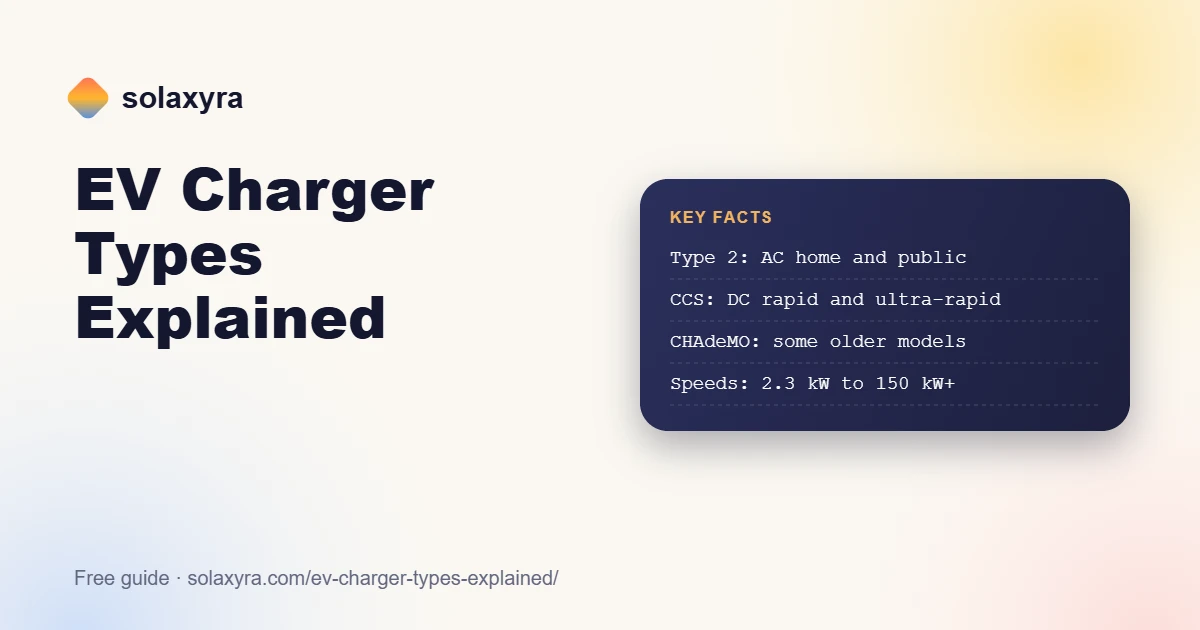
Quick answer: Most electric cars sold in the UK use a Type 2 connector for AC charging at home and on slower public chargers, and a CCS connector, which adds two large pins below the Type 2 shape, for DC rapid charging. Some older models use CHAdeMO for rapid charging. Speeds range from about 2.3 kW on a 3-pin plug to 150 kW or more on ultra-rapid chargers.
AC and DC charging
Your car’s battery stores DC electricity. With AC charging, the car’s own onboard charger converts mains AC to DC, which limits the speed to that charger’s rating, often 7.4 or 11 kW. With DC charging, the conversion happens inside the public charger, so energy can flow much faster, up to the car’s DC limit.
Connector types
| Connector | Used for | Notes |
|---|---|---|
| 3-pin (UK BS 1363) | Slow AC charging | Granny cable; about 2.3 kW |
| Type 2 | AC charging | Standard in the UK and Europe |
| CCS (Combo 2) | DC rapid charging | Type 2 shape plus two DC pins; most new EVs |
| CHAdeMO | DC rapid charging | Some older models such as early Nissan Leafs |
Charging speed categories
Public charging networks in the UK commonly group chargers like this:
| Category | Typical power | Typical use |
|---|---|---|
| Slow | up to about 7 kW | Home, overnight, on-street lamp-post chargers |
| Fast | 7 to 22 kW | Workplaces, supermarkets, car parks |
| Rapid | about 50 kW | Service stations and hubs |
| Ultra-rapid | 100 to 350 kW | Motorway hubs; depends on the car’s limit |
Tethered or untethered?
A tethered home charger has its cable permanently attached, which is convenient. An untethered charger has a Type 2 socket, so you use your own cable; it looks neater and suits a change of car with a different connector. Both work equally well.
Single phase or three phase?
Most UK homes have a single-phase supply, which limits home charging to about 7.4 kW. A three-phase supply can support 11 or 22 kW, if the car can accept it on AC.
What should you look for in a home charger?
- Smart features to schedule charging on an off-peak tariff.
- Compliance with the UK smart charge point regulations.
- Load management to avoid overloading your main fuse.
- Installation by a qualified electrician, often with a dedicated circuit and RCD protection.
Frequently Asked Questions
What type of charger does my electric car use?
Most UK EVs use Type 2 for AC and CCS for DC rapid charging.
What is the difference between Type 2 and CCS?
Type 2 is for AC charging; CCS adds DC pins for rapid charging.
Can I use any public charger?
You need a matching connector and to pay through the network’s app, card or contactless.
Is a 22 kW home charger worth it?
Only with a three-phase supply and a car that accepts 22 kW AC.
Checked November 2026 by the Solaxyra Editorial Team. Sources: Energy Saving Trust: Charging electric vehicles, GOV.UK: Electric vehicle smart charge points regulations.