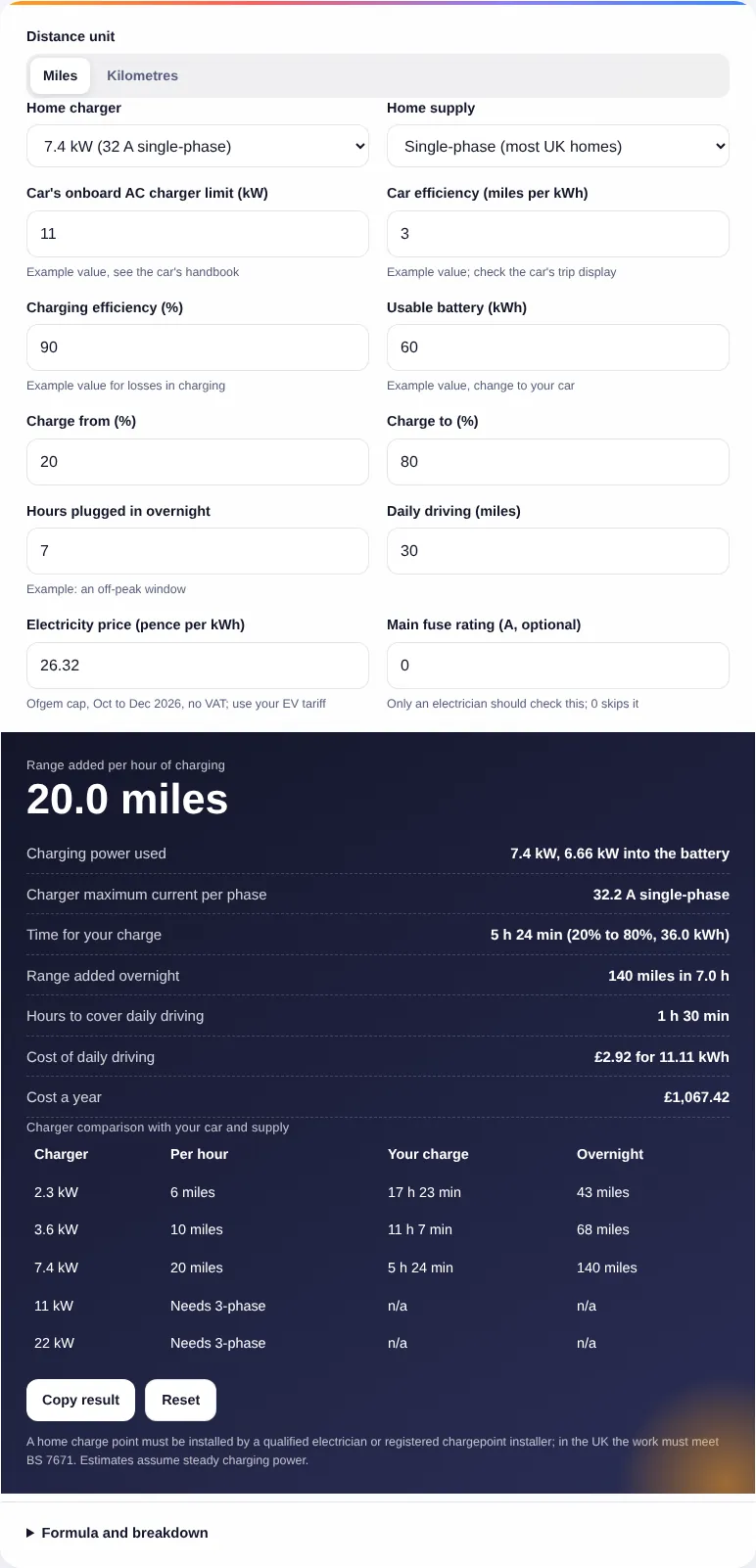
| Charger | Per hour | Your charge | Overnight |
|---|
A home charge point must be installed by a qualified electrician or registered chargepoint installer; in the UK the work must meet BS 7671. Estimates assume steady charging power.
Formula and breakdown
n/a
n/a
n/a
This home EV charger calculator compares 3.6 kW, 7.4 kW, 11 kW and 22 kW home charge points for your car and your home supply, showing the miles or kilometres added per hour, the time for a typical top-up, the range added overnight and the running cost, for drivers in the UK, Ireland and Europe. It also shows the current each charger draws, the starting point for the supply check your electrician must carry out.
Quick answer: A home EV charger calculator multiplies charging power by charging efficiency and the car’s miles per kWh. Example: a 7.4 kW charger at 90% efficiency puts 6.66 kW into the battery, which at 3 miles per kWh adds about 20 miles an hour and around 140 miles in a 7-hour overnight charge.
What Is a Home EV Charger Calculator?
A home EV charger calculator is a tool that estimates how quickly a home charge point refills an electric car and what that costs. In plain words: power into the battery equals the lower of the charger rating and the car’s onboard charger limit, times charging efficiency; range per hour equals that power times the car’s miles per kWh; and time equals the energy needed divided by the power into the battery.
The Energy Saving Trust’s guide to charging electric vehicles gives a useful rule of thumb: the charging power in kW roughly equals the miles of range added in 20 minutes, so a 7 kW charger adds about 7 miles every 20 minutes. That matches about 3 miles per kWh, the example default here; your car’s own figure will differ with the model, speed and season.
How Do You Use the Home EV Charger Calculator?
- Choose miles or kilometres.
- Pick a charger rating and say whether the home has a single-phase or three-phase supply.
- Enter the car’s onboard AC charger limit from its handbook, its efficiency, and its usable battery size.
- Set the state of charge you start from and charge to, and the hours the car is plugged in overnight.
- Enter your daily driving and your electricity price per kWh to see the daily and yearly cost.
- Compare all five charger ratings in the table under the result.
Is a 7 kW or 3.6 kW Home Charger Better?
A 7.4 kW charger adds range about twice as fast as a 3.6 kW unit, roughly 20 miles an hour against 10 in the example, but both cover a typical day’s driving overnight. The table, taken from the home EV charger calculator, compares the ratings for a car using 3 miles per kWh, charging at 90% efficiency with a 60 kWh usable battery and an 11 kW onboard charger.
| Charger | Supply | Current per phase | Miles per hour | 20% to 80% (36 kWh) | Miles in 7 hours |
|---|---|---|---|---|---|
| 2.3 kW (example, three-pin cable) | Single-phase | 10 A | 6 | 17 h 23 min | 43 |
| 3.6 kW | Single-phase | 15.7 A | 10 | 11 h 7 min | 68 |
| 7.4 kW | Single-phase | 32.2 A | 20 | 5 h 24 min | 140 |
| 11 kW | Three-phase | 15.9 A | 30 | 3 h 38 min | 144 (battery full) |
| 22 kW | Three-phase | 31.8 A | 30 (car limit 11 kW) | 3 h 38 min | 144 (battery full) |
If your mileage is low, a 3.6 kW unit or a slower charge may be all you need. For the full running cost comparison with a petrol or diesel car, see the solar EV charging calculator, which also works out how much of the charge solar panels could supply.
Two points apply to every rating. First, the charger rating changes the time, not the cost per mile: at 26.32p per kWh, 90% charging efficiency and 3 miles per kWh, each mile costs about 9.7p whether the car charges at 3.6 kW or 7.4 kW. Second, many cars reduce their charging power as the battery approaches full, so the last part of a charge to 100% can take longer than the home EV charger calculator’s straight-line estimate; the 20% to 80% times in the table are the more reliable guide.
Can You Get a 22 kW Charger at Home?
Only with a three-phase supply, which most UK homes do not have. The Wikipedia article on the Type 2 connector notes that in common practice it delivers about 7.2 kW at 32 A on single-phase AC and 22 kW on three-phase. A 22 kW charger also helps only if the car’s onboard charger accepts 22 kW; many cars accept less, so in the table above the 22 kW unit charges no faster than the 11 kW one.
The current figures in the home EV charger calculator come from the standard power formulas: on single-phase, current equals power divided by 230 V; on three-phase, it equals power divided by 1.732 times 400 V. Our kW to amps calculator and three-phase power calculator explain both.
Does My House Need an Upgrade for an EV Charger?
A 7.4 kW charger draws about 32 A for hours at a time, one of the largest continuous loads in a home, so a qualified electrician must check the supply before installation. They assess the main fuse, the maximum demand of the whole house, the consumer unit and earthing, and may fit load management that turns the charger down when other appliances are running. The work must meet BS 7671, the IET’s national standard for electrical installations in the UK.
The Energy Saving Trust advises using a registered chargepoint installer, who will usually register the device for you. Never charge with a domestic extension lead, and never try to install or alter charge point wiring yourself.
Do Home EV Chargers Have to Be Smart?
Yes, in Great Britain: under the Electric Vehicles (Smart Charge Points) Regulations 2021, in force since 30 June 2022, charge points sold for homes and workplaces must be able to send and receive information and respond to signals. They must come with pre-set off-peak default charging hours that the owner can accept or change, a randomised delay function and security in line with ETSI EN 303 645.
Smart charging matters for cost. The home EV charger calculator’s default price is the Ofgem price cap of 26.32p per kWh for 1 October to 31 December 2026, which Ofgem notes excludes VAT because VAT has been removed from electricity bills from 1 October 2026 to 31 March 2027. An off-peak EV tariff can be much cheaper, so enter your own rate.
Worked Example: Overnight Charging With a 7.4 kW Charger
Example: a household in Leeds with a single-phase supply drives 30 miles a day in a car that averages 3 miles per kWh, with a 60 kWh usable battery and an 11 kW onboard charger. They choose a 7.4 kW charge point and pay 26.32p per kWh.
- Power used: lower of 7.4 kW and 11 kW = 7.4 kW; into the battery at 90% = 6.66 kW.
- Range per hour: 6.66 x 3 = 20 miles.
- Daily need: 30 / 3 = 10 kWh into the battery, which takes 10 / 6.66 = 1 h 30 min.
- From the meter: 10 / 0.9 = 11.11 kWh, costing 11.11 x 26.32p = £2.92 a day, or £1,067 a year.
- A 20% to 80% top-up of 36 kWh takes 36 / 6.66 = 5 h 24 min, well inside a 7-hour overnight window.
- Current: 7,400 / 230 = 32.2 A, so an electrician checks the supply and may fit load management.
Frequently Asked Questions
How many miles per hour does a 7 kW charger add?
Roughly 20 miles an hour for a car that covers 3 miles per kWh, after allowing for 10% charging losses. The Energy Saving Trust’s rule of thumb is that a charger’s kW rating roughly equals the miles added in 20 minutes, so a 7 kW unit adds about 21 miles an hour.
Is a 3.6 kW home charger enough?
For many drivers, yes. A 3.6 kW charger adds about 10 miles an hour in the example, or about 68 miles in a 7-hour overnight charge, which covers a typical daily commute. A 7.4 kW unit costs a similar amount to run but refills a large battery in half the time.
Can I install an 11 kW charger on a single-phase supply?
No. An 11 kW or 22 kW AC charger needs a three-phase supply, and most UK homes are single-phase, which limits home charging to about 7.4 kW at 32 A. Upgrading to three-phase is a job for the network operator and a qualified electrician, and the car’s onboard charger must also accept the higher power.
How long does it take to charge an electric car at home?
Divide the energy needed by the power going into the battery. Charging a 60 kWh battery from 20% to 80% needs 36 kWh; at 7.4 kW with 90% efficiency that is 36 / 6.66 = about 5 hours 24 minutes. At 3.6 kW it takes about 11 hours.
Do I need an electrician to install a home EV charger?
Yes. A home charge point must be installed by a qualified electrician or registered chargepoint installer, working to BS 7671 in the UK. They check that the supply, main fuse, consumer unit and earthing can take a continuous load of up to 32 A, and fit load management where needed.
Does a home EV charger have to be a smart charger?
In Great Britain, yes. Since 30 June 2022 charge points sold for home and workplace use must be smart: able to send and receive information, with pre-set off-peak default charging hours the owner can change, a randomised delay function and cyber security in line with ETSI EN 303 645.
Checked October 2026 by the Solaxyra Editorial Team. Sources: Energy Saving Trust: Charging electric vehicles, GOV.UK: Electric vehicle smart charge points regulations, Ofgem: Energy price cap 1 October to 31 December 2026, Wikipedia: Type 2 connector, IET: BS 7671.