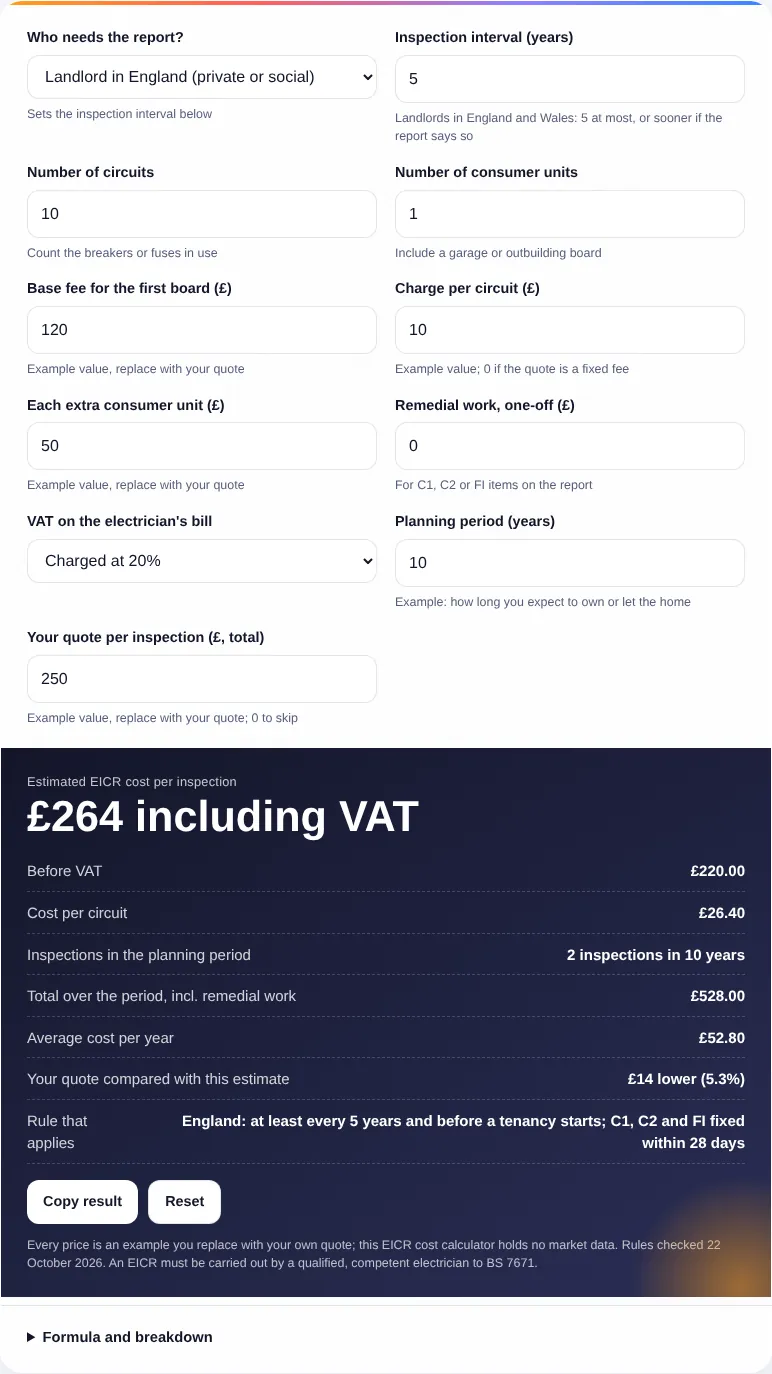
Every price is an example you replace with your own quote; this EICR cost calculator holds no market data. Rules checked 22 October 2026. An EICR must be carried out by a qualified, competent electrician to BS 7671.
Formula and breakdown
n/a
n/a
n/a
This EICR cost calculator prices an Electrical Installation Condition Report from the way electricians actually quote it, a base fee plus a charge per circuit and per extra consumer unit, and then shows what repeat inspections cost over the years you own or let a home. It is built for landlords in England and Wales and for UK homeowners comparing quotes, and every price is yours to replace.
Quick answer: An EICR cost calculator adds a base fee, a charge for each circuit, any extra consumer units and VAT to give the price of one inspection. Landlords in England must test before a tenancy starts and at least every five years, so multiply by the inspections due in your period and add any one-off remedial work.
What Is an EICR Cost Calculator?
An EICR cost calculator is a tool that estimates the price of a periodic electrical inspection and test of a home, and the total cost of keeping that inspection up to date. In plain words: one inspection costs the base fee plus circuits times the charge per circuit plus extra boards times the extra board charge, with VAT on top if the electrician is VAT registered. The number of inspections in your planning period is the period divided by the interval, rounded up, and remedial work is added once.
An EICR is a report on the condition of the fixed wiring, consumer unit, sockets, switches and fittings, measured against BS 7671. It is not a pass certificate for appliances. Prices vary because the time needed depends mainly on the number of circuits and how easy each one is to reach and test.
How Do You Use the EICR Cost Calculator?
- Choose who needs the report. The inspection interval fills in: 5 years for landlords in England and Wales, and an example of 10 years for owners, which you should change to the date on your last report.
- Enter the number of circuits and consumer units. A garage or outbuilding with its own board counts as an extra unit.
- Replace the example base fee, charge per circuit and extra board charge with figures from your quote. If the quote is a single fixed fee, enter it as the base fee and set the per-circuit charge to 0.
- Add any remedial work quoted after a previous report, and choose whether VAT is charged.
- Set the planning period and enter your quote to see the difference.
What Does an EICR Price Depend On?
The number of circuits is the main driver, because each circuit has to be isolated, inspected and tested. A flat with six circuits and a large house with eighteen circuits and a detached garage board need very different amounts of time on site. The table shows how each input changes the result and why.
| Input | Why it changes the price | How to check your quote |
|---|---|---|
| Base fee | Travel, set-up, the main board and the written report | Ask whether the report is included or charged separately |
| Charge per circuit | Testing time grows with every circuit | Count circuits on your board and compare |
| Extra consumer units | Each board has its own tests and schedule | Include outbuildings and sub-mains |
| Interval | Shorter intervals mean more inspections in your period | The report states the next inspection date |
| Remedial work | Fixing C1, C2 or FI items is separate from the inspection | Ask for remedial prices in writing before work starts |
| VAT | 20% when the electrician is VAT registered | Compare quotes on the same VAT basis |
If an inspection recommends a new board, our consumer unit replacement estimate prices that job line by line, and the rewiring cost estimate covers older installations that need more. For circuits feeding big loads such as showers, you can check current draw with the watts to amps converter.
How Often Do Landlords Need an EICR?
In England, landlords must have every electrical installation inspected and tested before a tenancy starts and at intervals of no more than five years, or sooner if the last report sets an earlier date. That is regulation 3 of the Electrical Safety Standards in the Private Rented Sector (England) Regulations 2020, as amended in 2025 to extend the duties to the social rented sector. The current text is on legislation.gov.uk.
The same regulation sets the paperwork deadlines. A copy of the report goes to each existing tenant within 28 days of the inspection, to a new tenant before they move in, and to the local housing authority within 7 days of a written request. The landlord must keep the report until the next one is due or done.
In Wales, regulation 6 of the Renting Homes (Fitness for Human Habitation) (Wales) Regulations 2022 requires a valid electrical condition report for each period of occupation. A report is valid for up to five years, and the contract-holder must get a copy within 14 days of the occupation date. Scotland and Northern Ireland have their own rules, so check the official guidance there; the tool’s “elsewhere” option leaves the interval for you to set.
What Do C1, C2, C3 and FI Mean?
C1 and C2 mean remedial work is required, FI means further investigation is needed without delay, and C3 is a recommendation only. The GOV.UK guidance for private and social landlords, published in November 2025, defines them as follows: C1, danger present and a risk of injury; C2, potentially dangerous; C3, improvement recommended; FI, further investigation required without delay.
For landlords in England, regulation 3 says the remedial or investigative work must be done by a qualified person within 28 days, or within any shorter period the report gives. The landlord then needs written confirmation from a qualified person and must send it, with the original report, to each tenant and to the local housing authority within 28 days of the work being finished. Put the cost of that work in the remedial field of the EICR cost calculator, since it is paid once rather than at every inspection.
What Is the Penalty for Not Having an EICR?
The maximum financial penalty in England is now £40,000. Regulation 11(2)(b) was changed by the 2025 amending regulations, in force from 1 November 2025 for some purposes and from 1 May 2026 for the rest, so the £30,000 figure still quoted on many pages is out of date. The penalty is set by the local housing authority, which may choose a lower amount.
Worked Example: A Rented House With a Garage Board
Example: a landlord in England lets a house with 14 circuits on the main board and a separate garage consumer unit. The electrician quotes a £120 base fee, £10 per circuit and £50 for the extra board, plus VAT. The last report found one C2 item, and the fix costs £180 plus VAT. The landlord plans to let the house for 10 years.
- One inspection before VAT: £120 + 14 x £10 + 1 x £50 = £310.
- With VAT at 20%: £310 x 1.2 = £372.
- Inspections in 10 years at a 5-year interval: 10 / 5 = 2.
- Remedial work with VAT: £180 x 1.2 = £216, paid once.
- Total: 2 x £372 + £216 = £960, or £96 a year on average.
A rival quote of £360 per inspection is £12, or 3.2%, below the build-up. The EICR cost calculator makes this kind of comparison quick, and it shows that the cost per year matters more than a small gap between quotes.
How Does the EICR Cost Calculator Help Owner-Occupiers?
The landlord regulations do not apply to people living in their own home, but every report sets a recommended date for the next inspection. Choose the owner option, enter that interval and the years you expect to stay, and the EICR cost calculator spreads the cost per year. Owners often book an inspection before buying, before major work such as a new board or an electric shower, or when an insurer asks. Running costs for new appliances can be checked with the electricity cost calculator.
Whoever books it, the inspection must be carried out by a qualified, competent electrician. GOV.UK guidance points to the competent person registers and the Electrical Safety First finder for checking registration.
Frequently Asked Questions
How much does an EICR cost?
It is usually a base fee plus a charge per circuit, with extra consumer units and VAT added. No official body publishes a national price, so enter the figures from your quotes. Larger homes, outbuildings with their own board and poor access all add time, which adds cost.
How often does a landlord need an EICR?
In England, landlords must have the installation inspected and tested before a tenancy starts and at intervals of no more than five years, or sooner if the last report says so. In Wales, a valid report must exist for each occupation and lasts up to five years.
What do C1, C2, C3 and FI mean on an EICR?
GOV.UK guidance says C1 means danger present with a risk of injury, C2 means potentially dangerous, C3 means improvement recommended and FI means further investigation is needed without delay. C1, C2 and FI need action; C3 does not require remedial work but is worth considering.
What is the fine for not having an EICR?
In England, regulation 11 of the 2020 electrical safety regulations allows a local housing authority to impose a financial penalty of up to £40,000. That maximum was raised by a 2025 amending instrument, so pages still quoting £30,000 are out of date.
Do homeowners need an EICR?
The landlord regulations do not apply to owner-occupiers, but every report states when the next inspection is recommended. Use that date in the calculator. Buyers, insurers or a planned consumer unit replacement are common reasons owners book one between those dates.
Is VAT included in EICR prices?
Only if the electrician is VAT registered, in which case the standard rate of 20% is added. A trader with taxable turnover under the £90,000 registration threshold does not have to charge VAT. Check each quote states whether VAT is included before comparing them.
Checked October 2026 by the Solaxyra Editorial Team. Sources: legislation.gov.uk: SI 2020/312 regulation 3, legislation.gov.uk: SI 2020/312 regulation 11, GOV.UK: Electrical safety standards in the private and social rented sectors, legislation.gov.uk: WSI 2022/6 regulation 6, GOV.UK: VAT rates, GOV.UK: Register for VAT.