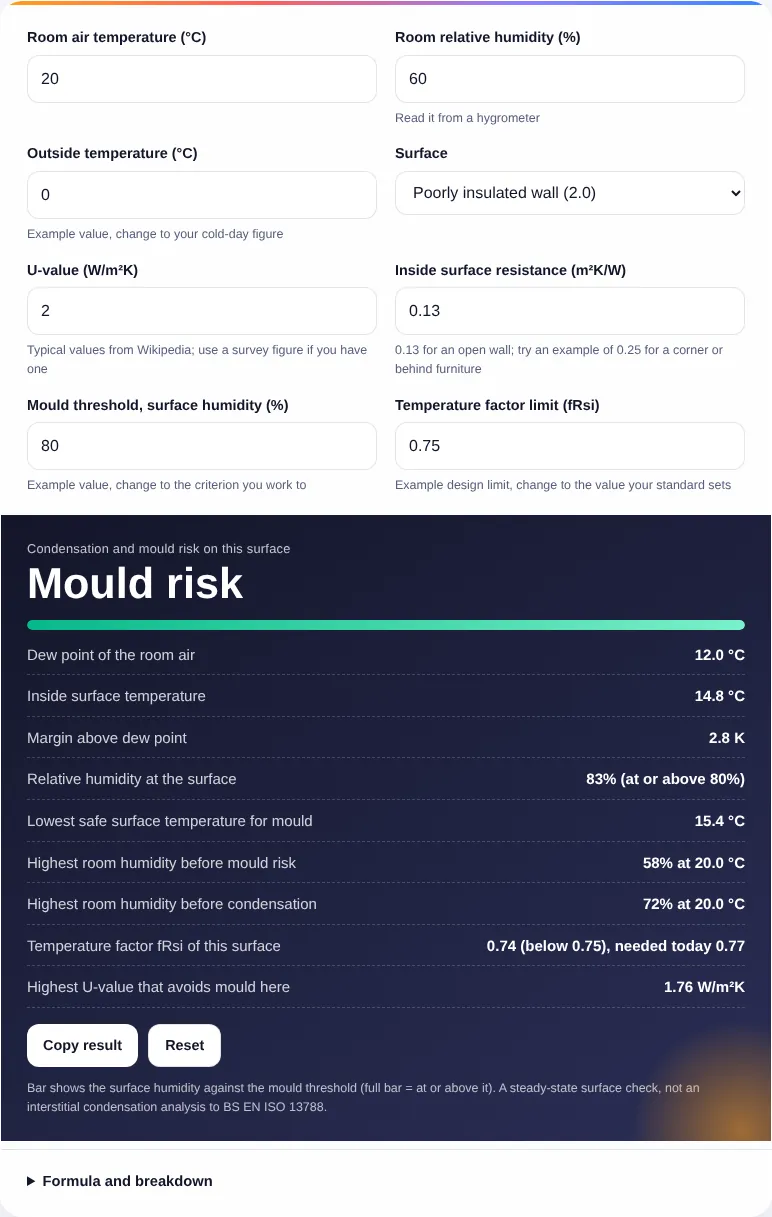
Bar shows the surface humidity against the mould threshold (full bar = at or above it). A steady-state surface check, not an interstitial condensation analysis to BS EN ISO 13788.
Formula and breakdown
n/a
n/a
n/a
n/a
This condensation risk calculator tells you whether a wall, window or ceiling in your home is likely to get condensation or mould in winter, from the room temperature, room humidity, outside temperature and the surface’s U-value. It is written for homeowners, tenants and landlords in the UK and Europe who are looking at black spots in a corner or wet glass every morning and want to know which change will help most: more heat, less moisture or better insulation.
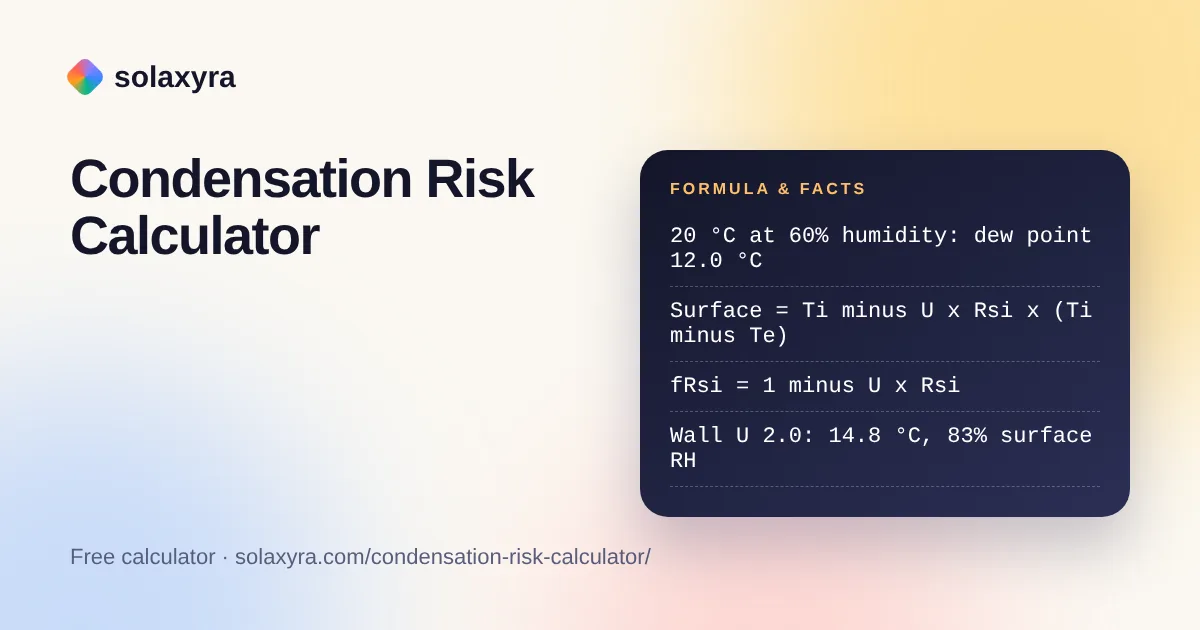
Quick answer: A condensation risk calculator compares the dew point of the room air with the temperature of the inside surface. At 20 °C and 60% humidity the dew point is 12.0 °C. A poorly insulated wall with 0 °C outside sits near 14.8 °C, so it stays dry but reaches about 83% surface humidity, enough for mould.
What Is a Condensation Risk Calculator?
A condensation risk calculator is a tool that estimates whether water vapour in room air will condense on, or keep damp, a cold inside surface. In plain words: work out the dew point of the room air from its temperature and relative humidity, work out how cold the inside face of the wall or window gets from its U-value and the outside temperature, then compare the two. A surface at or below the dew point gets wet; a surface a few degrees above it can still hold enough moisture for mould.
This page deals with surface condensation, the visible kind. Condensation inside a wall build-up, called interstitial condensation, needs a layer-by-layer analysis to BS EN ISO 13788 and BS 5250, which insulation manufacturers and building designers carry out with specialist software.
How Do You Use the Condensation Risk Calculator?
- Measure the room temperature and relative humidity with a hygrometer and enter both.
- Enter a cold-day outside temperature for your area.
- Pick the surface you are worried about, or type a U-value from an energy assessment or survey.
- Keep the inside surface resistance at 0.13 for an open wall, or raise it to test a corner, a wall behind a wardrobe or the bottom of a curtain.
- Set the mould threshold and temperature factor limit you want to check against. Both are example values you can change.
- Read the risk band, then the margin and the humidity limits. Open the breakdown to see each step.
How Do You Calculate the Dew Point?
The dew point is the temperature at which room air becomes saturated, and it is calculated with the Magnus formula from air temperature and relative humidity. The Wikipedia article on dew point gives the constants b = 17.625 and c = 243.04 °C, chosen to keep errors small from minus 40 to 50 °C. First find gamma = ln(RH / 100) + b x T / (c + T), then dew point = c x gamma / (b minus gamma).
| Room humidity | Dew point at 18 °C | Dew point at 20 °C |
|---|---|---|
| 40% | 4.2 °C | 6.0 °C |
| 50% | 7.4 °C | 9.3 °C |
| 60% | 10.1 °C | 12.0 °C |
| 70% | 12.4 °C | 14.4 °C |
| 80% | 14.5 °C | 16.4 °C |
The table shows why drying laundry indoors or skipping the extractor fan matters so much: going from 50% to 70% humidity at 20 °C raises the dew point by about 5 K, so surfaces that were safe start to sweat.
How Cold Does an Inside Wall or Window Get?
The inside surface temperature equals room temperature minus U-value times inside surface resistance times the indoor to outdoor temperature difference. With 0.13 m²K/W for the inside surface, the value the Wikipedia article on thermal transmittance uses for an inside surface, a poorly insulated wall (U 2.0) in a 20 °C room with 0 °C outside sits at 20 minus 2.0 x 0.13 x 20 = 14.8 °C.
The same idea gives the temperature factor, fRsi, which is the surface’s position between outside and inside temperature: fRsi = (surface minus outside) / (inside minus outside), or simply 1 minus U x Rsi. A factor of 1 means the surface is as warm as the room; 0 means as cold as outside. Because it does not depend on the weather, building codes use it as a design limit. A 2014 study in Technical Transactions quotes 0.72 as the Polish requirement for homes; the 0.75 default in the tool is an example value, so enter whatever limit your standard or designer works to.
Which Surfaces Are Most at Risk of Condensation?
Single and older double glazing are the first surfaces to get wet, then uninsulated solid walls, especially corners and spots behind furniture. The table runs each preset in the condensation risk calculator for an example room at 20 °C and 60% humidity with 0 °C outside, where the dew point is 12.0 °C.
| Surface (U-value) | Surface temperature, open wall (Rsi 0.13) | Surface humidity | fRsi | Result |
|---|---|---|---|---|
| Single glazing (5.7) | 5.2 °C | 100% | 0.26 | Condensation |
| Double glazed window with frame (3.3) | 11.4 °C | 100% | 0.57 | Condensation |
| Poorly insulated wall (2.0) | 14.8 °C | 83% | 0.74 | Mould risk |
| Triple glazed window with frame (1.8) | 15.3 °C | 81% | 0.77 | Borderline |
| Poorly insulated roof or ceiling (1.0) | 17.4 °C | 71% | 0.87 | Low risk |
| Well insulated wall (0.15) | 19.6 °C | 61% | 0.98 | Low risk |
Typical U-values are from Wikipedia. Raise the surface resistance to 0.25 as an example for a corner and the poorly insulated wall drops to 10.0 °C, below the dew point, which matches where black mould usually starts. Whole-window U-values include the frame, so the centre of the glass may be a little warmer than shown.
Why Can Mould Grow Without Visible Condensation?
Mould needs damp, not running water: a surface that stays at high relative humidity for long periods can grow mould even though it never looks wet. Surface humidity rises as a surface cools, because cold air holds less water. The tool works out the humidity right at the surface from the ratio of saturation vapour pressures and compares it with a threshold you set, 80% by default as an example. The condensation risk calculator then shows the coldest the surface can be, and the highest room humidity you can allow, before that threshold is reached.
For floors, Approved Document C for England asks that ground floors do not promote surface condensation or mould growth and that their U-value does not exceed 0.7 W/m²K at any point, which is the same idea expressed as a maximum U-value. The tool gives that maximum for your own conditions in the last result row.
How Do You Reduce the Risk of Condensation?
Lower the room humidity, keep surfaces warmer, or both; the condensation risk calculator shows which lever moves the result most. Typical steps:
- Remove moisture at source with extract fans in kitchens and bathrooms; our extractor fan size calculator gives the minimum rates.
- Run a dehumidifier in rooms where laundry dries; the dehumidifier running cost calculator shows what it costs per day.
- Keep rooms evenly heated rather than letting one room go cold, then check the cost with the electric heater running cost calculator if you use a portable heater.
- Move furniture a few centimetres off cold outside walls so warm air reaches the surface.
- Upgrade the coldest elements, often windows or solid walls, and check the effect on heat loss with the heat loss calculator.
Persistent damp can also come from leaks, rising damp or blocked gutters, which no humidity change will cure. If mould keeps returning, have the building surveyed. Tenants should report damp and mould to the landlord in writing.
Worked Example: Outside Wall in a Living Room
Example: a living room with a solid outside wall, taken as poorly insulated at U 2.0, is kept at 20 °C. A hygrometer reads 60% on a day when it is 0 °C outside. This is the default in the condensation risk calculator.
- Dew point: gamma = ln(0.60) + 17.625 x 20 / 263.04 = 0.829. Dew point = 243.04 x 0.829 / (17.625 minus 0.829) = 12.0 °C.
- Surface temperature: 20 minus 2.0 x 0.13 x 20 = 14.8 °C, a margin of 2.8 K above the dew point, so no visible condensation.
- Surface humidity: 60% x 23.3 hPa / 16.8 hPa = 83%, above the 80% example threshold, so mould can grow.
- Temperature factor: 1 minus 2.0 x 0.13 = 0.74, just below the 0.75 example limit.
- Lowest safe surface temperature for mould: 15.4 °C. Highest room humidity before mould risk: about 58%.
Bringing the room down to 55% humidity takes the surface to about 76%, under the threshold. Insulating the wall to U 0.15 lifts the surface to 19.6 °C and removes the risk at any normal humidity.
Frequently Asked Questions
What humidity causes condensation on walls?
It depends on how cold the wall is. Condensation forms when the wall surface is at or below the dew point of the room air. At 20 °C a wall at 12 °C gets wet at about 60% room humidity, while a wall at 15 °C copes with nearly 73% before it gets wet.
What is the dew point at 20 °C and 60% humidity?
About 12.0 °C, using the Magnus formula with constants 17.625 and 243.04 °C. Any surface in the room colder than 12 °C will collect condensation. At 50% humidity the dew point falls to about 9.3 °C, and at 70% it rises to about 14.4 °C.
What is the temperature factor fRsi?
The temperature factor is the inside surface temperature’s position between outside and inside air: surface minus outside, divided by inside minus outside. For a plain wall it equals 1 minus U-value times inside surface resistance. Higher is better, and design codes set a minimum to limit mould risk.
Can mould grow without condensation?
Yes. Mould can grow where the relative humidity at a surface stays high for long periods, even when no water droplets form. That is why this condensation risk calculator also checks surface humidity against a threshold, set to 80% as an example value you can change.
Why do corners and walls behind wardrobes get mould first?
Less warm air reaches them, so the inside surface resistance is higher and the surface runs colder. Raising the resistance from 0.13 to an example 0.25 in the calculator drops a poorly insulated wall from 14.8 °C to 10.0 °C in the default room, below the 12.0 °C dew point.
Does this condensation risk calculator check inside the wall?
No. It checks surface condensation and surface mould risk only. Condensation between the layers of a wall or roof needs a full interstitial analysis to BS EN ISO 13788 and BS 5250, usually done by a designer or an insulation manufacturer’s technical service.
Checked October 2026 by the Solaxyra Editorial Team. Sources: Wikipedia: Dew point, Wikipedia: Thermal transmittance, Approved Document C (gov.uk), Orlik-Kożdoń and Szymanowska-Gwiżdż, Technical Transactions, 2014, Mumovic et al., Condensation risk: steady-state and transient methods (UCL).