Bar shows the share of the total spent on radiators and pipework. Every price is an editable example, not a market average. Gas work must be done by a Gas Safe registered engineer.
Formula and breakdown
n/a
n/a
n/a
This central heating installation cost calculator builds a price for a new wet central heating system, line by line, for homeowners and landlords in the UK who want to understand or check a quote. You enter the boiler, the number of radiators, pipework, any hot water cylinder, controls and commissioning, then see the total, the cost per radiator and how far your own quote sits from the estimate.
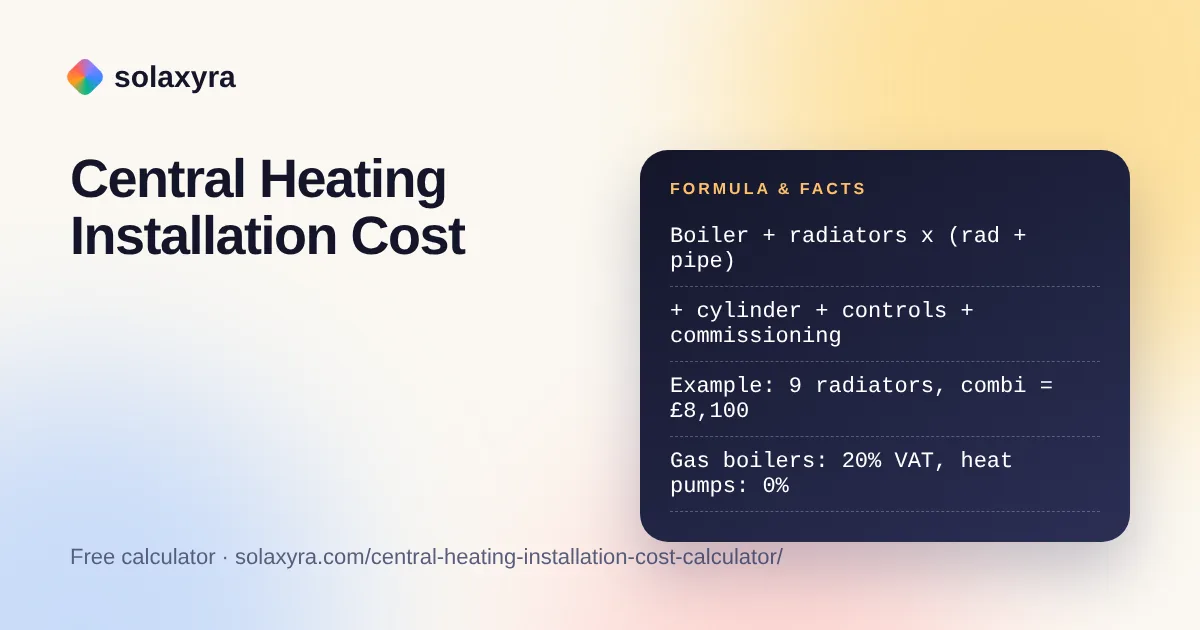
Quick answer: A central heating installation cost calculator adds the boiler, radiators, pipework, cylinder, controls and commissioning. With this page’s example prices, a combi system with 9 radiators comes to £8,100 including VAT. The Energy Saving Trust puts a straightforward gas boiler swap with thermostatic radiator valves at about £3,700, so new radiators and pipework drive most of the difference.
What Is a Central Heating Installation Cost Calculator?
A central heating installation cost calculator is a tool that adds up the separate parts of a new heating system so you can see what a total price is made of. In plain words: total cost equals the boiler, plus the number of radiators times the price of each fitted radiator, plus the number of radiators times the pipework cost per radiator, plus a cylinder if you need stored hot water, plus controls, commissioning and extras, then any local adjustment and VAT.
No official body publishes a national price list for a full system, so every price in the tool is an editable example labelled as such. Replace each one with the figures on your written quotes. The calculator then shows which parts carry the cost, which is far more useful than a single average from a quote website.
How Do You Use the Central Heating Installation Cost Calculator?
- Choose a combi boiler, which heats water on demand, or a system or regular boiler that needs a hot water cylinder.
- Enter the boiler price from your quote, supplied and fitted.
- Count the radiators the new system needs and enter the price of each one with its valves.
- Enter the pipework cost per radiator. Use 0 if the installer will reuse sound existing pipes.
- Add the cylinder, controls, flushing and commissioning, and any extras such as a larger gas pipe or a new flue route.
- Say whether your prices include VAT, then type the total of your quote to see the gap between quote and estimate.
The bar under the results shows how much of the total goes on radiators and pipework, which is the part that separates a full new system from a boiler swap.

How Much Does a New Central Heating System Cost?
There is no official national figure for a complete new system; the closest primary benchmark is the Energy Saving Trust boiler advice, which says a straightforward gas boiler replacement plus thermostatic radiator valves typically costs about £3,700, and an oil boiler replacement about £5,500. That page was last updated on 3 January 2024, so treat the figure as a reference point, not today’s price.
A full installation in a home without wet heating adds every radiator, every metre of pipe and often a cylinder, so the total rises with the number of rooms. The table uses the central heating installation cost calculator’s example prices: boiler £2,500, each radiator £250, pipework £300 per radiator, cylinder £1,200, controls £250 and commissioning £400. They show how the total scales, not what a particular installer will charge.
| Radiators | Typical home (example) | Combi system | With hot water cylinder |
|---|---|---|---|
| 5 | 1-bedroom flat | £5,900 | £7,100 |
| 7 | 2-bedroom house | £7,000 | £8,200 |
| 9 | 3-bedroom semi | £8,100 | £9,300 |
| 12 | 4-bedroom detached | £9,750 | £10,950 |
Each extra radiator adds £550 at these example prices, so radiator count matters more than boiler brand once you go beyond a simple swap. To size each radiator properly, work out the room’s needs with the room heat loss calculator and then the radiator size calculator.
What Drives the Price of a Central Heating Installation?
Labour time drives most of the price, and labour time depends on how much pipe has to be run and how many floors must be lifted. The main factors are:
- Number of radiators and their size, set by each room’s heat loss.
- Pipe routes: under suspended timber floors is quicker than through solid concrete floors.
- Boiler type and position: moving a boiler means a new flue and longer gas and condensate pipes.
- Hot water: a combi needs no cylinder, while a system or regular boiler needs one, plus space for it.
- Gas supply: a new boiler may need a larger gas pipe from the meter.
- Controls: a basic programmer and room thermostat cost far less than multi-zone smart controls.
- Making good: lifting carpets, boards and plaster, then repairing them afterwards.
Boiler output should come from the home’s heat loss and hot water needs rather than a guess; the boiler size calculator shows the method.
Is VAT Charged on a New Central Heating System?
Yes, a gas boiler central heating installation is normally charged at the standard 20% VAT rate in the UK. HMRC’s VAT Notice 708/6 on energy-saving materials and heating equipment lists energy-efficient boilers among products that are standard-rated unless grant-funded.
The same notice zero-rates the installation of heat pumps and wood-fuelled boilers from 1 May 2023 to 31 March 2027, after which the rate returns to 5%. A reduced 5% rate can apply to grant-funded heating installed for a qualifying person aged 60 or over or receiving certain benefits, but only on the grant-funded part. Ask installers to show VAT as a separate line, then set the VAT switch in the central heating installation cost calculator to match, so the comparison is fair.
Who Can Legally Install Central Heating?
Any work on a gas boiler, gas pipe or flue must be done by a Gas Safe registered engineer; the Health and Safety Executive states that anyone doing gas work in a home must be Gas Safe registered and competent in that type of work. Check the engineer’s ID card before work starts.
Plumbing parts such as radiators and pipework do not carry the same legal restriction, but a new boiler connects to the gas supply and the electrics, so a mixed DIY job still needs a registered engineer to fit and commission the boiler. Any new electrical circuit, for example for a cylinder immersion heater, must be installed by a qualified electrician to BS 7671. Oil systems are a separate trade with their own competent person schemes.
How Do You Check a Central Heating Quote?
Ask for an itemised quote, enter each line in the central heating installation cost calculator, and compare the result with the quoted total. A gap of a few percent is normal rounding; a gap of 20% or more means a line is missing, extra work has been included, or the price is high.
- Check the radiator count matches the rooms you expect to heat.
- Confirm whether pipework is new or reused, and whether floors are lifted and made good.
- Look for a system flush, inhibitor and filter, which protect the new boiler.
- Check the quote states the boiler model, its warranty and who registers it.
- Confirm whether VAT is included.
Once installed, running costs depend on your gas or electricity use; the energy consumption calculator helps you track it, and the heat pump running cost calculator compares a heat pump with gas if you are weighing up both.
Worked Example: Checking a Quote for a 3-Bedroom Semi
Example: a 3-bedroom semi with no existing wet heating receives a quote of £9,000 including VAT for a combi boiler and 9 radiators. Entering the example prices in the central heating installation cost calculator gives:
- Boiler: £2,500.
- Radiators: 9 x £250 = £2,250.
- Pipework: 9 x £300 = £2,700.
- Controls £250, commissioning £400, no extras, no cylinder.
- Total: 2,500 + 2,250 + 2,700 + 250 + 400 = £8,100, or £900 per radiator.
- Quote check: £9,000 minus £8,100 = £900 above the estimate, about 11%.
An 11% gap is worth a question, not a refusal. If the quote turns out to include a system boiler with a cylinder, switching the tool to the cylinder option gives £9,300, and the same quote is then £300 below the estimate.
Frequently Asked Questions
How much does it cost to install central heating from scratch?
It depends mainly on the number of radiators and how much new pipework is needed. With this page’s example prices, a combi system ranges from £5,900 for 5 radiators to £9,750 for 12. Replace each example with figures from written quotes for your home.
Is a boiler swap cheaper than a full central heating system?
Yes. A swap reuses the radiators and pipework. The Energy Saving Trust puts a straightforward gas boiler replacement plus thermostatic radiator valves at about £3,700, on a page last updated in January 2024. A full system adds every radiator, pipe run and the work of making good.
Do I pay VAT on a new central heating system?
Usually yes, at 20%. HMRC Notice 708/6 treats energy-efficient boilers as standard-rated unless the work is grant-funded for a qualifying person. Heat pump installations are zero-rated until 31 March 2027, then 5%. Check whether each quote includes VAT before comparing.
Who is allowed to fit a gas central heating boiler?
Only a Gas Safe registered engineer who is competent in that type of gas work. The Health and Safety Executive advises checking the engineer’s Gas Safe ID card before any work begins. New electrical circuits need a qualified electrician working to BS 7671.
How many radiators does a house need?
Most homes need one radiator per heated room, plus the hall and landing, and large rooms may need two. The right size for each comes from that room’s heat loss in watts, not from the room count, so work that out before accepting a quote.
How accurate is this central heating installation cost calculator?
It is only as accurate as the prices you enter. The defaults are labelled examples, not market averages. Its value is in showing which parts make up a total and how far a quote sits from the sum of its own lines, so ask installers for itemised prices.
Checked October 2026 by the Solaxyra Editorial Team. Sources: Energy Saving Trust: Boilers, HMRC VAT Notice 708/6 (gov.uk), HSE: Domestic gas safety FAQs.