Category: Plug-in & Balcony Solar Guides

  • Balcony Solar Rules in Germany: Limits, Registration and Rights

    Balcony Solar Rules in Germany: Limits, Registration and Rights

    This guide sets out the balcony solar Germany rules that apply in 2026 for anyone fitting a Balkonkraftwerk (in law, a Steckersolargerät): the power limits, registration, plug and meter rules, and the rights of tenants and flat owners. It is written in English for residents of Germany, and for UK and Irish readers comparing the German model with the plug-in solar rules that started in Great Britain in August 2026.

    Quick answer: Under the balcony solar Germany rules, a system may have up to 800 VA of inverter output and 2,000 Wp of panels per grid connection. Register it in the Marktstammdatenregister within one month; the grid operator is informed automatically. Kits up to 960 Wp may use a Schuko plug, and tenants have a legal right to request one.
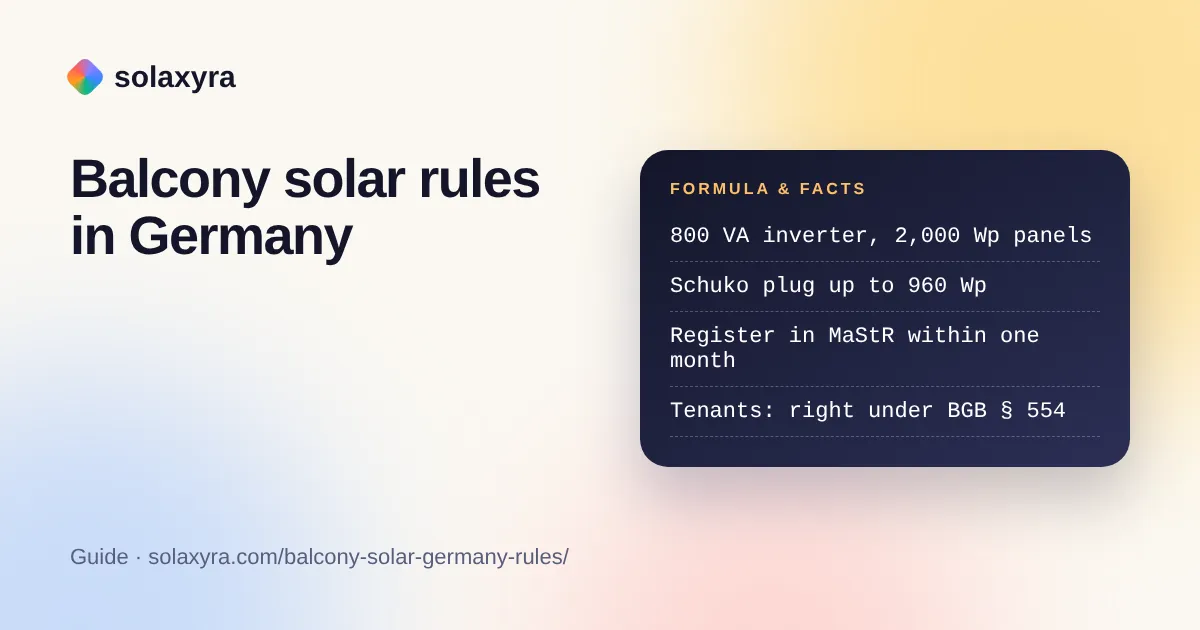
    Balcony solar Germany rules: 800 VA limit, MaStR registration, Schuko plug up to 960 Wp

    What Are the Power Limits for Balcony Solar in Germany?

    A German balcony solar system may feed in no more than 800 VA through its inverter and carry no more than 2,000 W of panels, and both limits are totals for all plug-in devices behind the same grid connection point. The Bundesnetzagentur balcony solar page states the limits and dates the simplified rules from 16 May 2024, when the Solarpaket amendments to the Renewable Energy Sources Act (EEG) took effect.

    Because the limit is cumulative, two small kits on one flat count together. Two 400 VA inverters are fine; two 800 VA inverters behind one meter are not. A system above these limits is treated as a normal solar installation, with the full connection process that involves the grid operator and an installer.

    The 2,000 W panel allowance exists because panels rarely deliver their rated power on a vertical railing or in winter. Extra panel area keeps the inverter closer to its 800 VA output for more of the day. To see what a given panel size and mounting angle produce, the balcony solar calculator includes Germany as a country option.

    How Do You Register a Balkonkraftwerk?

    You register a balcony solar system in the Marktstammdatenregister (MaStR), the Bundesnetzagentur’s register of energy installations, within one month of putting it into operation. Since 2024 this single entry replaces a separate notice to the local grid operator, which receives the location and technical data automatically from the register.

    The register’s own help guide for balcony systems asks for only a few items about the device: the commissioning date, total module power, inverter power and your meter number, together with your location and a name for the unit. Registration is done online in two stages: create a user account, then register yourself as operator and add the system.

    1. Create a user account on the Marktstammdatenregister website and confirm your email address.
    2. Register yourself as the operator of the installation.
    3. Choose the balcony solar option and enter the commissioning date, module watts, inverter VA and meter number.
    4. Download and keep the registration confirmation.

    Which Plug and Socket Can You Use in Germany?

    Since the DIN VDE V 0126-95 product standard was published in December 2025, a balcony solar device with up to 960 Wp of panels may connect through a normal household Schuko socket, while a system with up to 2,000 Wp needs a special energy socket. That is the position set out by VDE FNN, the grid technology forum of the German electrical standards body.

    Panel power (Wp)Inverter outputConnection allowedWho connects it
    Up to 960 WpUp to 800 VAHousehold Schuko socket, with a device built to DIN VDE V 0126-95 (protected plug or internal disconnection)The user, following the manufacturer’s instructions
    961 to 2,000 WpUp to 800 VASpecial energy socket (often called a Wieland socket) or fixed connectionThe socket and circuit work is for a qualified electrician
    Above 2,000 Wp or above 800 VAAnyNot a balcony solar device; normal PV connection processInstaller and grid operator

    VDE FNN recommends the energy socket as the safe option whenever the conditions for a household socket cannot be met, and says an electrician should check that the existing circuit is adequately rated and protected. Never use a multi-way adaptor or join devices together to get round the limits, and do not alter sockets or wiring yourself.

    Do You Need a New Electricity Meter?

    Yes, a bidirectional meter is required, but you do not have to wait for it: the Bundesnetzagentur says an older meter that runs backwards may be tolerated temporarily until the replacement is made. Under § 10a EEG the meter operator must replace it without undue delay, and you do not need to ask separately because registration in the MaStR triggers the process.

    Electricity you feed into the grid is unpaid by default. The Bundesnetzagentur assigns balcony solar to free feed-in (unentgeltliche Abnahme), so the value of a system comes from the power you use at home while it generates. The self-consumption calculator shows how daytime habits change that share.

    Can Tenants and Flat Owners Install Balcony Solar in Germany?

    Yes, since October 2024 tenants and condominium owners have a legal claim to install a balcony solar device, because plug-in solar was added to the privileged structural changes in § 554 of the Civil Code (BGB) for tenants and § 20 of the Condominium Act (WEG) for owners. The Bundestag voted the change through on 4 July 2024.

    The claim is not unconditional. A landlord may refuse where the measure cannot reasonably be expected of them, and landlords and owners’ associations keep a say over how the system is installed, for example the position and fixing on the facade. Ask in writing, describe the device and its mounting, and keep the reply.

    How Do Germany’s Rules Compare With the UK?

    The two systems share the 800 W output cap and the 2,000 W panel allowance, but the UK adds stricter rules on devices per home, extension leads and mounting surfaces. The UK rules took effect on 27 August 2026 under SI 2026/848 and the government’s interim product specification, which names the German product standard DIN VDE V 0126-95 as its main technical reference.

    RuleGermanyGreat Britain
    In force since16 May 2024 (EEG Solarpaket limits)27 August 2026
    Inverter output800 VA800 VA
    Panel power2,000 Wp (960 Wp on a Schuko socket)2,000 W (professional assessment advised above 960 W)
    Number of devicesSeveral allowed if the totals stay within the limits per connection pointOne device per household
    PlugSchuko or special energy socketMoulded BS 1363 plug with a fuse of 5 A or less
    RegistrationMarktstammdatenregister within one monthOnline registration; householder notifies the network operator
    TenantsLegal claim under BGB § 554Landlord permission needed
    Feed-in paymentNone by default (free feed-in)Normally none (MCS needed for the Smart Export Guarantee)
    BatteryOutside the simple balcony rulesNot allowed with a plug-in device

    The UK government’s announcement noted that around half a million new devices were plugged in in Germany last year, and described the UK safety specification as more stringent than Germany’s. For the full British position, see our guide to the plug-in solar rules in the UK, and for output and payback figures with UK or German yields, use the plug-in solar calculator.

    What About Batteries?

    A balcony solar device with built-in battery storage falls outside the simple rules described here: DIN VDE V 0126-95 covers devices without storage, and the consumer advice centres (Verbraucherzentrale) say kits with integrated storage still need installation by a qualified electrician and notification to the grid operator. Treat any home battery as fixed electrical equipment and have it fitted and checked by a qualified electrician.

    Frequently Asked Questions

    Is 800 W the maximum for balcony solar in Germany?

    Yes. The inverter may feed in no more than 800 VA, and all plug-in devices behind one grid connection point count together. The panels may total up to 2,000 Wp, so a kit can produce close to 800 VA for more hours of the day.

    Do I have to tell the grid operator about my Balkonkraftwerk?

    Not separately. Since 2024 registering the system in the Marktstammdatenregister within one month of commissioning is enough, and the Bundesnetzagentur says the grid operator receives the location and technical data automatically.

    Can I plug a balcony solar system into a normal socket in Germany?

    Yes, for devices with up to 960 Wp of panels built to the DIN VDE V 0126-95 product standard from December 2025. Systems with up to 2,000 Wp need a special energy socket, and that socket and circuit work should be done by a qualified electrician.

    Can my landlord stop me installing balcony solar in Germany?

    Only in limited cases. Since October 2024 § 554 BGB gives tenants a claim to approval for plug-in solar, but a landlord may refuse where it cannot reasonably be expected of them and can set conditions on how the system is installed.

    Will an old electricity meter be a problem?

    No. The Bundesnetzagentur says an older meter that runs backwards may be tolerated temporarily. After you register, the meter operator must fit a bidirectional meter without undue delay, and you do not need to request it separately.

    Checked October 2026 by the Solaxyra Editorial Team. Sources: Bundesnetzagentur: Balkon-Solaranlagen, Marktstammdatenregister registration guide for balcony systems, VDE FNN: plug-in PV systems, VDE FNN: what is now possible, Deutscher Bundestag, 4 July 2024, Verbraucherzentrale: laws and standards for plug-in solar, GOV.UK plug-in solar announcement, DESNZ interim product specification.
  • Plug-In Solar for Renters: Permission, Rules and Moving

    Plug-In Solar for Renters: Permission, Rules and Moving

    This guide explains how tenants in England, Scotland and Wales can use plug-in solar legally: whose permission you need, where you can and cannot fit a kit, how to ask your landlord, and what happens when you move. Plug in solar for renters became a realistic option on 27 August 2026, when 800 W kits that plug into a normal socket became legal in Great Britain.

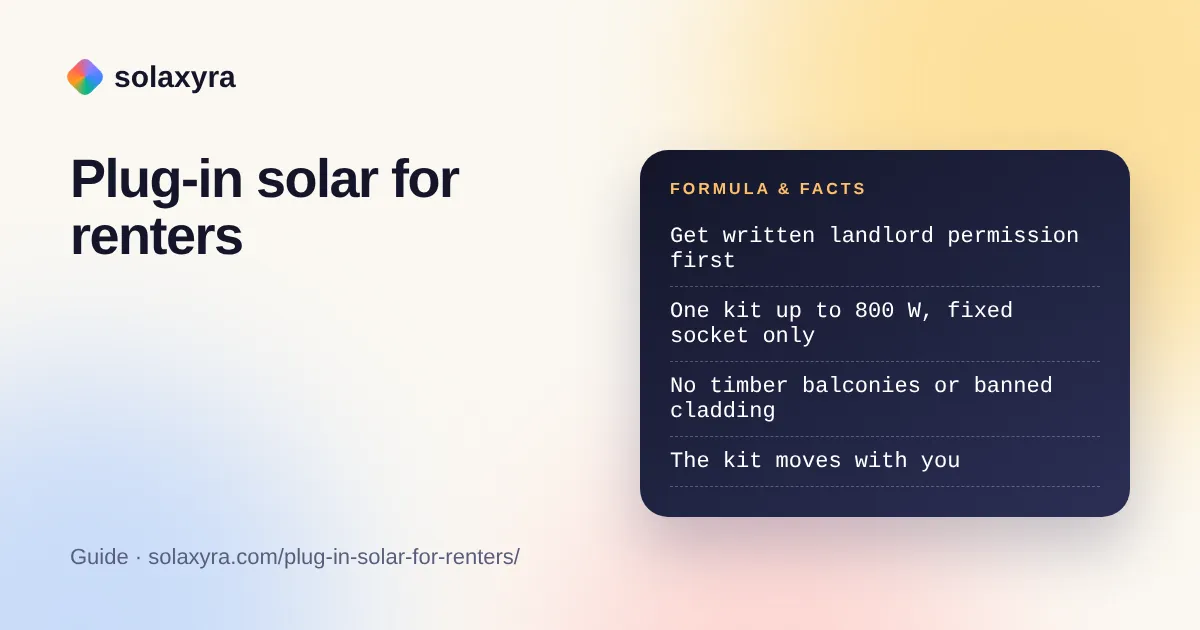
    Quick answer: Plug in solar for renters is allowed in Great Britain, but you must get permission from your landlord, freeholder or managing agent first. The kit must be up to 800 W, plug straight into a fixed socket, be registered and avoid banned spots such as timber balconies. You can take it with you when you move.

    Plug in solar for renters: landlord permission, allowed homes and moving out checklist

    Can Renters Use Plug-In Solar in the UK?

    Yes, renters in Great Britain can use one plug-in solar device of up to 800 W, provided they have permission from whoever is responsible for the building. In its July 2026 consultation response, the government said renters, leaseholders and residents in managed buildings should obtain any permissions that may be required before installing a device, and its interim product specification makes the user responsible for getting consent from the property owner, landlord, freeholder, managing agent or relevant authority.

    The same response recognised why the change matters to tenants: people in rented homes, flats and properties without suitable roof space usually cannot fit rooftop solar because they do not control the roof. It also recorded concerns from respondents that landlord opposition and uncertainty about insurance could hold renters back.

    Plug-in solar is not currently legal in Northern Ireland, so tenants there cannot use it yet.

    Do You Need Your Landlord’s Permission?

    Yes, you should get written permission before you buy, because the government guidance, the product specification and the Energy Saving Trust all say to get consent from whoever is responsible for the building. A kit fixed to a wall, railing, fence or flat roof is attached to property you do not own, and your tenancy agreement may also restrict alterations, so a written yes protects you if there is a dispute later or when your deposit is returned.

    Planning can also apply. The Energy Saving Trust checklist tells you to check the Planning Portal in England and Wales or ePlanning Scotland, and to ask the local authority if the building is listed or in a conservation area. Your landlord may already know the answer.

    How Do You Ask Your Landlord for Permission?

    A short written request that answers the landlord’s likely worries in advance gets the quickest yes. Include these points:

    1. The exact make and model, and confirmation that it is listed on the ENA type test register required for plug-in devices.
    2. Where it will go and how it is fixed, using the manufacturer’s frame. Mention that the rules require any fixing to be reversible and non-permanent, and that ropes, cable ties, tape and straps are not allowed as the only fixing.
    3. Which socket it will use: a fixed socket, with no extension lead or adaptor, on a circuit with RCD or RCBO protection.
    4. That you will register the device as required and that only one device will be used.
    5. Who pays for any electrical check and that you will remove the kit and make good any fixing holes when you leave.
    6. That you will tell your contents insurer, and ask the landlord to check whether the buildings insurer needs to know.

    Keep the reply with your tenancy papers. If the landlord refuses or attaches conditions, ask what would change their mind; a freestanding ground frame in a garden involves no fixings to the building at all.

    Which Rented Homes Suit Plug-In Solar?

    Houses with a garden or yard suit plug-in solar best, while some flats are ruled out by the mounting rules regardless of what the landlord says. The table summarises the main situations, based on the government product specification and Energy Saving Trust guidance.

    Rented homeUsually possible?What to check
    House with a garden or yardYes, with permissionA freestanding frame and a suitable socket; an outdoor socket must be fitted by a qualified electrician and be at least IP65
    Flat with a masonry or metal balconyPossiblyLandlord and freeholder consent, the building’s fire safety rules and a manufacturer mount suited to your railing
    Flat with a timber balconyNoThe specification bans installation on timber balconies
    Building with ACM, MCM, HPL or timber claddingNoThe specification bans installation on these cladding systems
    Building under external wall or building safety remediationNoExcluded by the specification until restrictions are lifted
    Shared house where another tenant already has a kitNoOnly one plug-in device is allowed per household
    Home with an old fuse board and no RCD or RCBOOnly after an electrical checkA registered electrician must check and, where needed, upgrade the installation to BS 7671; this needs the landlord’s agreement

    Fire safety in flats was raised by many consultation respondents, who said balconies and walls of multi-occupancy and high-rise buildings carry greater risk. Expect landlords and managing agents of blocks to be cautious, and do not install on a balcony without clear written consent from the building owner.

    What Electrical Rules Apply in a Rented Home?

    The kit must plug directly into a fixed BS 1363 socket on a circuit protected by an RCD or RCBO, and never into an extension lead or multi-way adaptor. The Energy Saving Trust adds that the socket should not also control lighting or a hardwired appliance such as a boiler or cooker.

    In a rented home the electrical installation belongs to the landlord, so any work on it, including a new outdoor socket or an upgrade from an old fuse board, needs their agreement and must be done by a registered electrician to BS 7671. Do not change sockets, fuses or wiring yourself. The specification also requires a label to be fixed at or near the consumer unit showing that a plug-in solar device is present, which helps anyone working on the electrics later.

    You cannot add a battery. The legal definition of a plug-in microgenerator excludes devices that store energy, and every kit must warn that it is not for use with a battery storage system. Portable power stations charged from their own panels are a separate product and are not connected to your home wiring.

    Is Plug-In Solar Worth It If You Might Move?

    Yes, often, because the kit moves with you: the Energy Saving Trust notes that plug-in panels are portable and can be taken when you move home. The money you save while you live in one place is a bonus on top of a kit you still own.

    The table shows savings over the time left in a tenancy, using the Energy Saving Trust estimate of about 700 kWh a year and the Ofgem price cap rate of 26.32p per kWh for 1 October to 31 December 2026. The share used at home is an example; change it to match your daytime habits.

    Share of output used at home (example)Yearly savingSaving over 1 yearSaving over 3 yearsSaving over 5 years
    40% (out during the day)£74£74£221£368
    50%£92£92£276£461
    60% (home most of the day)£111£111£332£553

    These figures assume the same rate each year; the cap changes every quarter, and the 26.32p rate excludes VAT only until 31 March 2027. Your output will also change at a new address with a different direction or more shade. To test a specific spot before you buy, use the plug-in solar calculator, and if your only space is a balcony the balcony solar output calculator compares railing and angled mounts.

    What Should Renters Do When They Move Out?

    Unplug the kit, remove it and its fixings, and tell the network operator it has been disconnected, since the rules require notification of both connection and disconnection.

    1. Switch off and unplug the device from the socket before dismantling the panels.
    2. Remove the mounting frame and make good any marks, as agreed in your permission letter.
    3. Update the plug-in solar registration to record the disconnection.
    4. Leave the consumer unit label in place only if the landlord asks; otherwise remove it so the next occupant is not misled.
    5. At your new home, get fresh permission, check the socket and circuit, and register the device at the new address.

    Frequently Asked Questions

    Can my landlord refuse plug-in solar?

    Yes. The government says renters should obtain any permissions that may be required before installing, and landlords, freeholders and managing agents can refuse or set conditions. A freestanding ground frame with no fixings, and an offer to pay for any electrical check, can make agreement easier.

    Can I use plug-in solar in a rented flat?

    Sometimes. You need consent from the landlord and often the freeholder or managing agent, and the kit must not go on a timber balcony, on ACM, MCM, HPL or timber cladding, or on a building under safety remediation. A masonry or metal balcony with a suitable mount may be possible.

    Can I take plug-in solar panels with me when I move?

    Yes. The Energy Saving Trust says plug-in panels are portable and can be taken when you move. Record the disconnection on the registration, remove all fixings, then get permission and register the device again at your new home before plugging it in.

    Who pays for electrical work needed for plug-in solar in a rented home?

    That is for you and your landlord to agree in writing. Any work such as a new outdoor socket or replacing an old fuse board must be done by a registered electrician to BS 7671, and the landlord must agree because the installation belongs to them.

    Can renters add a battery to plug-in solar?

    No. UK law defines a plug-in microgenerator as a device that does not store energy, and the government specification says it must not be connected to or used with a battery storage system. This applies to tenants and owners alike.

    Checked October 2026 by the Solaxyra Editorial Team. Sources: DESNZ plug-in solar government response, July 2026, DESNZ Plug-in Solar Device Interim Product Specification, SI 2026/848, Energy Saving Trust: plug-in solar panels, Energy Saving Trust: plug-in solar checklist, Ofgem price cap October to December 2026.

  • Are Plug-In Solar Panels Worth It? UK Savings and Payback

    Are Plug-In Solar Panels Worth It? UK Savings and Payback

    This guide shows UK households how to judge whether a plug-in solar kit pays for itself, using official output and price figures and a payback table you can read off for your own situation. If you are asking are plug in solar panels worth it, the honest answer depends on one number more than any other: how much of the electricity you use at the moment the panels produce it.

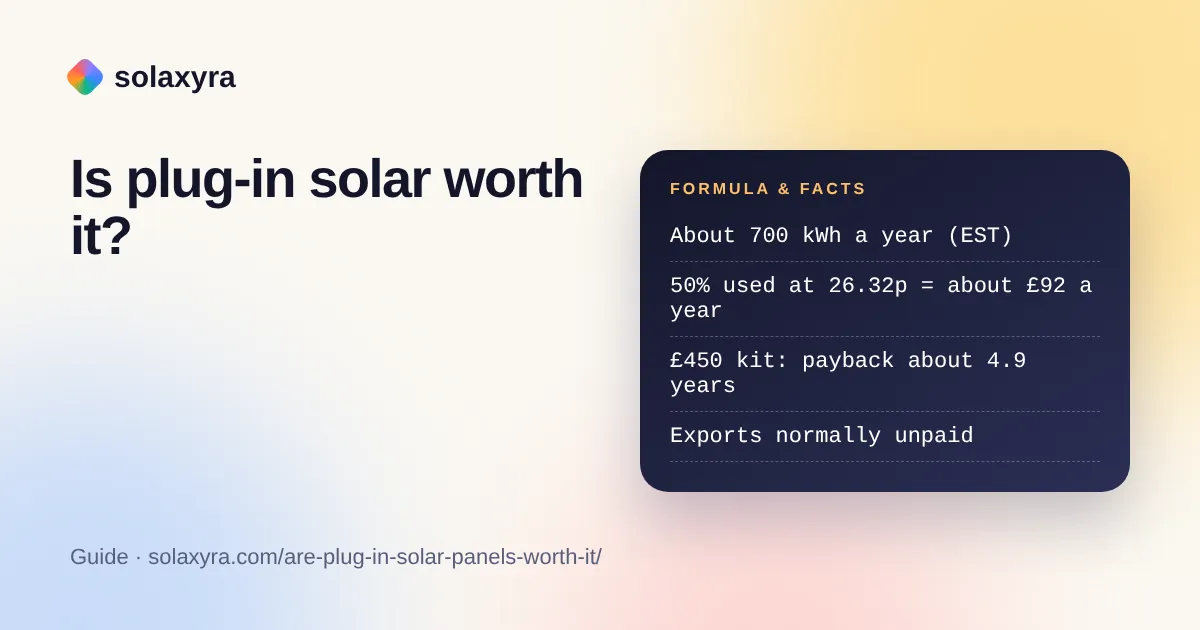
    Quick answer: Are plug in solar panels worth it? Often yes, if you use much of the power as it is generated. The Energy Saving Trust estimates about 700 kWh a year from a typical kit. At 26.32p per kWh, using half of that saves about £92 a year, so a £450 kit pays back in roughly five years.

    Are plug in solar panels worth it: UK payback by kit price and share of power used at home

    How Much Does a Plug-In Solar Kit Save a Year?

    A typical plug-in kit saves about £70 to £110 a year in the UK, depending mainly on whether someone is at home using power during daylight. The Energy Saving Trust puts typical output at around 700 kWh a year and estimates savings of £100 a year for a household at home all day and £70 for one out during the day, while the government announcement quotes savings of up to £110 a year.

    Those Energy Saving Trust figures were worked out at 24.7p per kWh. From 1 October to 31 December 2026 the Ofgem price cap unit rate for electricity paid by direct debit is 26.32p per kWh, so the same kWh are now worth a little more. Working backwards from the published figures also reveals the hidden assumption about self-consumption:

    Energy Saving Trust casePublished saving at 24.7pkWh used at home (saving divided by 24.7p)Share of 700 kWh used at homeSame kWh valued at 26.32p
    At home during the day£100about 405 kWhabout 58%about £107
    Out during the day£70about 283 kWhabout 40%about £75

    In other words, even a household that is home all day is assumed to use a little under three fifths of what the panels make. The rest flows out to the grid.

    Why Does Self-Consumption Decide Whether It Is Worth It?

    Self-consumption decides the answer because each kWh you use yourself saves the full unit rate, while a kWh you export earns nothing in most cases. The Energy Saving Trust says an MCS certificate is needed to sell electricity under the Smart Export Guarantee, and plug-in kits do not normally have one, so surplus power is given to the grid for free.

    A kit can deliver up to 800 W at midday on a clear day. Your home only absorbs that if something is drawing power at the same moment. The always-on load of a home, often called the baseload, comes from fridges, freezers, routers and devices on standby. Example: if your baseload is 150 W (an example value, check yours on a smart meter display), a kit producing 600 W at noon covers that 150 W and sends the other 450 W to the grid unless you run a washing machine, dishwasher or other appliance at the same time.

    Ways to raise your share without breaking the rules:

    • run timed appliances such as the dishwasher and washing machine in the middle of the day;
    • charge laptops, tools and e-bikes in daylight;
    • face the panels east or west if you use more power in the morning or evening, accepting a lower total;
    • avoid shading, since a shaded kit produces less of the power you could have used.

    You cannot add a battery to store the surplus: the UK rules say a plug-in device must not be used with a battery storage system.

    How Long Does Plug-In Solar Take to Pay Back?

    Payback can fall anywhere between about 3 and 18 years, and the table shows why the range is so wide. It uses 700 kWh a year from the Energy Saving Trust, the October 2026 cap rate of 26.32p per kWh and three example kit prices; the Energy Saving Trust says complete kits start from around £450. Payback here is simply kit price divided by yearly saving, with no export income.

    Share used at homekWh used a yearYearly savingPayback, £450 kit (example)Payback, £700 kit (example)Payback, £1,000 kit (example)
    30%210£558.1 years12.7 years18.1 years
    40%280£746.1 years9.5 years13.6 years
    50%350£924.9 years7.6 years10.9 years
    60%420£1114.1 years6.3 years9.0 years
    70%490£1293.5 years5.4 years7.8 years
    80%560£1473.1 years4.7 years6.8 years

    Two cautions apply. First, the 26.32p rate excludes VAT, which Ofgem confirms has been removed from electricity bills only from 1 October 2026 to 31 March 2027, and the cap is reset each quarter, so re-run the sum when your rate changes. Second, 700 kWh is an average: a vertical railing mount, a north-east aspect or heavy shading produces less, while oversized panels behind the 800 W inverter can produce more. For your own location, angle and tariff, the plug-in solar calculator works out kWh, savings and payback in one step, and the solar payback calculator adds price rises over time.

    How Many kWh Must You Use for a Kit to Pay Off?

    A £450 kit pays back in 5 years if you use about 342 kWh a year of its output yourself, roughly half of a typical 700 kWh. The rule is: kWh needed each year equals kit price divided by the payback years you want, divided by your unit rate in pounds. The table applies it at 26.32p.

    Kit price (example)kWh you must use a year for 5-year paybackShare of 700 kWhkWh you must use a year for 10-year paybackShare of 700 kWh
    £45034249%17124%
    £70053276%26638%
    £1,000760more than 100%38054%

    A £1,000 kit cannot reach a five-year payback on 700 kWh at today’s rate, whatever your habits. That is the clearest sign of when a kit is not worth it: if the price is high and your daytime use is low, the numbers rarely work. To estimate your daytime share before buying, the self-consumption calculator helps you test different habits.

    Is Plug-In Solar Better Value Than Rooftop Solar?

    Plug-in solar costs far less but saves far less: the Energy Saving Trust gives around £450 for a kit against an average of around £7,600 for a rooftop system, and the government says rooftop solar can save up to £480 a year compared with up to £110 for plug-in. Rooftop systems are also fitted by certified installers, can usually earn Smart Export Guarantee payments and can be paired with a home battery.

    FactorPlug-in solar kitRooftop solar PV
    Typical cost (Energy Saving Trust)From around £450Around £7,600 on average
    Yearly saving (government figures)Up to £110Up to £480
    Export paymentsNormally none (no MCS certificate)Usually possible under the Smart Export Guarantee
    BatteryNot allowedAllowed
    InstallationSelf-install into a fixed socketCertified installer, electrical work to BS 7671
    Moving homeCan be taken with youStays with the property

    For a renter, a flat owner without roof access or someone who may move, plug-in solar is often the only realistic way to generate power. For an owner-occupier with a suitable roof who plans to stay, a rooftop system usually saves more in total.

    Who Should Not Buy Plug-In Solar?

    Plug-in solar is a poor fit if your only space faces north or is heavily shaded, if nobody uses power in daylight, or if the rules rule you out. Before buying, check these points:

    • You live in Northern Ireland, where the Energy Saving Trust says plug-in solar is not currently legal.
    • You already have a plug-in device; only one is allowed per household.
    • You want to store power in a battery, which the rules forbid for plug-in kits.
    • Your only mounting option is a timber balcony or certain cladding types, which the government specification excludes.
    • Your landlord, freeholder or managing agent will not give permission.
    • Your home has an old fuse board without RCD or RCBO protection and you are not willing to pay a registered electrician to check or upgrade it to BS 7671.

    How Do You Decide If a Kit Is Worth It for Your Home?

    Four checks, done in order, give a reliable answer in a few minutes.

    1. Confirm you are allowed: Great Britain, one device, permission from the building owner, a fixed socket on a protected circuit.
    2. Estimate output for your spot. Start from about 700 kWh and lower it for vertical, east, west or shaded positions, or use the calculator.
    3. Estimate your daytime share. Look at your smart meter’s daytime readings or use 40% if you are out at work and about 58% if someone is home, the shares implied by the Energy Saving Trust figures.
    4. Divide the kit price by kWh used times your unit rate. If the answer is longer than you are willing to wait, keep looking for a cheaper kit or a better spot.

    Frequently Asked Questions

    How much do plug-in solar panels save in the UK?

    The Energy Saving Trust estimates about £100 a year for a household at home during the day and £70 for one out at work, at 24.7p per kWh. At the October 2026 cap rate of 26.32p, the same use is worth about £107 and £75.

    How long do plug-in solar panels take to pay for themselves?

    Divide the kit price by your yearly saving. A £450 kit that saves £92 a year pays back in about 4.9 years. If you use only 30% of the output, payback stretches past 8 years, and a £1,000 kit can take over 18 years.

    Can I sell the electricity my plug-in solar panels export?

    Usually not. The Energy Saving Trust says you need an MCS certificate to be paid under the Smart Export Guarantee, and plug-in kits do not normally have one. Treat exported power as unpaid when you work out whether a kit is worth buying.

    Would a battery make plug-in solar more worth it?

    A battery would let you store surplus daytime power, but the UK rules do not allow it. The government specification says a plug-in solar device must not be connected to or used with a battery storage system, so savings depend on using power as it is made.

    Are plug-in solar panels worth it for renters?

    Often, because renters rarely have another way to generate power and the kit can move with them. You need written permission from your landlord or freeholder first, and the payback maths is the same: the more daytime electricity you use, the faster it pays back.

    Checked October 2026 by the Solaxyra Editorial Team. Sources: Energy Saving Trust: plug-in solar panels, GOV.UK: plug-in solar panels come to market, Ofgem price cap October to December 2026, DESNZ Plug-in Solar Device Interim Product Specification.

  • Plug-In Solar Rules in the UK: What the Law Allows

    Plug-In Solar Rules in the UK: What the Law Allows

    This guide explains the plug in solar rules UK households must follow in England, Scotland and Wales: what the law allows, which document sets each limit, what you must check before buying, and where the rules stop. It is written for homeowners, tenants and flat owners who want to plug a small solar kit into a socket legally and safely.

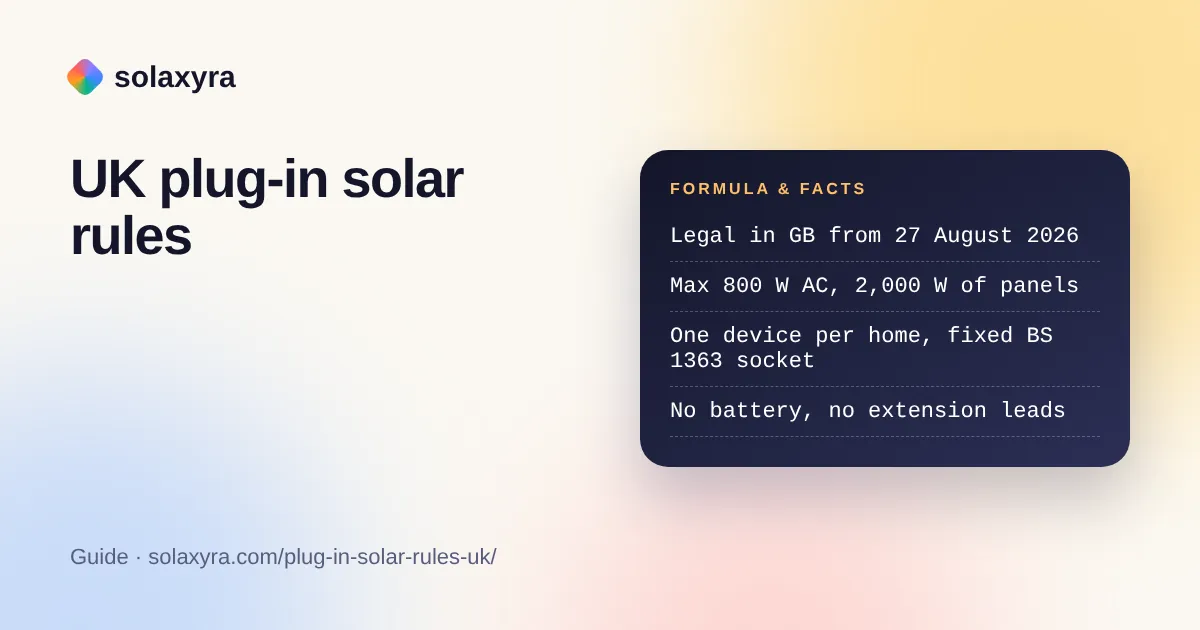
    Quick answer: The plug in solar rules UK households follow took effect on 27 August 2026. In Great Britain you may use one plug-in solar device of up to 800 W AC, with no more than 2,000 W of panels, plugged into a fixed BS 1363 socket. It must be ENA-registered, registered online, and never used with a battery.

    Plug in solar rules UK summary: 800 W AC limit, 2,000 W panel limit, one device per household

    When Did Plug-In Solar Become Legal in the UK?

    Plug-in solar became legal in Great Britain on 27 August 2026, when SI 2026/848 came into force after being made on 16 July 2026. Its full title is the Plugs and Sockets etc. (Safety) Regulations 1994 and Electricity Safety, Quality and Continuity Regulations 2002 (Amendment) Regulations 2026, and you can read it on legislation.gov.uk.

    The instrument does two things. First, it lets approved bodies certify a plug for a solar microgenerator that otherwise follows BS 1363, which the 1994 plug rules previously blocked. Second, it amends the 2002 supply regulations so that a plug-in microgenerator is acceptable when it complies with the government’s Plug-in Solar Device Interim Product Specification. The law defines a plug-in microgenerator as a device that turns sunlight into electricity, has a rated AC output of no more than 800 watts, connects through a standard plug and socket, runs in parallel with the network and does not store energy.

    Ofgem separately approved a change to Engineering Recommendation G98, the network connection standard for small generators, so that plug-in devices are treated as a distinct category limited to 800 W and one per household.

    What Are the Main Plug-In Solar Rules?

    There are seven core rules: an 800 W AC cap, a 2,000 W panel cap, a fixed BS 1363 socket, no adaptors or extension leads, one device per household, no battery, and registration so the network operator is told. The table shows each rule and the official document it comes from, so you can check it yourself.

    RuleLimit or requirementWhere it is set
    AC outputNo more than 800 VA (800 W) and 3.5 A into the homeSI 2026/848 definition; Interim Product Specification clause 4.1
    Panel sizeTotal panel rating (Pmax) no more than 2,000 WInterim Product Specification clause 4.1
    Above 960 W of panelsProfessional assessment should be consideredInterim Product Specification clause 4.1
    Plug and socketMoulded, non-rewireable BS 1363 plug with a BS 1362 fuse of 5 A or less, into a fixed socketInterim Product Specification clause 6.2.3.2
    AdaptorsNo extension cables, multi-way adaptors, RCD adaptors or travel adaptorsInterim Product Specification clauses 6.2.3.1 and 8.3.2
    Number of devicesOne plug-in solar device per householdG98 amendment approved by Ofgem; Interim Product Specification scope
    Type testingTested to G98 and listed on the ENA type test registerInterim Product Specification section 7
    BatteryMust not be connected to or used with a battery storage systemSI 2026/848 definition; Interim Product Specification clause 8.3.2
    NotificationThe householder tells the network operator about connection and disconnectionOfgem decision on DCRP/MP/26/02; Interim Product Specification clause 8.2.3.1
    PermissionsLandlord, freeholder, managing agent or planning consent where neededInterim Product Specification clause 8.3.1

    The 800 W limit applies to what the inverter delivers, not to the panels. That is why a kit can carry up to 2,000 W of panels: the extra panel area lifts output in mornings, evenings and winter, while the inverter clips anything above 800 W on bright days. To see how much an oversized kit actually adds where you live, run your numbers through the plug-in solar savings calculator.

    What Socket and Wiring Does Plug-In Solar Need?

    A plug-in solar device must go straight into a fixed BS 1363 socket on a circuit in good condition with modern residual current protection, and never into an extension lead or adaptor. The Energy Saving Trust plug-in solar checklist adds that the socket should not be one that also controls lighting or a hardwired appliance such as a boiler or cooker.

    A quick current check shows why the limits fit together. At 800 VA and a nominal 230 V, the device sends about 3.48 A into the circuit (800 divided by 230). That sits just inside the 3.5 A cap in the specification and well below the 5 A fuse required in the plug. You can repeat the sum for any inverter rating with our watts to amps converter.

    The specification tells users to check that the installation has modern RCBO protection. If your home still has an older fuse board without RCDs or RCBOs, the installation must be checked and, where necessary, upgraded by a professional electrician. Any change to the final circuit, or a new outdoor socket, is work for a registered electrician to BS 7671. The Energy Saving Trust says an outdoor socket should be rated at least IP65 and installed by a qualified electrician.

    The device must also stop feeding power when the grid goes down. The specification requires disconnection within 100 milliseconds of losing the mains, and the voltage on the plug pins must drop below 34 V in that time, so the pins are not live when you unplug the kit.

    Where Can You Mount Plug-In Solar Panels?

    You can mount a kit in a garden, on a flat roof, wall or suitable balcony, but the specification bans fixings that rely only on cable ties, rope, string, adhesive tape, bungee cords or straps. Every attachment must be reversible and non-permanent and must not harm the structure, fire performance or weatherproofing of the building.

    The specification lists surfaces where a plug-in kit must not be installed:

    • aluminium composite or metal composite cladding systems;
    • high pressure laminate cladding systems;
    • timber cladding systems;
    • timber balconies;
    • buildings subject to external wall remediation, building safety remediation or similar restrictions.

    Manufacturers must publish the full mounting system and a structural analysis covering wind and snow loads. If you plan to fix panels to a garage or outbuilding roof, the Energy Saving Trust advises checking that it can take the weight; for anything beyond a ground or wall frame, a structural engineer’s view is sensible. Facing direction also matters: east or west panels work but produce less, and the solar panel orientation calculator shows the loss for your angle.

    How Do You Install Plug-In Solar Legally?

    Installing legally comes down to five checks, done in this order, before and just after you plug in.

    1. Get permission. Ask your landlord, freeholder or managing agent in writing, and check planning on the Planning Portal (England and Wales) or ePlanning Scotland, especially for listed buildings and conservation areas.
    2. Check the product. Confirm the exact model appears on the ENA type test register and that it is sold as a complete kit with a moulded plug.
    3. Check the circuit. Find a suitable fixed socket, confirm RCD or RCBO protection at the consumer unit, and call a registered electrician if you have an old fuse board or need an outdoor socket.
    4. Mount it securely with the manufacturer’s frame, then plug directly into the socket and fix the supplied label at or near your consumer unit.
    5. Register the device. The Energy Saving Trust directs householders to the UK plug-in solar registration website, which asks for your name, postcode and the make and model. Ofgem’s decision places the duty to notify the network operator on the customer.

    The Energy Saving Trust also recommends telling your buildings and contents insurer and testing the circuit breaker protection every six months.

    Does Plug-In Solar Apply in Northern Ireland?

    No, plug-in solar is not currently legal in Northern Ireland, according to the Energy Saving Trust. SI 2026/848 changes the 2002 supply regulations only for England, Wales and Scotland, and Northern Ireland uses a separate connection standard, G98/NI. The interim specification says its application to Northern Ireland is still under consideration.

    Can You Add a Battery or Get Paid for Exports?

    No battery is allowed: the legal definition excludes devices that store energy, and every kit must carry a warning that it is not for use with a battery storage system. Ofgem’s decision notes that plug-in storage remains prohibited pending a future review.

    Payment for exported electricity is unlikely. The Energy Saving Trust says an MCS certificate is needed to sell power under the Smart Export Guarantee, which plug-in kits do not normally have. Surplus power simply flows to the grid unpaid, so the value of a kit comes from the electricity you use while it generates. The Energy Saving Trust estimates around 700 kWh a year from a typical kit and savings of about £70 to £100 a year depending on whether you are home in the day. At the current price cap rate of 26.32p per kWh set by Ofgem, every 100 kWh you use from the panels is worth about £26.

    Frequently Asked Questions

    What is the maximum size of plug-in solar allowed in the UK?

    The inverter may deliver no more than 800 W (800 VA) into your home, and the panels connected to it may total no more than 2,000 W. If your panels exceed 960 W, the government specification says you should consider a professional assessment before installing.

    Can I use an extension lead with plug-in solar panels?

    No. The interim product specification forbids extension cables, multi-way adaptors, plug-in RCD adaptors and travel adaptors. The kit’s moulded plug must go directly into a fixed BS 1363 socket on a circuit that is in good condition and protected by an RCD or RCBO.

    Do I need to register plug-in solar panels?

    Yes. The network operator must be told when a plug-in device is connected or removed, and the householder is responsible. The Energy Saving Trust points people to the UK plug-in solar registration website, which asks for your name, postcode and the make and model of the device.

    Can I have two plug-in solar kits?

    No. Ofgem approved a change to Engineering Recommendation G98 limiting plug-in microgenerators to one per household, and the specification requires kits to be labelled with this rule. Linking several devices together to get around the 800 W limit is not allowed.

    Is plug-in solar legal in Northern Ireland?

    Not yet. The 2026 amendment to the supply regulations covers England, Wales and Scotland only, and Northern Ireland uses its own connection standard, G98/NI. The Energy Saving Trust says regulations there need updating before plug-in solar can be used.

    Do I need an electrician for plug-in solar?

    Not to plug in a compliant kit, but you do if your home has an old fuse board without RCD or RCBO protection, if the circuit needs changing, or if you need a new outdoor socket. That work must be done by a registered electrician to BS 7671.

    Checked October 2026 by the Solaxyra Editorial Team. Sources: SI 2026/848 on legislation.gov.uk, DESNZ Plug-in Solar Device Interim Product Specification, Ofgem decision on DCRP/MP/26/02, Energy Saving Trust: plug-in solar panels, Energy Saving Trust: plug-in solar checklist, GOV.UK announcement, Ofgem price cap October to December 2026.