Cable sizing must also meet current-carrying capacity and voltage drop rules. Use a qualified electrician for fixed wiring.
Formula and breakdown
n/a
n/a
n/a
This cable power loss calculator works out how much power is wasted as heat in a cable, from the current, the cable length and the conductor size. It shows the voltage drop, the share of power lost and the yearly energy and cost of those losses.
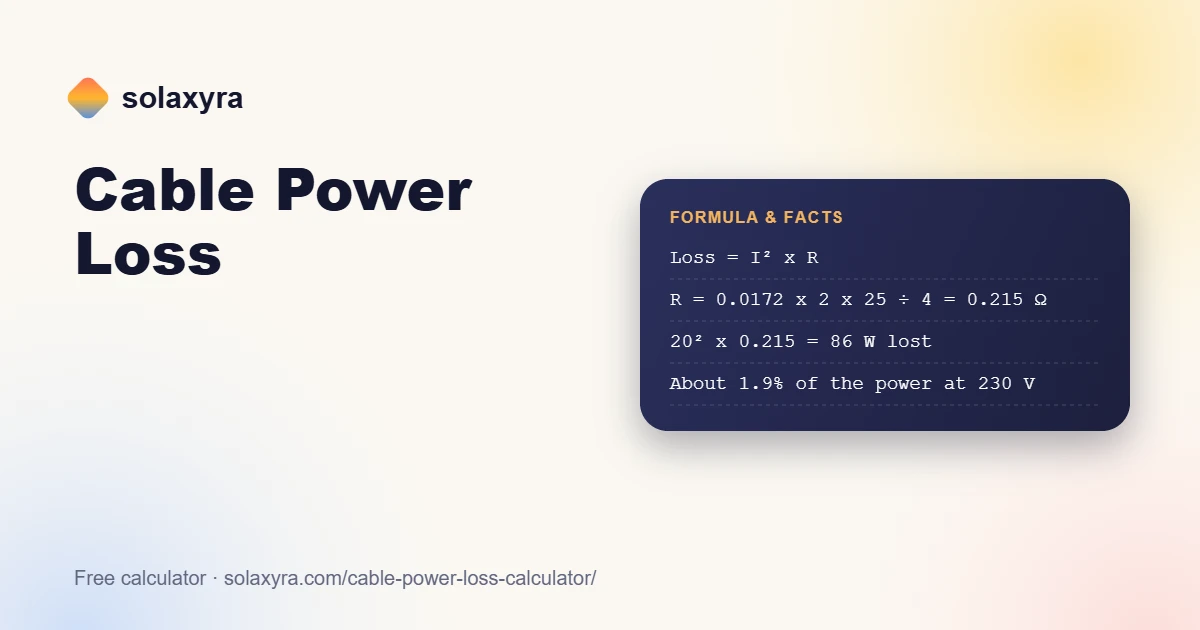
Quick answer: Power loss is current squared times the cable resistance. A 25 m run of 4 mm² copper cable carrying 20 A has a loop resistance of about 0.215 Ω, so it loses about 86 W, 1.9% of the power at 230 V. At 4 hours a day that is about 126 kWh, roughly £33 a year.
What Is a Cable Power Loss Calculator?
A cable power loss calculator estimates the energy turned into heat in the conductors of a cable. Every cable has some resistance, and current flowing through it produces heat equal to the current squared times the resistance. Thicker and shorter cables lose less. The calculator uses the out-and-back loop length for a single-phase or DC circuit.
How Do You Use the Cable Power Loss Calculator?
- Enter the current the cable carries.
- Enter the one-way length of the cable run.
- Enter the conductor size in mm² and choose copper or aluminium.
- Set the conductor temperature. Cables at full load run warm, which raises resistance.
- Enter the supply voltage, the hours per day at this current and your price.

Power Loss by Cable Size
20 A over 25 m (one way) of copper at 20°C, 230 V:
| Size | Loop resistance | Power lost | Share lost | Voltage drop |
|---|---|---|---|---|
| 2.5 mm² | 0.344 Ω | 138 W | 3.0% | 6.9 V |
| 4 mm² | 0.215 Ω | 86 W | 1.9% | 4.3 V |
| 6 mm² | 0.143 Ω | 57 W | 1.2% | 2.9 V |
| 10 mm² | 0.086 Ω | 34 W | 0.7% | 1.7 V |
Why Cable Losses Matter for EV Chargers and Solar
Long runs to an EV charger, a garden office or a solar inverter carry high currents for many hours. A few per cent lost every day adds up over the life of the installation. Upsizing a cable costs more at the start but can pay back through lower losses and lower voltage drop, and it keeps cables cooler.
Voltage Drop and Safety
In the UK, BS 7671 sets maximum voltage drop limits for final circuits and requires cables to carry the design current without overheating. This calculator estimates losses; it does not replace the full design calculations an electrician carries out, which include installation method, grouping and protective devices.
Worked Example: A Garden Office Supply
Example: a homeowner in Kent is choosing a cable for a 32 A garden office supply 30 m from the house, averaging 15 A for 6 hours a day.
- 6 mm² copper: loop resistance about 0.172 Ω; loss = 15² × 0.172 = 38.7 W.
- 10 mm² copper: about 0.103 Ω; loss = 23.2 W.
- Difference = 15.5 W for 6 hours a day, about 34 kWh a year, or £9 at 26.32p.
Frequently Asked Questions
How do you calculate power loss in a cable?
Multiply the current squared by the cable’s total resistance: P = I² × R.
Does a thicker cable reduce losses?
Yes. Doubling the cross-section roughly halves the resistance and the losses.
Is aluminium cable less efficient than copper?
For the same size, aluminium has about 64% more resistance, so it is usually installed one or two sizes larger.
How much power is lost in household wiring?
Usually a few per cent at most on long, heavily loaded circuits, and far less on most.
Checked November 2026 by the Solaxyra Editorial Team. Sources: IET: BS 7671 Requirements for Electrical Installations, Ofgem: Energy price cap, 1 October to 31 December 2026.