Bar shows the standing charge share of the bill before VAT. Rates checked 22 October 2026 on GOV.UK: CCL 0.801p per kWh from 1 April 2026; VAT standard 20 %; de minimis 33 kWh a day. This business electricity cost calculator is an estimate; your supplier’s bill and VAT declaration decide the final figures.
Formula and breakdown
n/a
n/a
n/a
This business electricity cost calculator works out what a UK business site pays for electricity over any period from its kWh, contract unit rate, standing charge, Climate Change Levy and VAT, and shows every part of the bill with and without VAT. It is for small business owners, office managers and bookkeepers in Great Britain and Northern Ireland who want to check a bill or budget a new contract.
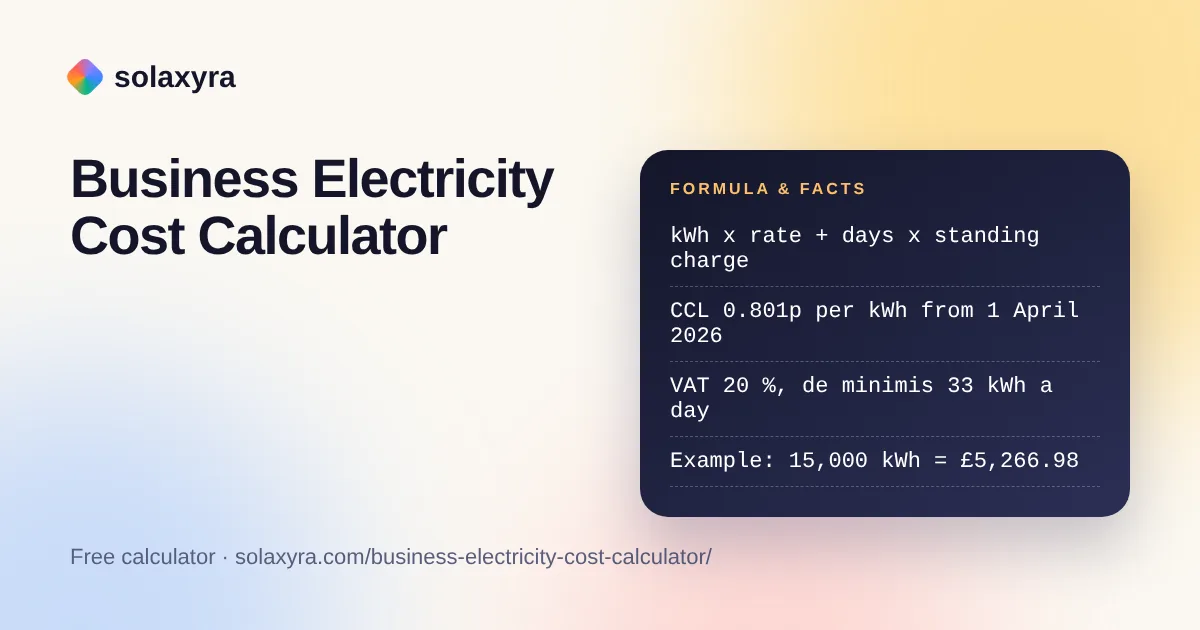
Quick answer: A business electricity cost calculator adds kWh times the unit rate, days times the standing charge and kWh times the Climate Change Levy of 0.801p, then adds VAT at 20 per cent. Sites averaging 33 kWh a day or less pay the reduced VAT rate and no CCL.
What Is a Business Electricity Cost Calculator?
A business electricity cost calculator is a tool that rebuilds a non-domestic electricity bill from its parts, so you can see the cost before VAT, the VAT and the total. In plain words: energy charge equals kWh times unit rate, standing charge equals days times the daily charge, CCL equals kWh times the levy rate, and VAT is charged on the sum of all three plus any other charges.
The Ofgem price cap applies to household default tariffs, so business sites have no single reference price. The calculator starts with example rates that you replace with the figures in your contract or on your latest bill.
How Do You Use the Business Electricity Cost Calculator?
- Enter the kWh used and the number of days the bill or budget covers.
- Type the unit rate and daily standing charge from your contract, both excluding VAT.
- If you have a day and night meter, enter the night share and night rate.
- Add any other charges on the bill, such as meter or capacity charges.
- Choose where the site is, the CCL treatment and the VAT treatment. Automatic VAT checks the 33 kWh a day de minimis for you.
- Read the total including VAT, the total excluding VAT and the all-in price per kWh, then open the breakdown to check each line.

What Is the Climate Change Levy on Electricity in 2026?
From 1 April 2026 the main rate of Climate Change Levy is £0.00801 per kWh, or 0.801p, for electricity, the same rate as natural gas. GOV.UK’s CCL rates notice for April 2026 sets the reduced rate for electricity under a Climate Change Agreement at 8 per cent of the main rate, which is 0.06408p per kWh.
CCL is charged by your supplier on each kWh and appears as a separate line on the bill. HMRC’s VAT notice says CCL is included in the value for VAT, so VAT is charged on the levy as well. At the main rate, a site using 15,000 kWh a year pays £120.15 of CCL before VAT.
When Does a Business Pay 5 Per Cent or 0 Per Cent VAT on Electricity?
Business electricity is standard-rated at 20 per cent unless the supply is for qualifying use or falls under the de minimis limit of an average of 33 kWh a day or 1,000 kWh a month per premises. Qualifying use means domestic use or a charity’s non-business use, and if 60 per cent or more of the supply is for qualifying use, the whole supply gets the reduced rate.
From 1 October 2026 to 31 March 2027, qualifying supplies of electricity in Great Britain are taxed at a temporary 0 per cent, while Northern Ireland stays at the reduced rate of 5 per cent. HMRC’s VAT on fuel and power notice says there are no changes to which electricity supplies qualify, so de minimis supplies that were reduced-rated follow the same temporary rate. The same notice says CCL does not apply to domestic use, charity non-business use or de minimis supplies.
| Type of supply | VAT in Great Britain | VAT in Northern Ireland | CCL |
|---|---|---|---|
| Business use above 33 kWh a day | 20 % | 20 % | 0.801p per kWh |
| Business use with a Climate Change Agreement | 20 % | 20 % | 0.06408p per kWh (8 %) |
| De minimis: 33 kWh a day or less | 0 % from 1 Oct 2026 to 31 Mar 2027 | 5 % | Not charged |
| Domestic use or charity non-business use | 0 % from 1 Oct 2026 to 31 Mar 2027 | 5 % | Not charged |
| Mixed use, 60 % or more qualifying | Whole supply at the qualifying rate | 5 % | Check with your supplier |
Should a Business Compare Costs With or Without VAT?
Whether you budget with or without VAT depends on whether your business can recover the VAT it pays, which your accountant can confirm. The business electricity cost calculator shows the total excluding VAT next to the total including VAT, so you can use whichever applies. When comparing supplier quotes, put them all on the same basis, because a quote excluding VAT and a bill including it can differ by a fifth.
How Do You Check Whether Your Unit Rate Is Reasonable?
DESNZ publishes average prices paid by non-domestic consumers by size band each quarter in Quarterly Energy Prices tables 3.4.1 and 3.4.2, last updated on 29 September 2026. Compare the all-in price per kWh excluding VAT from the business electricity cost calculator with the band that matches your yearly use, because standing charges make the all-in price higher than the unit rate for small sites.
To find out where your kWh go, the energy consumption calculator adds up equipment by wattage and hours, and the appliance electricity cost calculator prices one machine at your contract rate. If your site uses gas as well, the business gas cost calculator follows the same method with the 145 kWh a day gas limit.
Worked Example: A Café Using 15,000 kWh a Year
Example: a café in Bristol uses 15,000 kWh a year on a single-rate contract at an example 27.00p per kWh and 60.00p a day, both excluding VAT. Energy costs £4,050.00, the standing charge £219.00 and CCL at 0.801p £120.15, a total of £4,389.15 before VAT. Average use is 41.1 kWh a day, above the de minimis, so VAT at 20 per cent adds £877.83 and the business electricity cost calculator shows £5,266.98 for the year.
Example: a small shop in Cardiff on the same rates uses 9,000 kWh a year, an average of 24.7 kWh a day. That is within the de minimis, so no CCL is charged and, during the temporary period, VAT is 0 per cent. The bill is £2,430.00 plus £219.00 = £2,649.00. The same shop in Belfast would pay 5 per cent VAT, making £2,781.45.
What Else Can Change a Business Electricity Bill?
Some business bills carry extra lines beyond the unit rate and standing charge, such as meter or capacity charges. Enter these in the other charges box exactly as your bill shows them. Any change to wiring, meters or the supply itself must be carried out by a qualified electrician working to BS 7671 or by your network operator, never by staff.
Once you know the yearly cost, the tariff comparison tool helps you weigh unit rate against standing charge when quotes arrive, and the business electricity cost calculator can be rerun with each quote to see the effect on your total.
Frequently Asked Questions
How is a business electricity bill calculated?
Multiply the kWh used by the unit rate, add the daily standing charge times the number of days, add the Climate Change Levy at 0.801p per kWh and any other charges, then add VAT, normally at 20 per cent. VAT is charged on the levy too.
What is the Climate Change Levy rate for electricity in 2026?
From 1 April 2026 the main rate is £0.00801 per kWh, which is 0.801p, the same as natural gas. Businesses with a Climate Change Agreement pay 8 per cent of the main rate for electricity, which is 0.06408p per kWh.
Do small businesses pay 5 per cent VAT on electricity?
Only if the supply is within the de minimis limit of an average 33 kWh a day or 1,000 kWh a month, or is for qualifying use. In Great Britain those supplies are at 0 per cent from 1 October 2026 to 31 March 2027; Northern Ireland stays at 5 per cent.
Does the 0 per cent VAT on electricity apply to businesses?
It applies to qualifying supplies in Great Britain, which include domestic use, charity non-business use and de minimis supplies. A normal business supply above 33 kWh a day stays at 20 per cent VAT. The temporary rate runs from 1 October 2026 to 31 March 2027.
Is the Climate Change Levy charged on small business sites?
Not if the supply is within the de minimis limits. HMRC’s VAT notice says CCL does not apply to domestic use, charity non-business use or de minimis supplies. Above the limit, CCL is charged on every kWh at 0.801p unless a Climate Change Agreement reduces it.
Are business electricity prices capped by Ofgem?
No. The Ofgem price cap covers household default tariffs. Business electricity is sold on contracts agreed with the supplier, so the unit rate and standing charge depend on your contract. Use the rates on your bill or quote in the calculator.
Checked October 2026 by the Solaxyra Editorial Team. Sources: GOV.UK: Climate Change Levy rates from 1 April 2026, HMRC: VAT on fuel and power (Notice 701/19), GOV.UK: VAT rates, DESNZ: Gas and electricity prices in the non-domestic sector.